
Illegal Vape Sales in Bahrain: 5 Penalties


If I sell vape products in Bahrain outside the vaping laws and regulations in Bahrain, I could face more than a fine. I may be hit with a court fine from BHD 100, a shipment hold, stock seizure, licence trouble, or even shop closure for up to 3 months. And if I sell to anyone under 18, the risk starts straight away.
Here’s the short version in plain language:
- Under-18 sales are banned
- Products may need Ministry of Health approval before sale
- Imports need customs clearance and the right papers
- Labels must meet Bahrain rules, including Arabic and English text
- Online, delivery, and WhatsApp sales follow the same rules as shop sales
Some reported figures go higher, such as BHD 1,000–3,000 for certain breaches and a reported proposal of up to BHD 1,000 for sales to minors. But not every reported figure is current law. That point matters.
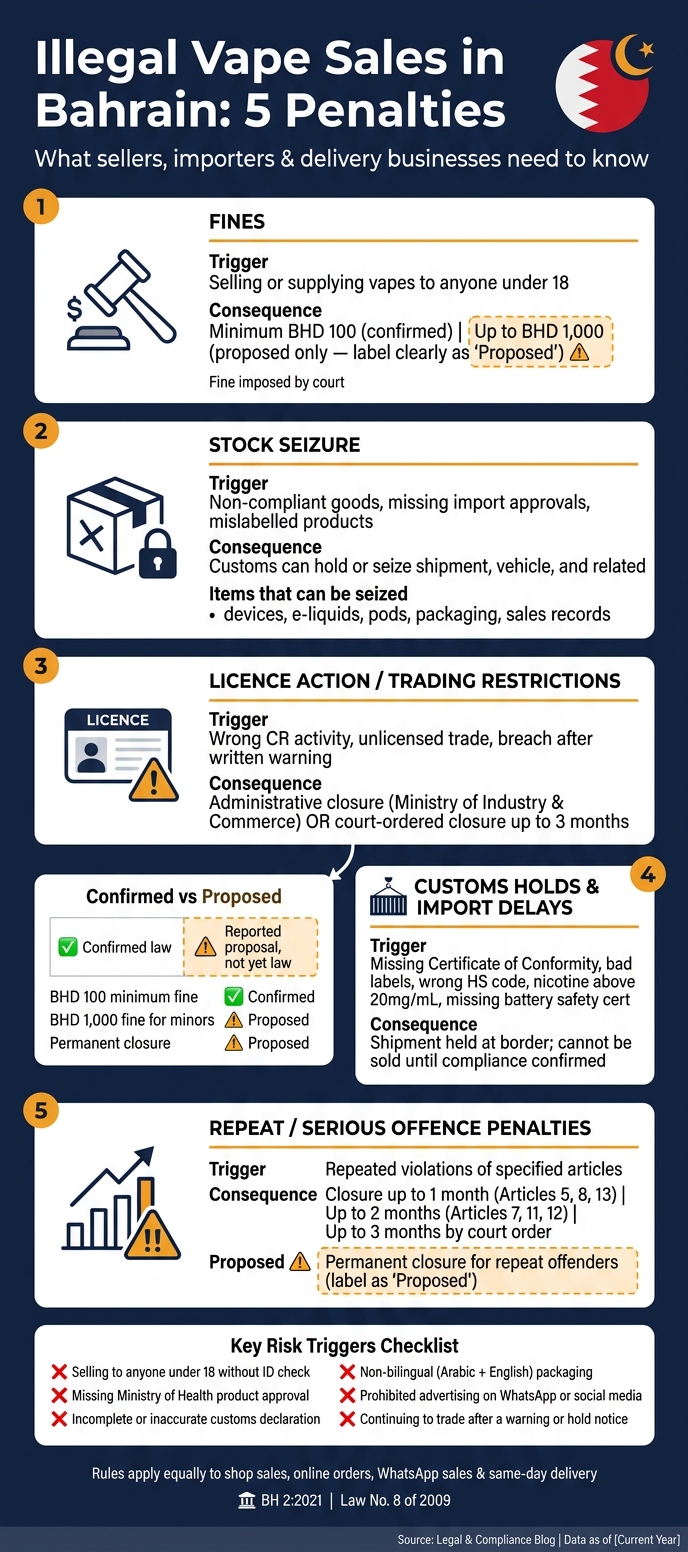
Illegal Vape Sales in Bahrain: 5 Penalties Explained
Quick comparison
| Penalty | What can trigger it | Confirmed position |
|---|---|---|
| Fine | Selling or supplying to someone under 18 | From BHD 100 |
| Stock seizure | Non-compliant goods, suspect imports, linked offence materials | Possible |
| Licence action | Wrong CR activity, unlicensed trade, breach after warning | Possible |
| Customs hold | Missing approvals, bad labels, wrong declarations | Possible |
| Closure for repeat offences | Repeat breach or conviction | Up to 3 months in some cases |
My takeaway: if I import, list, deliver, or sell vapes in Bahrain, I need to check age controls, approvals, labels, and customs papers before anything goes live.
sbb-itb-837e7ad
The Rules That Govern Vape Sales in Bahrain
Bahrain’s vape rules mainly rest on BH 2:2021 and Law No. 8 of 2009. Together, they set the rules for imports, labelling, age limits, and how these products can be sold and shown in shops.
BH 2:2021 applies to electronic nicotine products, including vape devices, refill cartridges, and e-liquid containers. That covers both nicotine and nicotine-free products. On the import side, the Ministry of Health asks for artwork, samples, and supporting papers that show pack size, warnings, and label text. Based on the case, those papers can include an importer health certificate, copies of labels and warnings, and a pledge to keep distribution records.
Labelling rules are strict. Required warnings and product details must appear in both Arabic and English. Regulated packs also need to show an 18+ symbol that is at least 1 cm × 1 cm, along with a statement saying that sale and consumption by anyone under 18 is banned. When buying vape juice in Bahrain, packaging must also include a bilingual warning stating that the product may be hazardous if inhaled, swallowed, or brought into contact with skin.
Age control is another big part of the rulebook. Selling to anyone under 18 is not allowed. Sellers must put up a clear notice at the point of sale and ask for ID if a buyer’s age is not clear. That rule doesn’t stop at the shop counter either. For delivery orders, age has to be checked at handover, not just by message or online confirmation alone. If a seller skips these steps, the penalties in the next section can apply.
For more information on navigating the local market, see our complete guide to Bahrain’s vape scene. Any sale that ignores these rules can lead to the penalties below.
What Counts as an Illegal Vape Sale
In Bahrain, a vape sale becomes illegal when it breaks the rules on age, product approval, labelling, import documents, or the way the product is sold. So even if a sale looks routine on the surface, it can still be against the law. In some cases, one sale can break more than one rule at the same time. The penalties in the next section apply when any of these breaches happen.
The most direct example is selling to anyone under 18. If a seller sells or gives a vape product, or another covered nicotine product, to a person under 18, the sale is illegal no matter how the deal happened. It does not matter if it was in a shop, through delivery, or any other channel.
A sale is also illegal when the product itself does not meet Bahrain’s rules. That includes products that are not approved for the market or are mislabelled for sale in Bahrain.
Import rules matter too. If stock enters Bahrain without the customs papers and Ministry of Health documents that are required, that stock can be held and cannot lawfully be sold.
The same point applies to digital sales channels. Online sales, social media sales, and WhatsApp sales are not treated as a shortcut around the rules. They are still subject to the same checks and legal duties as sales made in a physical shop.
These are the breaches that trigger the penalties set out below. The next five penalties relate to these types of illegal vape sales.
1. Fines for Unlawful or Under-18 Vape Sales
Legal Basis Confirmed vs Proposed
Bahrain’s Law No. 8 of 2009 sets the minimum age for tobacco and regulated nicotine products at 18. If a seller provides a vape to anyone under 18, the case can lead to a fine of at least BD100.
That amount is the usual starting point in enforcement. But it isn’t the whole picture.
Some 2026 reports say the fine for selling to minors may go up to BD1,000. At this stage, though, that change has not been confirmed as law.
How It Is Enforced
Enforcement can involve the MoH, NHRA, Customs, and municipalities. These bodies can inspect businesses, record breaches, and refer cases onward. The fine itself is imposed by the court.
When the Risk Is Triggered
The risk starts with any sale or supply to a person under 18. Payment doesn’t need to happen for the rule to apply.
That also means the same issue can come up through delivery orders or sales arranged on WhatsApp.
| Penalty type | Figure | Status |
|---|---|---|
| Fine for violating the under-18 sales provision | Minimum BD100 | Confirmed |
| Separate range for other specified tobacco-control breaches | BD1,000–BD3,000 | Confirmed for specified articles only |
| Proposed penalty increase for sales to minors | Up to BD1,000 | Reported proposal, not confirmed law |
The next section looks at what often comes after the fine: seizure of vape stock and related materials.
2. Seizure of Vape Stock and Related Materials
Legal Basis Confirmed vs Proposed
Bahrain Customs can hold or seize vape shipments when they’re tied to an offence or suspected smuggling. That can also extend to the vehicle used to move the goods.
At the border, Customs deals with holds and seizures. Final confiscation, though, is a court matter and can be ordered after conviction.
When the Risk Is Triggered
The risk goes up when imports arrive without approval, customs declarations are wrong, or the stock breaches labelling or nicotine rules.
And it’s not just the products sitting in a shipment that matter. WhatsApp catalogues, online listings, and stock stored in homes, warehouses, or delivery vehicles can all be used to support seizure action.
Authorities may seize more than finished vape devices. This can include:
- e-liquids
- nicotine devices
- flavour stock
- pods and coils
- packaging and labels
- advertising materials
- sales records linked to the suspected breach
Once stock is seized, the seller may also face licence action.
Business Impact
A seizure can stop stock from moving, hold up deliveries, and add port or storage costs.
For a business, that can snowball fast. What starts as a stock issue can move into licence review, trading limits, or even closure.
3. Licence Review, Shop Closure, or Trading Restrictions
Legal Basis
In Bahrain, a business needs the right licence to import, distribute, or sell tobacco and electronic nicotine products. If a seller does not have the correct CR activity, or it breaches licence terms, the risk goes beyond the goods themselves. At that point, the business’s right to trade can be restricted too.
Once the issue moves past the stock, the licence is often the next pressure point.
After conviction, the court may order closure for up to three months and confiscation of offence materials. Repeat breaches can bring up to one month’s closure for Articles 5, 8, or 13, and up to two months for Articles 7, 11, or 12.
Who May Impose It
The table below shows the difference between administrative closure and court-ordered penalties.
| Authority | Role |
|---|---|
| Ministry of Industry and Commerce | Administrative closure after a written warning for unlicensed activity |
| Court | Closure of up to three months and/or confiscation of offence materials after conviction |
| Ministry of Health | Licensing and product-compliance requirements for CR holders selling tobacco and electronic nicotine products |
When the Risk Is Triggered
The risk starts when a seller does not have the required tobacco or electronic-nicotine activity on its CR, sells products without the required approval, or keeps trading after a written warning. Age breaches can also lead to licence action.
The Ministry of Industry and Commerce’s published guidance states that administrative closure may apply when a business carries out an unlicensed activity and does not fix it after a written warning. That warning stage matters. Miss it, and the issue can escalate fast.
Business Impact
A closure stops sales for the full closure period. For a physical shop, that means no customers through the door. For a delivery or WhatsApp-based operation, it can also mean losing the ability to fulfil orders, advertise stock, or collect payment while its legal status or product approvals are under review.
If the issue begins at the import stage, Customs action may come first.
4. Customs Holds, Import Delays, or Shipment Seizure
Legal Basis
If stock enters Bahrain without the right approvals, the border is the first place where enforcement can hit. Electronic nicotine products are regulated imports in Bahrain. Before a commercial shipment can be released, the importer must submit product samples, packaging details, health warnings, labels, and conformity documents to the relevant authorities.
Customs holds are confirmed. What the official rules do not set out is a fixed detention period. So a shipment may be held, but there is no stated rule saying it must be released or dealt with within a set number of days.
Who May Impose It
Bahrain Customs decides whether a shipment is released at the border. The Ministry of Health’s Anti-Smoking Group handles compliance approval before final clearance.
If a product fails labelling or technical checks, Customs can refuse release and seize the shipment. Put simply, the goods can arrive in Bahrain and still go nowhere.
When the Risk Is Triggered
A shipment can be held for several reasons, including the ones below.
| Trigger | Example |
|---|---|
| Missing approval documents | No Certificate of Conformity submitted before import |
| Missing required labels or warnings | Missing required warnings or label information |
| Nicotine above 20 mg/mL | E-liquid declared at a higher strength than permitted |
| Misdeclared HS code | Nicotine products listed as generic electronic devices |
| Missing battery safety certificates | No UN38.3 battery safety certificate for lithium-cell devices |
Without approval, Customs can hold the shipment or refuse release.
Business Impact in Bahrain
A hold means the goods cannot be moved or sold until compliance is confirmed. For a retailer offering same-day delivery across Bahrain, even a short delay can throw off order fulfilment and add storage costs. That can sting fast, especially when customers expect delivery the same day and stock is tied up at the border.
If release is refused, the seller loses time, freight costs, and the stock itself. And if the same compliance issue keeps showing up, enforcement may become stricter next time.
5. Stronger Penalties for Repeat or Serious Offences
Legal Basis Confirmed vs Proposed
Bahrain steps up penalties when tobacco-control breaches happen again. Repeat violations of Articles 5, 8 and 13 can lead to closure for up to one month. Repeat violations of Articles 7, 11 and 12 can lead to closure for up to two months. A court may also order closure for up to three months or confiscation of materials linked to the offence. In more serious situations, penalties under other applicable laws may also come into play.
There is also one reported proposal to tighten the rules further. Under that proposal, the fine for sales to minors would rise to as much as BD1,000, and repeat offenders could face permanent closure.
Who May Impose It
Closure and confiscation orders are imposed by the courts after a conviction. Before that point, regulators can begin enforcement action, hold goods, and review licences.
When the Risk Is Triggered
The risk tends to increase where there are repeated breaches, continued trading without a licence, sales to people under 18, or imports that stay non-compliant after being held.
Here’s the split between confirmed outcomes and reported proposals:
| Breach | Confirmed consequence |
|---|---|
| Violations of Articles 5, 8 or 13 (repeat) | Closure for up to one month |
| Violations of Articles 7, 11 or 12 (repeat) | Closure for up to two months |
| Conviction for offence involving materials | Court may order closure up to three months or confiscation |
| Reported proposal: sales to minors and repeat offenders | Fine up to BD1,000; permanent closure for repeat offenders (proposed only) |
Confirmed Penalties vs Reported Proposals: A Quick Check
Use this quick check to tell confirmed penalties apart from reported proposals.
Confirmed Consequences and Reported Proposals Table
| Penalty or Measure | Status | What It Means in Practice |
|---|---|---|
| Ban on selling or giving tobacco or vaping products to anyone under 18 | Confirmed | Age checks and point-of-sale warning required. |
| Fine of at least BHD 100 for violations of Articles 5, 8 and 13, including under-18 sales | Confirmed | Confirmed minimum fine for the relevant under-18 offence. |
| Court may order closure of the establishment for up to three months after conviction | Confirmed | Court may close the business after conviction. |
| Court may order confiscation of materials used in the offence | Confirmed | Court may confiscate offence materials after conviction. |
| Fine of BHD 1,000–BHD 3,000 for specified violations of Articles 7 and 12 | Applies only to those articles. | Confirmed only for the specified articles. |
| Fine of up to BHD 1,000 for selling vaping products to minors | Reported proposal | Reported proposal, not current law. |
| Permanent closure for repeat offenders | Reported proposal | Reported proposal, not current law. |
The key point is simple: not every reported penalty is part of the law right now.
That distinction matters. If someone treats a reported proposal as already in force, they can get compliance wrong fast.
How Online and WhatsApp Vape Sales Fit Within Bahrain’s Rules
The main point is simple: the sales channel doesn’t change the rulebook. A website, social media page, direct message, or WhatsApp catalogue is still just a way to sell. It does not exempt a business from Bahrain’s vape rules.
So if a business takes orders through WhatsApp, those orders still need the same CR activity and approvals as any other sale. Bahrain’s Ministry of Industry and Commerce classifies internet retail under ISIC 4791, which means online vape sales still need the correct commercial registration, along with any required tobacco or electronic-nicotine approvals, before orders are accepted. Put plainly, every WhatsApp order should be treated as part of the business, not as an informal side sale.
The same logic applies to product listings. Only approved stock should be listed online. If approval, labelling, or import paperwork is missing, the listing should be paused until the issue is fixed. Leaving a non-compliant listing live can itself support enforcement action.
Age checks also don’t stop once the order is placed. Bahrain’s tobacco-control law prohibits selling or providing tobacco products to anyone under 18, so checks need to happen at both stages:
- when the order is made
- when the product is handed over
That second step matters a lot. Even with same-day delivery, staff should not hand over the order unless the recipient shows valid ID. Fast delivery doesn’t remove the need for an ID check at the door.
VapeShop.bh uses WhatsApp ordering and same-day delivery, but the same product, import, and age-check rules still apply.
For sellers and importers, the main risks are clear: missing approvals, weak age checks, and incomplete import records.
Key Risk Points for Sellers and Importers
The five penalties above may look separate on paper, but they often begin with the same compliance mistakes.
The biggest risk points are sales to anyone under 18, missing product approval or an importer health certificate, and incomplete or wrong customs declarations. Packaging is another common tripwire. If the pack is not compliant – say it does not include bilingual Arabic and English health warnings, or the shipment is missing packaging compliance documents – the goods can be stopped before they ever reach a shelf.
Advertising is a risk area too. Promotions on your website, social media pages, and even WhatsApp still count as advertising. A casual post can still lead to action if it breaks the rules.
There’s another point many sellers miss: if a warning or hold notice has already been issued, carrying on as normal can make things worse. Stop the activity, fix the issue, and only resume once it has been cleared.
Use this checklist to catch the main triggers before enforcement moves further.
| Risk Trigger | Potential Outcome |
|---|---|
| Under-18 sale, no age check at delivery | Fine |
| Missing product approval or importer health certificate | Shipment hold |
| Incomplete or inaccurate customs declaration | Border hold |
| Non-compliant or non-bilingual packaging | Import refusal |
| Prohibited advertising or promotional content | Enforcement action |
| Trading after a warning or hold notice | Aggravated penalty, licence review |
| Repeated breach of specified provisions | Court-ordered closure of up to one month |
Conclusion
Taken together, Bahrain’s vape rules create five main enforcement risks. Illegal vape sales in Bahrain can lead to fines, stock seizure, licence action, customs holds, and repeat-offence penalties. Penalty levels change based on the breach, from lower fines to heavier court action, including stock seizure or customs holds, shop closure, and confiscation of materials used in the offence.
What happens next comes down to the rule that was broken, the facts of the case, and whether there was any previous offence.
Online, delivery, and WhatsApp sales don’t get a pass. They still carry the same duties: age checks, approvals, compliant packaging and e-liquids, and customs documents. Those are the same checks that help you avoid the penalties above.
Before importing, listing, delivering, or selling, make sure your commercial registration and the related tobacco or electronic-nicotine-product approvals cover the planned activity. Also check that each product has the required Ministry of Health approval, that packaging meets bilingual Arabic and English rules, and that customs declarations are complete and accurate. If you get mixed guidance from any authority, ask for written confirmation before moving ahead.
Check approvals, age controls, packaging, and customs paperwork before you sell. Using a compliant pod vape kit ensures your inventory meets local standards.
FAQs
Do nicotine-free vapes follow the same rules?
Not always. Nicotine-free vapes aren’t always handled in the exact same way as products that contain nicotine, even though both still go through regulatory checks.
Under BH 2:2021, nicotine products are classed as tobacco equivalents. Nicotine-free products may, in some import cases, be handled more like consumer electronics. That said, regulators still review them for safety and compliance, and the Digital Stamps Scheme is expected to cover both.
Who checks vape compliance in Bahrain?
Several authorities check vape compliance in Bahrain.
The Ministry of Health (MOH) and NHRA look after product registration, safety, and labelling. The Ministry of Industry and Commerce deals with commercial licensing, market inspections, and technical standards.
Bahrain Customs checks imports, customs duties, and shipment paperwork. The Ministry of Interior’s Cyber Crimes Directorate monitors illegal online sales and promotions. Local municipalities may also inspect shops to check licensing and day-to-day operating compliance.
Can a delivery order still break the law?
Yes. A delivery order can still break the law in Bahrain if it fails on age checks, product safety, or licensing.
That covers cases like unregistered products, items with poor or missing labels, and sales to minors. In those situations, both the retailer and the delivery partner may face fines, permit suspension, and stock seizure. The same rules apply to online sales and WhatsApp orders.
Related Blog Posts
- Vape Devices vs. E-Liquids: Bahrain Customs Policies
- How Bahrain Regulates Vape Ads
- Why Health Warnings Matter on Vape Products
- Vaping age rules in Bahrain
{“@context”:”https://schema.org”,”@type”:”FAQPage”,”mainEntity”:[{“@type”:”Question”,”name”:”Do nicotine-free vapes follow the same rules?”,”acceptedAnswer”:{“@type”:”Answer”,”text”:”Not always. Nicotine-free vapes aren’t always handled in the exact same way as products that contain nicotine, even though both still go through regulatory checks. Under BH 2:2021, nicotine products are classed as tobacco equivalents. Nicotine-free products may, in some import cases, be handled more like consumer electronics. That said, regulators still review them for safety and compliance, and the Digital Stamps Scheme is expected to cover both.”}},{“@type”:”Question”,”name”:”Who checks vape compliance in Bahrain?”,”acceptedAnswer”:{“@type”:”Answer”,”text”:”Several authorities check vape compliance in Bahrain. The Ministry of Health (MOH) and NHRA look after product registration, safety, and labelling. The Ministry of Industry and Commerce deals with commercial licensing, market inspections, and technical standards. Bahrain Customs checks imports, customs duties, and shipment paperwork. The Ministry of Interior’s Cyber Crimes Directorate monitors illegal online sales and promotions. Local municipalities may also inspect shops to check licensing and day-to-day operating compliance.”}},{“@type”:”Question”,”name”:”Can a delivery order still break the law?”,”acceptedAnswer”:{“@type”:”Answer”,”text”:”Yes. A delivery order can still break the law in Bahrain if it fails on age checks, product safety, or licensing. That covers cases like unregistered products, items with poor or missing labels, and sales to minors. In those situations, both the retailer and the delivery partner may face fines, permit suspension, and stock seizure. The same rules apply to online sales and WhatsApp orders.”}}]}
Frequently Asked Questions
Illegal vape sales may lead to a court fine from BHD 100, stock seizure, licence action, customs holds, or shop closure in certain cases. The exact consequence depends on the breach, the evidence, and whether the offence is repeated.
No. Selling or giving vape products to anyone under 18 is prohibited under Bahrain vape laws and may result in a fine from BHD 100. A court may also order confiscation of materials or temporary shop closure after conviction.
New tobacco and electronic nicotine products may require Ministry of Health submissions, including product samples, label artwork, health warnings, and supporting documents. A conformity certificate may also be required for customs clearance and market authorization.
Yes. A shipment may be held if required approvals, customs declarations, product papers, or compliant labels are missing or incorrect. Non-compliant goods and materials connected to an offence may also be subject to seizure.
Bahrain vape labelling rules require product information and health warnings in Arabic and English, together with details such as the product name, brand, batch number, country of origin, and nicotine information where applicable. Packaging must also carry the required under-18 warning and age-restriction symbol.
Yes. Listing, delivering, or selling vape products online or through WhatsApp does not remove the requirements for age controls, approvals, customs compliance, and permitted labelling. The same Bahrain vaping compliance obligations apply to online transactions as to shop sales.
A court may order temporary closure after a conviction, particularly for repeated or serious breaches. The provided legal information states that closure can reach up to three months in some cases, while other provisions may set shorter periods depending on the offence.