
E-Liquids Explained: Types and Nicotine Levels


The short answer: I should match the e-liquid to the device first, then check nicotine type, strength in mg/mL, and VG/PG ratio. If I get that wrong, I can end up with a burnt hit, leaks, or far more nicotine than I meant to use.
Here’s the article in plain terms:
- E-liquid is not water vapour. It usually contains PG, VG, flavourings, and sometimes nicotine.
- Two nicotine types matter most:
- Freebase: stronger throat hit, often used at 3–12 mg/mL
- Nicotine salts: smoother inhale, often used at 5–20 mg/mL
- Bahrain’s nicotine cap is 20 mg/mL for e-liquids.
- 50/50 VG/PG often suits small pods and MTL devices.
- 70/30 VG/PG is usually for sub-ohm tanks that handle thicker liquid.
- 6 mg/mL means 6 mg of nicotine in each 1 mL. So a 10 mL bottle at 6 mg/mL contains 60 mg total nicotine.
- Warning signs of too much nicotine can show up within 15 to 60 minutes and may include nausea, dizziness, sweating, shakiness, and a fast heartbeat.
- In Bahrain’s heat, where summer temperatures can go above 40°C, bottles should stay tightly closed and stored in a cool, dry place.
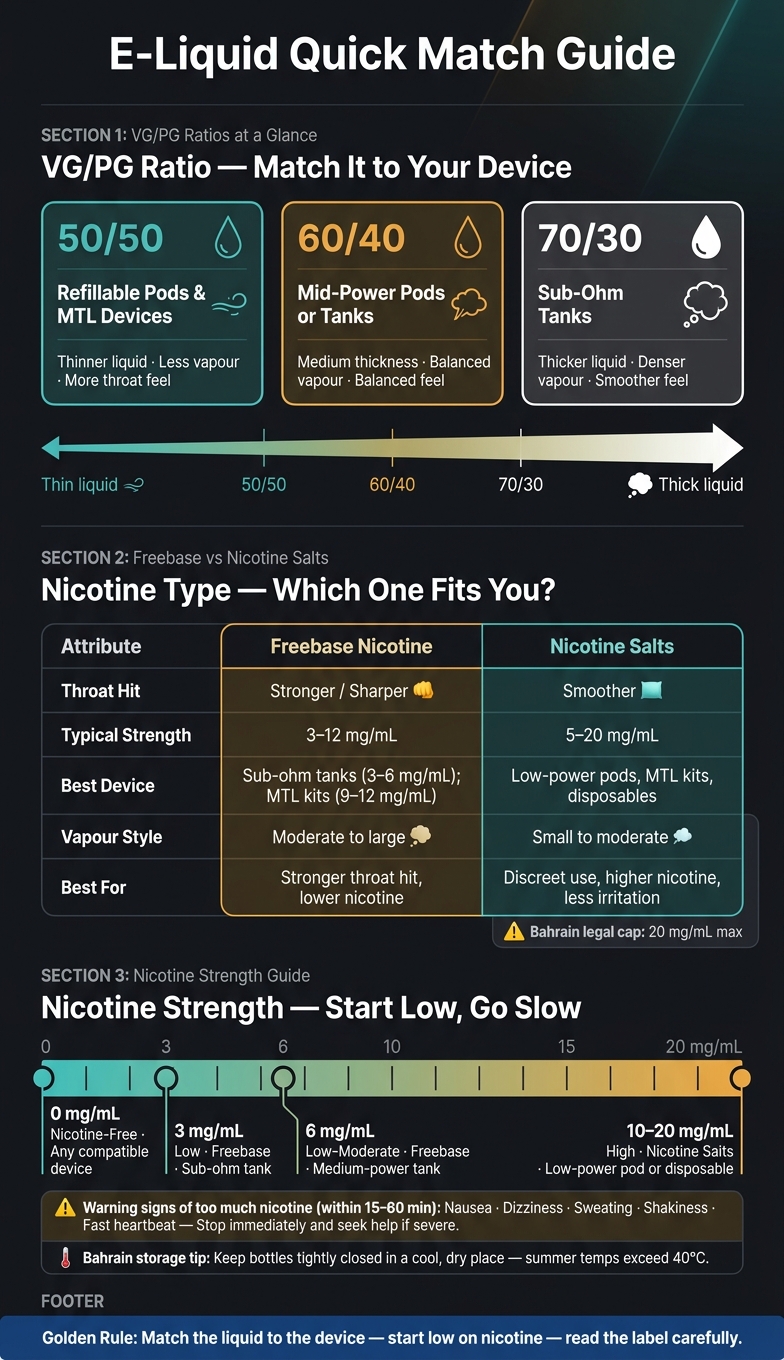
E-Liquid Types, Nicotine Levels & VG/PG Ratios: Quick Visual Guide
How to choose nicotine strength
sbb-itb-837e7ad
Quick comparison
| Type | Best match | Usual strength | Feel |
|---|---|---|---|
| Freebase nicotine vs salts | MTL kits at higher strengths, sub-ohm tanks at low strengths | 3–12 mg/mL | More throat hit |
| Nicotine salts | Low-power pods, MTL devices, disposables | 5–20 mg/mL | Smoother inhale |
| VG/PG ratio | Best match | What to expect |
|---|---|---|
| 50/50 | Refillable pods, MTL devices | Thinner liquid, less vapour, more throat feel |
| 60/40 | Mid-power pods or tanks | Middle ground |
| 70/30 | Sub-ohm tanks | Thicker liquid, denser vapour |
Bottom line: I’d keep it simple – match the liquid to the device, start low on nicotine, and read the label with care. That is the safest way to avoid the most common mistakes.
E-Liquid Basics: Ingredients, VG/PG Ratios, and Device Match
E-liquids usually contain VG, PG, flavourings, and sometimes nicotine. Nicotine strength appears in mg/mL on the label. Some liquids contain no nicotine at all, so it’s worth checking before you fill your device.
Here’s the simple version: VG is thicker and makes more vapour. PG is thinner and carries flavour more clearly. That difference matters more than it might seem at first, because liquid texture plays a big part in how a device performs.
With the base covered, the next step is understanding how VG and PG behave in actual use.
What VG and PG Do in Practice
VG is thick, produces denser vapour, and moves through the wick more slowly. PG is thinner, so it soaks into the wick faster, carries flavour well, and gives a stronger throat sensation.
That said, PG can feel harsher for some people. If it irritates you, stop using it.
Liquid thickness also affects whether the coil stays properly soaked. If the liquid is too thick for the wick, the coil may not get enough e-liquid in time. That can lead to a dry hit or a burnt taste. On the other hand, if the liquid is too thin for a high-power tank, too much can enter the coil at once. That often leads to gurgling, leaking, or a flooded coil.
Common Ratios: 50/50, 60/40, and 70/30
A label that says 70/30 means 70% VG and 30% PG.
| VG/PG Ratio | Thickness | Vapour Output | Throat Sensation | Suitable Device Type |
|---|---|---|---|---|
| 50/50 | Relatively thin | Low to moderate | More noticeable | Refillable pods, MTL devices, higher-resistance coils |
| 60/40 | Medium | Moderate | Balanced | Mid-power pods or tanks |
| 70/30 | Thick | Higher and denser | Smoother, less pronounced | Sub-ohm tanks with strong wicking and airflow |
For many refillable pod users, 50/50 is a sensible place to start. It’s thin enough for smaller wicks and tends to work well in MTL setups. 60/40 can suit some larger pods or moderate-power devices. 70/30 is mainly made for sub-ohm tanks that can handle thicker liquid and have the airflow to match.
Why the Wrong Ratio Causes Poor Performance
A mismatch between liquid and device can cause trouble straight away.
Use a high-VG liquid in a small pod, and the wick may struggle to keep up. The result can be dry or burnt-tasting draws. Use a thin, PG-heavy liquid in a high-power tank, and the coil may get more liquid than it can vaporise. That can cause flooding, gurgling, spitback, or leaks.
Before filling, check the device maker’s guidance on VG/PG ratio, coil type, and wattage. Once the liquid suits the device, the next step is choosing the nicotine type.
Freebase vs Nicotine Salts: Key Differences
After VG/PG, the next choice is your nicotine format: freebase or nicotine salts. The right pick usually comes down to three things: your device, the throat hit you want, and the nicotine strength that suits you.
Freebase Nicotine: Lower Strengths and Stronger Throat Hit
Freebase nicotine is the standard form. It gives a stronger throat hit, and that feeling becomes more noticeable as the strength goes up. It’s most common at 3–6 mg/mL for sub-ohm devices and 9–12 mg/mL for lower-power MTL kits.
Nicotine Salts: Smoother Inhale at Higher Concentrations
Nicotine salts use an acid-based formula, which makes higher strengths feel smoother on the inhale. They’re usually sold in the 5–20 mg/mL range, with the higher end most often used in low-power pod systems. In Bahrain, e-liquid nicotine content must not exceed 20 mg/mL.
That smoother feel can be misleading. It doesn’t mean the liquid is weaker. In fact, because the throat sensation is softer, some people end up taking more puffs without noticing, so puff frequency matters.
Freebase vs Nicotine Salts: Device, Strength, and User Profile
The easiest way to choose is to start with the device, not the flavour. A small pod or MTL starter kit will usually work better with nicotine salts. A sub-ohm tank that produces large clouds is usually better paired with a low-strength freebase e-liquid.
Here’s the fastest way to match nicotine type with device and inhale style.
| Nicotine Formulation | Throat Sensation | Typical Strength Range | Suitable Device | Vapour Style | Best For |
|---|---|---|---|---|---|
| Freebase nicotine | More noticeable; sharper at higher strengths | 3–12 mg/mL | Sub-ohm tanks at 3–6 mg/mL; lower-power MTL at higher strengths | Moderate to large | Users who want a stronger throat hit, more vapour, or lower nicotine strengths |
| Nicotine salts | Smoother, even at higher concentrations | 5–20 mg/mL | Low-wattage pods, MTL kits, and disposables | Small to moderate | Users who want compact equipment, discreet vapour, or stronger nicotine delivery with less throat irritation |
Nicotine Levels Explained: How to Choose the Right One
Once you know the nicotine type, the number on the label tells you how strong the liquid is. For example, a 10 mL bottle labelled 6 mg/mL contains 60 mg of nicotine in total. A higher number means a higher concentration. But the hit you feel doesn’t come from that number alone. Your device, coil, and how you inhale all shape the result.
What 3 mg/mL, 6 mg/mL, and 20 mg/mL Actually Mean
A 6 mg/mL freebase liquid and a 6 mg/mL salt liquid contain the same amount of nicotine per millilitre. Even so, they can feel quite different in use and may suit different devices. The label tells you the concentration. The nicotine type and device decide how that concentration reaches you.
Use the table below to match the strength to the setup you’re using.
A Simple Way for Beginners to Pick a Strength
Start with the device type: tank, pod, or disposable. Then look at the coil resistance and type and the maker’s wattage range. After that, check whether the liquid is freebase or salt nicotine. From there, pick a cautious strength within the right range and test it for a short period.
If a liquid feels harsh or makes you nauseous after a few puffs, the strength may be too high. It could also mean your device settings are off. If satisfaction feels low, make sure the device is working as it should before moving to a stronger liquid. Don’t try to fix a poor match by pushing the wattage up or chain-vaping.
Strength Guide for Common Setups in Bahrain
| Labelled concentration | Relative level | Commonly paired nicotine type | Commonly paired device | Warning signs it may be too high |
|---|---|---|---|---|
| 0 mg/mL | Nicotine-free | Usually freebase or nicotine-free flavour liquid | Any compatible device, subject to VG/PG requirements | Irritation usually comes from PG, flavouring, wattage, or dehydration |
| 3 mg/mL | Low | Freebase | Sub-ohm tank | Nausea, dizziness, headache, or racing heartbeat |
| 6 mg/mL | Low to moderate | Freebase | Lower- to medium-power tank or suitable open device | Harshness, nausea, dizziness, or feeling unwell after only a few puffs |
| 10–20 mg/mL | High | Commonly nicotine salts | Low-power pod or disposable | Nausea, vomiting, dizziness, sweating, shakiness, drowsiness, or rapid heartbeat |
Safety note: Never use a high-strength salt liquid intended for a low-power pod in a sub-ohm tank.
The next section covers the beginner mistakes that usually cause harsh hits, leaks, or too much nicotine.
Common Beginner Mistakes and a Final Safety Checklist
Even if you pick the right e-liquid, things can still go wrong if it doesn’t suit your device.
Mistakes That Lead to Harsh Hits, Leaks, or Too Much Nicotine
One mistake shows up all the time: using high-strength nicotine salts in a sub-ohm tank. That setup is usually a bad mix. High-strength salts are meant for low-power pod systems, not high-output devices.
VG/PG balance matters too. High-VG liquid in a small pod can struggle to wick well. High-PG liquid in a sub-ohm tank can feel off and may not perform the way you expect. And here’s a simple step many new users skip: when you install a new coil, prime it first and give it a few minutes before vaping.
Two nicotine mix-ups catch a lot of beginners:
- mg/mL is concentration, not total nicotine in the bottle. You need to check both the strength and the bottle size.
- Nicotine salts are made to reduce throat irritation, so a smooth inhale doesn’t always mean low nicotine. It can still be quite strong.
Warning Signs and Storage Basics
Too much nicotine can hit fast. Warning signs include nausea, dizziness, headache, sweating, shakiness, weakness, or a fast heartbeat. These can show up within 15 to 60 minutes. If any of these happen, stop vaping at once. If symptoms are severe or getting worse, get medical help straight away and keep the product label with you for healthcare providers.
Storage matters more than people think, especially in Bahrain’s summer heat, where temperatures can go above 40°C. Keep all e-liquid bottles tightly closed and stored in a cool, dry place. Make sure they’re out of reach of children and pets. The same goes for used bottles too. Don’t leave them lying around where a child or animal could get to them.
Final Checklist: Match Liquid, Strength, and Device
Before you fill any device, run through this quick check:
- Match the VG/PG ratio to the device.
- Pick freebase or nicotine salt based on the device and how you inhale.
- Start with a lower strength and read the mg/mL label carefully.
- Prime a new coil, fill the tank without overfilling, and begin at the low end of the suggested wattage range.
- Stop if the liquid tastes burnt, the coil stays dry, the device leaks again and again, or the hardware gets unusually hot.
- Store all items safely away from children and pets.
- Check current Bahrain rules on nicotine limits, labelling, importation, and age restrictions before you buy.
Check the label, the device, and the legal limits before you vape.
FAQs
How do I know if my device needs 50/50 or 70/30 e-liquid?
Check your device manual or the manufacturer’s guidance first.
As a rule of thumb, pod systems and MTL devices tend to work best with thinner 50/50 or 60/40 VG/PG e-liquids. Sub-ohm and DTL setups, on the other hand, usually need higher-VG blends like 70/30 or 80/20.
Get this wrong and you’ll often feel it straight away. Liquid that’s too thick can lead to dry hits and burnt coils. Liquid that’s too thin may leak.
Should I choose freebase or nic salts as a beginner?
It depends on your device and what you want from vaping. If you’re just starting out in Bahrain, nic salts are usually the easier pick. They feel smoother in low-wattage pod systems and can help with cravings without feeling too harsh.
Go with freebase if you want lower nicotine and you’re using a higher-power sub-ohm device. The main thing is to match the e-liquid to your hardware:
- 50/50 VG/PG works well for nic salts in pod systems
- High-VG freebase suits sub-ohm tanks
Use the wrong mix, and the whole setup can feel off. A pod device with thick high-VG liquid may struggle, while a sub-ohm tank paired with thin salt liquid might not give you the vape you’re after.
How can I tell if my nicotine strength is too high?
If your nicotine strength is too high, you might start to feel dizzy or sick. It can also make the throat hit feel harsh and unpleasant, especially with freebase nicotine.
If that happens, or the vape feels like too much, move to a lower nicotine level that better fits your tolerance. In Bahrain, nicotine strength is capped at 20 mg/mL.
Related Blog Posts
- أسئلة شائعة عن السولت نيكوتين وإجاباتها
- Nicotine Strength Guide for Smokers Switching to Vaping
- 5 Tips for Choosing Nicotine Strength as a Beginner
- E-Liquid Ingredients Explained
{“@context”:”https://schema.org”,”@type”:”FAQPage”,”mainEntity”:[{“@type”:”Question”,”name”:”How do I know if my device needs 50/50 or 70/30 e-liquid?”,”acceptedAnswer”:{“@type”:”Answer”,”text”:”Check your device manual or the manufacturer’s guidance first. As a rule of thumb, pod systems and MTL devices tend to work best with thinner 50/50 or 60/40 VG/PG e-liquids. Sub-ohm and DTL setups, on the other hand, usually need higher-VG blends like 70/30 or 80/20. Get this wrong and you’ll often feel it straight away. Liquid that’s too thick can lead to dry hits and burnt coils. Liquid that’s too thin may leak.”}},{“@type”:”Question”,”name”:”Should I choose freebase or nic salts as a beginner?”,”acceptedAnswer”:{“@type”:”Answer”,”text”:”It depends on your device and what you want from vaping. If you’re just starting out in Bahrain, nic salts are usually the easier pick. They feel smoother in low-wattage pod systems and can help with cravings without feeling too harsh. Go with freebase if you want lower nicotine and you’re using a higher-power sub-ohm device. The main thing is to match the e-liquid to your hardware: 50/50 VG/PG works well for nic salts in pod systems. High-VG freebase suits sub-ohm tanks. Use the wrong mix, and the whole setup can feel off. A pod device with thick high-VG liquid may struggle, while a sub-ohm tank paired with thin salt liquid might not give you the vape you’re after.”}},{“@type”:”Question”,”name”:”How can I tell if my nicotine strength is too high?”,”acceptedAnswer”:{“@type”:”Answer”,”text”:”If your nicotine strength is too high, you might start to feel dizzy or sick. It can also make the throat hit feel harsh and unpleasant, especially with freebase nicotine. If that happens, or the vape feels like too much, move to a lower nicotine level that better fits your tolerance. In Bahrain, nicotine strength is capped at 20 mg/mL.”}}]}
Frequently Asked Questions
Freebase nicotine generally provides a stronger throat hit and is often used at 3–12 mg/mL. Nicotine salts offer a smoother inhale and are commonly used at 5–20 mg/mL in low-power pod systems and MTL devices.
Bahrain’s nicotine limit for e-liquid is 20 mg/mL. The guide covers freebase strengths of 3–12 mg/mL and nicotine salt strengths of 5–20 mg/mL.
A 50/50 VG/PG ratio often suits small pod systems and MTL devices because it is a thinner e-liquid blend. Device compatibility should be checked before choosing an e-liquid.
A 70/30 VG/PG ratio is usually intended for sub-ohm tanks that can handle thicker e-liquid. It is different from the thinner 50/50 blend commonly used in small pods and MTL devices.
Match the e-liquid to the device first, then check whether it contains freebase nicotine or nicotine salts and review the strength in mg/mL. Freebase e-liquid is often listed at 3–12 mg/mL, while nicotine salts are commonly listed at 5–20 mg/mL.
A strength of 6 mg/mL means the e-liquid contains 6 mg of nicotine in every 1 mL. A 10 mL bottle at this strength contains 60 mg of nicotine in total.
Using an e-liquid that does not suit the device can contribute to a burnt hit or leaks. Matching 50/50 VG/PG liquid with suitable small pods or MTL devices, and thicker 70/30 liquid with compatible sub-ohm tanks, helps avoid a poor fit.
Keep e-liquid bottles tightly closed and store them in a cool, dry place. This is especially important during Bahrain’s hot summer conditions, when temperatures can rise above 40°C.