How Bahrain Regulates Vape Ads


Bahrain enforces strict advertising rules for vape products, treating them the same as traditional tobacco under its Technical Regulation BH 2:2021, effective since May 2022. These rules aim to protect public health, especially youth, by banning nearly all forms of advertising, promotion, and sponsorship. Here’s what you need to know:
- Advertising Restrictions: No vape ads on TV, radio, print, or social media. Retail displays cannot show branded slogans, packaging, or price tags. Promotions like discounts or giveaways are banned.
- Digital Monitoring: Social media is closely watched by the Ministry of Health and Cyber Crimes Directorate to enforce compliance.
- Packaging Rules: Products must pass a label approval process before sale, ensuring health warnings and accurate information.
- Legal Framework: Key laws include Law No. 8 of 2009, Ministerial Resolution No. 3 of 2011, and Decision No. 121 of 2021, among others.
- Enforcement: Violations result in seizures, penalties, and possible prosecution, with inspections conducted regularly.
Businesses must comply by auditing their marketing, ensuring age verification (21+), and keeping up with regulatory updates. Non-compliance risks severe consequences, including legal action.
Key takeaway: Bahrain’s vape advertising laws are among the strictest globally, designed to limit nicotine product exposure and prioritize public health.
Legal Framework for Vape Advertising in Bahrain
Key Laws and Regulations
Bahrain’s approach to vape advertising is part of a broader framework aimed at tobacco control, which has been evolving over the past decade. Below is a summary of the key laws and regulations shaping how vape products can be marketed:
| Regulatory Instrument | Description |
|---|---|
| Law No. 8 of 2009 | Sets the foundation for tobacco control, banning most forms of advertising, promotion, and sponsorship. |
| Technical Regulation BH 2:2021 | Classifies electronic nicotine products as equivalent to traditional tobacco products, applying the same advertising restrictions. |
| Ministerial Resolution No. 3 of 2011 | Extends the advertising ban to include point-of-sale displays, brand slogans, and event sponsorships. |
| Decision No. 121 of 2021 | Formally adopts the BH 2:2021 technical standards under the Ministry of Industry and Commerce. |
| Resolution No. 55 of 2025 | Grants the Ministry of Health authority to oversee compliance with vape-related technical regulations. |
The introduction of BH 2:2021 in May 2022 addressed earlier classification uncertainties, ensuring vape products are regulated with the same stringency as traditional tobacco products.
What the Advertising Bans Cover
The advertising restrictions in Bahrain are extensive. Direct advertising through traditional media is prohibited, and indirect forms of promotion – such as event sponsorships or any marketing that encourages nicotine use – are also banned.
At the retail level, Ministerial Resolution No. 3 of 2011 enforces stricter rules. This includes prohibiting the display of brand slogans, branded packaging, or even price tags at sales points. Special attention is given to avoiding marketing strategies that could appeal to younger audiences.
Packaging regulations are equally stringent. Before shipment, product samples must be submitted for label matching to ensure compliance with health warnings and other standards. This process is free of charge and typically takes about seven working days.
Regulatory Authorities
The enforcement of these regulations relies on the active involvement of key regulatory bodies. Three primary authorities are responsible for ensuring compliance with vape advertising rules in Bahrain:
- Ministry of Health (MOH): Oversees compliance with vape-related technical regulations under Resolution No. 55 of 2025 and leads the National Antismoking Committee.
- Ministry of Industry and Commerce (MOIC): Issues technical standards, including BH 2:2021, and handles commercial registrations for importers .
- Ministry of Interior’s Cyber Crimes Directorate: Collaborates with the MOH to identify and address illegal promotions, particularly on social media platforms.
As highlighted by WHO EMRO:
"Rigorous monitoring of ban implementation and the referral of violators to public prosecution played a pivotal role in maintaining compliance."
sbb-itb-837e7ad
How Vape Advertising Restrictions Are Enforced
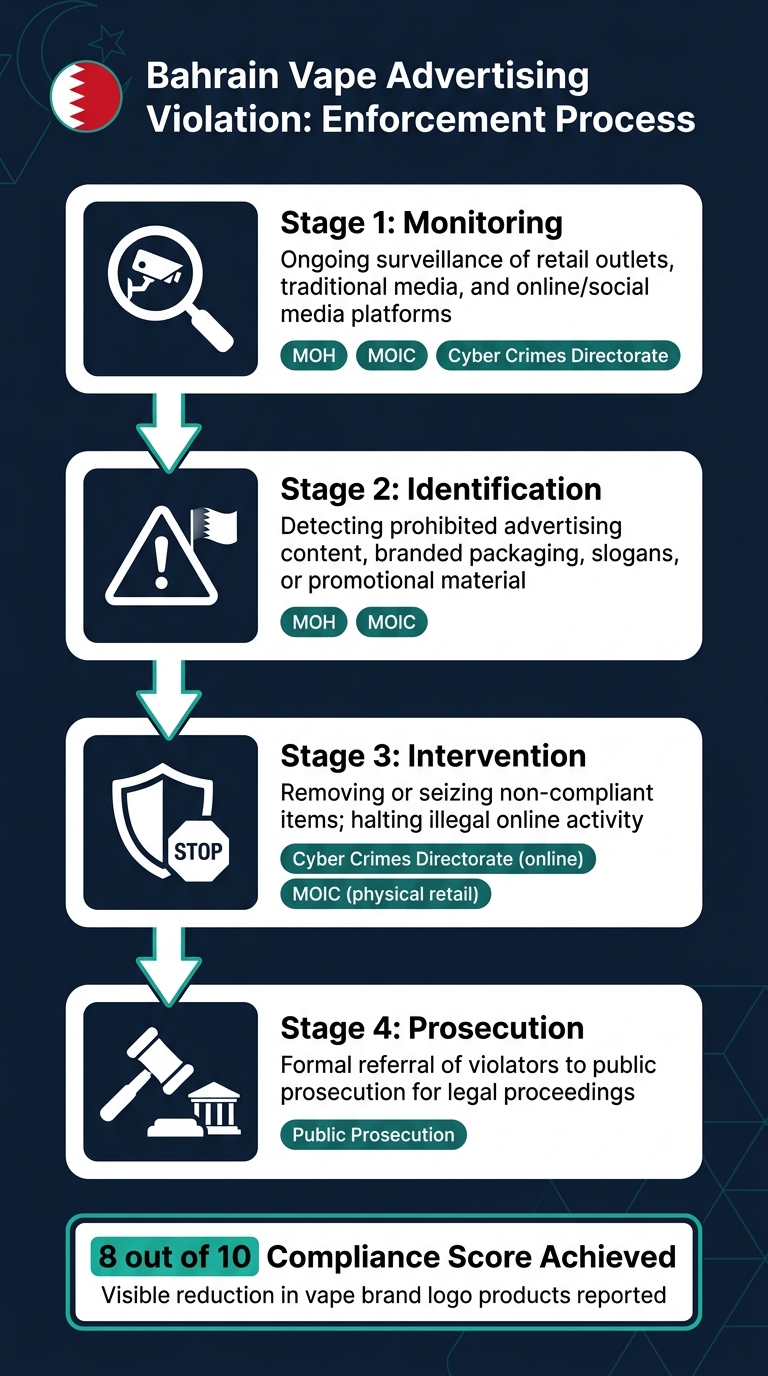
Bahrain Vape Ad Violation: Enforcement Process Step-by-Step
Monitoring and Inspections
In Bahrain, government authorities actively inspect reputable vape shops and keep a close eye on both traditional and digital media to ensure vape advertisements comply with regulations and help consumers identify trusted retailers. Even one non-compliant social media post can prompt an official investigation.
A noteworthy initiative is Bahrain’s Digital Stamps Scheme for e-cigarettes. This system requires producers and importers to attach digital tax stamps to their products, creating a traceable system to ensure compliance. Such measures lay the groundwork for addressing violations effectively, as explained below.
Common Violations and Penalties
Some common violations include displaying branded slogans, using packaging with brand logos, offering promotional discounts, or distributing free product samples. Those caught violating these rules are referred to public prosecution. These enforcement efforts have led to an 8 out of 10 compliance score and a visible reduction in products featuring vape brand logos.
When violations are detected, enforcement follows a structured process, as outlined in the table below.
Steps in an Enforcement Action
Once a violation is identified through monitoring, authorities follow a step-by-step process to address the issue:
| Stage | Action | Authority Responsible |
|---|---|---|
| Monitoring | Ongoing surveillance of retail, media, and online platforms | MOH, MOIC, Cyber Crimes Directorate |
| Identification | Detecting prohibited content or products | MOH, MOIC |
| Intervention | Removing or seizing non-compliant items | Cyber Crimes Directorate, MOIC |
| Prosecution | Referring cases to public prosecution | Public Prosecution |
For online violations, the Cyber Crimes Directorate steps in to halt the activity before prosecution. For physical violations, such as those found during retail inspections, the Ministry of Industry and Commerce (MOIC) handles the initial response. Regardless of the type of violation, the final step is a formal legal referral.
"The Ministry of Health has collaborated with the Cyber Crimes Directorate in the Ministry of Interior to address violations occurring on social media." – WHO
How Vape Businesses Can Stay Compliant
Understanding enforcement is just one part of the equation. The other part is ensuring your vape business operates within the boundaries of the law. After addressing how enforcement works, the focus should shift to maintaining compliance across all marketing and operational channels.
Auditing Your Marketing Channels
Start by reviewing every customer interaction point – your website, social media accounts, WhatsApp communications, and physical storefronts. The goal is to ensure these channels provide factual descriptions of your products without promoting them.
Here are the key areas to verify immediately:
- Make sure your online and offline platforms prominently display the legal purchase age of 21. Additionally, for online sales, you need a valid Commercial Registration (CR) with ISIC4 Code 4791 (Retail sale via Internet). Keep in mind, a "Sijili" virtual CR cannot be used for selling tobacco or electronic nicotine products.
- Confirm that all products undergo the Ministry of Health’s "Package Label Matching" process before being sold. This ensures label accuracy and is a free service that typically takes around seven working days to complete.
Once you’ve completed your audit, you can focus on building an online presence that aligns with Bahrain’s regulations.
Building a Compliant Online Presence
Your website’s structure is just as important as its content. The Ministry of Industry and Commerce requires vape retailers to meet specific standards for online platforms. These include having a functional shopping cart, secure payment options, and a valid domain URL. Additionally, your site must clearly outline policies such as Returns & Refund, Terms of Use, and Consumer Protection.
When it comes to content, stick to the facts. Product descriptions should include details like nicotine strength (in mg/ml), a full list of ingredients, and information that exactly matches the Ministry of Health–approved packaging labels. Avoid promotional language, images that promote a lifestyle, or anything that could appeal to younger audiences. For example, platforms like VapeShop.bh follow these guidelines by keeping their product information straightforward and factual, without using slogans or making health claims.
Communicating Prices and Product Details Legally
In addition to a compliant online storefront, ensure that the way you share pricing and product details also adheres to the rules. Public promotions, such as announcing discounts on social media, are prohibited under Bahrain’s advertising laws. Instead, consider using private communication channels like WhatsApp to handle pricing and product inquiries. This approach allows for direct, one-on-one communication without violating regulations.
When discussing product details, stick to factual information. Share specifics like device features, nicotine concentrations, and available variants. If a customer requests details about a product, ensure your response matches the approved label exactly – nothing more, nothing less. This keeps your communication helpful while staying within legal boundaries.
Maintaining Compliance Over Time
Ensuring compliance is not just about adhering to regulations initially – it requires ongoing effort. This involves consistent internal oversight, thorough staff training, and staying alert to legal updates.
Internal Compliance Practices
Start by assigning a dedicated compliance lead. This person should monitor updates from the Ministry of Industry and Commerce (MOIC) and the Ministry of Health (MOH) weekly. Their role will include maintaining a detailed checklist to ensure adherence to regulations, such as:
- Checking that all product displays feature the required health warnings and nicotine content disclosures.
- Ensuring retail displays avoid prohibited advertising, like brand slogans, branded boxes, or visible price tags.
- Keeping distribution records current, as importers must maintain detailed documentation under licensing requirements.
For reference, Bahraini Technical Regulation BH 2:2021 can be purchased for BHD 10.5 from the BSMD store in either Arabic or English.
Once these internal protocols are in place, ensure your team is fully aware of and trained on these requirements.
Training Staff on Advertising Rules
Your staff plays a critical role in maintaining compliance. Employees who interact with customers – whether in-store or through platforms like WhatsApp – must clearly understand what is permissible. Training should focus on:
- The ban on promotional discounts and free samples.
- The strict requirement to verify customers’ ages using original physical ID, such as the Bahrain Civil Personal Record (CPR) card or a valid passport.
Social media behaviour is equally important. The Ministry of Health, in collaboration with the Cyber Crimes Directorate of the Ministry of Interior, actively monitors online advertising violations. Staff managing social media accounts should be cautious not to post promotional offers or brand-focused imagery, as even informal posts could lead to enforcement actions.
Keeping Up with Legislative Changes
To maintain compliance, staying informed about regulatory updates is essential. Bahrain’s regulations are evolving, with new measures frequently introduced. For instance:
- The National Antismoking Committee aims to regulate electronic nicotine delivery systems under the same rules as traditional tobacco products.
- A Digital Stamps Scheme will soon require producers and importers to affix digital tax stamps to nicotine-containing and nicotine-free e-liquids.
- New Gulf Technical Regulations (GSO) are expected to be introduced as late as 2026, which will further update product standards.
Here’s how to stay updated:
| Regulatory Body | What to Monitor | Where to Check |
|---|---|---|
| Ministry of Industry and Commerce (MOIC) | Updates on BH 2:2021 and licensing rules | moic.gov.bh / bsmd.moic.gov.bh |
| Ministry of Health (MOH) | New resolutions on packaging and health warnings | moh.gov.bh |
| Bahrain News Agency (BNA) | Royal Decrees and newly ratified laws | bna.bh |
As the Ministry highlights:
"Prior to importing new tobacco or electronic nicotine products into the Kingdom of Bahrain, it is mandatory to submit product samples… to ensure compliance with the specifications and standards enforced within the Kingdom."
Conclusion: Running a Legal Vape Business in Bahrain
Running a vape business in Bahrain means navigating a detailed set of regulations. These include ensuring bilingual packaging compliance, verifying that all customers are at least 21 years old, and incorporating taxes like the 100% excise tax, 10% VAT, and 5% import duty (calculated on the CIF value) into pricing. These rules highlight the strict regulatory environment governing the industry.
Failing to comply with these standards can result in serious consequences, such as shipment seizures, delays in customs clearance, and even legal penalties under Law No. 8 of 2009. The Ministry of Health (MOH), the National Health Regulatory Authority (NHRA), and the Ministry of Industry and Commerce (MOIC) closely monitor compliance, leaving little room for error.
An example of a business adhering to these regulations is VapeShop.bh. As Bahrain’s first licensed online vape store, it has served over 10,000 customers. The platform ensures strict 21+ age verification both online and during delivery. It only sells products that meet the BH 2:2021 standards and provides clear ingredient and nicotine content information for every item. Instead of relying on promotional tactics, VapeShop.bh prioritises transparency and customer convenience in its operations.
FAQs
Can I post vape products on Instagram in Bahrain?
In Bahrain, advertising or promoting vape products on Instagram is strictly forbidden. The Ministry of Health, along with other authorities, actively monitors social media platforms to enforce this rule. Violators risk facing legal consequences, including fines, as the marketing of vaping products is entirely prohibited under public health regulations.
What can I legally show in-store about vape products?
In Bahrain, advertising vaping products is strictly prohibited. This means you cannot display any promotional materials that encourage the use of these products, whether in public spaces or retail environments.
Additionally, it’s mandatory to display a clear sign at the point of sale stating that the sale of tobacco and electronic nicotine products to anyone under the age of 18 is against the law. Products must also comply with technical standards set by regulations and feature approved, highly visible warning labels, as specified by the Ministry of Health.
What happens if my shop breaks the vape ad rules?
Violating Bahrain’s vape advertising rules can have serious consequences. According to Law (8) of 2026, authorities have the power to inspect businesses, take down illegal advertisements, and enforce penalties such as fines or imprisonment for violations, including unlicensed promotions or obstructing inspectors. The Ministry of Health keeps a close watch on advertisements, particularly on social media, and can escalate cases for prosecution. Additionally, businesses that fail to comply risk having their licences temporarily or permanently revoked.
Related Blog Posts
- Top 5 Factors Driving Vape Sales in Bahrain
- Vaping Market Size in Bahrain 2026
- Ultimate Guide to Vape Delivery in Bahrain
- Vape Devices vs. E-Liquids: Bahrain Customs Policies
Frequently Asked Questions
No. Under Technical Regulation BH 2:2021, Bahrain treats electronic nicotine products the same as traditional tobacco for advertising, so commercial vape advertising is effectively banned across mainstream and digital channels. This follows the wider tobacco control framework that prohibits most forms of advertising, promotion, and sponsorship to reduce exposure, especially for young people.
Vape products cannot be advertised on TV, radio, newspapers, magazines, or social media platforms. Retailers also are not allowed to use branded display materials, visible promotional price tags, or marketing campaigns like discounts, giveaways, or sponsorships for electronic nicotine products.
Social media accounts promoting vape products are monitored by the Ministry of Health together with the Cyber Crimes Directorate to enforce the national bans on advertising, promotion, and sponsorship. Pages or accounts that use influencers, hidden ads, or direct product marketing risk enforcement action, including referral for prosecution.
Before any electronic nicotine product can be sold, its packaging and labelling must be approved by the competent authority under BH 2:2021. Labels must include required health warnings and accurate product information, and they cannot use misleading terms, discount coupons, or designs that resemble food or cosmetics.
Vape advertising is controlled through a combination of Law No. 8 of 2009 on tobacco, Ministerial Resolution No. 3 of 2011 on tobacco advertising bans, and Decision No. 121 of 2021 that adopted Technical Regulation BH 2:2021 for electronic nicotine products. Together, these measures extend tobacco-style restrictions to vapes, covering advertising, promotion, sponsorship, packaging, and market approval.
Authorities can seize non-compliant products, impose penalties, and refer serious advertising or promotion violations to the public prosecution. Regular inspections and online monitoring support this enforcement, so businesses that ignore the rules face both financial and legal consequences.
Under the current framework, electronic nicotine products must comply with BH 2:2021 and the related tobacco control laws, including product approval and strict packaging requirements. Any tax, stamp, or track-and-trace measures that apply to tobacco-equivalent products must be followed as part of overall regulatory compliance, and businesses are expected to stay updated on new decisions from the relevant ministries.