Sub-Ohm Vaping for Flavor: Guide


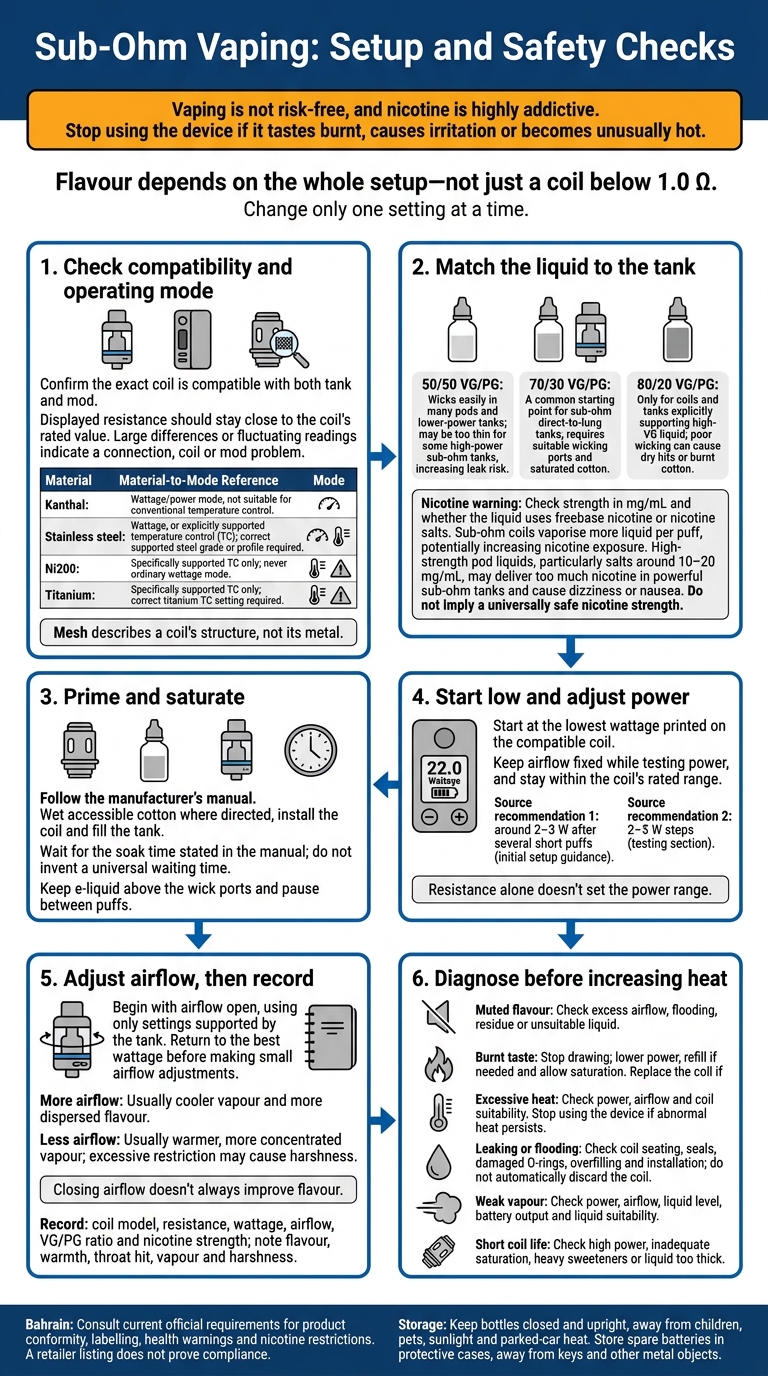
Sub-ohm flavour depends on the whole setup – not just a coil below 1.0 Ω. Start at the lowest wattage marked on a compatible coil, keep the wick saturated and change only one setting at a time.
For adult vapers in Bahrain, this guide covers matching airflow, VG/PG ratio, nicotine strength and coil type, plus priming, fault checks, storage and local product rules. Vaping is not risk-free, and nicotine is highly addictive. Stop using the device if it tastes burnt, causes irritation or becomes unusually hot.
Sub-Ohm Vaping: Setup and Safety Checks
Balance Resistance, Wattage and Airflow
Once you know the coil’s limits, adjust power and airflow together. Resistance alone doesn’t set the power range: wattage controls heat, while airflow affects flavour concentration.
Use the Coil’s Recommended Wattage
Coils with the same resistance may need different power settings because their surface area and wick design differ. Mesh can spread heat across a large surface without high power. Start at the lowest wattage printed on your coil, then increase by around 2–3 W after several short puffs.
| Power relative to the coil’s range | Warmth and vapour | Flavour and checks |
|---|---|---|
| Insufficient: below the recommended range | Cooler, thinner vapour | Flavour may seem muted or thin. Flooding or gurgling may mean the coil isn’t vaporising liquid fast enough. |
| Suitable: within the recommended range | Warmth, vapour and liquid use should match the coil’s design. | Flavour is generally clearest when the vape feels comfortable and the wick stays saturated. Adjust in small steps. |
| Excessive: above the maximum marked wattage | Hotter vapour and more vapour | Harshness, a burnt taste or a hot, dry hit. Stop, reduce power and check the liquid supply. |
Even within the rated range, long puffs can dry the wick. Keep e-liquid above the wick ports, prime new vape coils as instructed and pause between puffs. Thick liquid can also cause dry hits if it feeds too slowly.
If the vape still tastes muted or feels harsh, check the airflow next.
Adjust Airflow and Warmth
Airflow changes the flavour balance by controlling cooling and draw resistance. Use only settings your tank supports. Closing the airflow doesn’t always improve flavour.
More airflow usually cools the vapour and spreads the flavour. Less airflow usually makes it warmer and more concentrated.
| Intended airflow setting | Draw resistance | Warmth and vapour | Flavour effect |
|---|---|---|---|
| Open | Loose, airy | Cooler; more vapour | Can reduce flavour intensity |
| Medium | Moderate | Balanced cooling and warmth | A balance of flavour and vapour |
| Restricted, where supported | Firmer | Warmer, more concentrated vapour | May intensify flavour, but too much restriction can cause harshness |
Direct-to-lung (DTL) means inhaling vapour straight into the lungs. Sub-ohm tanks commonly use a relatively open DTL draw, though some users may find this too intense.
Start with the tank’s airflow open and wattage at the low end of its recommended range. Change one setting at a time, then reassess. If the draw becomes hot, dry, painful or irritating, stop and check that the wick is saturated before trying again. Replace the coil if the burnt taste remains.
Next, match the liquid and coil to the tank’s design.
sbb-itb-837e7ad
Choose Suitable E-Liquid and Coils
VG/PG Ratio and Nicotine Strength
Match the VG/PG ratio to your tank’s requirements.
| VG/PG ratio | Flavour and throat sensation | Vapour | Wicking and compatibility |
|---|---|---|---|
| 50/50 | Clear flavour with a more noticeable throat sensation; can feel sharper at higher nicotine strengths | Moderate | Wicks easily in many pods and lower-power tanks; may be too thin for some high-power sub-ohm tanks, increasing the risk of leaks |
| 70/30 | Smoother inhale, more body and balanced flavour when paired with a suitable coil | Dense | A common starting point for sub-ohm direct-to-lung tanks; needs large enough wicking ports and well-saturated cotton |
| 80/20 | Very smooth, thick vapour with a softer throat sensation; flavour may seem less bright or concentrated, depending on the formulation | Very dense | Use only with coils and tanks that explicitly support high-VG liquid; poor wicking can cause dry hits or burnt cotton |
Check the nicotine strength in mg/mL and whether the liquid uses freebase nicotine or nicotine salts. Sub-ohm coils vaporise more liquid per puff, which can increase nicotine exposure. High-strength pod liquids, particularly salts around 10–20 mg/mL, may deliver too much nicotine in a powerful sub-ohm tank and cause dizziness or nausea.
Coil Materials, Mesh and Ramp-Up Time
Mesh describes a coil’s structure, not its metal. Mesh coils can use materials such as Kanthal or stainless steel. Many heat quickly, but ramp-up time – the delay before vapour forms – depends on surface area, mass and contact with the wick. Higher-mass coils take longer to heat.
Residue, sweetener build-up and the cotton’s condition also affect flavour. The metal alone won’t tell you how a coil will taste.
Once you’ve matched the liquid to your tank, coil design affects how efficiently it heats that liquid.
| Coil material | Suitable operating mode | What to check |
|---|---|---|
| Kanthal | Wattage/power mode | Not suitable for conventional temperature control |
| Stainless steel | Wattage, or explicitly supported temperature control (TC) | TC needs the correct supported steel grade or profile |
| Ni200 | Specifically supported TC only | Never use it as an ordinary wattage-mode coil |
| Titanium | Specifically supported TC only | Needs the correct titanium TC setting |
Check the coil’s material markings and follow your device instructions. Don’t guess the operating mode.
Prime and Replace Your Coil
Follow the manual when fitting a new coil. Wet any accessible cotton where directed, install the coil and fill the tank. Allow the soak time stated in the manual before use. If the cotton scorches on the first puff, the burnt taste may remain even after soaking.
A persistent burnt taste, muted flavour or reduced vapour may mean it’s time for a replacement – but check the liquid level, power and airflow first. Leaking or gurgling alone calls for different checks: inspect the coil seating and seals, and check for overfilling or flooding before throwing the coil away. These issues can affect new coils too.
With the coil primed and the liquid matched, adjust wattage and airflow in small steps.
Adjust Settings and Fix Flavour Problems
Test and Record Your Settings
Check that your exact coil is compatible with both your tank and mod. The displayed resistance should stay close to the coil’s rated value. Large differences or fluctuating readings point to a connection, coil or mod problem.
Once you’ve checked this, keep airflow fixed and increase power in 2–5 W steps, staying within the coil’s rated range. Allow the wick to resaturate between tests. If flavour still falls short, use the table below to narrow down the cause.
Before each change, assess flavour, warmth, throat sensation and vapour. Return to the best wattage before making small airflow adjustments. Record the coil model, resistance, wattage, airflow, VG/PG ratio and nicotine strength, along with notes on flavour, warmth, throat hit, vapour and harshness.
Find the Cause of Flavour Problems
More heat won’t fix deposits, damaged cotton or poor liquid delivery. A fault that changes with wattage or airflow points to a settings issue. If it persists, inspect the coil, tank or liquid.
Stop using the device if it repeatedly overheats, displays electrical faults or error messages, or has a damaged battery. Unusual battery heat, swelling or hissing is a safety issue – not something to fix by changing flavour settings.
| Problem | Check first | What to do |
|---|---|---|
| Muted flavour | Excess airflow, flooding, residue or unsuitable liquid | Reduce airflow slightly, clean the tank and inspect the coil. Try a different flavour for comparison. |
| Burnt taste | Poor saturation, excessive power or a blocked wick | Stop drawing, lower power, refill if needed and allow the wick to saturate. Replace the coil if the cotton tastes permanently burnt. |
| Excessive heat | Excessive power, restricted airflow or an unsuitable coil | Lower wattage, open airflow slightly and shorten draws. Stop using the device if abnormal heat persists. |
| Weak vapour | Low power, restricted airflow, low liquid level, poor battery output or an unsuitable VG/PG ratio | Check the battery and connections. Increase power gradually within the coil’s range and open airflow. |
| Leaking or flooding | Excess liquid in the coil, loose seals, damaged O-rings, overfilling or incorrect installation | Check coil seating and seals, and clear excess liquid from the airflow path. Avoid overfilling and replace damaged parts. |
| Short coil life | High power, inadequate saturation, heavily sweetened liquid or liquid that is too thick for the coil | Stay within the recommended power range, pause between draws and prime the coil properly. Consider a less sweet liquid that suits the coil. |
If adjustments don’t resolve the issue, check the device, liquid and compliance with local rules.
Check Products and Bahrain’s Vaping Rules
If tuning doesn’t solve the problem, check the product itself and Bahrain’s rules. Consult current Bahrain Ministry of Health information and other relevant official requirements for product conformity, labelling, health warnings and nicotine restrictions. Use VapeShop.bh product pages only to confirm stock, model names and stated ratings. A listing does not prove compliance.
Keep bottles closed and upright, away from children, pets, sunlight and the heat inside parked cars. Follow vape battery safety guidelines and store spare batteries in protective cases, away from keys and other metal objects.
Conclusion: Match Your Setup and Adjust Gradually
When adjusting wattage, airflow and liquid, flavour depends on the whole setup – not resistance alone. Find a comfortable setting you can return to, change one variable at a time, and note the result. Stop using the device if you notice heat, dryness or irritation. Identify the cause before using it again, and seek medical advice if irritation persists.
FAQs
Why does my e-liquid taste different in a sub-ohm tank?
Sub-ohm tanks run at higher wattages than standard setups, producing more vapour and heat. This can make flavours stronger, but the wrong settings or ingredients can leave them tasting muted, harsh or burnt.
Your VG/PG ratio matters. Sub-ohm tanks generally need high-VG blends to help prevent leaks and keep the coil properly supplied with e-liquid. Nicotine strength that doesn’t suit your setup, incorrect airflow or wattage outside your coil’s recommended range can also affect taste.
Is my coil worn out, or is it flavour fatigue?
A worn-out coil often causes a persistent burnt or scorched taste, weak flavour, or leaking. If the flavour just seems less noticeable or bland, flavour fatigue may be the cause.
Check the coil for residue or damage, and make sure the wick is fully soaked with e-liquid. Replace the coil if the burnt taste persists. If the device is clean, try a different e-liquid flavour profile to help reset your palate.
Can Bahrain’s heat affect my vaping setup?
Yes. Bahrain’s heat thins e-liquid, making leaks, flooding and gurgling more likely. Your device may also run warmer, leading to harsher draws if the airflow is too restricted.
Consider a higher VG ratio, such as 80/20 VG/PG, to keep the e-liquid thicker. Open the airflow slightly for cooler vapour. A top-airflow tank can also help prevent leaks.
Store your device and e-liquid in a cool, dry place, away from direct sunlight. Avoid leaving either in a hot vehicle.
Related Blog Posts
- What Is Coil Resistance in Vaping?
- Sub-Ohm vs. High-Resistance Coils
- Beginner’s Checklist for Cloud Chasing
- Cloud Chasing Airflow and Wattage Guide
{“@context”:”https://schema.org”,”@type”:”FAQPage”,”mainEntity”:[{“@type”:”Question”,”name”:”Why does my e-liquid taste different in a sub-ohm tank?”,”acceptedAnswer”:{“@type”:”Answer”,”text”:”Sub-ohm tanks run at higher wattages than standard setups, producing more vapour and heat. This can make flavours stronger, but the wrong settings or ingredients can leave them tasting muted, harsh or burnt. Your VG/PG ratio matters. Sub-ohm tanks generally need high-VG blends to help prevent leaks and keep the coil properly supplied with e-liquid. Nicotine strength that doesn’t suit your setup, incorrect airflow or wattage outside your coil’s recommended range can also affect taste.”}},{“@type”:”Question”,”name”:”Is my coil worn out, or is it flavour fatigue?”,”acceptedAnswer”:{“@type”:”Answer”,”text”:”A worn-out coil often causes a persistent burnt or scorched taste, weak flavour, or leaking. If the flavour just seems less noticeable or bland, flavour fatigue may be the cause. Check the coil for residue or damage, and make sure the wick is fully soaked with e-liquid. Replace the coil if the burnt taste persists. If the device is clean, try a different e-liquid flavour profile to help reset your palate.”}},{“@type”:”Question”,”name”:”Can Bahrain’s heat affect my vaping setup?”,”acceptedAnswer”:{“@type”:”Answer”,”text”:”Yes. Bahrain’s heat thins e-liquid, making leaks, flooding and gurgling more likely. Your device may also run warmer, leading to harsher draws if the airflow is too restricted. Consider a higher VG ratio, such as 80/20 VG/PG, to keep the e-liquid thicker. Open the airflow slightly for cooler vapour. A top-airflow tank can also help prevent leaks. Store your device and e-liquid in a cool, dry place, away from direct sunlight. Avoid leaving either in a hot vehicle.”}}]}
Frequently Asked Questions
Sub-ohm flavour depends on the complete setup, not only a coil below 1.0 Ω. This guide explains how wattage, airflow, VG/PG ratio, nicotine strength and coil type work together for adult vapers in Bahrain.
Start at the lowest wattage printed on a compatible coil and keep the wick saturated. Adjust only one setting at a time, checking airflow and flavour concentration as power changes.
Keep the wick saturated before vaping and begin at the coil’s lowest marked wattage. If the vapour tastes burnt, stop using the device and check the coil and liquid saturation.
Wattage controls heat, while airflow affects flavour concentration. Adjust both together within the coil’s recommended range, changing one setting at a time to identify what improves the result.
The guide explains how VG/PG ratio should be matched with the coil and overall setup. Use the compatible coil’s guidance rather than choosing a ratio based only on resistance, because wick design and surface area also affect performance.
Nicotine strength is one of the setup factors covered in this guide, alongside airflow, VG/PG ratio and coil type. Bahrain customers should follow local product rules and remember that nicotine is highly addictive and vaping is not risk-free.
Stop using the device if it tastes burnt, causes irritation or becomes unusually hot. Check that the wick is saturated and that the power setting is within the coil’s recommended range before using it again.