
Sub-Ohm vs. High-Resistance Coils


If I want bigger clouds and warmer vapour, I go sub-ohm. If I want lower power use, a tighter draw, and higher nicotine strength, I go with a high-resistance coil.
That is the whole choice in one line. In most cases:
- Sub-ohm coils are below 1.0Ω
- High-resistance coils are 1.0Ω and above
- Sub-ohm setups often run at 30W–120W+
- High-resistance setups often run at 8W–15W
- Sub-ohm coils usually suit 3mg–6mg freebase
- High-resistance coils usually suit nic salts up to 20mg/ml in Bahrain
I’d put it this way: sub-ohm is about output, while high-resistance is about lower power use. One gives me more vapour, more heat, and faster e-liquid use. The other gives me longer battery life, a more cigarette-like pull, and less frequent refills.
A few points matter most before I buy:
- Draw style: open DTL vs tight MTL
- Device type: mod or RDL pod vs compact pod or pen
- Nicotine strength: low freebase vs higher-strength salts
- Running cost: high-wattage setups often cost more over time in BHD
Explained! Ohms and vaping resistance
sbb-itb-837e7ad
Quick Comparison
| Feature | Sub-Ohm Coils | High-Resistance Coils |
|---|---|---|
| Resistance | <1.0Ω | ≥1.0Ω |
| Usual wattage | 30W–120W+ | 8W–15W |
| Inhale style | DTL / open draw | MTL / tight draw |
| Vapour | Large clouds | Small, discreet clouds |
| Vapour temp | Warm to hot | Cooler |
| E-liquid use | High | Low |
| Battery drain | Faster | Lower |
| Best nicotine match | 3mg–6mg freebase | Nic salts up to 20mg/ml |
| Coil life | About 5–14 days | About 1–2 weeks, sometimes 2–4 weeks with light use |
| Best e-liquid ratio | 70% VG+ | 50/50 PG/VG |
My short take: if I care more about clouds, warmth, and strong flavour, I’d pick sub-ohm. If I care more about battery life, lower liquid use, and a simple daily setup, I’d pick high-resistance.
Sub-Ohm Coils: Performance, Benefits, and Limits
How sub-ohm coils perform day to day
Sub-ohm coils heat up almost at once. Ramp-up time is usually 0.1 to 0.3 seconds, and vapour temperature can hit 200°C to 250°C. In day-to-day use, that extra heat tends to bring out dessert, cream, and layered flavour profiles by releasing more volatile notes. It also fits the open, direct-lung inhale style mentioned above.
Airflow matters a lot here. Keep it open enough to manage heat and help protect the wick. If you choke the airflow too much on a high-wattage sub-ohm coil, the vapour can get uncomfortably hot and the cotton may scorch.
A lot of newer sub-ohm coils now use mesh strips instead of round wire, often ranking among the best vape coils for flavour production. The reason is pretty simple: more surface area means faster, more even heating, which helps keep flavour output steadier from puff to puff.
Sub-ohm pros and cons
The trade-off is pretty clear. You get more vapour, more flavour intensity, and a warmer vape, but you also burn through battery charge and e-liquid much faster. High-nicotine e-liquids, especially 20 mg+ nic salts, can also feel harsh in a sub-ohm setup.
Here’s the snapshot version:
| Feature | Sub-Ohm Coils (<1.0Ω) |
|---|---|
| Vapour Production | Massive, dense clouds |
| Vapour Temperature | Warm to hot (200°C–250°C) |
| E-Liquid Use | High (15–40 ml/day) |
| Battery Drain | Fast (high wattage required) |
| Best Nicotine Strength | Low (3–6 mg freebase) |
| Coil Lifespan | 5–14 days |
Device and e-liquid compatibility
Sub-ohm coils usually pair best with regulated box mods, sub-ohm tanks, or advanced pod-mod systems with variable wattage control. In most cases, lower-resistance sub-ohm coils perform best at 60–120 W+, while 0.3Ω to 0.5Ω coils are often a better match for 30–60 W. Standard low-power pod devices usually can’t push that kind of output unless they’re made for RDL use.
For e-liquid, 70% VG or higher is the usual match. High-VG juice makes the thick clouds these coils are built for, and it works well with the larger wicking ports made for denser, high-viscosity liquid. When fitting a new coil, prime it first: drip e-liquid straight onto the cotton wicking holes, leave it to soak for 5 to 10 minutes, then begin at the lowest suggested wattage. After that, move up slowly in 2–5 W steps.
Next: how high-resistance coils compare on heat, efficiency, and draw.
High-Resistance Coils: Performance, Benefits, and Limits
How high-resistance coils perform day to day
High-resistance coils – usually 1.0Ω to 1.8Ω – use much less power than sub-ohm coils. Most work best in the 8W to 15W range. If sub-ohm is about output, high-resistance is more about control and efficiency. The lower power keeps vapour cooler and helps your battery last longer.
The draw is tighter too, which makes these coils a good fit for Mouth-to-Lung vaping. Vapour output stays modest, so clouds are smaller and more discreet.
High-resistance pros and cons
The big plus here is efficiency. Lower wattage means cooler vapour, less battery drain, and lower e-liquid use. Coil life is decent as well: about 1–2 weeks with regular use, or 2–4 weeks if you vape more lightly.
The downside is pretty simple. High-resistance coils don’t produce large clouds. So if you like an open draw and a lot of vapour, they can feel a bit limiting. They also don’t pair well with thick, high-VG e-liquids.
| Feature | High-Resistance Coils (1.0Ω+) |
|---|---|
| Vapour Production | Low / Discreet |
| Vapour Temperature | Cool |
| Airflow Style | Tight (MTL) |
| Operating Wattage | 8W–15W |
| Battery Life | Long |
| E-Liquid Use | Low |
| Best Nicotine Type | Nicotine salts (up to 20 mg/ml in Bahrain) |
| Coil Lifespan | 1–2 weeks regular use; 2–4 weeks lighter use |
That brings you to the next part of the choice: matching the coil with the right device and e-liquid.
Device and e-liquid compatibility
High-resistance coils are common in compact pod systems, vape pens, and low-wattage MTL tanks. These devices are built for low power and tighter airflow, so the pairing makes sense.
For e-liquid, a 50/50 PG/VG ratio is the safer pick. Thick high-VG liquids, especially 70%+ VG, can struggle to wick through the smaller ports in these coils. That can lead to dry hits. High-resistance coils also work well with nicotine salts or freebase e-liquids.
One small habit makes a big difference: don’t chain vape. Taking several puffs back to back doesn’t give the wick enough time to soak up more liquid, and that can shorten coil life. In Bahrain, e-liquid rules cap nicotine strength at 20 mg/ml, which helps keep nicotine delivery smooth instead of too strong.
Next: a direct side-by-side comparison of performance and everyday use.
Sub-Ohm vs. High-Resistance: Side-by-Side Comparison
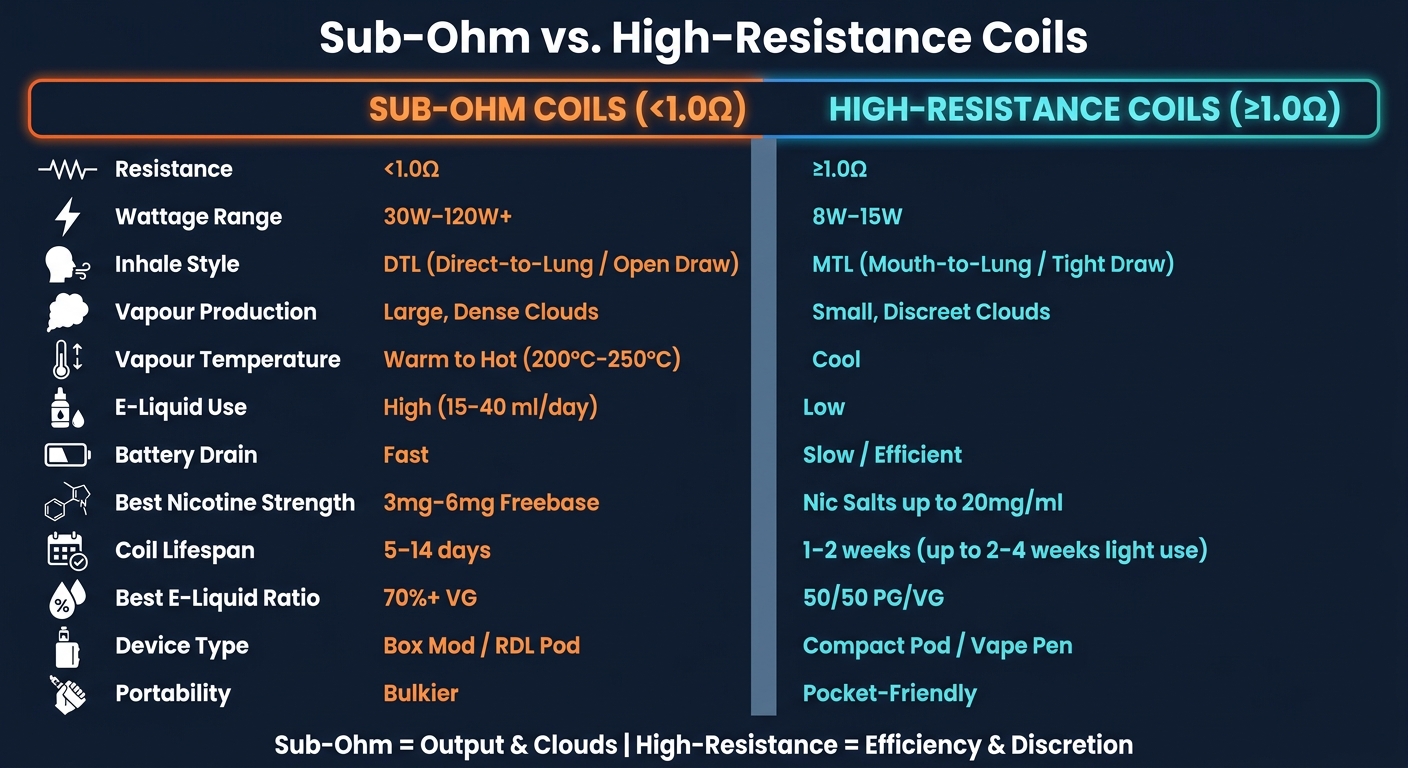
Sub-Ohm vs High-Resistance Coils: Full Comparison Chart
The main difference is simple: output vs. efficiency.
If you want more power, warmer vapour, and bigger clouds, sub-ohm coils lean that way. If you care more about lower power use, longer battery life, and a steadier draw, high-resistance coils usually make more sense.
Performance comparison
Sub-ohm coils run at higher wattage, while high-resistance coils stay cooler and steadier. That one difference shapes almost everything else: vapour volume, flavour feel, and throat hit.
| Feature | Sub-Ohm Coils (<1.0Ω) | High-Resistance Coils (≥1.0Ω) |
|---|---|---|
| Wattage Needs | High (30W – 120W+) | Low (8W – 15W) |
| Vapour Production | Large clouds | Small clouds |
| Flavour Style | Intense and warm | Subtle and cool |
| Vapour Temperature | Warmer | Cooler |
| Throat Hit | Smooth, especially with low nicotine | Stronger / cigarette-like |
| Inhale Style | Direct-to-Lung (DTL) | Mouth-to-Lung (MTL) |
Put simply, sub-ohm vaping is geared towards high output. You get more vapour and a warmer inhale, which is why it often pairs with DTL devices. High-resistance coils take the opposite path. They work at lower wattage, make less vapour, and tend to feel closer to a cigarette-style MTL draw.
That leads to the practical part: which option fits your battery life, e-liquid use, and nicotine strength?
Practical comparison
In day-to-day use, the gap becomes even clearer. Sub-ohm setups usually cost more to run because they drain batteries faster and use e-liquid at a much faster rate. High-resistance coils are the lower-cost option for regular use.
| Feature | Sub-Ohm Coils (<1.0Ω) | High-Resistance Coils (≥1.0Ω) |
|---|---|---|
| Battery Drain | Shorter (high drain) | Longer (efficient) |
| Liquid Use | High / Fast consumption | Low / Economical |
| Best Match | Low (3mg – 6mg freebase) | High (up to 20mg salts) |
| Portability | Often bulkier devices | Highly portable / pocket-friendly |
| Maintenance | More frequent coil changes | Less frequent coil changes |
Here’s the everyday trade-off. A sub-ohm device can feel punchier, but you’ll likely charge it more often, refill more often, and swap coils more often too. High-resistance setups are easier on battery and e-liquid, and they’re often better suited to smaller, pocket-friendly devices.
Nicotine choice matters as well. Sub-ohm coils are usually paired with lower nicotine strengths, such as 3mg to 6mg freebase. High-resistance coils work better with higher nicotine strengths, including nicotine salts up to 20mg.
Next, match those differences to your vaping style and daily routine.
Which Coil Fits Your Vaping Style
Use the differences above to match the coil to your day-to-day routine. Once you compare them side by side, the choice comes down to two things: output or efficiency.
Choose sub-ohm for clouds, open airflow, and lower-nicotine vaping
Sub-ohm coils fit best if you use a sub-ohm mod or an RDL pod, like an open draw, and vape low-strength freebase e-liquid. There is a clear trade-off here. You’ll need to charge your device more often, refill the tank more often, and change coils more often too. If you vape a lot, coil life usually gets shorter. Following daily vaping tips can help you maintain performance even with heavy use.
That said, if that setup matches how you vape, you get the upside: stronger flavour and bigger clouds.
If that feels a bit too power-hungry, high-resistance coils are the better pick for day-to-day efficiency.
Choose high-resistance for efficiency, tighter draws, and higher nicotine strength
High-resistance coils are a good fit for discreet, low-fuss vaping. They pair well with compact pod systems, give a tighter draw that feels closer to a cigarette, and work naturally with nicotine salts up to 20mg/ml, which is the Bahrain limit.
You’ll also get more time between charges, and your e-liquid will last longer. For light users, coil life tends to last the longest with this type of setup.
Key points for adult vapers in Bahrain
Before you buy, check these four things:
- Device type – a sub-ohm mod or RDL pod usually points to sub-ohm, while a compact pod system usually points to high-resistance
- Nicotine strength – freebase at 3mg–6mg suits sub-ohm; nic salts up to 20mg suit high-resistance
- Airflow preference – open and airy suits DTL; tight and restricted suits MTL
- Running cost – this matters more in Bahrain because high-liquid, high-wattage setups cost more to use over time
FAQs
How do I know which coil my device supports?
Check the manufacturer’s manual or the device’s original packaging for the recommended resistance range. Vape hardware isn’t universal, so each device may need a specific pod or coil.
If you’re not sure which model you have, look for the device name on the pod or tank, or check the old coil for its resistance rating. On VapeShop.bh, product listings show device compatibility, which helps you avoid the wrong fit.
Can I switch between sub-ohm and high-resistance coils on one device?
Not always. Coils are not universal, so you should only use coils made for your specific tank or pod system. Use the wrong coil and you can end up with leaks, weak performance, or even damage to the device.
That said, if your device supports different resistances within the same coil range, you can switch between them. You’ll just need to adjust your wattage, airflow, and nicotine strength to match the new coil.
What happens if I use the wrong e-liquid with my coil?
Using the wrong e-liquid can wear out your coil fast and make the whole device feel off. When the PG/VG ratio doesn’t match the coil resistance, the wick may struggle to soak up the liquid properly, or the coil may end up flooded.
High-VG e-liquid used with a high-resistance coil can lead to dry, burnt hits. On the flip side, a thinner 50/50 liquid in a sub-ohm coil can cause leaking, flooding, and spitting. Nicotine salts used in high-power sub-ohm devices can also hit too hard, delivering too much nicotine too fast.
Related Blog Posts
- Best Wattage for MTL vs. DTL Vaping
- Mesh vs Regular Coils: E-liquid Efficiency
- Mesh Coils vs Regular Coils: Pros and Cons
- What Is Coil Resistance in Vaping?
Frequently Asked Questions
Sub-ohm coils are below 1.0Ω, while high-resistance coils are 1.0Ω and above. In simple terms, sub-ohm setups are built for more vapour and warmth, while high-resistance coils focus on lower power use and a tighter draw. This is the main choice customers usually compare when looking at coil resistance in Bahrain.
Sub-ohm coils are the better match for bigger clouds and warmer vapour. They run at higher power and are used when the goal is more output rather than battery savings. For Manama buyers comparing options, this is the coil style linked with a more open DTL inhale.
High-resistance coils are usually the better match for nicotine salts. They use less power and suit a tighter MTL draw, which is why they are commonly paired with higher nicotine strengths up to 20mg/ml in Bahrain. That makes them a practical choice for lower-output vaping.
Yes, sub-ohm setups usually use more battery power and e-liquid. Because they run hotter and produce more vapour, they tend to drain the device faster and need refills more often. High-resistance coils do the opposite and are more efficient for everyday use.
Yes, that is the usual match. Sub-ohm coils are generally used for DTL, which gives an open draw and more vapour, while high-resistance coils are better for MTL and a tighter pull. That difference is often what shoppers mean when they ask about DTL vs MTL.
Sub-ohm setups often run at about 30W to 120W+, while high-resistance setups often run at about 8W to 15W. The higher wattage range is tied to more vapour and warmth, while the lower range is meant for efficiency. The right range still depends on the exact device and coil being used.
High-resistance coils are usually the more discreet option. They produce less vapour, use less power, and give a tighter draw, which many users prefer for a quieter vape. If the goal is lower output rather than cloud chasing, this is the simpler fit.