Cloud Chasing Airflow and Wattage Guide


My starting rule: set airflow for a comfortable draw, then adjust wattage within the coil’s stated range. Start at the low end on a regulated mod, change one setting at a time, and stop if the vapour tastes burnt or feels unusually hot.
Here’s what I focus on:
- Airflow: An open draw usually feels cooler and lighter; a tighter draw can feel warmer and more concentrated.
- Power and liquid: More wattage uses more e-liquid and battery charge. A saturated wick matters more than chasing the biggest cloud.
- Safe testing: Use compatible parts, prime the best vape coils as instructed and check batteries before use. Don’t use mechanical mods.
- Bahrain’s heat and rules: Keep devices out of parked vehicles, follow manufacturer storage limits and check whether vaping is permitted before using it in shared spaces.
<u>No setting makes vaping risk-free.</u> For adults who already vape, I’d put steady flavour, comfortable heat and sound equipment ahead of cloud size.
How Airflow Affects the Draw
Airflow sets the draw; wattage then controls how hot it feels. A bigger cloud can feel thinner. Opening the airflow mixes more air into the aerosol, making the draw feel lighter even when you see more vapour. Research found that faster airflow generally reduced aerosol density while increasing propylene glycol/vegetable glycerin consumption.
Compare Open, Partly Closed and Tight Airflow
Use these settings as starting points. Coil design, power, e-liquid and how you inhale also affect the draw.
| Airflow position | Draw resistance | Vapour density | Flavour intensity | Suitable setup |
|---|---|---|---|---|
| Open | Very loose | Lower | May be softer | Low-resistance, high-wattage direct-to-lung tank |
| Partly closed | Moderate | Higher | Often stronger | Adjustable-airflow sub-ohm tank or rebuildable atomiser |
| Tight | Firm to very tight | Can be high | May be intense, but harsh if overheated | Mouth-to-lung coil or low-power restricted draw setup |
If an open draw feels too thin, close the airflow a little before adding power. Very tight airflow won’t make clouds denser on its own. At high wattage, reduced cooling can lead to excess heat, harshness and dry hits.
Match Airflow to Your Atomiser
Stick to the manufacturer’s intended draw style, whether direct-to-lung or mouth-to-lung. Check the recommended wattage, coil resistance and airflow configuration together. The same airflow-ring position can produce different results on different atomisers.
Use only the device’s built-in airflow control. Restricted pods and fixed-output disposables aren’t suited to adjustable cloud chasing. Don’t cover air inlets or modify sealed devices.
If the vapour feels hot or dry, stop and let the device cool. Check that the wick is saturated, then retest with lower power and more airflow. Once the draw feels right, adjust the wattage around it.
sbb-itb-837e7ad
How Wattage Affects Heat and Vapour
Once airflow is set, wattage lets you fine-tune heat and vapour density. Wattage controls the power sent to the coil – not its temperature. Within your setup’s limits, more power generally produces more heat and vapour while using e-liquid faster. Airflow affects how that power feels: open airflow cools the vape, while tighter airflow makes it warmer.
Compare Settings Within the Coil’s Wattage Range
Follow the wattage range printed on the coil. Resistance alone won’t tell you the right power setting. And a mod’s maximum output is a limit, not a target.
| Setting within the recommended range | Heat and output | Flavour tendency | Battery demand | E-liquid use |
|---|---|---|---|---|
| Lower | Cooler; lower cloud potential | Clearer or less intense; sometimes muted | Lower | Slower |
| Middle | Warmer; balanced vapour output | Often a useful balance | Moderate | Moderate |
| Upper | Warmer still; potentially greater output | May intensify, then become harsh | Higher | Faster |
The upper end isn’t automatically best. A coil’s stated range doesn’t guarantee comfortable use in every condition. If you notice a burnt flavour, unusual heat or poor wicking, stop and check the liquid supply, airflow and coil condition. Research also links use above the recommended range with higher carbonyl emissions.
Balance Cloud Volume and Flavour
Coil surface area, ramp-up speed and airflow all affect vapour output and flavour. Higher-VG liquid can produce dense vapour, but its thickness needs compatible wicking. Don’t take longer puffs to chase bigger clouds. Give the wick time to re-saturate between puffs to avoid dry hits and early coil wear.
Aim for comfortable heat, consistent flavour and reliable wicking rather than the most visible vapour. Too much heat can mute flavours or make them harsh before you see any improvement in clouds. Higher output can also deliver more nicotine per puff. Stop if you feel nauseous or dizzy, or experience palpitations.
Use this balance as your starting point when testing settings on a regulated mod.
Test Settings on Regulated Mods
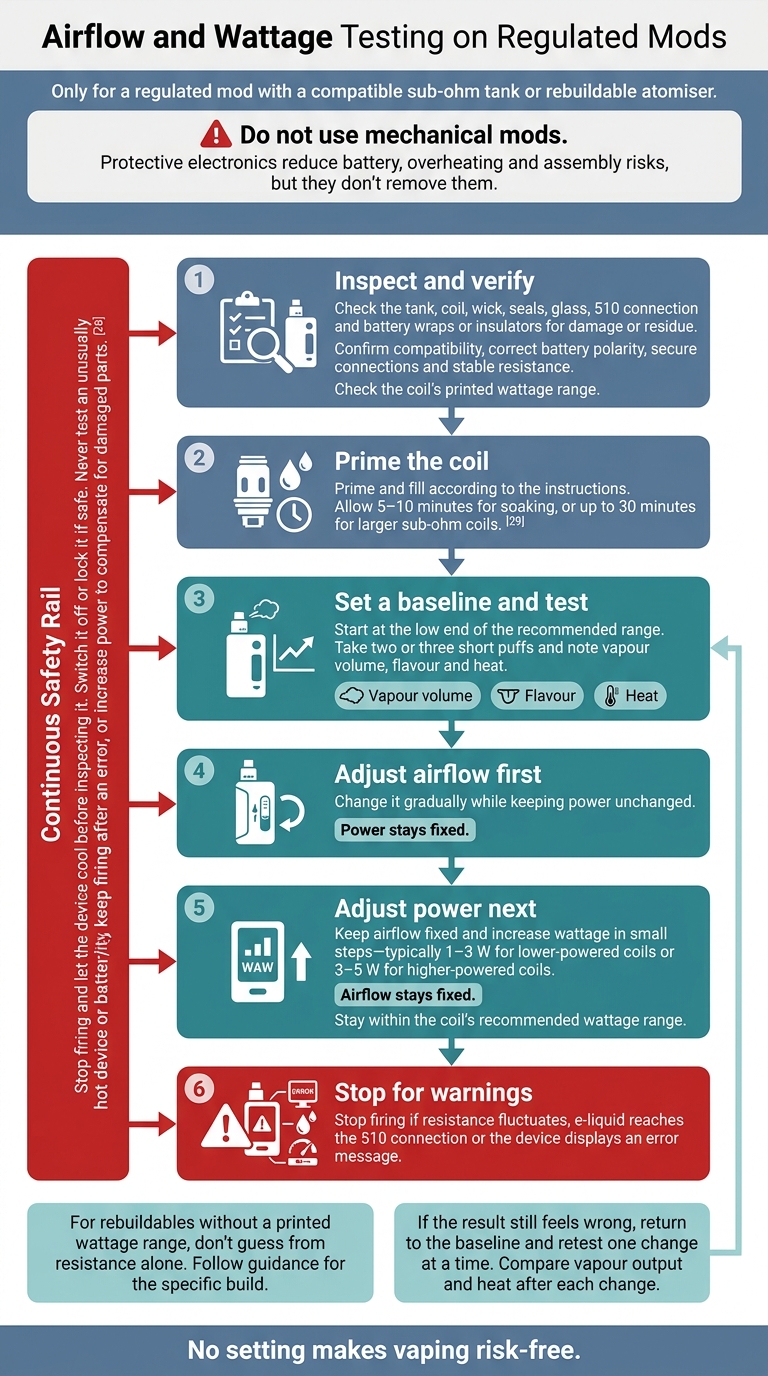
Airflow and Wattage Testing on Regulated Mods
Use this protocol only with a regulated mod and a compatible sub-ohm tank or rebuildable atomiser to find a balance of cloud, heat and flavour. Protective electronics reduce battery, overheating and assembly risks, but they don’t remove them. Do not use mechanical mods.
Start at the low end of the recommended range, then adjust airflow and wattage separately.
Change One Setting at a Time
- Inspect and verify: Check the tank, coil, wick, seals, glass, 510 connection and battery wraps or insulators for damage or residue. Confirm compatibility, correct battery polarity, secure connections and stable resistance. Check the coil’s printed wattage range.
- Prime the coil: Prime and fill according to the instructions. Allow 5–10 minutes for soaking, or up to 30 minutes for larger sub-ohm coils.
- Set a baseline and test: Start at the low end of the recommended range. Take two or three short puffs and note vapour volume, flavour and heat.
- Adjust airflow first: Change it gradually while keeping power unchanged.
- Adjust power next: Keep airflow fixed and increase wattage in small steps – typically 1–3 W for lower-powered coils or 3–5 W for higher-powered coils.
- Stop for warnings: Stop firing if resistance fluctuates, e-liquid reaches the 510 connection or the device displays an error message.
For rebuildables without a printed wattage range, don’t guess from resistance alone. Follow guidance for the specific build.
Check Batteries and Chargers
Use only the battery type and ratings specified by the device manufacturer. Check wraps and insulators, and do not use damaged cells. Multi-cell mods need matched cells of the same brand, age, capacity and charge level.
Follow the mod manufacturer’s battery limits and approved charging method. Charge on a clean, flat, non-flammable surface, and never leave charging unattended. In Bahrain, keep stored batteries away from direct sunlight, hot vehicles and other sources of heat.
Troubleshoot Vapour, Flavour and Heat Problems
Stop firing and let the device cool before inspecting it. Switch it off or lock it if safe. Never test an unusually hot device or battery, keep firing after an error, or increase power to compensate for damaged parts.
| Symptom | Possible causes | Corrective action |
|---|---|---|
| Burnt taste | Dry wick, high power, tight airflow, coil damage | Check wick saturation, lower wattage, open airflow slightly and replace a burnt coil. |
| Weak vapour | Low power, open airflow, low charge, weak connection | Check charge, connections and resistance before adjusting airflow or wattage. |
| Leaking | Loose coil, damaged seals or glass, overfilling, flooding | Dry and repair the assembly, then check wick saturation before retesting. Do not resume with e-liquid at the 510 connection. |
| Excessive heat | Repeated puffs, tight airflow, high power, battery or device fault | Stop and let it cool. Resolve faults before retesting at lower wattage with more airflow. |
| Muted flavour | Airflow mismatch, flooding, coil wear, dirty tank | Check wick saturation, clean the tank and replace a worn coil before adjusting airflow. |
If the result still feels wrong, return to the baseline and retest one change at a time. Compare vapour output and heat after each change.
Vaping Rules and Device Storage in Bahrain
After tuning airflow and wattage, give local rules and storage the same care.
Before buying or storing hardware in Bahrain, check Ministry of Health or official government guidance for current rules and storage limits covering devices and refill liquids.
Follow venue rules and Bahrain’s public-place restrictions. Law No. 8 of 2009 covers smoking in specified enclosed public places; don’t assume vaping is allowed there. In malls, restaurants, public transport, healthcare facilities and other shared spaces, ask staff when rules are unclear. Avoid vaping unless it’s explicitly permitted.
Bahrain’s heat can put devices and batteries at risk. Follow whichever manufacturer-specified temperature limit is lower, keep both indoors in a cool, dry place and never leave them in a parked vehicle.
Check Compatibility Before Buying
Before checkout, check that the exact parts fit your device.
Give the retailer your exact mod and tank model names, plus the replacement coil reference. Then check the supported resistance in Ω, recommended power in W, battery type and quantity, connector format, tank capacity in mL and charging method.
Match the written specifications, not the product photo.
Conclusion: Keep Airflow, Power and Heat in Balance
Match airflow to the atomiser, then adjust wattage to balance heat and clouds within the device’s limits. Extra airflow cannot fix excessive power.
Start near the coil’s lowest recommended wattage. Increase power in 2–5 W steps, leave several seconds between puffs, and stop increasing once the balance feels right.
No airflow or wattage setting removes vaping risk. For those new to the hobby, following a vaping guide for first-time users can help ensure a safe setup. Bigger clouds aren’t worth stressing the coil or battery. Stop immediately if you notice a burnt flavour, unusual heat, swelling, hissing or device warnings. Replace a coil that still tastes burnt, and stop using any device that shows battery warning signs.
FAQs
Why does my ideal wattage change with different e-liquids?
Your ideal wattage depends on your e-liquid’s thickness and your coil’s requirements. Thicker, high-VG liquids need more power to vaporise efficiently. Thinner, high-PG blends work better at lower power to avoid harsh or burnt tastes.
Flavour matters too. Sweet blends suit steady, lower heat to limit sweetener build-up, while icy liquids often suit cooler settings. Start at your coil’s lowest recommended wattage, then adjust gradually until you find the balance that suits you.
How can I distinguish a dry hit from nicotine harshness?
A dry hit tastes burnt, scorched or bitter because the wick is dry or hasn’t absorbed enough liquid. Nicotine harshness feels sharp, scratchy or stinging in your throat, usually because the nicotine strength is too high for your setup.
Lower wattage or better wicking can help liquid reach the coil. But if you suspect a dry hit, stop firing immediately to avoid further coil damage. Turning down the power won’t fix scorched cotton.
Can Bahrain’s heat affect my airflow and wattage settings?
Yes. Bahrain’s heat can thin e-liquid, making leaks more likely and devices feel warmer. Opening the airflow slightly can cool the vapour. If it’s too tight, heat can build up, leading to harsh draws or dry or burnt hits.
Start at the lowest recommended wattage and increase it in small steps, adjusting airflow in 5–10% increments. If you notice leaks, reduce the airflow opening and check that the wick is properly primed.
Related Blog Posts
- How to Build Coils for Competitive Cloud Chasing
- Checklist for Cloud Chasing Competitions
- Beginner’s Checklist for Cloud Chasing
- How Airflow Affects Flavor and Clouds
{“@context”:”https://schema.org”,”@type”:”FAQPage”,”mainEntity”:[{“@type”:”Question”,”name”:”Why does my ideal wattage change with different e-liquids?”,”acceptedAnswer”:{“@type”:”Answer”,”text”:”Your ideal wattage depends on your e-liquid’s thickness and your coil’s requirements. Thicker, high-VG liquids need more power to vaporise efficiently. Thinner, high-PG blends work better at lower power to avoid harsh or burnt tastes. Flavour matters too. Sweet blends suit steady, lower heat to limit sweetener build-up, while icy liquids often suit cooler settings. Start at your coil’s lowest recommended wattage, then adjust gradually until you find the balance that suits you.”}},{“@type”:”Question”,”name”:”How can I distinguish a dry hit from nicotine harshness?”,”acceptedAnswer”:{“@type”:”Answer”,”text”:”A dry hit tastes burnt, scorched or bitter because the wick is dry or hasn’t absorbed enough liquid. Nicotine harshness feels sharp, scratchy or stinging in your throat, usually because the nicotine strength is too high for your setup. Lower wattage or better wicking can help liquid reach the coil. But if you suspect a dry hit, stop firing immediately to avoid further coil damage. Turning down the power won’t fix scorched cotton.”}},{“@type”:”Question”,”name”:”Can Bahrain’s heat affect my airflow and wattage settings?”,”acceptedAnswer”:{“@type”:”Answer”,”text”:”Yes. Bahrain’s heat can thin e-liquid, making leaks more likely and devices feel warmer. Opening the airflow slightly can cool the vapour. If it’s too tight, heat can build up, leading to harsh draws or dry or burnt hits. Start at the lowest recommended wattage and increase it in small steps, adjusting airflow in 5–10% increments. If you notice leaks, reduce the airflow opening and check that the wick is properly primed.”}}]}
Frequently Asked Questions
Start with an airflow setting that gives a comfortable draw rather than aiming for the biggest cloud. A more open draw usually feels cooler and lighter, while partly closed or tighter airflow can feel warmer and more concentrated. Coil design, power, e-liquid and inhalation style also affect the result.
Set the wattage at the low end of the coil’s stated range when using a regulated mod. Increase it gradually, changing one setting at a time, and stop if the vapour tastes burnt or feels unusually hot. Higher wattage also uses more e-liquid and battery charge.
Prime compatible coils as instructed by the manufacturer and make sure the wick is properly saturated before testing. A saturated wick matters more than simply increasing power for a larger cloud. Stop using the setup if it produces a burnt taste.
No setting makes vaping risk-free, so steady flavour and comfortable heat should come before cloud size. Use compatible parts, check batteries before use and avoid mechanical mods. Keep the device out of parked vehicles in Bahrain’s heat.
Opening the airflow mixes more air into the aerosol, making the draw feel lighter and often cooler, while a tighter draw can feel warmer and more concentrated. A bigger cloud may feel thinner because of the added airflow. Use these as starting points and adjust for comfort.
Higher wattage can increase vapour production, but it also uses more e-liquid and battery charge. Cloud size depends on airflow, coil design, power, e-liquid and inhalation style, so increasing wattage alone is not a reliable approach. Stay within the coil’s stated range and stop if the vapour becomes unusually hot.
Check batteries before use and operate only with compatible parts. Do not use mechanical mods, and follow the manufacturer’s storage limits. In Manama and elsewhere in Bahrain, keep the device away from parked vehicles and check whether vaping is permitted in shared spaces.
Check whether vaping is permitted before using the device in any shared space. The guide also advises following manufacturer storage limits and keeping devices out of parked vehicles because of Bahrain’s heat. These precautions do not make vaping risk-free.