
Coil Resistance and Its Impact on Vaping


Your coil’s ohm rating changes almost everything: heat, vapour, flavour, battery drain, e-liquid use, and the type of inhale that feels right.
If I had to boil it down, it’s this:
- Low resistance coils heat faster, use more power, and suit DTL vaping
- Higher resistance coils run cooler, use less power, and suit MTL vaping
- A 0.5 Ω coil at 3.7 V makes about 27 W, while a 1.5 Ω coil at the same voltage makes about 9 W
- Sub-ohm usually means below 1.0 Ω
- Nic salts up to 20 mg/ml are usually better with 1.0 Ω+ coils and lower wattage
- If your resistance reading jumps around, stop and check the coil fit and connection
I look at coil resistance as a simple trade-off: more vapour and heat on one side, less battery and liquid use on the other. That one number on the screen – like 0.2 Ω, 0.8 Ω, or 1.2 Ω – gives a fast clue about how the vape will feel.
Here’s the short version:
| Resistance | Common use | Power level | Vape feel |
|---|---|---|---|
| 0.15–0.5 Ω | DTL | Higher wattage | Warmer, denser, more vapour |
| 0.6–0.9 Ω | RDL | Mid-range wattage | Balanced warmth and cloud |
| 1.0 Ω+ | MTL | Lower wattage | Cooler, tighter, lighter vapour |
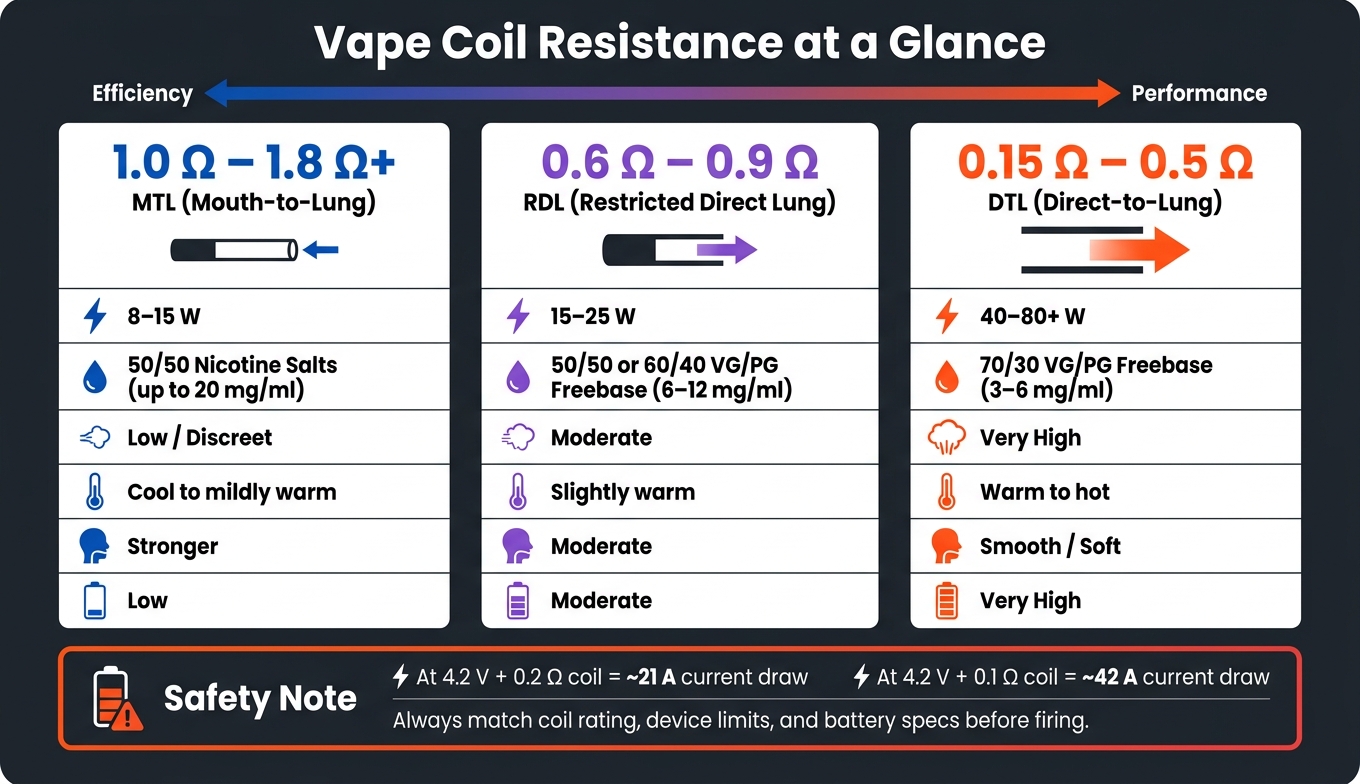
I’d also keep one safety point in mind: lower ohms mean more current draw. For example, at 4.2 V, a 0.2 Ω coil could draw about 21 A, while 0.1 Ω could hit about 42 A. That’s why checking coil rating, device limits, and battery strain matters before firing.
So if you want a simple rule, use this: match the coil to your draw style, your liquid, and your wattage range – then start low and move up in small steps.
Vape Coil Resistance Guide: MTL vs RDL vs DTL Comparison
Wotofo Guide To Vaping: Vape Ohm Laws & Safe Vaping!
sbb-itb-837e7ad
How Resistance Affects Flavour, Vapour, and Vaping Style
Once you know the resistance range, the next step is seeing how that changes the vape in actual use. It affects how warm the coil feels, how much vapour you get, how the flavour comes through, and what kind of inhale feels right.
Low Resistance for DTL Vaping
Low-resistance coils are built for DTL vaping. They produce warm, dense clouds with rich flavour, and that higher vapour output changes how you choose the right nicotine strength.
Because of that, these coils usually work best with high-VG freebase e-liquids (70/30 VG/PG) and 3–6 mg/mL nicotine. Go much higher on nicotine at this level, and the hit can feel too strong very fast.
Medium to High Resistance for RDL and MTL Vaping
RDL coils sit in the middle. They produce smaller, more discreet clouds at a moderate warmth, which makes them a good match for 50/50 or 60/40 VG/PG e-liquid and medium nicotine strengths like 6–12 mg/mL freebase or lower-strength nicotine salts.
MTL coils run cooler and produce much less vapour, but they usually give a stronger throat hit. That makes them well suited to 50/50 nicotine salt e-liquids at higher nicotine strengths. The thinner liquid also wicks well through the tighter coil, helping deliver a satisfying hit through the day.
| Resistance | Style | E-Liquid | Vapour | Warmth | Throat Hit | Battery and liquid use |
|---|---|---|---|---|---|---|
| 0.15–0.5 Ω | DTL | 70/30 VG/PG Freebase (3–6 mg/mL) | Very high | Warm to hot | Smooth / soft | Very high |
| 0.6–0.9 Ω | RDL | 50/50 or 60/40 (6–12 mg/mL) | Moderate | Slightly warm | Moderate | Moderate |
| 0.8–1.8 Ω+ | MTL | 50/50 Nicotine Salts | Low / discreet | Cool to mildly warm | Stronger | Low |
Performance vs. Efficiency: The Key Trade-Off
Resistance also affects how fast you get through battery charge and e-liquid. Lower resistance gives more output, more cloud, and more warmth. Higher resistance uses less power and less liquid.
Put simply: lower resistance leans toward performance, while higher resistance leans toward efficiency.
Safe Wattage, Device Limits, and Ohm’s Law Basics
Resistance gives you the starting point. Wattage decides how hard the coil runs. Push the wattage too high and you can scorch flavour, cut coil life short, and make the device run hotter than it should. So once you know the resistance, the next job is simple: match it to a safe wattage.
Start Low and Increase Wattage Slowly
Every coil comes with a recommended wattage range. Stay inside that range so the coil and wick can keep up. The safest move is to start at the bottom end, then edge upward in small steps.
For example, if you’re using a 0.2 Ω coil rated for 40–70 W, begin at around 40–45 W. Take a few pulls. If the vapour still feels too cool or the flavour seems muted, bump the wattage up a little and test again.
Here’s a rough guide to how resistance often lines up with wattage:
| Resistance | Wattage Range | Style |
|---|---|---|
| 1.2 Ω | 8–15 W | MTL |
| 0.8 Ω | 12–20 W | MTL / RDL |
| 0.6 Ω | 15–25 W | RDL |
| 0.4 Ω | 25–50 W | RDL / DTL |
| 0.2 Ω | 40–70 W | DTL |
| 0.15 Ω | 50–80+ W | DTL / cloud-chasing |
Ranges vary by coil design and manufacturer.
What Ohm’s Law Means in Practice
You don’t need to sit down and study the formula to use Ohm’s law well. What matters in day-to-day use is this: lower resistance means higher current draw, and higher current puts more strain on the battery.
At 80 W, a 0.2 Ω coil pulls much more current than a 0.8 Ω coil. That extra current means more heat in the battery and device, faster battery drain, and more wear on the cell over time. It’s a bit like pressing harder on a car’s accelerator; you’ll get more output, but you’ll also burn through fuel faster.
On a regulated mod, the chip handles the voltage side for you, so you only set the wattage. Even so, the battery still has to deliver the current. That’s why very low-resistance, high-wattage builds need high-drain cells.
A battery at 4.2 V across a 0.2 Ω coil could, in theory, draw about 21 A. Drop that to 0.1 Ω, and the draw climbs to roughly 42 A. That is beyond the continuous rating of many consumer 18650 or 21700 cells.
Checking Resistance Before You Vape
After fitting a new coil, check the resistance reading on the mod’s screen before you fire it. If the number jumps around or sits well outside the coil’s rated range, stop there and find the issue first.
With stock coils, an unstable reading often means one of two things:
- The coil isn’t seated properly
- The 510 connection needs cleaning
With rebuildable setups, the cause is usually a bit more hands-on. Loose post screws or a coil leg touching the deck are common culprits.
That quick resistance check only takes a few seconds, but it saves a lot of guesswork before the first pull. It matters even more with custom coils, where even small build changes can shift the resistance.
How to Choose the Right Coil Resistance
Knowing what resistance does to heat, vapour, and battery life is only part of it. The right pick also depends on how you like to draw, what e-liquid you use, and what your device can handle.
Match Resistance to Your Vaping Style
Start with the way you vape.
If you like a tight, cigarette-style draw, MTL is the better fit. If you want something a bit airier for daily use, RDL sits nicely in the middle. And if you prefer open airflow and bigger clouds, DTL is where low-resistance coils usually make more sense.
A lot of vapers end up using two setups for this reason: a small MTL pod for day-to-day use, and a DTL kit for evenings at home. It’s a simple way to get the best of both without forcing one setup to do everything.
Match Resistance to Your E-Liquid
Once you’ve picked your draw style, line up the coil with your e-liquid. This matters more than many people think, because liquid thickness and nicotine strength both affect how the vape feels.
High-VG freebase liquids usually work best with low-resistance sub-ohm coils in the 0.15 Ω–0.4 Ω range. These coils handle thicker liquid better and help cut down on dry hits.
Nicotine salts, up to Bahrain’s 20 mg/ml limit, tend to work best with coils at 1.0 Ω or above and at low wattage. Lower power keeps the vapour smoother and makes the throat hit easier to handle.
If you use a 50/50 PG/VG liquid, that sits in the middle. These liquids usually pair well with 0.6 Ω–1.0 Ω coils, which suits RDL or a looser MTL draw.
| E-Liquid Type | Ideal Resistance | Wattage Range |
|---|---|---|
| High-VG freebase (70/30+) | 0.15 Ω – 0.4 Ω | 40 – 80 W |
| 50/50 freebase | 0.6 Ω – 1.0 Ω | 15 – 30 W |
| Nicotine salts (up to 20 mg/ml) | 1.0 Ω – 1.4 Ω | 8 – 15 W |
Check Device Compatibility Before Buying Coils
Before you buy anything, choosing the best vape coils involves checking that the coil actually fits your device. This sounds obvious, but it trips people up all the time.
Pods and tanks are built for specific coil families. Use the wrong one, and you could end up with a bad fit, leaks, or a device that doesn’t read the resistance at all.
Before ordering, look at the device manual or the packaging and check:
- the exact compatible coil names
- the resistance options
- whether the coil’s wattage range fits within your mod’s output range
- whether the physical fit matches your pod or tank
A coil can look right on paper and still be wrong for the hardware, so this last check is worth the extra minute.
Custom Coils and Final Takeaways
What Changes Resistance in a Custom Build
With rebuildables, resistance comes from the coil you make. That means even small tweaks to the build can shift the final reading.
Four things decide where resistance ends up: wire material, wire gauge, coil inner diameter, and number of wraps.
Wire material matters even if the coil shape stays the same. Kanthal A1 is known for a steady, clean taste. Ni80 Nichrome usually ramps up faster and often reads lower in the same build. SS316L can read lower again.
Wire gauge is the other big control. A higher AWG number means thinner wire and more resistance. A lower AWG number means thicker wire and less resistance.
For MTL builds, 28–30 AWG with more wraps often lands around 0.8–1.5 Ω. For DTL, 22–26 AWG with fewer wraps usually falls around 0.15–0.4 Ω.
A few simple patterns help:
- More wraps = higher resistance
- Wider inner diameter = slightly higher resistance, because each wrap uses more wire
- Thicker wire = lower resistance
- Thinner wire = higher resistance
If you want to plan the build before cutting wire, tools like Steam Engine can map it out first. That saves time and helps you get closer to your target on the first go.
From there, match the resistance to your vaping style, then dial in the wattage on your mod.
Build-Check Steps on Regulated Mods
After the coil is installed, check the build before sending power through it. That step matters. A coil that looks fine at a glance can still shift, short, or read wrong.
1. Install the coil and secure the legs firmly under the posts.
Make sure the legs are clamped down well. A loose connection can throw off the reading and make the coil heat unevenly.
2. Confirm it is not touching the chamber walls, which would cause a short.
Give the coil a proper look from all sides. Even slight contact with the chamber can cause trouble fast.
3. Check the resistance reading on your mod before and after wicking; a changing reading means the build has shifted.
If the number moves around, something likely changed during setup. That’s a sign to stop and inspect the build again before firing.
4. Wick snugly, saturate fully, and wait 3–5 minutes before firing.
The wick should feel snug, not jammed in tight. Once it’s saturated, give it those 3–5 minutes so the liquid can soak through properly.
Start at the low end of the wattage range, then move up slowly until the vape feels right.
FAQs
How do I know which coil resistance suits me?
Match the coil resistance to the kind of inhale and vapour you want.
Choose coils above 1.0Ω if you like a tighter, cigarette-style mouth-to-lung draw, cooler vapour, and smaller, more discreet clouds.
If you want larger clouds, warmer vapour, and a more open direct-lung hit, go for sub-ohm coils (0.6Ω or less). You can also filter options by draw type at VapeShop.bh.
Can I use nic salts with a sub-ohm coil?
No. High-strength nicotine salts should not be used in a DTL sub-ohm tank.
Sub-ohm devices run at high wattage, usually 30W to 100W, and they turn a lot of e-liquid into vapour in a short time. That means using 20mg or 50mg salts in this kind of setup can hit far too hard. In many cases, it leads to strong throat irritation or nicotine sickness.
For the best results, use nic salts with higher-resistance coils above 0.8 ohms and lower-wattage devices.
Why is my coil resistance reading changing?
Changing coil resistance readings usually point to a weak connection between the pod or coil and the device.
First, make sure the pod is fitted in place properly. Then clean the pod base and the internal contacts to clear away any e-liquid residue or dirt. Gently wipe the battery contacts with a cotton swab as well.
If the reading still keeps changing after that, the coil is likely near the end of its life.
Related Blog Posts
- Best Wattage for MTL vs. DTL Vaping
- What Is Coil Resistance in Vaping?
- Sub-Ohm vs. High-Resistance Coils
- Checklist for Cloud Chasing Competitions
Frequently Asked Questions
Coil resistance is the coil’s ohm rating, and it affects how quickly the coil heats up, how much vapour it makes, and how the vape feels. Lower resistance usually gives a warmer, stronger draw, while higher resistance gives a cooler and tighter inhale.
Yes, sub-ohm coils are generally used for DTL vaping because they run at lower resistance and produce more vapour. They also tend to use more power, so the vape feels warmer and denser.
Higher resistance coils are usually better for MTL vaping because they run cooler and use less power. They create a tighter draw, which suits a more cigarette-like inhale.
Lower resistance coils need higher wattage, while higher resistance coils work at lower wattage. That also changes battery drain and e-liquid use, with low-ohm coils typically using more of both.
RDL usually sits between DTL and MTL, so it uses a mid-range coil resistance. In the guide, 0.6–0.9 Ω is shown as the balanced range for a warmer but not overly open vape.
Ohm's law helps show how resistance, voltage, and current work together in a vape. Since lower resistance can draw more current, checking the coil rating and device limits is an important part of vape safety.
Yes, coil building affects the final resistance, which changes heat, vapour output, and inhale style. Small changes in the build can shift the vape from cooler MTL to warmer DTL performance.