
Checklist for Cloud Chasing Competitions


If I want a steady competition run, I need five things in order: the right hardware, thick e-liquid, safe batteries, repeatable practice, and a last check before I step up.
This article boils cloud chasing prep down to the parts that matter most. It covers high-wattage mods around 150–230 W, low-resistance setups often below 0.2 Ω, high-VG liquid at 70%+ VG, and battery checks that matter even more in Bahrain’s summer heat, where outdoor temperatures can go above 40 °C.
Here’s the short version:
- I pick a setup that can handle 60–200 W without drifting.
- I check resistance with an ohm reader or multimeter, not just the mod screen.
- I use 70–100% VG e-liquid and keep nicotine low at 0–3 mg/ml.
- I inspect battery wraps, insulator rings, and heat exposure before every session.
- I practise the same inhale, wattage, airflow, and exhale each time.
- I pack spares: best vape coils, cotton, O-rings, batteries, tools, and 60–120 ml of e-liquid.
A few points stand out. Heat changes things. In Bahrain, a setup left in a parked car can get too hot before I even arrive. And in competition, consistency often scores better than a single messy big cloud.
So instead of guessing on the day, I treat this checklist as a simple run-through of what to pack, what to test, and what to avoid.
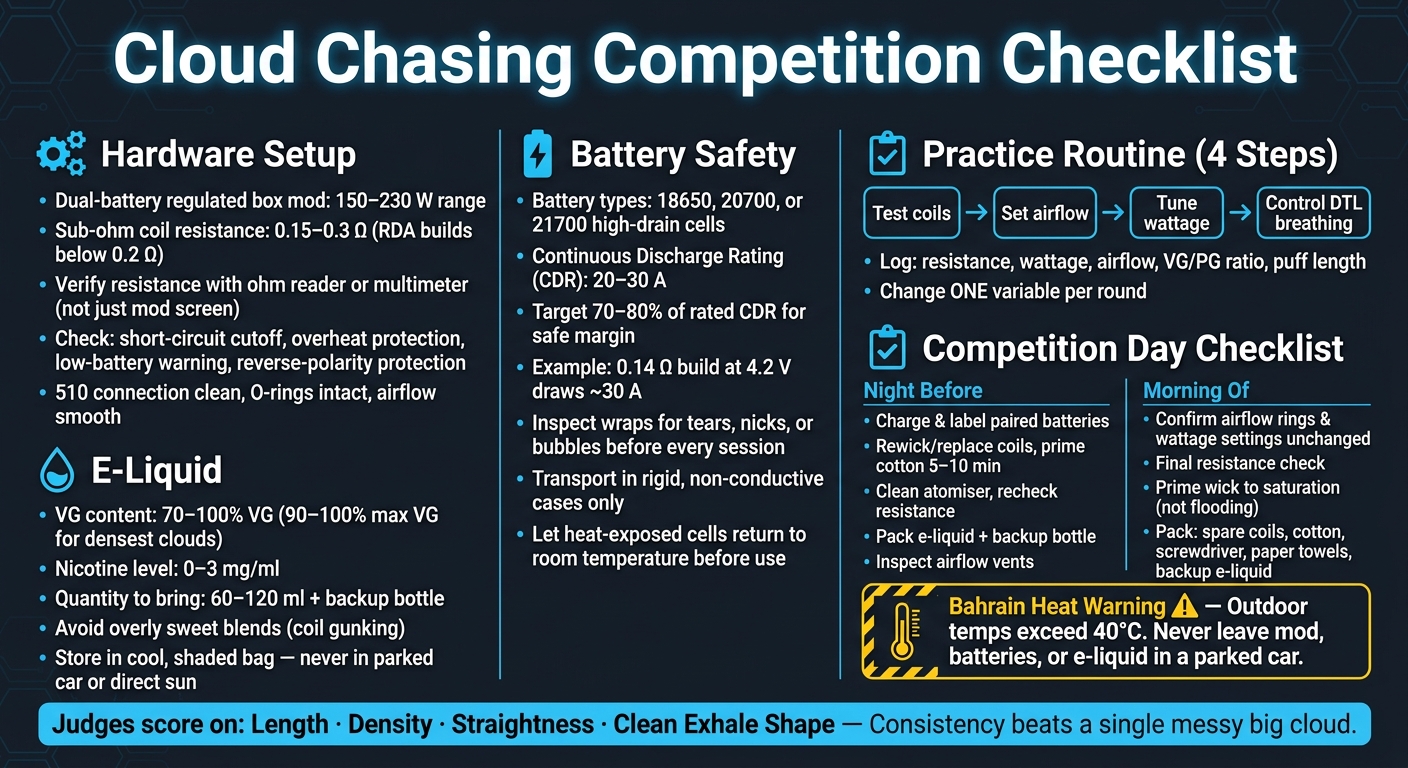
Cloud Chasing Competition Checklist: Gear, Safety & Settings
How To Blow Fat Clouds (Vape Comp Style)
sbb-itb-837e7ad
Hardware Checklist: Mods, Atomisers, Coils, and Tools
Start with the mod, then pair the atomiser, coils, and tools around it. Get everything packed and checked before competition day, not on the morning of the event.
Choosing the Right Mod for High-Wattage Use
A dual-battery regulated box mod in the 150–230 W range is the practical pick for most competitors. These devices tend to stay steady through repeated high-power draws.
Before competition, check that every safety feature is working as it should. That means short-circuit cutoff, overheat protection, low-battery warning, reverse-polarity protection, and an automatic cutoff for long draws. The display should clearly show individual cell voltages, live wattage, and any temperature warnings.
In Bahrain’s warm climate, heat handling matters more than many people think. A mod with solid thermal control and clear ventilation slots can make a big difference, especially if you’re moving between outdoor heat and a heavily air-conditioned venue.
Mechanical mods are for advanced users only. Use one only if you can work out current draw and keep it below battery CDR.
Once the power source is sorted, match the atomiser and coil build to it.
Matching Your Atomiser and Coil Build to Cloud Output
Sub-ohm tanks with factory coils in the 0.15–0.3 Ω range and RDAs with custom dual or triple coil builds can both work for competition.
Before the event, go over the full setup carefully. Check that coil posts and screws are tight, O-rings are in good shape, airflow moves smoothly and stays where you set it, and the 510 connection is clean with no e-liquid residue. For RDAs, make sure the juice well is deep enough for repeated pulls without leaking, and that the cotton is packed evenly without choking airflow.
Always verify coil resistance with an ohm reader or multimeter before firing – after mounting, after tightening screws, and again after any travel or adjustment. Don’t depend on the mod screen alone for this reading.
It also helps to pack spares now, while everything is in front of you. A loose screw, worn O-ring, or dead coil is a small issue at home and a big problem at the venue.
Spare Parts and Build Tools to Pack
A small spares kit can save your run. Pack:
- Spare coils or factory coil heads
- Enough cotton for several full re-wicks
- Replacement O-rings for the atomiser base, top cap, and drip tip
- One spare wide-bore drip tip
For tools, bring precision screwdrivers in Phillips and flathead, ceramic tweezers for adjusting coils while pulsing, flush cutters for trimming coil leads, sharp scissors for neat cotton cuts, and needle-nose pliers for stubborn screws or dropped parts. Add a cloth or tissues to wipe e-liquid from contacts and hands. Pack an ohm reader or a pocket multimeter too.
For batteries, carry cells in rigid battery cases so they can’t touch metal objects. Bring an external charger with independent bay control as well.
E-Liquid and Battery Safety Checklist
With the hardware packed, two things will shape how steady your setup feels: e-liquid thickness and battery safety margin.
Using High-VG E-Liquid for Dense Clouds
For competition use, go with 70%+ VG to keep vapour dense and steady. In practice, that means using e-liquid with at least 70% VG. If you want the thickest vapour possible, 90–100% max VG is the usual pick, but it needs stronger wicking to keep up.
Stick to 0–3 mg/ml nicotine and skip overly sweet blends, since they can gunk up coils.
Bring 60–120 ml with you in a cool, shaded bag. In Bahrain, that matters more than people think. Never leave bottles in a parked car or in direct sun.
When you wick, prime the cotton all the way through, wait 5–10 minutes, then bring the wattage up slowly.
Checking Battery Condition, Ratings, and Heat Exposure
Once the liquid is sorted, turn to the cells.
Use reputable high-drain 18650, 20700, or 21700 batteries rated at 20–30 A CDR. Stay away from rewrapped or unbranded cells. The number on the wrap can look fine, but under load, actual performance may tell a different story.
Before each competition session, check every cell by eye. A tear, nick, or bubble in the wrap, especially near the positive terminal, is a red flag. If you spot one, rewrap the battery or take it out of service. A damaged positive-end insulator ring is just as serious, more so in mechanical setups.
Use Ohm’s law to make sure your build stays inside safe limits. At 4.2 V, a 0.14 Ω build pulls about 30 A, so leave yourself some margin. A good rule is to aim for 70–80% of rated CDR.
Parked cars in Bahrain can get brutally hot, and that heat can push cells into a risky zone under load. Let them return to room temperature before use. For transport, keep cells in rigid, non-conductive cases only. Never carry loose batteries with keys or coins.
Practice and Competition-Day Checklist
Once the hardware and safety checks are done, the next job is consistency. Big clouds matter, sure. But on practice day and competition day, repeatable performance is what keeps your setup from falling apart when it counts.
Building a Simple Practice Routine
Keep practice simple. Focus on four steps: test coils, set airflow, tune wattage, and control DTL breathing.
Start each session in still air so you can watch how the clouds form and where they drift. That gives you a cleaner read on density and shape. Begin with a few deep breaths, then start at a safe low wattage and move up in small steps until the vapour becomes dense. After that, open the airflow to the widest draw that still keeps the vapour thick. End with breathing drills: steady DTL inhales followed by slow, controlled exhales.
Write down your resistance, wattage, airflow, VG/PG ratio, and puff length. Change one variable per round. If you change everything at once, you won’t know what actually helped.
Night-Before and Same-Day Checks
The night before, go through your setup calmly. No rushing, no guesswork.
- Charge batteries and label paired cells.
- Rewick or replace tired coils, then prime fresh cotton and let it sit for 5–10 minutes.
- Clean the atomiser, clear condensation, and recheck resistance before packing.
- Pack your competition e-liquid and a backup bottle.
- Inspect airflow vents for dust or lint so the draw stays clear.
On the morning of the event, check that your airflow rings and wattage settings are still where you left them. Travel can nudge adjustment rings out of place, and that tiny shift can throw off your run. Do one last resistance check to catch loose post screws, then prime the wick to saturation, not flooding.
It also helps to carry a small kit with you:
- Spare coils
- Cotton
- A screwdriver
- Paper towels
- A backup bottle of e-liquid
Reviewing Rules and Judging Criteria Before Your Turn
Before your turn, match your setup to the event rules.
Check whether the event allows regulated mods, mechanical mods, or both. Then confirm any limits on nicotine, coil type, or e-liquid mix. Getting disqualified because you missed one line in the rules is a rough way to lose.
Most cloud chasing events score on length, density, straightness, and clean exhale shape. That means a clean, steady exhale that holds its form will often score better than a huge cloud that looks messy on the way out. Set up your device for those points in particular. Also confirm attempt limits, time limits, and disqualification rules.
Conclusion: The Cloud Chasing Competition Checklist at a Glance
Preparation is what helps you show up ready for a cloud chasing competition. In simple terms, it comes down to five core checks: choose suitable hardware, use high-VG e-liquid, put battery safety first, practise often, and check every item before you leave.
Hardware and batteries carry most of the risk, so start there. A matched setup tends to be more consistent than one that’s pushed too far. Use batteries within their discharge rating, and retire any cell with damaged wraps, contacts, or signs of heat stress.
If you still need supplies, sort them before event day. VapeShop.bh supplies high-VG e-liquids, coils, and accessories with same-day delivery across Bahrain via WhatsApp.
FAQs
How do I choose a safe coil resistance?
Choose your coil resistance based on how you like to vape and what your device is built for. If you want a tight, cigarette-like draw, go for 1.0Ω or higher. 0.8Ω sits in the middle, giving you a good mix of flavour and cloud production. If you prefer higher wattage and a more intense, restricted direct-lung hit, 0.4Ω is the better fit.
Always check the manufacturer’s recommended wattage range for your specific coil.
What should I do if my batteries get hot?
Stop vaping at once and place the device in a cool area until the outer casing gets back to room temperature. If you can, remove the pod to help air move around it.
Heat build-up often happens because of chain vaping or hot weather. If the device stays hot even when it’s not in use, the battery may have a fault and should be checked. Don’t leave it in extreme heat, such as inside a parked car.
How can I make my clouds more consistent?
Use a device with a regulated chipset so power stays steady. Keep your airflow setting fixed too, as even small changes can affect vapour volume.
Clean the pod bay, mouthpiece, and connection points every day. When you fit a new coil, prime it for 5 to 10 minutes after filling. Then swap it out as soon as flavour starts to dull or vapour gets thin.
Related Blog Posts
- Beginner vs. Advanced Vapes: Which Is Right for You?
- How to Swap Vape Mod Panels Easily
- Advanced VG/PG Ratio Tips for Cloud Chasers
- How to Build Coils for Competitive Cloud Chasing
Frequently Asked Questions
A solid checklist starts with the right hardware, a thick e-liquid, safe batteries, repeatable practice, and a final pre-run check. For cloud chasing, the article also points to high-wattage mods, low-resistance setups, and spare parts like coils, cotton, O-rings, batteries, tools, and e-liquid. That keeps the run more consistent in Bahrain conditions.
The article recommends high-VG e-liquid, specifically blends in the 70%+ VG range, for thicker vapor. It also notes keeping nicotine low at 0–3 mg/ml for this type of setup. That combination is aimed at steady cloud production rather than harsh hits.
Battery safety starts with inspecting the wraps, insulator rings, and signs of heat exposure before every session. The checklist also says to avoid leaving a setup in a parked car, since Bahrain heat can raise temperatures fast. A quick visual check before use is part of the routine.
The article describes low-resistance setups often below 0.2 Ω, paired with high-wattage mods around 150–230 W. It also says to choose a setup that can handle 60–200 W without drifting. That is the kind of range used for competition-style cloud chasing.
The checklist focuses on hardware that can stay stable during a run, and regulated mods fit that kind of repeatable setup. It highlights keeping wattage consistent and checking resistance with an ohm reader or multimeter, not only the mod screen. That helps reduce surprises on stage.
The article says to practise the same inhale, wattage, airflow, and exhale each time. That repetition matters because consistency can score better than one big cloud. A set routine is the main idea behind the practice section.
The checklist warns that Bahrain outdoor temperatures can go above 40 °C, so heat can affect batteries and hardware before a session starts. It advises checking battery condition and avoiding extra heat exposure, especially if the setup was left in a car. That makes the last safety check more important.