
Bahrain Doctors vs Vape Advocates: Key Views


If I had to sum it up in one line: Bahrain’s vaping debate is about one trade-off – protecting young people while still allowing adult smokers access to regulated vape products.
Here’s the short version:
- Doctors focus on youth use, nicotine addiction, lung and heart risks, and the fact that long-term effects are still not fully known.
- Vape advocates and retailers focus on harm reduction for adult smokers, saying vaping may expose users to fewer harmful substances than cigarettes when smokers switch fully.
- Both sides agree on one point: vapes should not be sold to anyone under 18 in Bahrain.
- The main split is over flavours, nicotine strength, enforcement, and how strict the rules should be after the 18+ limit.
A few facts shape this debate:
- About 15% of adults in Bahrain smoke every day.
- Around 18% to 19% use tobacco.
- Reports have also pointed to 14-year-olds vaping, even though sales are limited to 18+.
- Bahrain already has rules under BH 2:2021, including nicotine limits, warning labels, and packaging rules.
So when I look at both sides, the picture is simple: one side says “be more careful”; the other says “keep it legal for adults, but police it hard.”
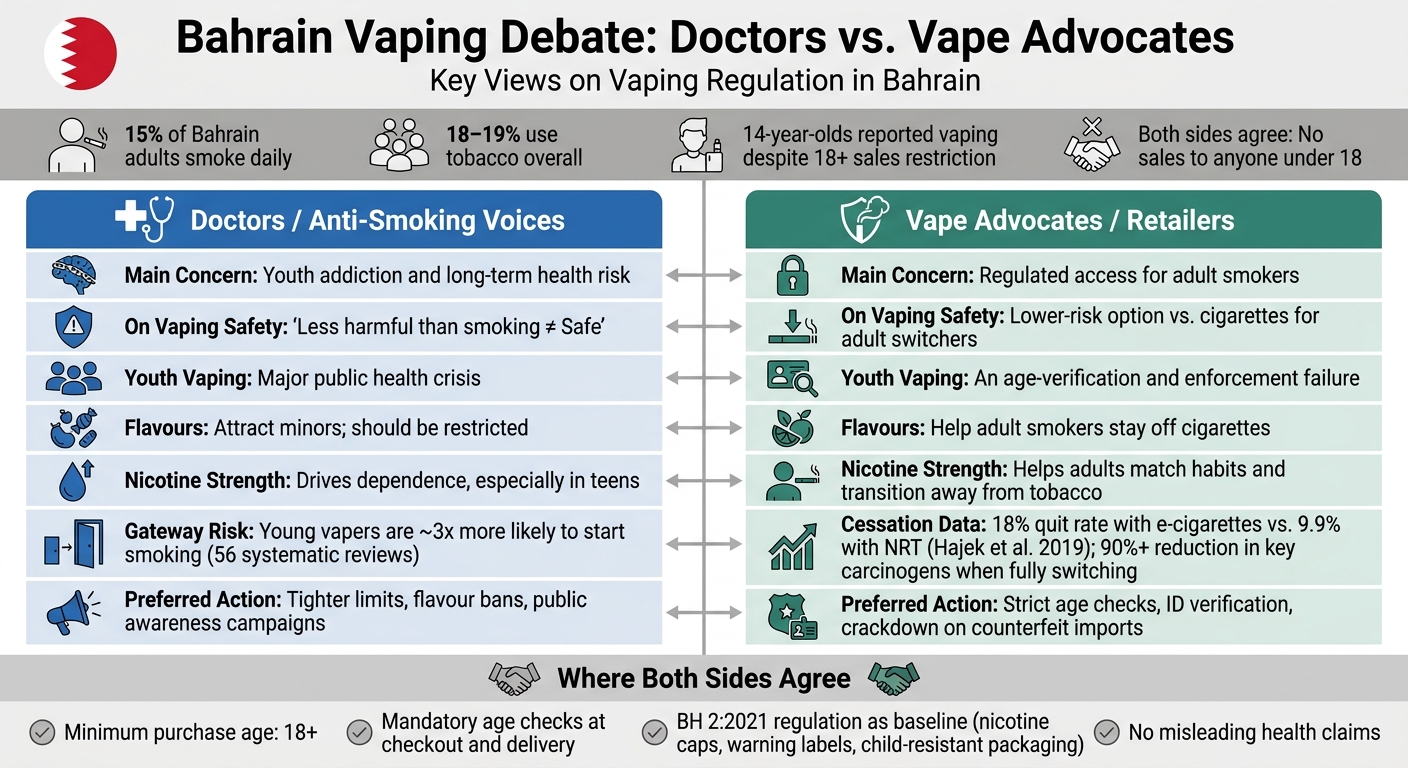
Bahrain Vaping Debate: Doctors vs Advocates – Key Views Compared
The Vaping Debate and Health: Evidence and Unknowns
For those following the legal developments, staying updated on the vaping laws and regulations in Bahrain provides necessary context for the ongoing debate.
sbb-itb-837e7ad
Quick Comparison
| Point | Doctors / Anti-Smoking Voices | Vape Advocates / Retailers |
|---|---|---|
| Main concern | Youth addiction and health risk | Adult smoker access |
| View on vaping | Vaping is less harmful than smoking but does not mean it is safe | May be a lower-risk option than cigarettes for some adults |
| Youth vaping | Big public health problem | A sales and enforcement failure |
| Flavours | Can attract minors | Can help adults stay off cigarettes |
| Nicotine strength | Can drive dependence, especially in teens | Helps adult smokers move away from cigarettes |
| Product safety | Long-term effects still unclear | Regulated products are better than informal supply |
| Preferred action | Tighter limits and public awareness | Strong age checks and rule enforcement |
If you’re reading this as an adult in Bahrain, that’s the core issue: how far the law should go to stop youth use without cutting off legal adult access.
Bahrain Doctors and Anti-Smoking Voices: Core Concerns
Bahraini doctors tend to draw a clear line here: vaping may be less harmful than smoking for some adults, but that does not make it safe, especially for younger people. Their main concerns are straightforward. Who is using these products? What does nicotine do to a brain and body that are still developing? And what are we still not seeing when it comes to long-term harm?
At the centre of the medical case is nicotine. Doctors point out that nicotine is highly addictive, and that some high-strength vapes and salt nicotine devices can deliver nicotine doses that match or even exceed cigarettes. For younger users, that matters a lot. Brain development continues into the mid-20s, which means adolescents are more open to dependence. Clinicians also connect vaping with respiratory irritation, lower lung function, and cardiovascular strain, while stressing that the long-term picture is still uncertain.
Youth Use, Addiction, and Gateway Risks
This is where concern gets sharper. When vaping reaches school-age users, doctors and anti-smoking voices in Bahrain see a serious public health issue. Health advocates say devices and e-liquids can still get to minors through informal routes, including adults supplying students. Add flavours and nicotine strengths and social media marketing to the mix, and vaping can start to look trendy instead of risky. That makes it easier for use to spread through friend groups.
Research adds weight to that concern. An umbrella review titled Vaping and harm in young people, which brought together 56 systematic reviews, found that young people who use e-cigarettes are approximately three times more likely to start smoking cigarettes than those who have never vaped. Across individual studies, the odds ratios ranged from 1.5 to 26. For Bahraini doctors, that is the key point: giving nicotine to young people who were not already smoking is not a harmless detour. It can increase the chance that cigarettes come next.
Calls for Stricter Rules and Public Awareness
For doctors, the 18+ rule and nicotine caps are only the starting point. They argue that enforcement has to be tighter at every stage, from shop counters to online checkouts. That includes mandatory age checks for in-person and online sales, plus actual penalties for anyone selling to minors.
They also call for campaigns aimed at parents, schools, and young people that explain nicotine addiction, brain development, and respiratory risks in plain language. Adult advocates and retailers look at the same evidence and come to a different view, saying regulated access still has a place for smokers who want to switch.
Adult Vape Advocates and Retailers: Harm Reduction and Regulated Access
Adult advocates say regulated vaping can cut exposure to toxic smoke by-products like tar, carbon monoxide, and many carcinogens for smokers who would otherwise keep smoking. Public Health England and the Royal College of Physicians have both said vaping carries only a small fraction of the risk of smoking. At the same time, advocates draw a clear line here: this argument is about existing adult smokers. It does not apply to non-smokers or young people.
Research often comes up at this point, and for good reason. A randomised controlled trial by Hajek et al. (2019) found one-year abstinence rates of 18% for smokers using e-cigarettes, compared with 9.9% for those using nicotine replacement therapy (NRT) such as patches or gum. A 2022 Cochrane Review also found that e-cigarettes are more effective than NRT for smoking cessation when used as a full substitute for cigarettes. Put simply, the evidence suggests e-cigarettes can help some adults quit smoking, especially when they replace cigarettes fully rather than partly.
Advocates then make a second point: this case falls apart if access is not kept tightly limited to adults.
Vaping as an Option for Adult Smokers
The harm-reduction case depends on substitution – replacing combustible tobacco with vapour. That’s the heart of it. Biomarker studies back this up, showing 90% or greater reductions in key tobacco-specific carcinogens, including NNAL and NNN, in adults who switch completely from smoking to vaping.
Bahrain’s technical regulation for e-cigarettes reflects that same boundary. It requires child-resistant packaging, an age-restriction symbol, and a warning that the product is "not for non-smokers."
Why Retailers Focus on Age Checks, Standards, and Convenience
For responsible retailers, age verification is not a box-ticking exercise. It is a basic legal step. That usually means:
- age-gate checks
- ID verification at checkout
- ID matching on delivery
Accepted documents include a Bahraini CPR/Civil ID, passport, or driving licence. Delivery drivers are trained to match the ID to the recipient and the order name, and to refuse delivery if anything does not line up.
Retailers also point to labelling rules as part of informed adult choice. These include nicotine strength, ingredients, batch codes, expiry dates, tamper-evident seals, and child-resistant packaging.
That brings the debate to the harder part: whether these controls do enough to keep products out of the hands of minors.
Youth Use and Product Safety: The Sharpest Points of Disagreement
The deepest split here comes down to flavours and product safety. Once both sides move past age checks, the argument gets narrower: flavours, nicotine strength, and what product labels can and can’t tell consumers.
Different Views on Protecting Young People
Doctors point to Arab university data showing that vaping is the most common tobacco product used, and they tie that pattern directly to concern about youth use in Bahrain. The WHO has also warned that sweet flavours and bright packaging are used to attract young people. From that angle, age checks on their own don’t go far enough.
Advocates see it differently. They argue that the answer is tighter age verification and stricter delivery checks, such as photo ID matching and refusal protocols, instead of broader limits that would also cut adult smokers off from products they may rely on.
So both sides reject youth vaping. That’s not the fight. The fight is over how far the rules should go after age limits are in place. Doctors want flavour limits because flavours can pull in minors. Advocates want to keep flavours available because those same flavours may help adult smokers stay away from cigarettes.
Different Views on Product Safety Information
That same divide shows up in how each side reads product information.
| Issue | Doctors / Anti-Smoking View | Vape Advocates / Retailer View |
|---|---|---|
| Youth risk | Flavours, high visibility, and social appeal can draw in minors | Youth access is mainly a failure of age verification and delivery checks |
| Nicotine strength | High-strength nicotine products can make dependence more likely, especially for adolescents | Strength options help adult smokers match their habits and transition away from cigarettes |
| Safety standards | Long-term inhalation effects are still uncertain, and aerosols can contain toxic substances | Regulated products with clear labelling and quality controls offer a better baseline than informal supply |
| Flavours | Flavours can make vaping more attractive to young people | Flavours help adult smokers avoid going back to tobacco |
| Enforcement | Tighter limits on marketing, visibility, and flavour availability | Stronger action against counterfeit imports and non-compliant sellers |
On safety, the two camps are not starting from the same place. Doctors focus on what still isn’t known. Long-term effects from inhaled aerosols are still not fully understood, and toxic substances can appear in e-cigarette vapour. Advocates focus on what Bahrain’s technical regulation already controls.
Both claims can sit side by side, and that’s part of why this argument doesn’t go away. Doctors tend to see the risk as similar across the market. Advocates draw a line between compliant stock and informal supply. This distinction often relies on consumers knowing how to select a trustworthy vape delivery service to ensure they receive regulated products.
That leads straight to the next issue: where the two sides still overlap, and where Bahrain should set the boundary for adult use.
Where Views Meet, Where They Split, and What It Means for Adults in Bahrain
Common Ground: Protecting Minors and Setting Clear Standards
There’s one clear area of agreement: vaping should not be sold to minors. Doctors, anti-smoking groups, and retailers all accept that the minimum purchase age is 18, that age checks must happen at checkout and on delivery, and that misleading claims should not be allowed.
BH 2:2021 is the shared starting point. It sets the nicotine cap, device limits, and mandatory health warnings. That part isn’t where the argument sits. The main split starts after that baseline, with one side asking for tighter limits and the other saying adults should still have room to choose within those rules.
Beyond that point, the two camps part ways on a simple issue: how much freedom adults in Bahrain should have.
Conclusion: The Central Trade-Off in Bahrain’s Vaping Debate
At its core, the debate comes down to risk and choice. Doctors and anti-smoking advocates put caution first. They point to WHO data showing that e-cigarette use among non-smoking youth increases conventional cigarette uptake by nearly three times, and they argue that e-cigarettes are not proven to help people quit smoking across the broader population.
Vape advocates and retailers see it differently. They argue that adult choice should still matter in a controlled market, and that Bahrain’s current standards – the nicotine cap, age checks, and labelling rules – already set a clear baseline.
That’s the trade-off adults in Bahrain are weighing under the current rules.
FAQs
What does BH 2:2021 regulate?
BH 2:2021 is Bahrain’s main technical rule for electronic nicotine products. In practice, it treats them much like regular tobacco products.
That means it sets the ground rules for:
- product composition
- safety
- labelling
- registration
- import
It also says the packaging must include health warnings, nicotine strength in mg/mL, total liquid volume in mL, and a list of ingredients in both Arabic and English.
On top of that, it bans commercial advertising, promotion, and sponsorship.
Why are flavours so controversial in Bahrain?
Flavours are a touchy issue in Bahrain for one main reason: they can appeal to younger people and encourage people to start using these products. Research in the country found that 35.7% of female users said flavour variety was a main reason they started vaping.
Authorities are also keeping a close eye on flavour-led packaging and bright designs. The concern is simple. Those visual cues can pull attention away from health warnings and make the product look less risky than it is.
Because of that, some flavour profiles – and the way products are presented – may face closer regulation.
Can vaping help adult smokers quit cigarettes?
Yes. For adult smokers, vaping can help replace cigarettes and support quitting. But there’s a catch: it tends to work best when the setup actually satisfies nicotine cravings.
In Bahrain, many users switch on day one, while others go through a short period of using both cigarettes and a vape. What often makes the difference is simple. You need the right device style and a legal nicotine strength, so cravings don’t pull you back to smoking.
Related Blog Posts
- Top 5 Factors Driving Vape Sales in Bahrain
- Vaping Market Size in Bahrain 2026
- How Bahrain Regulates Vape Ads
- Why Health Warnings Matter on Vape Products
{“@context”:”https://schema.org”,”@type”:”FAQPage”,”mainEntity”:[{“@type”:”Question”,”name”:”What does BH 2:2021 regulate?”,”acceptedAnswer”:{“@type”:”Answer”,”text”:”BH 2:2021 is Bahrain’s main technical rule for electronic nicotine products. In practice, it treats them much like regular tobacco products. That means it sets the ground rules for: product composition. safety. labelling. registration. import. It also says the packaging must include health warnings, nicotine strength in mg/mL, total liquid volume in mL, and a list of ingredients in both Arabic and English. On top of that, it bans commercial advertising, promotion, and sponsorship.”}},{“@type”:”Question”,”name”:”Why are flavours so controversial in Bahrain?”,”acceptedAnswer”:{“@type”:”Answer”,”text”:”Flavours are a touchy issue in Bahrain for one main reason: they can appeal to younger people and encourage people to start using these products. Research in the country found that 35.7% of female users said flavour variety was a main reason they started vaping. Authorities are also keeping a close eye on flavour-led packaging and bright designs. The concern is simple. Those visual cues can pull attention away from health warnings and make the product look less risky than it is. Because of that, some flavour profiles – and the way products are presented – may face closer regulation.”}},{“@type”:”Question”,”name”:”Can vaping help adult smokers quit cigarettes?”,”acceptedAnswer”:{“@type”:”Answer”,”text”:”Yes. For adult smokers, vaping can help replace cigarettes and support quitting. But there’s a catch: it tends to work best when the setup actually satisfies nicotine cravings. In Bahrain, many users switch on day one, while others go through a short period of using both cigarettes and a vape. What often makes the difference is simple. You need the right device style and a legal nicotine strength, so cravings don’t pull you back to smoking.”}}]}
Frequently Asked Questions
This guide explains that the core debate in Bahrain is about balancing youth protection with giving adult smokers access to regulated vape products under BH 2:2021. Doctors focus on youth use, nicotine addiction, and lung and heart risks, while vape advocates emphasize harm reduction for adults who fully switch from cigarettes to e-cigarettes.
According to the product content, doctors in Bahrain highlight concerns about teenagers using vapes, nicotine addiction, and potential lung and heart risks. They also stress that long-term effects of e-cigarettes are still not fully known, so they generally argue for being more careful with youth vaping and public health.
Vape advocates and retailers in this guide focus on harm reduction, arguing that vaping may expose adult smokers to fewer harmful substances than cigarettes if they switch completely. Their position is to keep regulated vape products legal for adults while enforcing age limits and rules strongly.
The product description notes that Bahrain already has rules under BH 2:2021, including nicotine limits, warning labels, and packaging regulations for vape products. These rules shape the debate by setting a legal framework around nicotine strength, how products look on shelves, and what information must be shown to consumers.
Both sides agree on the 18+ age limit, but they differ on how strictly flavours and nicotine strength should be controlled. Doctors worry that attractive vape flavours and higher nicotine levels can pull in young users, while advocates see flavours and regulated nicotine as tools that help adult smokers move away from traditional cigarettes.
The content states that about 15% of adults in Bahrain smoke every day and around 18–19% use tobacco overall. It also mentions reports of some 14-year-olds vaping despite sales being restricted to people aged 18 and above, which is a key concern for public health discussions.
Yes, the guide is clear that both doctors and vape advocates agree vapes should not be sold to anyone under 18. The main split comes after this age limit, with one side calling for stricter rules and the other focusing on keeping legal access for adults while improving enforcement against underage sales, including in areas like Manama.