

Battery Thermal Runaway: Study Summary For Vapers


If a vape battery gets hot fast, swells, leaks, hisses, smells like chemicals, or smokes, I treat it as dangerous and stop using it at once. That is the main point.
Here’s the short version: thermal runaway is a self-feeding heat failure inside a lithium-ion battery. Studies link it to electrical faults, physical damage, high heat, ageing, and hidden cell defects. In Bahrain, this matters more because a parked car can hit 72°C in about 25 minutes, while summer air can sit around 45°C.
What I’d want any vaper to know straight away:
- Warm is normal. Hot fast is not.
- A regulated mod can cut some electrical risks, but it cannot make a damaged battery safe.
- Loose cells in a pocket or bag can short against coins or keys.
- A torn wrap, dent, leak, or strange smell means stop using the cell.
- There is no one “safe temperature” for every lithium-ion battery.
A few plain vape safety tips from the research:
- Thermal runaway starts when a battery makes more heat than it can shed.
- One failed cell can heat nearby cells and make the problem spread.
- Damage inside a cell may start before the outside looks bad.
- Old or worn cells have less margin for error.
- Heat from storage, use, and charging can stack up.
What I’d do in practice:
- Keep devices and spare cells out of cars, direct sun, and hot rooms
- Charge with the correct cable and charger
- Put batteries on a hard, non-flammable surface while charging
- Carry spare cells only in a rigid battery case
- Retire cells that get hotter than usual, charge oddly, or lose power fast
| Risk area | What I watch for | What I do |
|---|---|---|
| Heat | Gets hot while idle, charging, or after light use | Stop use, move away from heat, do not recharge |
| Physical damage | Torn wrap, dent, crush mark, leak | Retire the cell |
| Charging | Wrong charger, soft surface, overnight charging | Use approved gear on a hard surface |
| Carrying spares | Loose battery near metal items | Use a battery case |
| Bahrain weather | Car heat, direct sun | Store in shade at room temperature |
So if I had to sum up the whole article in one line, it would be this: most battery trouble can be cut by using the right cell, checking it often, charging it properly, and keeping it away from heat.
Vape device battery goes thermal
sbb-itb-837e7ad
What starts the failure chain
Research puts the main starting points into four groups: electrical abuse, mechanical damage, thermal stress, and internal faults. Any one of them can create a hot spot or abnormal current flow inside the cell. Once that happens, the problem can snowball fast. Heat starts damaging internal materials, those materials begin to break down through heat-producing reactions, and the separator – the thin insulating layer that keeps the positive and negative electrodes apart – can shrink or fail. If the electrodes touch, an internal short can follow in very little time.
That matters because good device design can lower risk, but following vape battery safety practices is still essential.
Electrical, mechanical, thermal, and internal causes
Electrical problems are one common starting point. Overcharging can upset the cell’s chemistry and encourage lithium deposits that may later pierce the separator. Over-discharging – taking a cell below its safe minimum voltage – can also damage it and make the next charge risky. Too much current creates resistive heating inside the cell, and a short circuit from damaged wiring or contact with metal objects can force current down the wrong path.
Mechanical damage often looks less serious than it is. A dropped 18650 or 21700 cell, a dented casing, or a torn battery wrap may seem minor from the outside. Inside, though, the separator is thin and delicate. A crush, puncture, or hard impact can tear it and let the electrodes touch. That can create an internal short circuit straight away – or later, if the damaged layers move or wear down further. A new wrap won’t fix damage inside the cell.
Internal faults are the hardest to predict. Manufacturing defects, contamination, ageing, and needle-like lithium deposits called dendrites can all form without any clear sign on the outside. Dendrites can grow over repeated charge cycles and may eventually pierce the separator by themselves. In plain terms, a cell can fail even when it doesn’t look damaged.
| Cause type | What it means | Common vaping-related trigger | Why it matters |
|---|---|---|---|
| Electrical | Current or voltage is outside the cell’s safe operating range | Overcharging, over-discharging, excessive-current use, or a short circuit | Sustained heating can trigger internal failure and exothermic reactions. |
| Mechanical | Physical force damages the cell or its internal separator | Dropping, denting, puncturing, or carrying a loose battery near metal objects | Separator damage connects the electrodes, creating an internal short circuit. |
| Heat stress | The cell is exposed to excessive heat or cannot release heat effectively | Hot car, direct sun, or prolonged high-load use | Heat accelerates reactions and can cause separator shrinkage or collapse. |
| Internal | A defect or age-related change develops inside the cell | Manufacturing defect, contamination, ageing, or dendrite growth | Can cause an unexpected internal short circuit without obvious misuse. |
Why Bahrain‘s heat adds to battery risk
In Bahrain, heat makes all of these failure paths easier to trigger.
High ambient temperature is a recognised form of thermal stress. It speeds up internal chemical reactions and cuts the safety margin before damaging reactions begin. Parked cars are a major issue. Interior vehicle temperatures in Bahrain can reach 72°C within 25 minutes in summer, far above the ambient air temperature of 45°C that the country regularly experiences.
So if a battery sits in a hot car, then gets used or charged while already warm, it begins that session with less room for error. That’s why devices and spare cells should be kept out of hot cars, direct sun, and enclosed spaces.
That is why regulated mods and their protections matter.
How regulated mods lower battery risk
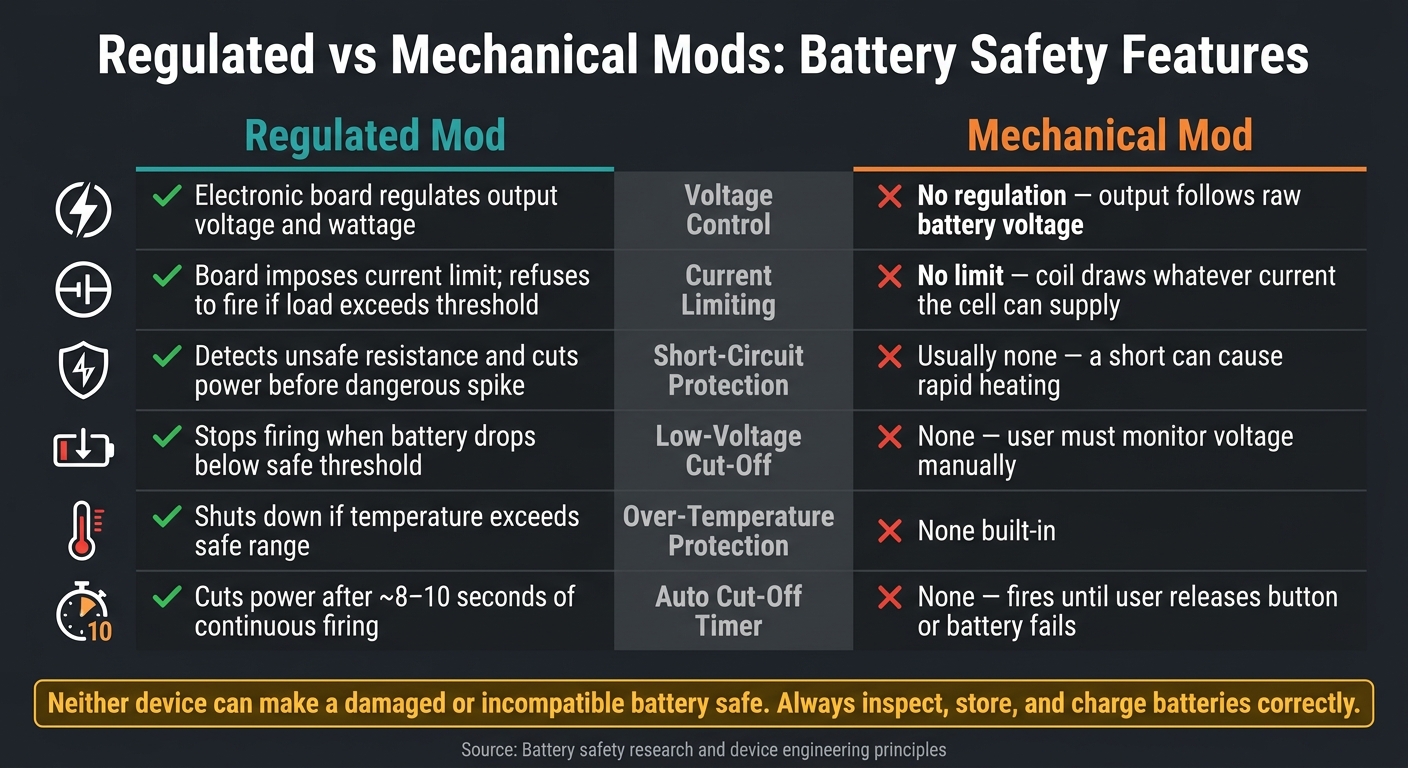
Regulated vs Mechanical Mods: Battery Safety Features Compared
Battery failure often starts with heat, short circuits, or physical damage. That’s why regulated mods place an electronic control board between the battery and the atomiser. The board checks battery conditions like voltage, current, and sometimes temperature. If something moves outside safer limits, it can stop the device from firing.
A mechanical mod doesn’t have that electronic layer. So the margin for error is much smaller. Safety comes down to the battery you pick, the coil resistance you build, and how carefully you handle the device.
Built-in protections in regulated devices
Most regulated mods come with protections for overcharge, over-discharge, short circuit, over-current, and over-temperature. They also usually include an auto cut-off after about 8 to 10 seconds.
Here’s how that stacks up against a mechanical device:
| Feature | Regulated mod | Unregulated mechanical device |
|---|---|---|
| Voltage control | Electronic circuitry regulates or limits output voltage and wattage | No regulation; output follows battery voltage directly and drops as the cell drains |
| Current limiting | Board imposes a current limit or refuses to fire when the load exceeds its programmed threshold | No automatic limit; the coil draws whatever current the cell can supply |
| Short-circuit protection | Detects a short or unsafe resistance and cuts power before a dangerous current spike | Usually none; a short can produce very high current and rapid heating |
| Low-voltage cut-off | Stops firing when battery voltage falls below a programmed threshold | None; the user must monitor voltage and stop at the right point |
| User responsibility | Still requires the correct, undamaged battery, safe charging, and proper use | Requires all battery safety basics plus a working knowledge of coil resistance and battery limits |
What these protections cannot do
These electronics can manage electrical faults. But they can’t fix a damaged battery or make an unsafe cell okay to use again. If the battery wrap is torn, the casing is dented, the cell has taken a hard knock, or there’s an internal short, the battery can still fail no matter what the board detects.
There’s another catch. A regulated mod still relies on the cell inside it. If that cell doesn’t have enough continuous-discharge rating for the power setting, it can overheat even when the device’s protections are switched on. In plain terms: battery size alone isn’t enough. You need the exact cell spec, not just the number on the wrapper or what a shop label says.
If the mod keeps showing a short-circuit error, a temperature warning, or a battery fault, stop using it straight away. Check the coil, the connections, and the battery, then follow the device manual.
Even with these built-in safeguards, storage, charging, and battery condition still matter. The board helps, but day-to-day handling is what makes the difference.
User habits that lower battery risk
Built-in protections help, but they don’t prevent every problem. They can’t fix rough handling, poor storage, or unsafe charging. Once you know what the mod can and can’t do, your day-to-day habits matter most.
Safe handling, storage, and charging
Always use the battery type, size, polarity, and discharge rating listed by the device maker. A cell may fit and still be the wrong choice for that device.
Before each use, give the battery a quick check. Look for tears in the wrap, lifted edges, or burn marks. Check both terminals too, especially for dents or corrosion. If the wrap is torn, stop using the cell and replace it. That’s a serious hazard.
Heat is another common problem. Never leave a vape or spare cell in a parked car or in direct sun. Store batteries in a cool, dry, shaded place at room temperature. And when you’re carrying spare cells, use a rigid battery case every time. Don’t toss them loose into a pocket or bag with coins or keys. Metal contact can cause an external short circuit, and this mechanism has been identified in vaping-related burn cases.
When it’s time to charge, stick to the manufacturer-approved cable and charger. Place the device on a hard, non-flammable surface where you can see it. Beds, sofas, and other soft surfaces hold heat, which is the last thing you want during charging. Unplug the device when charging is done, and if the battery feels hot, let it cool before charging it again.
When to stop using a battery or device
Careful use helps, but it won’t save a cell that’s starting to fail. Stop using and retire cells that:
- fire inconsistently
- lose capacity fast
- take longer than usual to charge
- run hotter than usual
Even if the wrapper still looks fine, the cell may not be. Repeated charge cycles, high operating temperatures, and deep discharges all chip away at its safety margin. And if a lithium-ion cell is damaged, don’t throw it in household rubbish. Use a proper battery recycling or hazardous-waste route instead.
Checking compatibility before you buy
Battery safety starts before first use. Buy the exact cell and charger the device was made for. Compatibility isn’t a nice extra; it’s a safety check.
Check the exact device model and the maker’s ratings before you buy. That includes discharge rating, battery size, charger voltage and current, and the permitted coil resistance range. Getting one of those wrong can turn a normal setup into a risky one.
| Situation | Lower-risk practice | Higher-risk practice |
|---|---|---|
| Carrying a spare cell | Rigid battery case | Loose in a pocket with keys or coins |
| Charging | Approved equipment on a hard, visible, non-flammable surface | Unapproved charger on a bed or sofa, or left unattended overnight |
| Storage | Cool, dry, shaded place away from direct sun | Parked car or direct sunlight |
What the studies show: key takeaways
Findings with strong evidence behind them
Set against that practical background, the studies land on a few plain takeaways.
The research backs the same failure chain described above: once heat builds faster than the cell can get rid of it, danger climbs fast. Recent reviews show the same pattern. Thermal runaway starts when a cell generates heat faster than it can shed it, and that process can then keep feeding itself.
Reviews also keep pointing to five main trigger groups: electrical abuse, mechanical damage, thermal stress, ageing, and internal faults. These triggers can overlap. For instance, impact damage can lead to an internal short, which then causes sharp local heating. One point matters a lot: a cell can seem normal on the outside while a fault is already forming inside. In Bahrain, hot storage cuts that safety buffer even further.
In day-to-day use, this comes down to a handful of plain safety rules.
| Finding | Source type | Confidence | Practical implication for vapers |
|---|---|---|---|
| Thermal runaway begins when heat generation exceeds heat dissipation and becomes self-sustaining | Recent peer-reviewed reviews and modelling research | High | Treat rapid heating, swelling, hissing, or smoke as a serious warning. |
| Electrical abuse, mechanical damage, thermal stress, ageing, and internal faults can initiate failure | Peer-reviewed reviews and incident-focused safety research | High | Avoid overcharging, shorts, impacts, hot cars, and old or damaged cells. |
| Mechanical damage can create an internal short circuit and rapid local heating | Battery safety reviews | High | Never use a crushed, punctured, dented, or unwrapped cell. |
| Ageing can reduce the safety margin before runaway | Fire-safety and ageing research reviews | Moderate to high | Retire cells that have visibly aged or lost performance. |
| Regulated protections can limit some overcharge, over-discharge, short-circuit, over-temperature, timeout, and current-limit conditions | Device engineering principles and battery safety literature | Moderate | Use a regulated mod, but do not trust it to make a damaged battery safe. |
| Surface temperature may not reveal an internal fault early enough | Recent thermal runaway review | Moderate to high | Do not rely on the outside of the cell; internal faults can be hidden. |
What readers should and should not conclude
The studies support prevention, not guesswork.
They support a simple point: avoiding damaged cells, unsafe charging, overheating, short circuits, and mismatched equipment can materially cut risk.
What they do not support is the idea that one wattage, one brand, one model, or one temperature is safe in every case. Thermal runaway depends on cell chemistry, state of charge, age, internal condition, enclosure, ventilation, charging conditions, and ambient temperature. Published critical temperatures vary a lot by cell type, so there isn’t one universal number you can lean on.
If a battery gets unusually hot, swells, vents, hisses, gives off a strong smell, or produces smoke, leave the area and keep other people away. Do not open it, puncture it, or carry on charging a suspect cell.
Key points to carry forward:
- Thermal runaway is self-sustaining heat build-up.
- Triggers include electrical abuse, damage, heat, ageing, and internal faults.
- Prevention depends on compatible equipment, inspection, safe charging, and cool storage.
FAQs
Can a battery fail without visible damage?
Yes. A battery can stop being safe even when the outside looks perfectly fine.
A drop or hard knock can damage parts inside the battery, even if the casing has no dents or cracks. On top of that, problems like gas build-up or chemical breakdown can begin before you see swelling or leakage.
Some warning signs are hard to miss:
- Unusual heat
- A sharp chemical smell
- Hissing sounds
- Unpredictable behaviour, such as auto-firing
If any of this happens, stop using the device immediately and move it to a safe, non-flammable place.
How do I know if my battery is too old to trust?
Stop using it if you notice damage like swelling, cracks, leaking fluid, or – on external batteries – a torn plastic wrap.
Other signs to watch for include unusual heat, a sharp chemical smell, much faster draining than when it was new, or a battery life drop of 30% or more. If these performance issues keep happening, replace the battery.
What should I do if a vape battery starts hissing or smoking?
If your vape starts hissing or giving off smoke, stop using it straight away. Put it on a non-flammable surface, like a tile floor or metal tray, and keep it well away from anything that can catch fire. Don’t put it back in your pocket or bag.
If the device feels hot, leave it alone until it cools down fully. If the hissing or smoking carries on, or you spot swelling, leaking, or a chemical smell, don’t try to fix it yourself. Retire the device and contact a professional waste management service.
Related Blog Posts
- Why Build Quality Matters in Vaping
- Vape Battery Storage Guide: Heat, Charge, Cases
- Vape Charging Safety: 8 Rules to Follow
- How to Store Vape Batteries at Home Safely
{“@context”:”https://schema.org”,”@type”:”FAQPage”,”mainEntity”:[{“@type”:”Question”,”name”:”Can a battery fail without visible damage?”,”acceptedAnswer”:{“@type”:”Answer”,”text”:”Yes. A battery can stop being safe even when the outside looks perfectly fine. A drop or hard knock can damage parts inside the battery, even if the casing has no dents or cracks. On top of that, problems like gas build-up or chemical breakdown can begin before you see swelling or leakage. Some warning signs are hard to miss: Unusual heat. A sharp chemical smell. Hissing sounds. Unpredictable behaviour, such as auto-firing. If any of this happens, stop using the device immediately and move it to a safe, non-flammable place.”}},{“@type”:”Question”,”name”:”How do I know if my battery is too old to trust?”,”acceptedAnswer”:{“@type”:”Answer”,”text”:”Stop using it if you notice damage like swelling, cracks, leaking fluid, or – on external batteries – a torn plastic wrap. Other signs to watch for include unusual heat, a sharp chemical smell, much faster draining than when it was new, or a battery life drop of 30% or more. If these performance issues keep happening, replace the battery.”}},{“@type”:”Question”,”name”:”What should I do if a vape battery starts hissing or smoking?”,”acceptedAnswer”:{“@type”:”Answer”,”text”:”If your vape starts hissing or giving off smoke, stop using it straight away. Put it on a non-flammable surface, like a tile floor or metal tray, and keep it well away from anything that can catch fire. Don’t put it back in your pocket or bag. If the device feels hot, leave it alone until it cools down fully. If the hissing or smoking carries on, or you spot swelling, leaking, or a chemical smell, don’t try to fix it yourself. Retire the device and contact a professional waste management service.”}}]}
Frequently Asked Questions
Thermal runaway is a self-feeding heat failure inside a lithium-ion battery, where the battery produces more heat than it can shed. Electrical faults, physical damage, high heat, ageing, and hidden cell defects can contribute to it.
Stop using the battery immediately if it gets hot fast, swells, leaks, hisses, smells like chemicals, or produces smoke. A torn wrap, dent, or unusual heat also means the cell should be retired rather than charged or used.
Keep the device and spare cells away from parked cars, direct sun, and hot rooms, since Bahrain heat can increase battery risk. Carry loose cells in a rigid battery case instead of a pocket or bag where coins or keys could cause a short.
A regulated mod can reduce some electrical risks, but it cannot make a damaged battery safe. Cells with a torn wrap, dent, leak, rapid heating, or unusual smell should not be used in any device.
Use the correct cable and charger, and charge the battery on a hard, non-flammable surface. If it becomes unusually hot, swells, leaks, hisses, or smells like chemicals, stop charging and stop using it.
Handle lithium-ion batteries carefully and inspect them for torn wraps, dents, leaks, swelling, or other damage before use. Spare cells should be kept in a rigid battery case and never loose with keys, coins, or other metal objects.
No. A parked car can become extremely hot, and heat from storage, use, and charging can stack up inside a lithium-ion battery. Keep the vape and spare cells out of cars and direct sunlight.