
Study Summary: Global Vaping and Bahrain


Here’s the short answer: global vaping data helps with context, but it does not tell me Bahrain’s vaping rate. The clearest points are simple: WHO put global adult current use at 1.9% and youth current use at 7.2%, Bahrain has legal rules under BH 2:2021, and local Bahrain market insights are still limited.
If I strip the article down to what matters most, I get this:
- Global use is higher among youth than adults
- Bahrain’s local data is thin and mostly sample-based
- Retail listings show supply, not population use
- Flavour and device trends hint at demand, not market share
- Rules in Bahrain affect what can be imported and sold
- The biggest gap is current national data for adults and youth
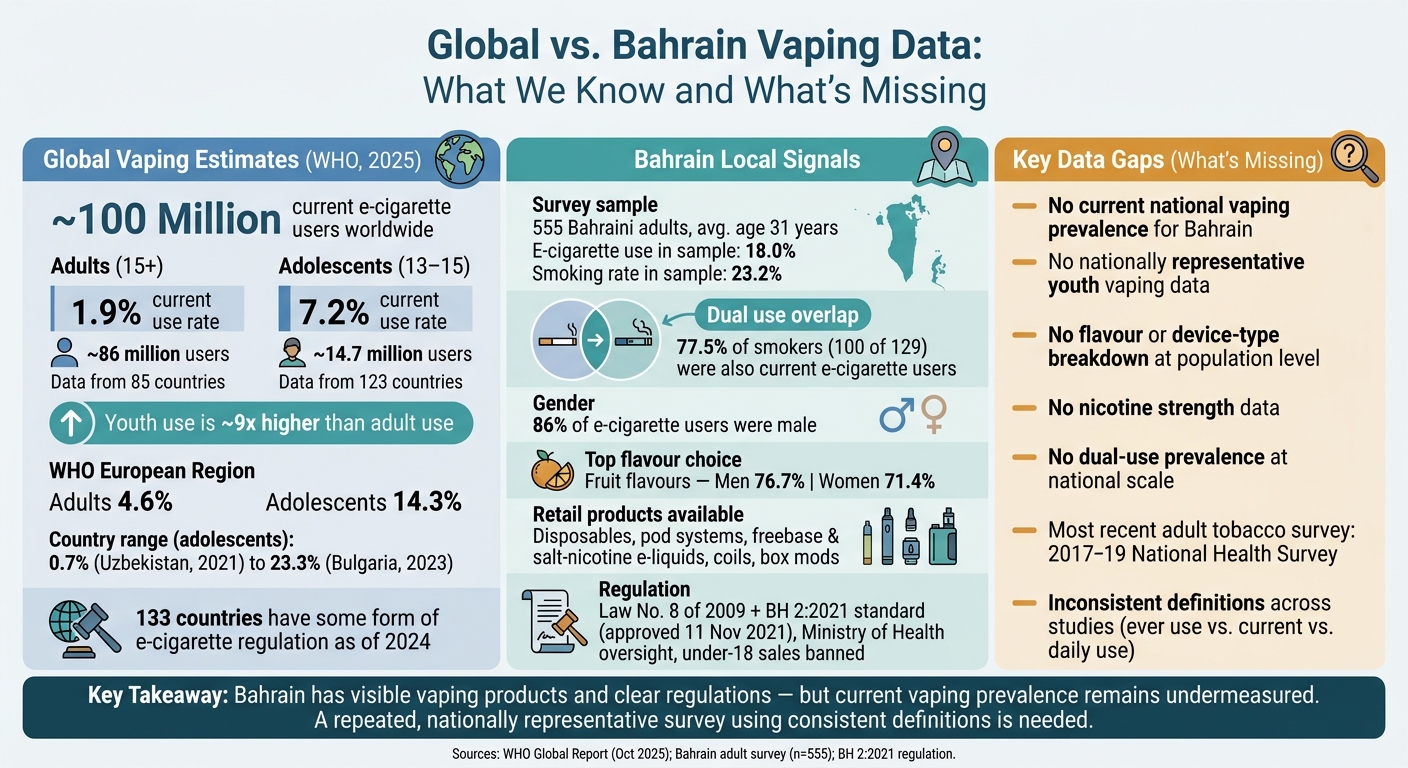
One Bahrain sample of 555 adults found 18.0% e-cigarette use and 23.2% smoking, with heavy overlap between the two. But that is not a national rate. It is just one sample. At the same time, local retail listings show a market that includes disposables, pods, e-liquids, coils, and mods. That tells me products are available, but not how common vaping is across Bahrain.
Global vs. Bahrain Vaping Data: What We Know and What’s Missing
Study finds vaping rising among youth as smoking declines
sbb-itb-837e7ad
Quick comparison
| Area | What the article shows | What it does not show |
|---|---|---|
| Global data | Broad context, including WHO estimates | Bahrain-specific rates |
| Bahrain survey | A local adult sample and behaviour signals | National prevalence |
| Retail listings | Product range and supply signals | Sales share or user numbers |
| Regulation | Legal supply rules and age limits | How many people vape |
So my takeaway is clear: Bahrain has visible vaping products from local brands and clear rules, but current use is still undermeasured. If I want a firmer picture, I’d need newer national survey data with the same definitions used each time.
Global Vaping Patterns in Recent Research
Adult and Youth Use in Global Estimates
The WHO’s first global estimate of e-cigarette use, published in October 2025, put the worldwide total at about 100 million current users. That includes about 86 million adults aged 15 and older and 14.7–15 million adolescents aged 13–15.
These numbers come from population-based surveys across 85 countries for adults and school-based data across 123 countries for adolescents, using the latest national and school survey data available to WHO. So this is a global snapshot built from many local datasets, not one single survey.
One point stands out straight away: youth use was much higher than adult use in comparable datasets. On average, adolescent current use was about nine times adult use. That doesn’t mean every country follows the same pattern, but it does show how far apart the two rates can be.
The table below sums up the main global figures.
| Population | Measure | Geography | Latest year used | Source type |
|---|---|---|---|---|
| Adults aged 15+ | Current e-cigarette use; 1.9% overall; ~86 million users | Global; surveys from 85 countries | Latest available country data used by WHO | WHO global report |
| Adolescents aged 13–15 | Current e-cigarette use; 7.2% overall; ~14.7 million users | Global; school-based data from 123 countries | Latest available country data used by WHO | WHO global report |
These figures give a sense of scale. But they don’t tell you what is happening in the Bahrain vape market, or how local buyers are behaving.
Differences by Country and Income Group
Adult e-cigarette use is concentrated mainly in high-income countries, according to WHO’s estimate. That likely reflects earlier product launch, better survey coverage, and easier product access, not just stronger demand.
In the WHO European Region, both adult and youth rates were above the global average. Adult prevalence reached 4.6%, while adolescent prevalence was 14.3%.
At country level, the spread is much bigger. Among adolescents aged 13–15, current use ranged from 0.7% in Uzbekistan in 2021 to 23.3% in Bulgaria in 2023. That’s a huge gap. And it doesn’t happen by chance.
A few factors can shape those differences:
- how developed the market is
- the rules in each country
- smoking history
- local norms
- survey timing
As of 2024, 133 countries had some form of regulation for electronic nicotine-delivery systems. But the rules differ a lot from one market to another, and that affects what surveys pick up. That’s why Bahrain’s local evidence can’t just be read through the lens of global averages.
These global patterns help frame the picture, but Bahrain still needs to be assessed on its own terms, using its own top e-cigarette brands and consumer signals.
Bahrain’s Consumer and Product Signals
Local evidence in Bahrain is thin, so the clearest clues come from a small adult survey and what retailers list for sale.
What Local Surveys Say About Adult Behaviour
The main local data point comes from a questionnaire study of 555 Bahraini adults with an average age of 31 years. Women made up 66.8% of the sample. The study found that 18.0% of respondents used e-cigarettes and 23.2% were smokers. These are sample findings, not national prevalence estimates, which is why product availability helps as a second signal.
Smoking and vaping overlapped in a big way. Of the 129 smokers in the sample, 100 – or 77.5% – were current e-cigarette users. Put simply, vaping in this group looked closely tied to smoking, not like a separate behaviour pattern.
Men made up 86% of e-cigarette users, but the study did not find a statistically significant sex difference in e-cigarette use. Many respondents also said they heard about e-cigarettes through family and friends. That points to close social circles as a key route for information and influence.
Product Formats Shaping Demand in Bahrain
Retail listings in Bahrain – including those on VapeShop.bh – show a broad product mix: disposable vapes, pod systems, freebase and salt-nicotine e-liquids, replacement pods and coils, box mods, and accessories.
That matters because it shows room for both ends of the market. On one side, you have convenience-led options like disposables. On the other, there are more custom setups like refillable pods and advanced mods. It’s a market signal, not proof of sales share or how many people use each type.
Flavour Interest as a Market Signal, Not a Prevalence Measure
Flavours add another clue. In the survey sample, fruit flavours were the top purchase choice for both men and women, at 76.7% and 71.4%. Again, that reflects sample preference, not population-level prevalence.
Retail flavour ranges tell a different part of the story. They show what sellers decide to stock, not what the full market prefers. Taken together, the survey and retail data point to demand signals, but they do not show market share.
Regulation in Bahrain and Possible Market Effects
Key Bahrain Rules and Technical Standards
These consumer signals sit inside Bahrain’s tobacco-control framework. And that framework shapes what can be imported, sold, and documented.
Bahrain’s rulebook for electronic nicotine products is built on Law No. 8 of 2009 on Combating Smoking and All Types of Tobacco. This law restricts unauthorised tobacco products, requires shipments to be inspected before entry and circulation, and bans sales to anyone under 18 years of age.
BH 2:2021 – Electronic Nicotine Products (Equivalents of Traditional Tobacco Products) was approved on 11 November 2021. It sets the technical and conformity requirements for the legal supply of electronic nicotine products. In plain terms, that can reduce the pool of compliant products and add more paperwork for importers and sellers. Official restricted-products guidance lists e-nicotine products as subject to the BH 2:2021 conformity form issued by the Ministry of Health. So not every product marketed online or brought in through private import will meet the rule.
GSO 2805:2025 points to continued Gulf-level standardisation for vaping-related liquids and products. But based on the sources here, its Bahrain status compared with BH 2:2021 is still not confirmed.
That can affect a few practical areas:
- product supply
- age checks
- import clearance and delivery
This matters because rules can shape what reaches the market without showing how many people actually vape.
What the Rules Do and Do Not Show
Knowing the rules helps. But it’s easy to stretch the meaning too far.
Regulation shows the formal conditions for legal supply: which products need conformity paperwork, which shipments face inspection, and what age limits apply. What it does not show is how many adults in Bahrain actually vape, or how often they do so.
Legal availability is not the same as prevalence. Retail listings, including those on VapeShop.bh, show that there is documented commercial supply. But they do not measure how common use is across the population.
To track behavioural change, you’d need before-and-after survey data or official market records.
Interpretation, Limitations, and Conclusion
What the Current Evidence Supports
Taken together, the evidence shows a global pattern that affects Bahrain’s market, but it does not tell us Bahrain’s vaping prevalence.
Three points stand out. First, vaping is still a major policy issue across the world, and youth use is especially high. For Bahrain, that matters mostly because global patterns shape product demand and regulation. Second, youth vaping is a clear concern across countries with available data, with adolescents much more likely to vape than adults. Third, Bahrain already has a defined regulatory framework under Ministry of Health oversight.
What the evidence does not support is using those global figures as a direct measure of Bahrain’s position. Global estimates combine countries with different income levels, rules, product access, and research methods. So if someone tries to treat a global number as Bahrain’s number, that’s a stretch. A Bahrain-specific conclusion needs Bahrain-specific data.
Main Gaps and Data to Watch
The main issue is not whether vaping exists in Bahrain. It is how little current data show who is vaping, what they use, and how often.
The biggest gap is the absence of up-to-date national vaping data for Bahrain. Bahrain’s WHO country profile cites the 2017–19 National Health Survey as the main adult tobacco-use source. That survey gives useful background, but it may not reflect recent shifts in vaping products or the rise of disposable devices.
There is also a problem with inconsistent definitions. Studies often use different meanings for ever use, current use, daily use, exclusive vaping, and dual use. That may sound like a small technical detail, but it changes the picture a lot. A reported "vaping rate" can mix one-time experimentation with regular use, which makes year-to-year or country-to-country comparisons shaky. Local market signals, such as product listings and reported demand, are better read as signs of commercial interest, not as proof of population prevalence.
The clearest gaps are:
- Current Bahrain prevalence
- Youth data
- Flavour breakdowns
- Device type
- Nicotine strength
- Dual use
Future Bahrain studies would gain the most from a repeated, nationally representative survey that covers both adults and adolescents. That survey should use the same definitions across each fieldwork round and report sample size, response rate, and confidence intervals. Until that data is available, the safest reading is simple: Bahrain has clear market signals and clear rules, but current vaping prevalence is still undermeasured.
FAQs
Why can’t global vaping figures show Bahrain’s rate?
Pinning down Bahrain’s exact vaping rate isn’t easy. In many reports, the country’s numbers are folded into broader MEA or GCC data instead of being shown on their own.
Because Bahrain is a smaller market, analysts often look at it through regional estimates and global growth patterns. That means standalone national vaping figures are rarely published in international reports.
What Bahrain data is still missing?
Bahrain still lacks detailed, real-time consumer data beyond broad usage figures.
The main gaps are pretty clear. There isn’t enough local data on long-term shifts in brand loyalty, and the exact effect of health campaigns on quitting versus first-time uptake is still hard to pin down.
More local, high-frequency data is also needed on how neighbourhood demographics in Manama, Riffa, and Muharraq respond to different product categories. That kind of detail would help support better planning.
Do Bahrain retail listings show how many people vape?
No. Retail listings do not show the exact number of people who vape in Bahrain.
What they do show is sales and distribution movement. For example, physical outlets account for a 54.9% market share. That tells you where products are being sold, not how many individual users there are.
To estimate vaping prevalence, you need demographic research. One example is the 21.2% rate among university students reported in study data. That kind of figure points to user prevalence in a specific group.
Retailers such as VapeShop.bh may look at market signals to plan stock and decide what to keep on shelves. But retail listings are not a measure of total users in Bahrain.
Related Blog Posts
- Top 5 Factors Driving Vape Sales in Bahrain
- Vaping Market Size in Bahrain 2026
- Why Health Warnings Matter on Vape Products
- Bahrain Doctors vs Vape Advocates: Key Views
{“@context”:”https://schema.org”,”@type”:”FAQPage”,”mainEntity”:[{“@type”:”Question”,”name”:”Why can’t global vaping figures show Bahrain’s rate?”,”acceptedAnswer”:{“@type”:”Answer”,”text”:”Pinning down Bahrain’s exact vaping rate isn’t easy. In many reports, the country’s numbers are folded into broader MEA or GCC data instead of being shown on their own. Because Bahrain is a smaller market, analysts often look at it through regional estimates and global growth patterns. That means standalone national vaping figures are rarely published in international reports.”}},{“@type”:”Question”,”name”:”What Bahrain data is still missing?”,”acceptedAnswer”:{“@type”:”Answer”,”text”:”Bahrain still lacks detailed, real-time consumer data beyond broad usage figures. The main gaps are pretty clear. There isn’t enough local data on long-term shifts in brand loyalty, and the exact effect of health campaigns on quitting versus first-time uptake is still hard to pin down. More local, high-frequency data is also needed on how neighbourhood demographics in Manama, Riffa, and Muharraq respond to different product categories. That kind of detail would help support better planning.”}},{“@type”:”Question”,”name”:”Do Bahrain retail listings show how many people vape?”,”acceptedAnswer”:{“@type”:”Answer”,”text”:”No. Retail listings do not show the exact number of people who vape in Bahrain. What they do show is sales and distribution movement. For example, physical outlets account for a 54.9% market share. That tells you where products are being sold, not how many individual users there are. To estimate vaping prevalence, you need demographic research. One example is the 21.2% rate among university students reported in study data. That kind of figure points to user prevalence in a specific group. Retailers such as VapeShop.bh may look at market signals to plan stock and decide what to keep on shelves. But retail listings are not a measure of total users in Bahrain.”}}]}
Frequently Asked Questions
The supplied study summary reports a global current vaping rate of 1.9% among adults and 7.2% among adolescents aged 13–15. These figures provide global context, but they do not establish Bahrain’s e-cigarette prevalence.
A confirmed national vaping rate for Bahrain is not established in the supplied study summary. One survey of 555 adults reported 18.0% e-cigarette use, but that sample cannot be treated as a population-wide Bahrain rate.
The survey reported e-cigarette use among 18.0% of its 555 adult participants and smoking among 23.2%. The study also found substantial overlap between vaping and smoking, but its results describe the sample rather than all adults in Bahrain.
BH 2:2021 is Bahrain’s technical regulation for electronic nicotine products. It sets requirements related to products such as e-liquids and vape devices, including import, packaging, labelling, display, and circulation.
Retail listings can show that Bahrain’s market includes product categories such as disposables, pod systems, e-liquids, coils, and mods. They indicate product availability and supply, not the percentage of people who vape or the market share of a category.
Global estimates and a local Bahrain survey may use different populations, dates, sampling methods, and definitions of current use. Comparing them directly can therefore give a misleading impression of Bahrain’s vaping rate.
Flavour and device trends may indicate what products are listed or sought in the market. They do not, by themselves, measure national demand, consumer numbers, prevalence, or market share.