Beginner’s Checklist for Cloud Chasing


If I’m new to cloud chasing, I need four things right from the start: a regulated box mod, a sub-ohm tank, high-VG e-liquid, and safe battery habits.
Cloud chasing is not the same as using a pod. It uses more power, more e-liquid, and a direct-to-lung inhale. That means I should expect higher liquid use, more refills, and a bigger running cost in BHD.
Before I buy anything, I’d keep this short checklist in mind:
- Age check: In Bahrain, vape sales are for 18+
- Device type: I should use a regulated mod, not a mechanical device
- Tank choice: A sub-ohm tank is the easier starting point than an RDA
- Coil range: For many beginners, 0.25–0.30 Ω at 40–70 W is a sensible starting range
- E-liquid: 70/30 VG/PG is the usual starting mix for thicker vapour
- Nicotine: 3 mg or 6 mg freebase fits sub-ohm use better than high-strength nic salts
- Setup steps: Prime the coil, start at the low end of the coil’s wattage range, then increase in 3–5 W steps
- Airflow and inhale: Keep airflow mostly open and use a 2–4 second direct-to-lung draw
- Battery care: No torn wraps, no loose cells in pockets, and no charging overnight
- Heat warning: Bahrain summer heat can be rough on vape gear, so I’d keep devices and batteries out of parked cars and direct sun
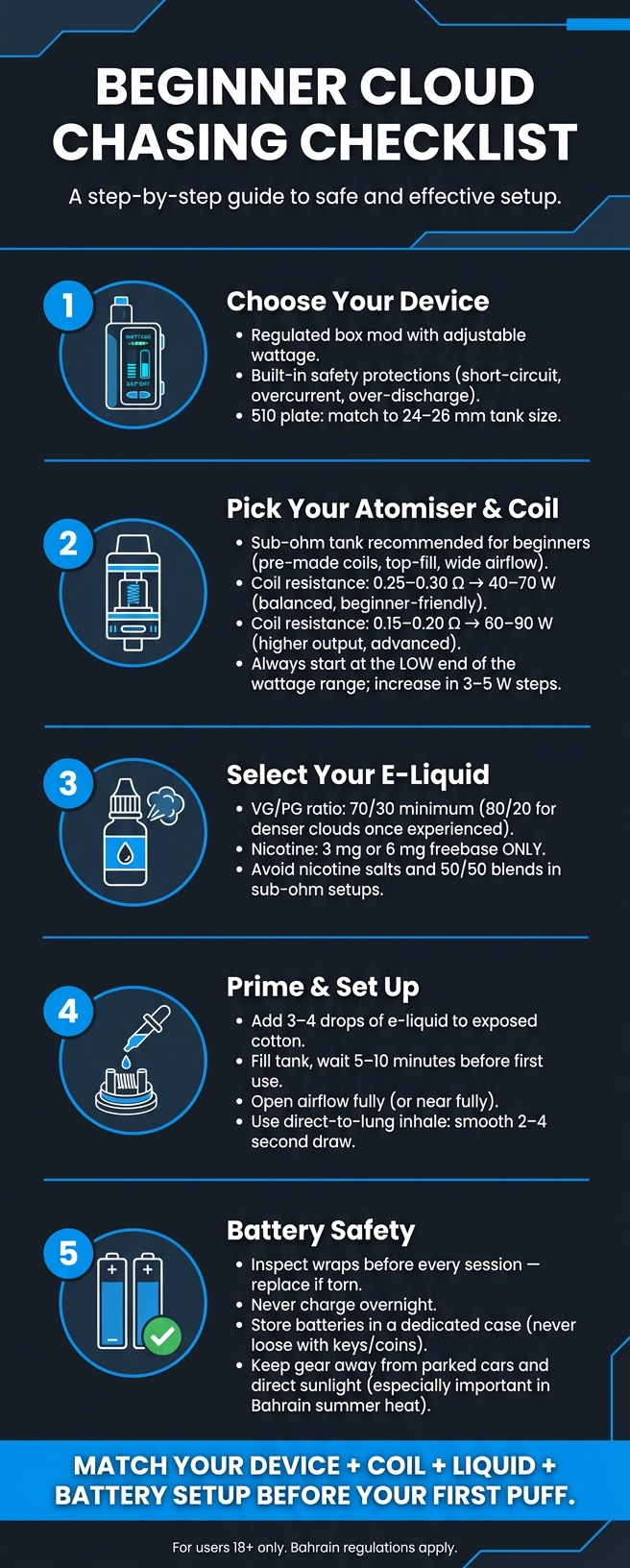
Beginner Cloud Chasing Setup Checklist: Step-by-Step Guide
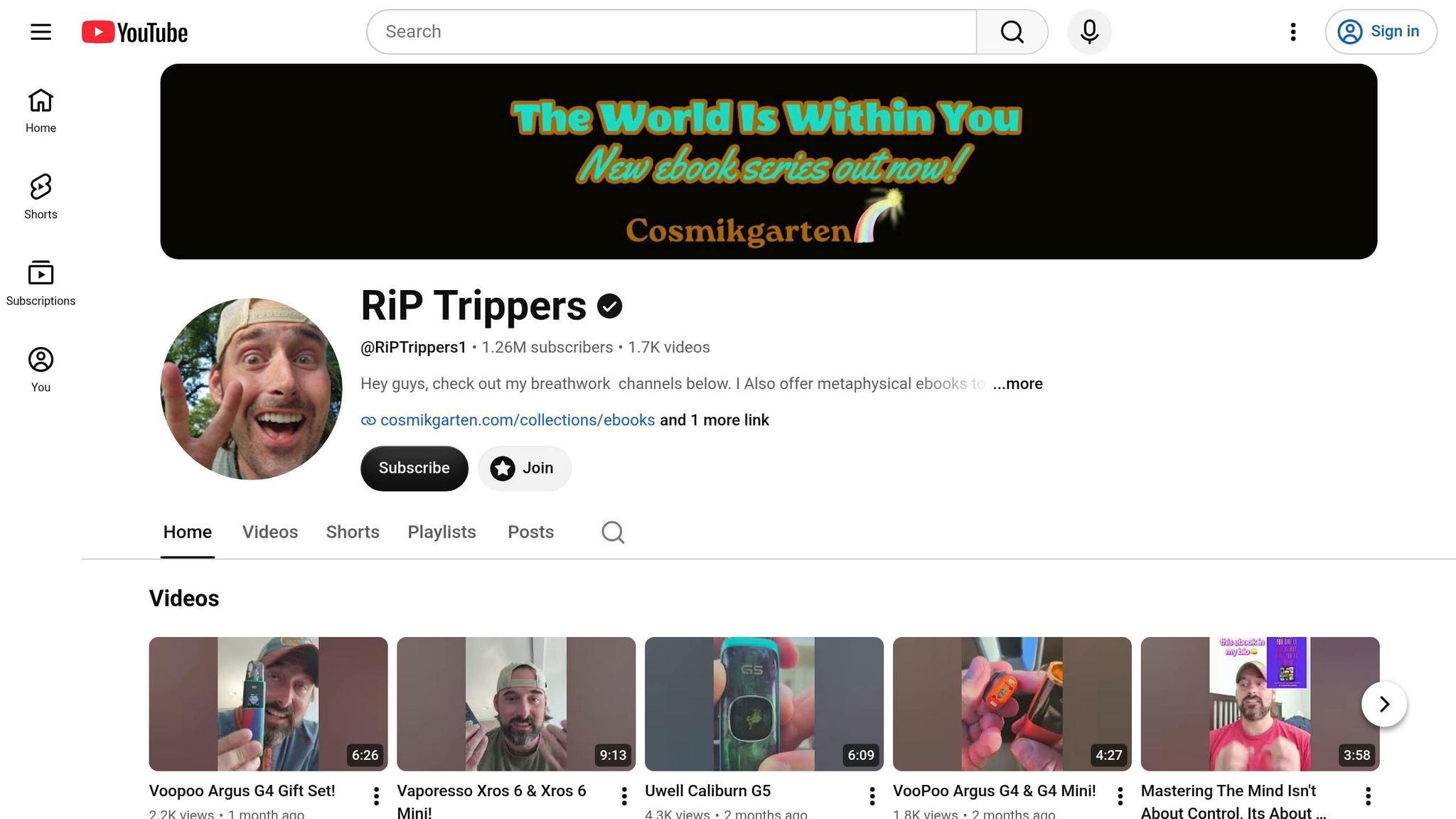
RiP Trippers: Cloud Chasing 101 Part 1
sbb-itb-837e7ad
Quick comparison
| Part | What I’d look for | Beginner note |
|---|---|---|
| Mod | Regulated box mod with adjustable wattage | Safer and easier to monitor |
| Tank | Sub-ohm tank | Less setup work than an RDA |
| Coil | 0.25–0.30 Ω | Good starting point for many new users |
| Wattage | 40–70 W | Start low, then move up slowly |
| E-liquid | 70/30 VG/PG or higher | Thicker liquid for denser vapour |
| Nicotine | 3 mg or 6 mg freebase | Lower strength suits sub-ohm use |
| Inhale style | Direct-to-lung | Not the same draw as a pod |
| Battery handling | Undamaged wraps and a battery case | Safety check before each use |
The short version: if I want bigger clouds without trouble, I need to match the device, coil, liquid, and battery setup properly before I even take the first puff.
Checklist: Choosing the Right Cloud-Chasing Device
Cloud chasing starts with three main pieces: a regulated box mod, a sub-ohm tank or RDA, and coils that fit the suggested wattage.
Use a Regulated Box Mod with Adjustable Wattage
If you’re new to cloud chasing, start with a regulated box mod. It’s the safer and simpler option. Unlike mechanical or unregulated devices, a regulated mod has a built-in chipset that manages power output and adds safety features like short-circuit, overcurrent, and over-discharge protection. Following vape safety tips is essential when pushing your device to higher wattages.
A clear screen also helps a lot. You should be able to check wattage, coil resistance, and battery level at a glance.
Fit matters too. Match the mod’s 510 plate to the tank size, usually 24–26 mm, so you don’t end up with overhang.
Once you’ve picked the mod, the next job is pairing it with an atomiser that’s easy to use.
Pair It with a Sub-Ohm Tank or RDA
The atomiser plays a big part in vapour output. For beginners, a sub-ohm tank is the better pick than an RDA. Pre-made coils make setup much easier, which saves a lot of trial and error.
When choosing a sub-ohm tank, check for:
- Wide, adjustable airflow slots that can open fully for direct-to-lung inhales
- Reliable O-rings and seals to help stop leaks
- A top-fill design that makes refilling simple
It’s best to leave RDAs for later. They need manual coil building, plus a good grasp of resistance and battery limits.
With the hardware sorted, the next step is picking the right coil resistance for your device’s wattage range.
Match Coil Resistance to Your Device’s Wattage Range
Always follow the manufacturer’s suggested wattage printed on the coil. Start at the lower end, then increase bit by bit.
Here are some beginner coil pairings to use as a guide:
| Example coil resistance | Cloud output | Example recommended wattage |
|---|---|---|
| 0.15–0.20 Ω | Higher | 60–90 W |
| 0.25–0.30 Ω | Balanced cloud-focused use | 40–70 W |
For most beginners, 0.25–0.30 Ω coils at 40–70 W are a good place to begin. Before using the device, make sure the mod reads the coil resistance correctly.
Checklist: Picking E-Liquid That Supports Dense Vapour
Once the device is sorted, the next step is simple: match the e-liquid to the setup. The two main things to look at are the VG/PG ratio and the nicotine strength.
Choose High-VG E-Liquid, Usually 70/30 VG/PG or Higher
Vegetable glycerin (VG) is what gives vapour its thickness. Propylene glycol (PG) does more of the heavy lifting for flavour and throat hit. If your goal is dense clouds, you’ll usually want more VG.
Go for 70/30 VG/PG or higher. A 50/50 blend is usually too thin for cloud chasing.
70/30 is the best place to start. It’s easier for beginners to work with and usually wicks well in most sub-ohm tanks. You can move to 80/20 later, but only if the cotton stays fully saturated. Thicker e-liquid needs more time to soak into the cotton, and if it doesn’t, you’ll feel it straight away.
After that, keep the nicotine level low enough for sub-ohm vaping.
Use Low Nicotine for Sub-Ohm Vaping
For sub-ohm devices, use freebase nicotine at 3 mg or 6 mg. Stay away from nicotine salts in this type of setup.
If you’ve been using a pod device with 20 mg nicotine salts, don’t bring that same strength into a sub-ohm device. It’s too much. Nicotine salts are made for low-power pod systems and can feel overwhelming at higher wattages. Instead, choose freebase nicotine that’s clearly labelled for sub-ohm use.
Checklist: Airflow, Priming, and Inhale Technique
Once you’ve picked the e-liquid, set up the coil and airflow before you fire the device.
Prime the Coil and Start at a Low Wattage
Add 3–4 drops of e-liquid to the exposed cotton, install the coil, fill the tank, and wait 5–10 minutes. If you skip this, the first puff can taste burnt.
Next, check the wattage range printed on the coil or its packaging. Start at the bottom of that range, then increase power in 3–5 W steps. For example, if the coil is rated 60–80 W, begin at 60 W.
It also helps to keep the device and e-liquid indoors, away from direct sun and hot cars.
Open the Airflow and Use Direct-to-Lung Inhales
Open the airflow fully, or close to fully. If the draw feels too loose, close it a little.
Then use a direct-to-lung inhale: pull the vapour straight to the lungs in one smooth 2–4 second draw.
After this, move to battery safety and wattage limits. Following a vape battery safety guide is crucial when pushing your device to its limits.
Final Checklist: Battery Safety and Daily Good Practice
Once your airflow and wattage are dialled in, check the battery side of the setup next. For cloud chasing, this part matters a lot. Give your gear a proper look before every session.
Check Batteries, Wraps, Charger, and Wattage Limits
Start with the battery wraps. If you spot even a small tear, treat it as a serious safety issue. Replace the wrap straight away or switch to a new battery. A damaged wrap can lead to overheating or venting.
Stick to the charger recommended for your batteries. Don’t charge overnight. And never toss loose batteries into a pocket or bag with keys or coins. Use a dedicated battery case every time.
On the device side, check the coil’s listed wattage range against your mod’s output whenever you change a coil. If you fire above the rated range, the coil will wear out faster and you can end up with burnt hits. In Bahrain’s summer heat, keep your kit indoors and well away from parked cars.
Conclusion: Your Beginner Cloud-Chasing Checklist at a Glance
Cloud chasing works best when your device choice, e-liquid, airflow, priming, and battery safety all stay within spec.
FAQs
How do I know if my tank is sub-ohm?
A tank is sub-ohm when it uses coils with a resistance below 1.0 ohm. In most cases, that means somewhere around 0.15 to 0.5 ohms.
The easiest way to check is to look at your device specs or the product packaging. It’s often labelled clearly. Sub-ohm tanks are built for direct-to-lung inhaling, along with the higher heat and airflow needed to produce dense vapour.
What happens if I use nic salts in a cloud-chasing setup?
Nic salts usually work best with a higher-resistance coil – about 0.8Ω or above – and lower wattage, usually around 12–18 W. That setup helps keep the vape smooth and cuts down on harshness.
They can also give faster satisfaction with fewer puffs and less visible vapour, which is why they pair well with MTL-style hardware. Use the wrong coil or push the wattage too high, and the result can be a rough hit plus a coil that burns out sooner.
How often will I need to refill e-liquid and replace coils?
E-liquid refill frequency comes down to how much you vape.
- Light users may go through 2–3 mL per day
- Average users often use 3–5 mL per day
- Heavy users can use 8–12 mL or more per day
Try to keep your pod or tank at least 25% full. That helps lower the chance of the cotton burning.
Coils and pods usually last 7–14 days. It’s time to replace them if you notice:
- a burnt or muted taste
- less vapour
- gurgling
Sweet, dark, or high-sucrose e-liquids can shorten coil life by up to 30%.
Related Blog Posts
- كيفية اختيار الفيب المناسب للمبتدئين
- Advanced VG/PG Ratio Tips for Cloud Chasers
- How to Build Coils for Competitive Cloud Chasing
- Checklist for Cloud Chasing Competitions
Frequently Asked Questions
For beginner cloud chasing, the checklist focuses on four core pieces: a regulated box mod, a sub-ohm tank, high-VG e-liquid, and safe battery habits.
This setup uses more power, more e-liquid, and a direct-to-lung inhale, so expect more refills and a higher running cost in BHD compared with small pod devices.
Sub-ohm vaping is different from pod use because it runs lower coil resistance and higher wattage, which gives you thicker vapour.
The beginner checklist suggests a sub-ohm tank with coils around 0.25–0.30 Ω at 40–70 W, paired with 70/30 VG/PG e-liquid for smoother direct-to-lung draws.
The guide clearly recommends starting with a regulated box mod because it has adjustable wattage and built-in safety protections, unlike a fully mechanical device.
With a regulated mod, you can set the coil within its suggested 40–70 W range and slowly fine-tune in 3–5 W steps, which is much safer and more predictable for new cloud chasers.
High VG e-liquid refers to juices where vegetable glycerin is the dominant base, and the checklist points to 70/30 VG/PG as the usual starting mix for thicker vapour.
This ratio helps produce dense clouds in a sub-ohm tank while still keeping enough PG for flavour and wicking, which suits direct-to-lung inhales.
The checklist highlights basic battery safety like avoiding torn wraps, never carrying loose cells in pockets, and not charging batteries overnight.
It also warns that summer heat can be harsh on vape gear, so devices and batteries should be kept out of parked cars and direct sun, which is especially important in hot Gulf weather.
The guide explains that cloud chasing uses a direct-to-lung inhale, with airflow kept mostly open and a longer 2–4 second draw.
This style works best with sub-ohm coils in the 0.25–0.30 Ω range and higher wattage, which increases vapour production compared with tight mouth-to-lung pod draws.
Coil priming means saturating the cotton inside a new coil before vaping so you avoid dry hits and burnt taste.
The checklist advises priming the coil, then starting at the low end of the coil’s wattage range and increasing in 3–5 W steps until you find a comfortable level for your cloud chasing setup.
For sub-ohm use, the checklist recommends freebase nicotine at 3 mg or 6 mg instead of high-strength nic salts, as these lower strengths are more suitable for direct-to-lung inhales and higher vapour production.
Higher-strength nic salts are not suggested here because cloud chasing devices use more power and e-liquid, which would make strong nicotine feel too harsh.