
Why Health Warnings Matter on Vape Products


If a vape warning is hard to see, it cannot help you make a better choice.
From what I see in Bahrain, the point is simple: vape labels should show nicotine strength, addiction risk, and health warnings before anyone buys or uses the product. That matters even more when research in Bahrain found that around 50% of male vapers think vaping is safer than smoking and 35.7% of female users said flavour variety was the main reason they started.
Here’s the short version:
- Bahrain requires Arabic and English labelling on vape packs.
- Nicotine content must be shown in mg/mL, along with liquid volume and other pack details.
- Warnings matter most at the point of sale, where the pack often does the talking.
- Online listings matter too because buyers may only look at the product image before checkout.
- Text-only warnings can get lost when branding and flavour design take over.
- Larger pictorial warnings can help make the risk harder to miss.
What this comes down to is simple: clear warnings support informed adult choices, while weak or hidden warnings leave room for confusion.
Health Experts Warning After New Link Between Vapes Cancer | 10 News+
sbb-itb-837e7ad
Bahrain’s vape labelling rules and what they require
Bahrain’s vape standard, BH 2:2021, sets the labelling rules for electronic nicotine products. In plain terms, it turns health warnings into information buyers can see before they open the pack.
Text warnings, nicotine statements, and bilingual labelling
Every pack must show a clear nicotine-addiction warning. It also needs to state the nicotine concentration in mg/mL and the total liquid volume in mL. The packaging must include the brand name, flavour, a detailed ingredient list, the country of production, and a traceable batch number.
Both Arabic and English must appear clearly on the pack. That matters because the pack isn’t just branding. It’s where buyers get the key facts at a glance.
Packaging restrictions and traceability measures
Packaging must not mislead buyers or attract minors. Packs also need age-restriction notices to meet distribution rules.
There is also a traceability side to this. Bahrain is moving towards digital tax stamps and tracking systems to check legal import status and tax compliance. So the label on the pack isn’t there for show. It helps buyers and regulators connect the product being sold with the details printed on it.
What compliant packaging means for online retail
The same clear presentation should appear on product pages. For online stores serving Bahrain – including VapeShop.bh – listings need to show clear images of the actual pack, with legible warnings, nicotine strength in mg/mL, and both Arabic and English visible before checkout.
What experts and studies say about warning labels
Views from Bahraini doctors and public health voices
Health warnings on vape packs matter in Bahrain because warning labels are already a central part of the country’s tobacco control approach. That matters even more when many users still downplay the risks linked to vaping.
Research overseen through the Primary Care Research Committee in Bahrain pointed to a clear knowledge gap. Many male users believed vaping was safer and also underestimated the harms of second-hand vapour. In plain terms, a lot of people weren’t seeing the full picture.
The authors didn’t leave it there. They called for educational interventions and stronger laws to help close that gap.
What global research shows about warning effectiveness
Research from other countries shows that warnings can lift awareness, but their effect depends a lot on how often people see them and how they’re designed. Bahrain’s knowledge gaps don’t sit in isolation. They line up with a pattern seen elsewhere.
In England, notice of nicotine warnings went up after mandatory labelling came in, but concern about vape use changed only a little. That’s an important distinction: seeing a warning and changing your view are not always the same thing.
Research from Universidad de los Andes found something similar. Text warnings drew less visual attention than product branding, and while they could reduce appeal among young adults, they often failed to increase perceptions of addictiveness. Put simply, if the branding shouts and the warning whispers, the warning may not do enough.
That helps explain Bahrain’s move towards larger pictorial warnings covering 70% of the pack.
The remaining question is how strong warnings should be in Bahrain’s market.
Why stronger warnings matter in Bahrain’s market
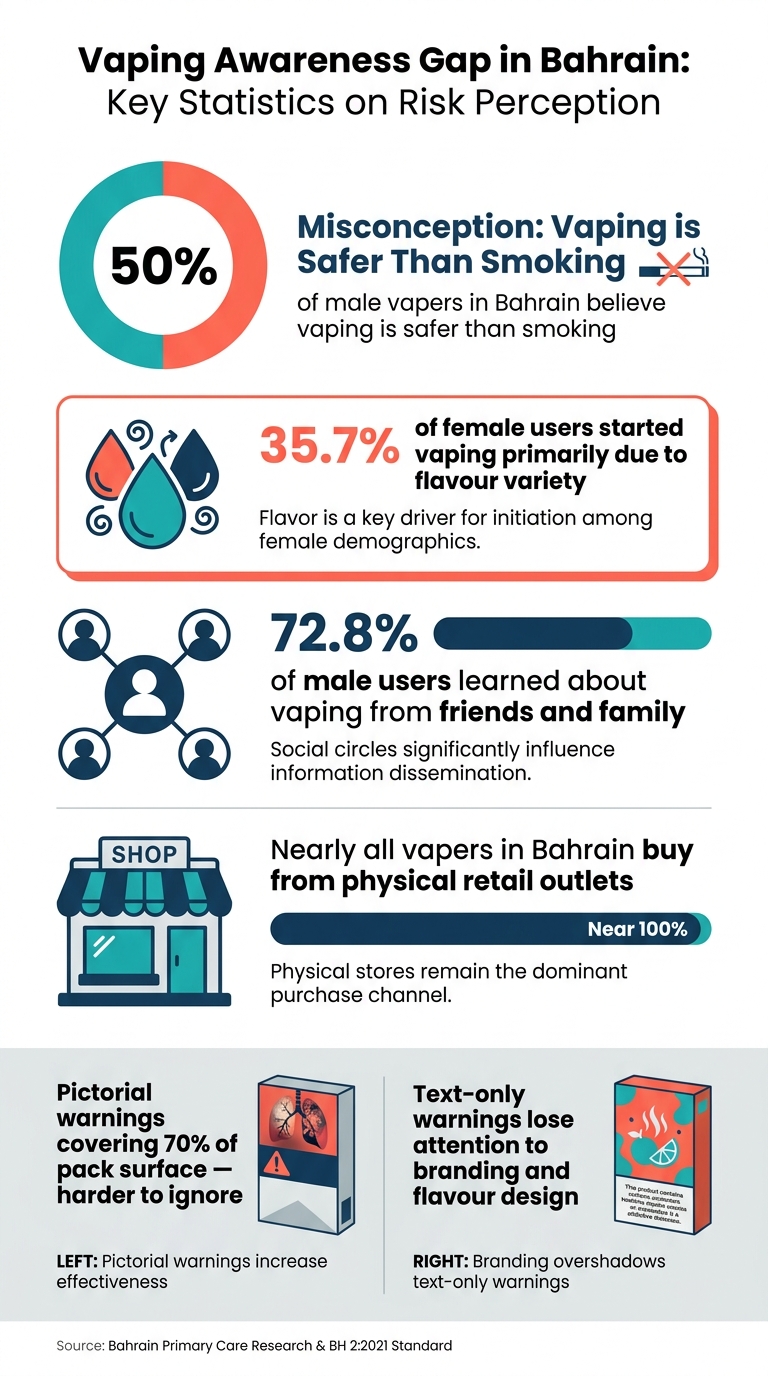
Vaping Awareness Gap in Bahrain: Key Statistics on Risk Perception
That makes the strength of the warning more important than the mere fact that a warning exists.
Reducing confusion and improving risk awareness
Bahrain’s data points to a plain misunderstanding: around 50% of male vapers believe vaping is safer than smoked tobacco. That isn’t a small mix-up. It shapes how people judge risk and what they decide to buy.
This applies across product types. Someone picking a nicotine salts or freebase e-liquids needs plain, easy-to-see details about nicotine strength and what that can mean for addiction risk. If that information isn’t clear on the pack, the pack starts doing the talking – and packs often lean more toward appeal than caution. Higher nicotine strengths mean a higher addiction risk, so the number on the pack needs to stand out.
Packaging design, online visibility, and purchase decisions
The problem gets worse when the pack design competes with the warning.
Packaging is part of how vape products are sold, and flavour images can easily drown out warning text. In Bahrain, flavour variety is the main reason 35.7% of female users started vaping, so flavour-led packaging can do more than decorate the box. It can help drive uptake.
Online retail adds another issue. On an e-commerce platform, the product image is often the first – and sometimes only – visual a buyer sees before purchase. If the warning is cropped out or too small to read in thumbnail view, it’s gone. Large, readable warnings and nicotine details keep the risk in sight when branding would otherwise take over.
Advantages and limits of strong warning rules
Stronger warnings help close that misconception gap. When accurate information appears where people will actually see it, it pushes back on false beliefs before a purchase happens. Since nearly all vapers in Bahrain buy from physical retail outlets, the pack itself becomes the main education tool at the point of sale. Prominent warnings can also reduce the low-risk feel that sleek branded packaging may create, which matters for youth protection at the point of sale.
But there are limits. Message fatigue is a known problem: when people see the same warning on every pack again and again, they can stop noticing it. Enforcement is uneven too. A market that depends heavily on street vape shops needs steady in-person inspection if compliance is going to happen in practice, not just sit in a rulebook. And with 72.8% of male users learning about vaping from friends and family, on-pack warnings need to be strong enough to push back against peer-led misinformation, even when enforcement is patchy.
The main issue is simple: if buyers don’t see the warning, it can’t do its job.
Conclusion: Clear warnings support more informed choices
Look at Bahrain’s rules and the research side by side, and the message is pretty plain: health warnings on vape products are a practical public health tool. Bahrain has steadily tightened its warning rules to make them harder to miss.
That still matters because the knowledge gap hasn’t gone away. If people don’t know what they’re buying or using, a clear warning can give them one more signal before they make a choice.
Online retail matters here too. Product listings online need the same clear labels, because many buyers judge the pack before they buy.
A warning only does its job if people can actually see it, whether that’s on the pack in a shop or on a product page online.
FAQs
Why do vape warnings need to be easy to see?
Vape warnings need to be easy to see because they’re meant to spell out health risks in a way people will remember.
When warnings are clear and hard to miss, they’re less likely to fade into the background. That matters. If people stop noticing them, the message loses its punch.
Visible warnings give users a better chance of stopping, reading, and thinking about the possible harms.
What should I check on a vape label before buying?
Check the label for clear health warnings about nicotine content, addiction risk, and any possible adverse health effects.
The label should also clearly state that sale and use are prohibited for anyone under 18.
Do the same warning rules apply online in Bahrain?
Yes. In Bahrain, the same rules on tobacco packaging, advertising, and health warnings apply online too.
That means these rules don’t stop at shops, billboards, or printed materials. They also cover digital channels, and they are strictly enforced across online platforms.
Related Blog Posts
- Top 5 Factors Driving Vape Sales in Bahrain
- Vaping Market Size in Bahrain 2026
- Vape Devices vs. E-Liquids: Bahrain Customs Policies
- How Bahrain Regulates Vape Ads
Frequently Asked Questions
Health warnings matter because many people still underestimate the risks of vaping, with research in Bahrain showing that about half of male vapers think it is safer than smoking. Clear labels that spell out nicotine strength, addiction risk, and health effects help adults see the trade-offs before they buy or use any device or e-liquid.
BH 2:2021 requires electronic nicotine products to have clear labelling in both Arabic and English on the pack. Nicotine content must be shown in mg/mL along with the liquid volume and other key pack details so users know what they are taking in before opening the product.
Nicotine strength in mg/mL tells you how concentrated the nicotine is in the liquid, which matters for both satisfaction and addiction risk. When this number is easy to see on the label, adults can choose a strength that matches their needs and stay within Bahrain’s legal limits.
Studies in Bahrain found that around 50% of male vapers believe vaping is safer than smoking, which can lead to underestimating the risks. Strong warnings that highlight health harms and addiction put the risk back in focus and balance out marketing messages about flavours or smoothness.
Many online buyers only glance at the product image before checkout, so if warnings are tiny or hidden, the risk message is missed. Making nicotine information and health warnings visible in the listing helps people make an informed choice even before the physical pack is in their hands.
Text-only warnings can easily get lost next to bright flavour designs and branding, especially when the font is small. Larger pictorial warnings grab attention faster and make it harder to ignore the health risks, which is especially important at the point of sale where decisions are made quickly.
When labels clearly show nicotine strength, addiction risk, and health warnings in both Arabic and English, adults can weigh the pros and cons before using any vape product. Weak or hard-to-see warnings leave room for confusion and make it easier to underestimate the potential harms of vaping.