

How to Use Feedback to Improve Vape Services


Customer feedback is the backbone of improving vape services. By listening to what your customers want – like fast delivery, better flavours, and reliable devices – you can make changes that keep them coming back. Here’s how you can start using feedback effectively:
- Collect feedback at key points: Use WhatsApp follow-ups, product QR codes, or website prompts to gather input during delivery, product use, or checkout.
- Ask specific questions: Tailor feedback forms to products (e.g., flavour quality for e-liquids or battery life for devices) and user types (beginners vs. advanced users).
- Simplify the process: Keep forms short and localized with Arabic/English options, Bahraini Dinar pricing, and familiar date formats.
- Act on feedback: Use insights to fix issues like delayed deliveries, unclear product descriptions, or device durability.
- Close the loop: Inform customers about changes made based on their input, boosting trust and loyalty.
In Bahrain, where vape customers value same-day delivery and localised product options, feedback helps businesses like VapeShop.bh stay competitive. Start small – like sending a WhatsApp message after delivery – and build a system that prioritises customer satisfaction.
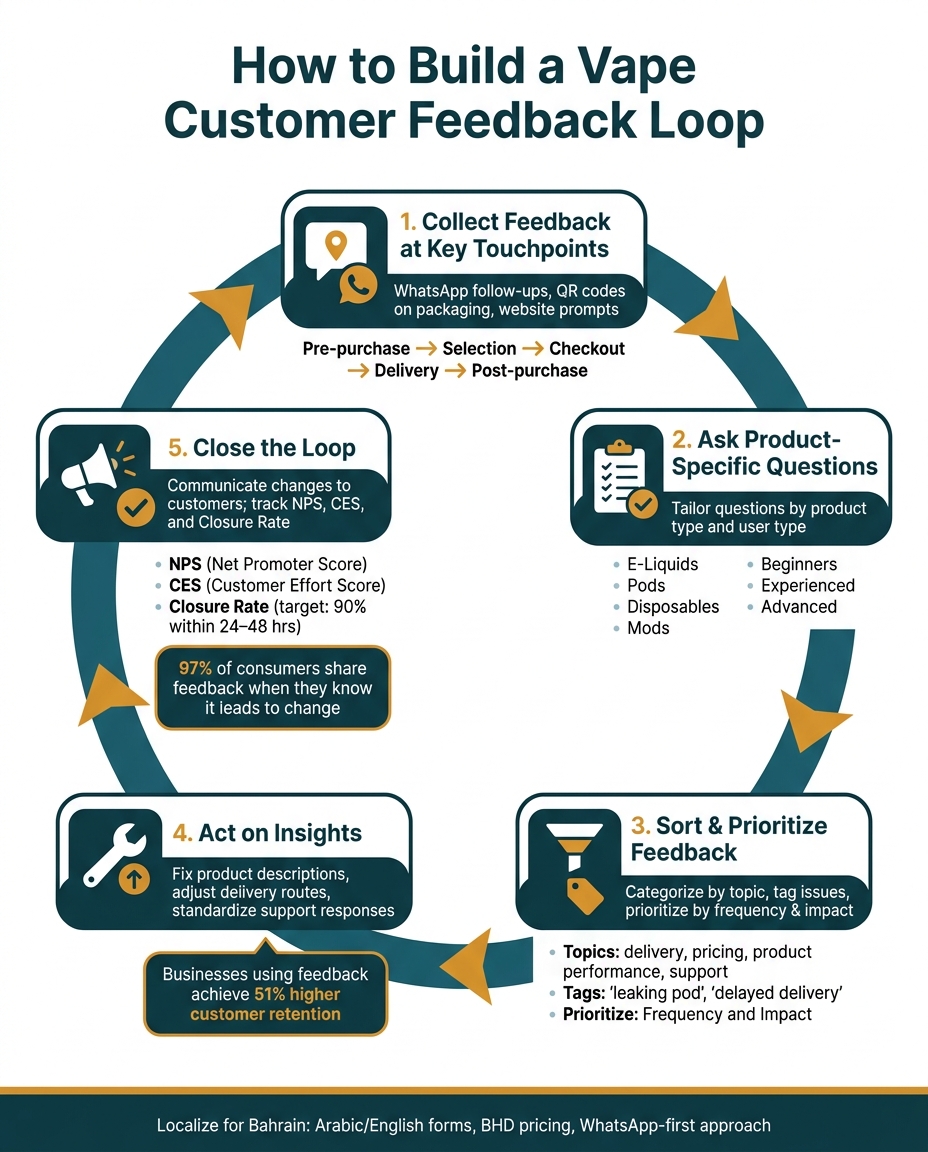
How to Build a Vape Customer Feedback Loop: 5 Key Steps
Setting Up a Feedback System
Incorporating a feedback system into the customer journey can provide valuable insights while keeping the process seamless for customers.
Identify Where to Collect Feedback
Feedback should be gathered at critical moments in the customer journey. Each stage provides different perspectives:
| Journey Stage | Key Touchpoint | What to Learn |
|---|---|---|
| Pre-Purchase | Social media groups, forums | Initial impressions and product awareness |
| Product Selection | Website navigation, product pages | Ease of finding items and clarity of descriptions |
| Checkout | Payment confirmation screen | Trust signals and friction points |
| Delivery | Order completion | Speed, packaging quality, and delivery accuracy |
| Post-Purchase | Product use over time | Satisfaction with flavour longevity and device performance |
For VapeShop.bh, two critical touchpoints stand out: the WhatsApp order confirmation message (since most orders are placed via WhatsApp) and the "My Account" page, where returning customers can leave reviews for products like SaltNic e-liquids or pod systems.
Once these touchpoints are identified, align feedback methods with these moments to make the process smooth and natural.
Choose the Right Feedback Channels and Tools
In Bahrain, WhatsApp is a powerful tool for capturing customer feedback. Since customers often place orders through WhatsApp, a follow-up message sent five minutes after delivery can encourage them to provide a quick rating or comment.
Another option is to include QR codes on product packaging. Scanning the code could direct customers to a feedback form or WhatsApp chat. For desktop users, adding prompts on the order history page offers another convenient way to share opinions.
To make feedback accessible, bilingual forms in Arabic and English are essential. Include local elements like pricing in BHD and date fields in the DD/MM/YYYY format to ensure clarity and encourage higher response rates.
Keep Feedback Collection Simple and Localized
Simplicity is key when designing feedback forms. Focus on just a few targeted questions, such as delivery speed, flavour satisfaction, or device performance. Avoid lengthy surveys that might deter customers.
Localization also plays a big role. For example, ask questions like, "Was this product good value at BHD 6.950?" and ensure date fields follow the familiar DD/MM/YYYY format. These small but thoughtful adjustments show customers that the feedback process is tailored for them, increasing the likelihood of participation.
sbb-itb-837e7ad
Collecting Useful Vape-Specific Feedback
Once you’ve set up your feedback channels, the questions you ask become just as important as where you ask them. Broad, generic queries like "How was your experience?" often fail to provide the kind of detailed input needed to refine vape products or services. Instead, focus on specific, technical questions tailored to the unique aspects of vaping.
Ask Product-Specific Questions
Customizing your questions based on the product type can uncover actionable insights. Here’s a helpful breakdown:
| Product Type | Key Questions to Ask |
|---|---|
| E-Liquids | How consistent is the flavour? Does the throat hit meet expectations? Is nicotine satisfaction adequate? |
| Pods & Coils | How long does the battery last? What’s the coil lifespan? Is refilling or charging convenient? |
| Disposable Vapes | Does the flavour last? Is the hit comfortable? Do you feel it’s worth the price? |
| Advanced Mods | How durable is the battery? Is the device well-built? Is it easy to navigate settings? |
These targeted questions help uncover specific areas for improvement. For instance, customer reviews on VapeShop.bh highlight that the Oxva Xlim Pro 3 pod offers strong battery life and excellent SaltNic flavour. However, some users feel it’s slightly overpriced. Such detailed feedback only emerges when the right questions are asked.
Once you’ve gathered product feedback, segmenting responses can make your analysis even more effective.
Group Feedback by Customer Type
Breaking down feedback by customer type allows you to better understand diverse needs. For example:
- Beginners moving from cigarettes often prioritise ease of use and a familiar throat hit.
- Experienced vapers focus on flavour richness and overall value for money.
- Advanced mod users care most about technical performance, such as battery endurance, build quality, and charging speed.
You can also segment based on nicotine preferences. SaltNic users might emphasise smoothness, while nicotine pouch users often discuss flavour longevity. For example, a VapeShop.bh customer, Maryam D., shared this about Mazaj pouches:
"The pouches from Mazaj turned out better than I expected. The nicotine is balanced and the taste is consistent and doesn’t bother the throat… but I wish the flavor lasted a little longer."
Tying this kind of feedback to specific products and user profiles makes it far more actionable.
Gather Feedback on Delivery and Support
In Bahrain, delivery speed is a key differentiator for vape services. Instead of asking vague questions like, "Was delivery fast?", tailor your queries to local benchmarks. For example, ask if an order in Riffa arrived within the expected 30–45 minute window, or if delivery in Manama met the 20–35 minute timeframe. Aligning feedback to these benchmarks ensures consistency across your data.
For customer support, response time is critical. VapeShop.bh, for instance, aims for a 5-minute response time on WhatsApp. When gathering feedback, ask not just about speed but also the quality of assistance. Did the support team help them choose the right nicotine strength or locate a compatible coil? These specifics can highlight areas where service can improve.
Using Feedback to Make Real Improvements
Transforming raw feedback into meaningful changes can lead to noticeable upgrades like quicker delivery, clearer product descriptions, and better customer support.
Sort and Prioritize Feedback Data
Start by categorizing feedback into areas like product performance, pricing, delivery, and customer support. Then, use topic-specific tags such as "leaking pod", "delayed delivery", or "slow charging" to ensure each issue gets routed to the appropriate team. The next step is to prioritise these issues based on their frequency and impact. For instance, if several customers highlight the same hardware issue – like a coil burning out too quickly – it’s critical to address that before diving into new product development.
As one example points out:
"Order of importance would dictate that you first fix the broken zippers, then consider whether the new jacket is worth developing."
Interestingly, a feature request buried in a negative support ticket often signals more urgency than the same suggestion in a general survey. By focusing on these prioritised insights, businesses can make targeted improvements to their product descriptions and services.
Improve Products and Product Descriptions
Feedback often highlights gaps in product details. For example, if customers frequently ask about battery life or coil compatibility through WhatsApp, it’s likely that these details are missing or unclear on the product page. Use these recurring questions as a guide to refine descriptions with precise and accurate specifications.
If a product consistently receives poor ratings – particularly around value for money or durability – it might be time to reconsider its place in your lineup. On the other hand, if customers regularly praise features like ease of use or build quality, highlight those strengths in your product copy. Businesses that actively use customer feedback have been shown to achieve 51% higher customer retention rates.
Improve Delivery and Customer Support
After fine-tuning product details, shift focus to delivery feedback. Analyse reviews by location; for example, if customers in Riffa or Muharraq often mention delayed deliveries, it might be time to reassess logistics in those areas. Adjusting delivery time estimates based on actual performance can help manage expectations and reduce frustration.
For customer support, feedback can guide the creation of standardised responses for common issues like order tracking, defective devices, or questions about nicotine strength. This approach can cut down on response times and ensure consistency. A great example is Global’s operations team, which reduced average response times to 1.5 hours and achieved 90% of response targets by implementing automated routing and sentiment tagging. Even on a smaller scale, directing WhatsApp queries about device issues to a team member with technical expertise can significantly improve the customer experience.
Closing the Feedback Loop
Once you’ve gathered and acted on vape-specific feedback, the final step is showing customers how their input has driven improvements.
Feedback only holds value when it’s addressed and communicated effectively. This step, often referred to as closing the loop, distinguishes businesses that thrive from those that fall behind.
Respond to Feedback and Communicate Changes
When customers highlight issues – like leaking pods or delivery delays – it’s essential to inform them about the steps taken to resolve these problems. Acknowledge their concerns and explain the solutions implemented. For instance, if repeated WhatsApp queries about coil compatibility prompt you to update product descriptions or if delivery timelines are adjusted for certain areas, let your customers know their feedback played a direct role in those changes.
Sharing these updates publicly, whether on product pages or social media, demonstrates that you genuinely value customer input. As Marcus Milione, founder of Minted New York, aptly said after redesigning a product based on customer feedback:
"Bringing your customer along on the journey helps them buy into the product even more."
Track Progress with Clear Metrics
Without clear metrics, it’s impossible to measure progress. Focus on these three key areas:
| Metric | What It Measures | Why It Matters |
|---|---|---|
| NPS (Net Promoter Score) | Likelihood of customers recommending your store | Indicates long-term loyalty trends |
| CES (Customer Effort Score) | Ease of resolving an issue | Identifies pain points in support or ordering processes |
| Closure Rate | Percentage of feedback tickets resolved and communicated back | Reflects how responsive you are to customer concerns |
Strive for a 90% closure rate for negative feedback within 24–48 hours. Regularly review these metrics – monthly reviews can help you catch trends early.
Build a Regular Feedback Routine
A structured feedback process ensures ongoing improvements. Establishing a routine, like monthly metric reviews and quarterly strategy updates, helps turn sporadic feedback into a consistent program for growth. As Elise Dopson from Shopify explains:
"A simple framework turns ad hoc feedback into a repeatable program that builds better products and happier shoppers."
The numbers don’t lie: over 97% of consumers are willing to share feedback if they know it will lead to meaningful change. Give your customers a reason to keep engaging, and they’ll gladly share their insights.
Conclusion: Better Vape Services Start with Listening
The success of vape services lies in truly listening to customers and acting on their feedback. By creating effective feedback channels, addressing concerns, and monitoring progress, businesses can foster loyalty. When customers feel their voices matter, they’re far more likely to return.
In Bahrain, where preferences like fast delivery and specific product flavours are highly valued, feedback becomes a powerful tool for staying ahead of the competition. Take VapeShop.bh as an example – this store has shown how paying attention to customer input, whether it’s about flavour quality or delivery times, can lead to tangible improvements and stronger customer relationships. This approach aligns perfectly with Bahrain’s broader emphasis on customer-focused services.
Since 2007, the Government of Bahrain has tracked its Customer Satisfaction Index annually, proving that consistent measurement fosters accountability. This principle applies equally to businesses. Bahrain’s Economic Vision 2030 underscores the importance of putting customers first, a goal that vape services can adopt to elevate their standards.
"The feedback collected is integral to service optimization, creating a continuous improvement loop." – Government of Bahrain
This guide provides practical steps to help businesses like VapeShop.bh grow by listening to their customers. Something as simple as sending a post-delivery WhatsApp message for a quick rating can be the starting point. By setting up effective feedback systems and showing customers their input matters, vape services can build trust and loyalty. Listening, responding promptly, and improving based on feedback are the keys to long-term growth in this competitive market.
FAQs
What’s the best time to ask customers for feedback?
The best time to ask for feedback varies depending on the situation. For services, it’s ideal to request feedback within 15 hours, preferably between 11:00 am and 1:00 pm. This window often aligns with when customers are most receptive.
For product purchases, waiting a bit longer is better. Aim for 1–4 days after the purchase, though 8 days tends to be the sweet spot. This allows customers enough time to use and reflect on the product, leading to more thoughtful and precise responses.
Which 1–3 questions should I ask for each vape product type?
Here are 1–3 key questions to consider for each type of vape product:
Disposable Vapes:
- What flavours and nicotine strengths are available?
- How long does the battery and e-liquid last?
- Are there any specific usage instructions or safety precautions?
Pod Systems and Coils:
- Which pods and coils are compatible with the device?
- How frequently should coils be replaced?
- What wattage or voltage settings work best for performance?
E-Liquids (Freebase and Salt Nic):
- What nicotine levels are available?
- Are there flavours that match my taste preferences?
- What’s the best way to store e-liquids to maintain freshness?
These questions can guide you in selecting the right products to enhance your vaping experience.
How do I turn feedback into changes customers actually notice?
To ensure feedback-driven changes stand out, it’s important to follow a clear process. Start by gathering and organising feedback in a systematic way. Then, focus on the most pressing issues and work on specific improvements, such as tweaking product features or enhancing service delivery.
Once the changes are in place, make sure to inform your customers – whether through direct communication, email updates, or announcements on your website or app. This demonstrates that you value their input, strengthens trust, and helps foster long-term loyalty.
Related Blog Posts
- Customer Reviews of VapeShop.bh Delivery
- Top 5 Factors Driving Vape Sales in Bahrain
- AI-Powered Vapes: How They Work
- Ultimate Guide to Vape Delivery in Bahrain
Frequently Asked Questions
Vape shops can collect useful feedback by adding quick questions at key points like checkout, after delivery, and a few days after product use. Simple WhatsApp follow-ups, QR codes on packaging, or short website pop-ups work well when they ask about specific things such as flavour quality, delivery experience, or device reliability.
WhatsApp can be used to send a short follow-up message after delivery, asking customers to rate their experience or answer one or two targeted questions. Vape businesses can also share a quick survey link and provide support via WhatsApp at +973 66324432 to turn feedback into real improvements in service and product choice.
Customer feedback highlights issues like delayed drivers, confusing address options, or missing order updates, so vape shops can fix the exact step causing frustration.
For e-liquids, questions should focus on flavour accuracy, sweetness level, throat hit, and how satisfied the customer is compared to what was written in the product description. Shops can also ask if customers would buy the same flavour again or prefer different flavour profiles, helping them adjust stock and descriptions accordingly.
Product reviews make it easy to spot recurring issues, such as unclear instructions or weak device durability, so the store can update descriptions, add usage tips, or switch suppliers. Highlighting honest reviews on product pages also helps new customers make decisions faster and builds trust in the store’s customer service.
A strong feedback loop starts by deciding where to ask for input, such as at checkout, after delivery, and after a week of product use. Then the shop collects short, focused answers, analyses common issues, makes clear changes (like clearer product pages or better device options), and finally informs customers about these improvements so they see their opinions being used.
Localised service with Arabic/English options, Bahraini Dinar pricing, and familiar date formats makes feedback forms faster and less confusing to fill out. This leads to more responses and better data, so vape businesses can fine-tune things like flavour selections and delivery options to match what local customers actually want.











Vape Shop AE is a Dubai-based vape retailer offering a wide range of authentic vaping products, including disposable vapes, pod systems, e-liquids, and premium vape kits. We are dedicated to quality, affordability, fast delivery, and excellent customer support for all types of vapers.https://vapsshop.ae/
Great article! I found your insights on vaping products and user experience very helpful. Many beginners struggle to find reliable information about devices and accessories. While researching, I also came across https://vapezozo.com/, which offers a variety of vaping products and information for enthusiasts. Thanks for sharing such valuable content. Looking forward to reading more posts from your blog!