
Mesh vs Regular Coils: E-liquid Efficiency


If I want my e-liquid to last longer, I’d usually pick a regular round-wire coil. Mesh coils often use more liquid per puff because they heat more cotton at once, and in many cases they run at higher power too.
Here’s the short version:
- Regular coils usually use less e-liquid
- Mesh coils usually give more vapour and flavour
- Low-wattage mesh pods can narrow the gap
- Wattage, airflow, and puff length can change consumption a lot
- In Bahrain’s summer heat above 40 °C, tanks can drain faster due to thinner e-liquid and faster wicking
A few numbers stand out. Mesh coils can touch around 3–5x more cotton than round-wire coils. Mesh heating area is often around 300–400 mm², while a standard wire coil may sit closer to 50–80 mm². That usually means more liquid vapourised per puff.
Mesh coil vs standard coil?
sbb-itb-837e7ad
Quick Comparison
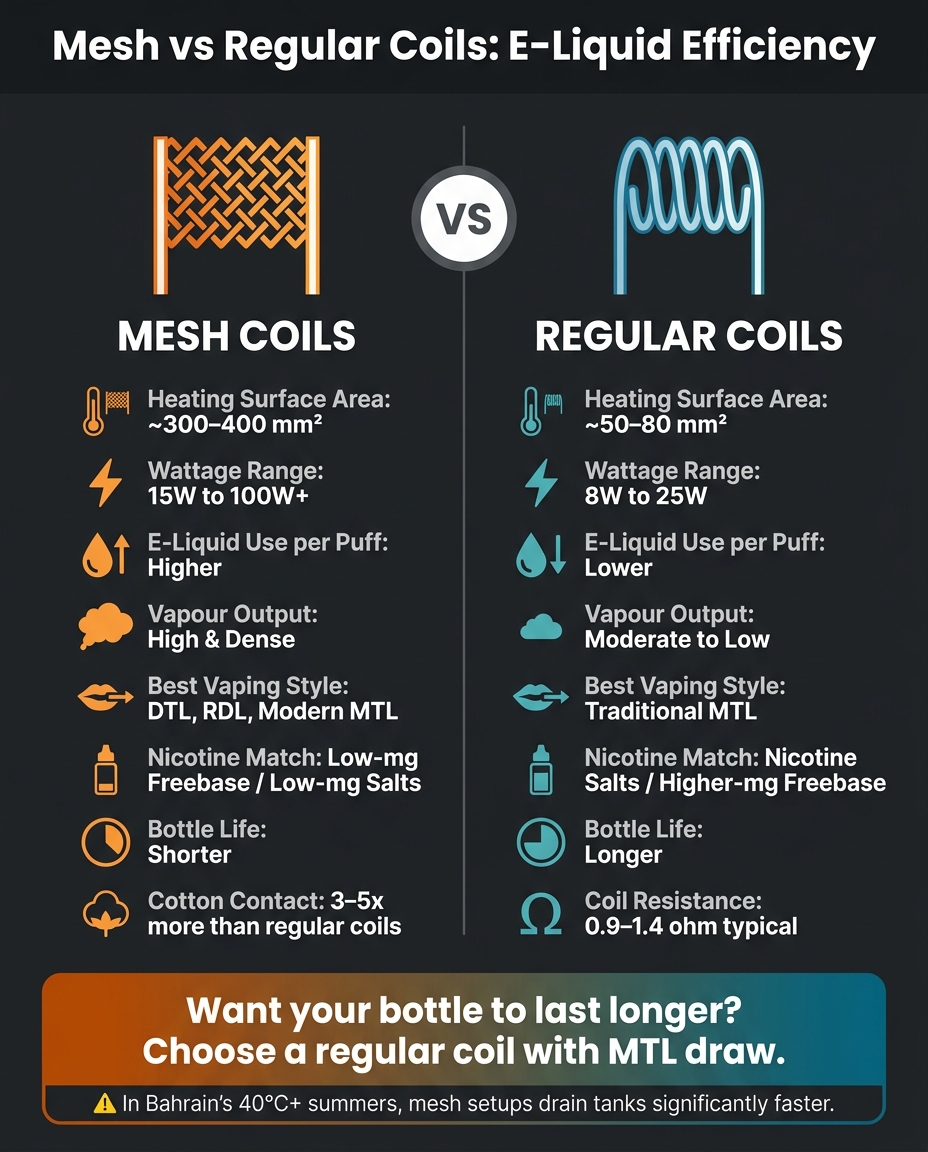
Mesh vs Regular Coils: E-Liquid Efficiency Comparison
| Point | Mesh Coils | Regular Coils |
|---|---|---|
| E-liquid use | Higher | Lower |
| Vapour output | High | Low to medium |
| Power range | 15W to 100W+ | 8W to 25W |
| Best for | DTL, RDL, modern MTL | MTL |
| Nicotine match | Low-mg freebase, low-mg salts | Nic salts vs freebase, higher-mg liquids |
| Bottle life | Shorter | Longer |
If I’m trying to cut refill frequency and make a 30 ml or 60 ml bottle go further, I’d lean toward a higher-resistance regular coil, lower wattage, tighter airflow, and shorter puffs.
How Mesh Coils and Regular Coils Heat E-Liquid
The difference starts with shape, and shape affects how fast e-liquid gets used. A regular coil is a single wire wrapped into a tight spiral. A mesh coil is a flat, perforated metal strip. That one design change explains most of the gap in e-liquid use.
Mesh Coils: Larger Surface Area and Faster, More Even Heating
Because the mesh strip is flat and wide, it presses against a much larger part of the cotton wick at the same time. When you fire the device, heat spreads across the strip almost at once.
"Because the heat is spread across a wider, flat surface, the vaporization process is much more efficient and uniform." – Vaporesso
That even heating vapourises more liquid with each puff, which leads to denser vapour and a tank that empties sooner. Mesh is common in high-power DTL setups, but it also shows up in newer low-wattage pod coils, where brands use it to improve flavour in smaller devices. More output usually means more liquid used, which is why mesh often drains e-liquid faster.
Regular Coils: Smaller Heating Area and Lower Vapour Output
A wound wire spiral only touches the wick along a thin line. Heat builds more in the centre, so the coil warms less evenly. That makes these coils a better fit for smaller, slower puffs. Ramp-up is slower too – usually around 2–3 seconds before the coil reaches its working temperature.
The result is lower vapour output and less e-liquid used per puff. That’s why regular coils work well for mouth-to-lung (MTL) vaping, where the draw is tighter and vapour volume is meant to stay lower. When paired with nicotine salts at higher resistance – usually 0.9–1.4 ohms – a regular coil can still give a satisfying throat hit without needing to vapourise large amounts of liquid. That lower output is the main difference in e-liquid efficiency.
Mesh vs Regular Coils: E-Liquid Consumption Compared
When learning how to use a vape effectively, this shows up in one simple place: how fast your tank runs dry. The way each coil heats e-liquid turns into a refill pattern you’ll notice pretty fast.
| Aspect | Mesh Coils | Regular Coils |
|---|---|---|
| Wattage Range | 15W to 100W+ | 8W to 25W |
| Vapour Output | High and dense | Moderate to low |
| E-Liquid Use per Puff | Higher | Lower |
| Best Nicotine Type | Freebase (low mg) or low-mg salts | Nicotine salts or high-mg freebase |
| Vaping Style | DTL, RDL, and modern MTL | Traditional MTL |
That matters most if you’re trying to make a bottle last longer between refills.
Why Mesh Coils Generally Use More E-Liquid Per Puff
Mesh coils usually have a heating surface of about 300–400 mm², while a standard wire coil sits closer to 50–80 mm². That’s a big gap. More surface area means the mesh touches more of the wick, so each puff pulls through more liquid.
You’ll feel this most in sub-ohm, RDL, and DTL setups that use high-VG freebase e-liquid at higher wattages. Those setups produce more vapour, but they also empty tanks much faster.
Why Regular Coils Can Stretch E-Liquid Further in MTL Vaping
A regular coil at lower wattage just uses less liquid per puff. The smaller heating area, slower ramp-up, and lower vapour output all help keep consumption down.
This is also why higher-resistance coils at lower wattages are often paired with nicotine salt e-liquid. That setup tends to be more efficient with e-liquid use overall. If your goal is to make each refill go further, regular coils are usually the better fit for MTL vaping.
When Low-Wattage Mesh Coils Can Still Be Efficient
Mesh doesn’t always mean heavy e-liquid use. Low-wattage pod mesh coils, usually in the 15W–20W range, sit somewhere in the middle. They can give you better flavour than a standard coil without draining e-liquid like a sub-ohm tank.
So the gap does get smaller here. Even so, low-wattage mesh still tends to use more liquid than a typical MTL coil.
Choosing the Right Coil Type for Your Vaping Style in Bahrain
Matching Coil Type to Freebase, Nicotine Salts, MTL, RDL and DTL
The right pick comes down to how you vape and how often you want to refill.
If you use freebase e-liquid at 3–6 mg/mL for DTL or RDL vaping, mesh coils in the 0.2–0.4 ohm range are usually a good match for flavour and vapour output. The trade-off is simple: that extra output often drains your tank faster.
If you like a tighter MTL draw with nicotine salts up to 20 mg/mL, a regular coil in the 0.9–1.4 ohm range makes more sense. It uses less e-liquid and runs at lower wattage, so each refill tends to last longer.
How Bahrain’s Summer Heat Affects Wicking and Tank Drain
In Bahrain, summer heat can make these differences feel much more obvious.
Bahrain’s summer temperatures can exceed 40 °C, which can thin e-liquid and speed up wicking. In a high-power mesh setup, faster wicking plus the larger heating area can empty a pod or tank much faster than you might expect. That also increases the chance of a dry hit if the liquid level drops without you noticing it.
A simple habit helps here: check your tank more often during summer. It also helps to run your device at the lower end of the recommended wattage range during peak heat. That can slow e-liquid use and help protect the coil. Regular coils usually give you a bit more room before the wick starts to dry out.
Buying Coils and E-Liquids Locally: Refill Frequency and Availability
In Bahrain, easy access to coils and e-liquid can save you a lot of hassle between refills.
VapeShop.bh stocks replacement coils and pods from brands including Vaporesso, VOOPOO, and Uwell, along with a range of e-liquids, with same-day delivery in Bahrain. That matters most if you want to avoid getting caught short when your coil needs changing or your tank is running low.
Reducing E-Liquid Waste and Final Verdict
Adjusting Wattage, Airflow and Puff Length to Use Less E-Liquid
Beyond coil type, three day-to-day habits have the biggest effect on how fast your tank empties.
A few small tweaks can help you use less e-liquid on almost any setup. Try running your coil in the lower to middle part of its rated range. Dropping the power by 5–10W and tightening the airflow a little will usually reduce vapour output and help your e-liquid last longer.
Puff length also makes a difference. Long, back-to-back draws can dry out the wick before it has time to soak up more liquid. Leaving 15–30 seconds between puffs helps lower the risk of dry hits and can reduce wear on the coil.
Coil Care That Protects Flavour and Reduces Waste
When you install a new coil, prime it with 3–5 drops of e-liquid. After filling the tank, wait 5–10 minutes before taking the first puff. It also helps to start at a lower wattage for the first few draws. That simple step may extend coil life by around 20%.
If you want your coil to last longer, it’s smart to avoid heavily sweetened dessert e-liquids. Sweeteners can burn onto the coil, dull the flavour, and shorten coil life. It’s also worth checking O-rings and seals from time to time. Leaks waste e-liquid, and Bahrain’s heat can wear seals out faster.
Conclusion: Mesh for Performance, Regular Coils for Stretching Bottle Life
Once those habits are sorted, coil design is the last big piece of the puzzle.
Mesh coils usually give better flavour and denser vapour, but they also go through more e-liquid. Regular coils tend to use less liquid and are a better match for MTL vaping. So if your main goal is to make each bottle last as long as you can, a regular coil with a tighter MTL draw is usually the smarter pick.
For fast replacements in Bahrain, VapeShop.bh offers same-day delivery on coils and e-liquids, with WhatsApp ordering.
FAQs
Do mesh coils burn out faster?
Usually, yes. Mesh coils tend to last longer than regular wire coils because the mesh heats more evenly. That even heat helps cut down on hot spots, which are a common reason cotton gets scorched.
That said, mesh coils can still burn out fast if you chain vape, push the wattage too high, or skip proper priming. The e-liquid matters too. Using the right viscosity, along with basic upkeep, can help the coil last longer.
Which coil suits nic salts best?
Regular coils are usually the best pick for nicotine salts. They tend to have a higher resistance of 1.0 ohms or more and are built for mouth-to-lung vaping, which gives you that tighter draw and sharper throat hit that many nic salt users like.
They also run well at lower wattages, so they pair nicely with these e-liquids.
Can e-liquid ratio affect coil efficiency?
Yes. The e-liquid ratio affects coil efficiency because it needs to match your device’s wicking ability.
Thicker, high-VG e-liquids tend to work better with larger wicking ports and mesh coils. Thinner 50/50 blends are usually a better fit for smaller, tighter MTL coils.
When the liquid and coil are matched well, the coil stays saturated and performs as it should. That helps reduce dry hits, leaking, flooding, and burnt flavour.
Related Blog Posts
- 5 طرق لإطالة عمر كويلات الفيب
- Mesh Coil vs. Regular Coil Disposable Vapes
- Best Wattage for MTL vs. DTL Vaping
- Best Coils for Temperature Control Vaping
Frequently Asked Questions
Yes, mesh coils usually go through more e-liquid than regular round-wire coils because they heat a much larger area of cotton at once. A mesh strip can contact roughly 3–5 times more cotton, so more juice gets vaporised every time you puff, which is why you see bigger clouds and stronger flavour. If the goal is to stretch a 30 ml or 60 ml bottle, a higher-resistance regular coil at sensible wattage will generally help it last longer.
If you want your e-liquid to last, a regular round-wire coil is usually the better choice. These coils tend to run at lower wattage, make less vapour per puff, and use less liquid overall, so your bottle typically lasts longer compared to mesh. Mesh is better if you care more about vapour and flavour than juice consumption.
Mesh coils are most often used for DTL and RDL styles because they handle higher power and produce more vapour and flavour. Regular coils are usually a better fit for classic MTL vaping, where you use higher-resistance coils, lower wattage, and tighter airflow, which keeps consumption lower. Some modern low-wattage mesh pods narrow the gap, but traditional MTL setups are still usually more e-liquid efficient.
In very hot weather above 40 °C, e-liquid becomes thinner and wicks into the cotton faster, so tanks can empty more quickly. With mesh coils already heating a big area of cotton and using more juice per puff, that effect can be even more noticeable in summer. Keeping wattage reasonable and avoiding long, aggressive pulls can help slow down consumption a bit.
Higher wattage, more open airflow, and long puffs all increase how much liquid you vaporise, whether you use mesh or regular coils. Because mesh coils often run between about 15W and 100W+ and are designed for airy draws, they tend to use more e-liquid in these settings. A regular coil run at lower wattage with tighter airflow and shorter puffs will generally consume less.
Regular coils are usually better for higher nicotine strengths (up to the legal 20 mg/ml limit) because they run at lower power and produce less vapour per puff, making the throat hit and intake easier to manage. Mesh coils pair more naturally with lower-mg freebase or low-mg salts, as the extra vapour can feel too strong with higher nicotine. Matching coil type to your nicotine level helps balance smoothness, satisfaction, and e-liquid efficiency.
Mesh coils often have good longevity because their large, even heating area helps avoid hot spots that burn the cotton quickly. Regular coils can wear faster if heat builds up in one section of the wire, but they are also typically used at lower wattages, which can partly balance that. Coil life in both cases still depends a lot on your wattage, sweetness of the e-liquid, and how often you vape.