
Mesh Coils vs Regular Coils: Pros and Cons


If I want more flavour and thicker vapour, I’d pick mesh. If I want lower e-liquid use, a tighter draw, and better battery life, I’d pick a regular coil.
That’s the whole choice in simple terms. Mesh coils heat more evenly, ramp up almost at once, and often last 14 to 30 days. Regular coils use less power, suit MTL vaping better, and often work well with nicotine salts in the 8 to 20 W range. For many vapers in Bahrain, the best option depends on draw style, wattage, e-liquid ratio, nicotine strength, coil life, and day-to-day cost in BHD.
Here’s the short version:
- Choose mesh coils if you want:
- Stronger flavour
- Denser vapour
- Fast ramp-up
- High-VG e-liquid, such as 70/30
- DTL or restricted DTL draws
- Choose regular coils if you want:
- Lower e-liquid use
- Longer battery life
- A tighter MTL draw
- Nic salts
- 50/50 PG/VG e-liquid
- Watch these points before you buy:
- Coil ohm range
- Device compatibility
- Your wattage range
- Whether you prefer MTL or DTL
- Coil lifespan: 5 to 10 days for many regular coils vs 14 to 30 days for many mesh coils
- Running cost, since mesh can use more liquid per puff
Mesh coil vs standard coil?
sbb-itb-837e7ad
Quick Comparison
| Feature | Mesh Coils | Regular Coils |
|---|---|---|
| Design | Perforated metal strip | Spiral wire |
| Flavour | Stronger | Lighter |
| Vapour | More | Less |
| Ramp-up | Almost instant | Slower |
| E-liquid use | Higher | Lower |
| Battery use | Higher at higher wattage | Lower at low wattage |
| Coil life | 14–30 days | 5–10 days or around 1–2 weeks |
| Best for | DTL / restricted DTL | MTL |
| Best e-liquid | 70%+ VG or mixed use | 50/50 PG/VG, nic salts vs freebase |
| Usual resistance | 0.15Ω–1.0Ω common | 0.7Ω–1.8Ω common |
My view: if I’m buying coils in Bahrain and I care most about cost per day, I’d lean regular. If I care most about flavour per puff, I’d lean mesh. The rest of the article breaks that down in a simple way.
Mesh coils: how they work, what they do well, and where they fall short
A mesh coil uses a flat, perforated metal strip instead of a spiral wire. That wider contact area heats the wick more evenly. You’ll see mesh coils most often in sub-ohm tanks, although they’re showing up in pod systems more often now too.
What mesh coils do better
That one design shift changes a lot in day-to-day use. Mesh coils heat up fast and put out strong flavour. Since the whole surface heats at the same time, ramp-up is almost instant. The flavour also tends to feel stronger and steadier because the e-liquid vaporises evenly instead of in small hot patches.
That even heating helps cut down hot spots too, which can lower the chance of dry, burnt hits. Mesh coils usually last 14 to 30 days, depending on how often you vape and what kind of e-liquid you use. Dual-mesh coils can also outlast standard wire coils.
Where mesh coils are less practical
The same larger surface area that gives mesh its edge also means it uses more e-liquid per puff. So, you’ll usually need to refill more often than you would with a regular coil. In high-wattage setups, battery drain is higher as well.
Mesh coils also tend to work better with an open, airy draw than with a tight, cigarette-style pull. In most cases, they’re a better match for direct-to-lung vaping. That said, mesh is now appearing in tighter MTL devices too, such as the Aspire Nautilus XS 0.7Ω mesh.
Priming matters here. A lot. Because mesh heats almost instantly, a wick that isn’t fully soaked can burn straight away. Add a few drops directly to the cotton ports, fill the tank, and wait at least 5 to 10 minutes before taking your first puff.
For that reason, mesh usually makes more sense in setups built for output rather than saving e-liquid.
When to use mesh coils
Mesh coils make sense if you care most about flavour accuracy, denser vapour, or if you use high-VG e-liquids like 70/30 blends. They’re also a strong fit for cloud chasing and higher-wattage devices. Use mesh when flavour, vapour density, and fast ramp-up matter more than e-liquid efficiency.
Regular coils: how they work, what they do well, and where they fall short
If mesh leans toward output, regular coils lean toward control, lower power use, and a tighter draw. A regular coil uses a single wire wrapped around cotton, which creates a small heating area. Because that area is smaller than mesh, the vape feels more focused and contained. For MTL setups, regular coils usually sit at around 0.7 to 1.8 ohms.
What regular coils do better
High-resistance regular coils – often above 1.0 ohm – are made for lower wattage and a tighter, cigarette-like draw. A lot of setups land in the 8 to 20-watt range. That lower power use also means they go easier on e-liquid, so you won’t need to refill as often. For compact pod devices and low-power vaping, that’s a good fit.
Regular coils also work well with nicotine salts and thinner 50/50 PG/VG e-liquids. Devices like the Uwell Caliburn G 1.0Ω and the Innokin Endura T18E 1.5Ω are built around this style of vape. The tighter draw and sharper throat hit suit nicotine salts, especially in 20 mg to 50 mg strengths, along with thinner 50/50 liquids.
Where regular coils fall short
There’s a trade-off. Because the heat is focused at a few wire contact points, hot spots can show up if the wick isn’t fully saturated. When that happens, the heating becomes uneven, and the cotton can wear out faster. That helps explain why regular coils often last around 5 to 10 days.
Flavour and vapour density also tend to be lower. A regular coil vaporises less liquid at one time because it has less surface area touching the wick. So, at a similar output, the flavour can seem thinner and less layered than mesh. Ramp-up is slower as well, which can make the start of a puff feel a bit weaker.
When to use regular coils
Regular coils make sense if you want a tighter draw, less vapour, and lower power use. Start at the lowest recommended wattage, then move up slowly. That gives you more control and helps cut the risk of scorching the cotton.
Next, compare both coil types side by side.
Mesh coils vs regular coils: side-by-side comparison
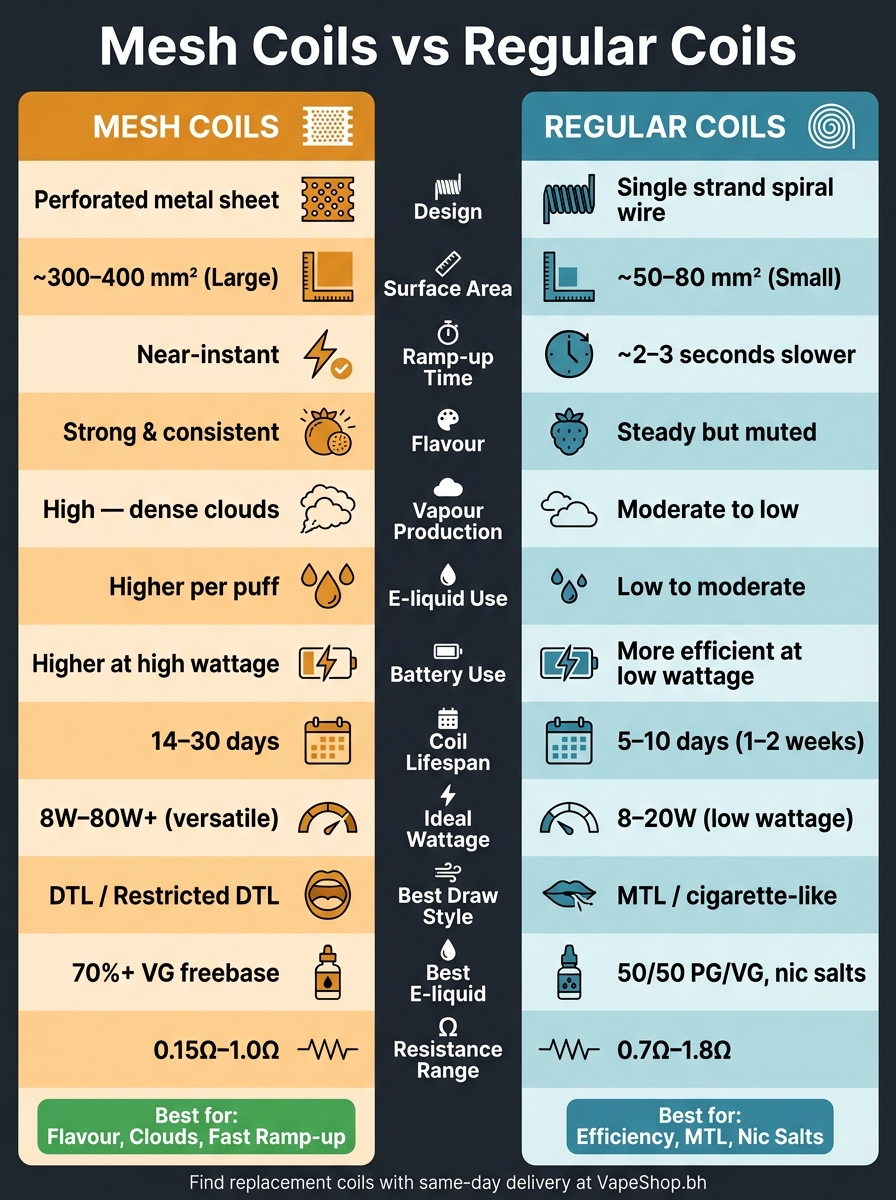
Mesh Coils vs Regular Coils: Full Comparison Chart
The main trade-off is pretty simple: mesh leans toward output, while regular coils lean toward efficiency. If you want a fast, punchy vape with more flavour and thicker clouds, mesh usually wins. If you care more about lower power use and slower e-liquid consumption, regular coils still have a place.
Use the table below to compare both coil types by output, efficiency, and draw style.
| Feature | Mesh Coils | Regular Coils |
|---|---|---|
| Design | Perforated metal sheet | Single strand spiral wire |
| Surface Area | Large – around 300–400 mm² | Small – around 50–80 mm² |
| Ramp-up Time | Near-instant | Slower – about 2–3 seconds longer |
| Flavour | Strong and consistent | Steady but can feel muted |
| Vapour Production | High – dense vapour | Moderate to low |
| Battery Use | Higher, especially at higher wattages | More efficient at low wattages |
| E-liquid Use | Higher – turns more e-liquid into vapour per puff | Low to moderate |
| Lifespan | 14–30 days | 1–2 weeks |
| Ideal Wattage Range | Versatile – MTL to high-wattage DTL | Best for low-wattage MTL |
| Best Draw Style | DTL / Restricted DTL / flavour chasing | MTL / cigarette-like draw |
Pros and cons table for quick decisions
If you just want the short version, this table makes the choice easier.
| Coil Type | Pros | Cons |
|---|---|---|
| Mesh Coils | Superior flavour, faster ramp-up, longer lifespan, fewer dry hits, denser vapour | Uses e-liquid faster, slightly higher cost per unit, can feel too airy for some |
| Regular Coils | Stronger throat hit, cooler vapour, uses less e-liquid, lower upfront cost | Slower ramp-up, shorter lifespan, prone to hot spots, muted flavour |
How to choose based on your device, e-liquid, and vaping style
Your best coil depends on three things: device type, e-liquid, and how you like to inhale.
For MTL, a higher-resistance coil between 0.8Ω and 1.4Ω usually works best. Pair it with choosing the right nicotine strength or a 50/50 PG/VG blend. This setup suits people who want a tighter, cigarette-like draw without burning through battery or liquid too fast.
For DTL, go with 0.15Ω to 0.4Ω mesh coils and use 70%+ VG e-liquid with low-strength freebase nicotine. That setup is better for warmer vapour, more airflow, and bigger clouds.
If flavour matters most, mesh coils in the 0.6Ω to 1.0Ω range tend to hit the sweet spot, especially with a 50/50 or 70% VG liquid. On the other hand, if your goal is to make your battery last longer and keep e-liquid spend down, a regular wire coil at 1.2Ω to 1.8Ω with a 50/50 freebase liquid is the lower-cost option.
Coils are not universal, so always check compatibility before you buy. If you’re shopping in Bahrain, you can confirm coil fit and stock on VapeShop.bh before ordering.
Conclusion: Which coil type suits you
Mesh coils lean toward stronger flavour, denser vapour, and a fast ramp-up. Regular coils lean toward a tighter draw, lower e-liquid use, and better battery life.
So the choice comes down to how you vape. Go with mesh if you prefer DTL, enjoy flavour-focused sessions, or use high-VG freebase liquids. Go with a 1.0Ω to 1.4Ω regular coil if you prefer MTL, use nicotine salts, or want battery life that lasts through the day.
Always prime a new coil before use.
Once you know which coil type fits your setup, the next job is finding the right replacement. For replacement coils and pods in Bahrain, VapeShop.bh offers same-day delivery and WhatsApp ordering, which makes it easy to check fit before you buy.
FAQs
Which coil is best for beginners?
For beginners, the best pick comes down to how you like to vape. If you want something simple, lower-cost, and closer to the draw of a cigarette, a regular wire coil is often the better fit.
If you want faster heat-up and stronger flavour, a mesh coil is a solid place to start. Either way, make sure the coil matches your device and your nicotine preference.
Can I use mesh coils for MTL vaping?
Yes. Mesh coils can be used for Mouth-to-Lung (MTL) vaping.
Regular coils have long been a common pick for MTL. But mesh options now exist for this style too. Higher-resistance mesh coils, such as 0.6–1.0 ohm, work well with the tighter draw and lower wattage that MTL users want.
They also tend to heat up faster and deliver more even flavour from puff to puff.
How do I know if a coil fits my device?
Check your pod or tank manufacturer’s specs first, because coils usually aren’t universal. One of the main things to look at is the resistance, measured in ohms (Ω). You’ll usually find it printed on the coil itself or on the box, and it’s a quick way to spot whether the coil fits your device.
Not sure which one to get? Take a look at the device manual or the original packaging so you don’t end up with the wrong match. You can also browse coil options at VapeShop.bh for a range of devices and fast service across Bahrain.
Related Blog Posts
- Mesh Coil vs. Regular Coil Disposable Vapes
- Best Wattage for MTL vs. DTL Vaping
- Best Coils for Temperature Control Vaping
- Mesh vs Regular Coils: E-liquid Efficiency
Frequently Asked Questions
Mesh coils generally give stronger flavour and denser vapour because they heat more evenly, ramp up almost instantly, and have a larger surface area in contact with the e-liquid. Regular coils use a spiral wire, so they tend to give a lighter vape with less cloud but still work well if you prefer a tighter, more cigarette-like draw.
Mesh coils are usually the better match for DTL or restricted DTL vaping, especially with thicker, high-VG e-liquids like 70/30 blends. Regular coils are more suited to MTL vaping with a tighter draw and typically run well with 50/50 e-liquid and nicotine salts in the 8–20 W range.
Many regular vape coils last around 5–10 days or roughly 1–2 weeks, depending on how often you vape and the wattage you use. Mesh coils often last longer, commonly in the 14–30 day range, because they spread heat more evenly across the wick and are less likely to develop hot spots.
Yes, mesh coils usually use more e-liquid per puff because they vaporise a larger amount of liquid at once to create thicker clouds and stronger flavour. Regular coils are more economical with e-liquid consumption, making them a better option if you want to keep your day-to-day running cost in BHD lower.
Regular coils typically give better battery life because they are designed for lower wattage ranges, often around 8–20 W, and do not demand as much power from your device. Mesh coils work best at higher wattages to deliver dense vapour, so they can drain your battery faster even though they heat very efficiently.
Before choosing, check your coil’s ohm range, whether it is compatible with your device, and the wattage range you normally vape at. It also helps to match the coil to your preferred draw style (MTL or DTL), typical coil lifespan you expect, and your preferred e-liquid ratio and nicotine strength, so your setup suits your daily routine in Manama and beyond.
Regular coils usually work at lower wattages and use less e-liquid, so they tend to be cheaper to run day-to-day when you factor in e-liquid consumption and battery usage. Mesh coils can cost more over time because they often use more liquid per puff, even though many vapers like them for the stronger flavour and longer coil life.