How to Match E-Liquids with Vape Devices


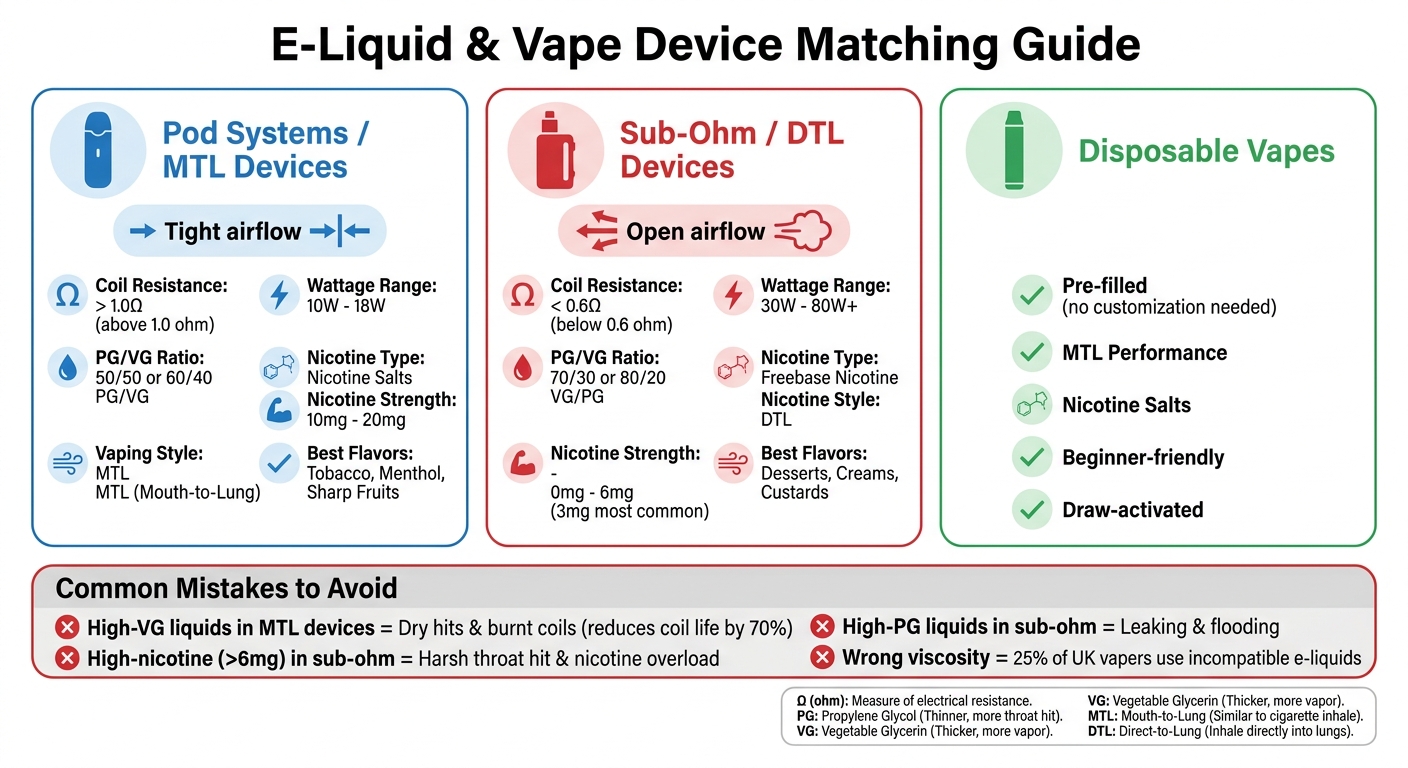
Choosing the right e-liquid for your vape device is essential to avoid burnt coils, poor flavour, and a harsh or weak throat hit. Here’s the main idea: match your device type, coil resistance, and wattage settings with the correct e-liquid properties like PG/VG ratio and nicotine type. Here’s how:
- Pod Systems/MTL Devices: Best with high-PG e-liquids (50/50 or 60/40) and nicotine salts or freebase (10mg–20mg). Ideal for smooth hits and tight airflow.
- Sub-Ohm/DTL Devices: Work well with high-VG e-liquids (70/30 or 80/20) and low-strength freebase nicotine (0mg–6mg). Perfect for big vapour clouds and rich flavours.
- Disposable Vapes: Pre-filled and beginner-friendly, providing MTL performance with nicotine salts.
Avoid common mistakes like using high-VG liquids in MTL devices (causes dry hits) or high-nicotine e-liquids in sub-ohm setups (leads to harshness or nicotine overload). Proper pairing ensures better performance, flavour, and coil longevity.
Want smooth vaping? Stick to the right e-liquid for your device!
E-Liquid and Vape Device Compatibility Guide
Vaping 101 – Aegis X Zeus Beginners Guide
sbb-itb-837e7ad
Types of Vape Devices
Choosing the right e-liquid starts with knowing your device – whether it’s designed for flavour-focused MTL vaping or the power-packed experience of DTL sessions. Understanding your device type is crucial for making the right choice. Vape devices generally fall into three categories, each tailored to a specific vaping style and e-liquid compatibility.
Pod Systems and MTL Devices
Pod systems are compact and user-friendly devices that use detachable pods. They’re designed for mouth-to-lung (MTL) vaping, where the vapour is drawn into the mouth first before being inhaled into the lungs, mimicking the sensation of smoking a cigarette. These devices typically feature high-resistance coils (0.7Ω and above) and operate at lower wattages, usually between 10W and 18W.
A standout example is the Vaporesso XROS 3, a refillable pod system praised for its lightweight build and dependable performance as of April 2026. Pod systems come in two main types: "closed" systems that use prefilled pods and "open" systems that allow users to refill with their own e-liquid. These devices are particularly well-suited for nicotine salts, as their lower power output provides a smooth throat hit even with higher nicotine levels. This makes them a natural match for nicotine salt e-liquids, which will be discussed further in later sections.
Sub-Ohm and DTL Devices
Sub-ohm devices are larger, more powerful setups designed for those who prefer direct-to-lung (DTL) vaping. With this style, vapour is inhaled directly into the lungs, similar to taking a deep breath. These devices use low-resistance coils (below 0.6Ω) and typically operate at wattages above 30W.
The SMOK Morph 3 is a popular choice in this category, offering up to 230W of power for advanced vapers looking for maximum customisation. Sub-ohm devices often feature wide-bore drip tips and adjustable airflow systems, making them ideal for producing dense clouds of vapour. They pair best with high-VG e-liquids and low-nicotine freebase formulations, which will be explored in more detail later.
Disposable Vapes
Disposable vapes are the most straightforward option for beginners. These devices come prefilled with e-liquid and don’t require any maintenance or pairing decisions. Once depleted, they are simply discarded. Most disposable vapes are draw-activated, offering an MTL experience.
A notable example is the Geek Bar Pulse 15000, a disposable vape featuring a "pulse mode" for stronger hits and a futuristic design. Modern high-capacity disposables, often referred to as "Big Puff" devices, can deliver between 6,000 and 35,000 puffs by combining a 2ml pod with a larger integrated refill system. Understanding their MTL design can help users seamlessly transition to refillable systems when they’re ready.
With the basics of device types covered, the next step is diving into e-liquid properties, starting with PG/VG ratios.
PG/VG Ratios and Device Compatibility
When it comes to vaping, knowing the makeup of your e-liquid is just as important as choosing the right device. E-liquids are made up of Propylene Glycol (PG) and Vegetable Glycerin (VG), and the balance between these two ingredients determines how well your device performs. PG is thinner and delivers a stronger throat hit along with better flavour intensity, while VG is thicker, sweeter, and creates bigger vapour clouds with a smoother inhale. Using the wrong PG/VG ratio can lead to issues like leaking, dry hits, or even burnt coils, so it’s essential to match the ratio to your device.
High-PG E-Liquids for MTL Devices
Devices designed for mouth-to-lung (MTL) vaping, like pod systems and vape pens, work best with high-PG e-liquids. Ratios such as 50/50 or 60/40 PG/VG are ideal, as they wick efficiently through the small coil ports found in these devices. High-PG blends also provide a more noticeable throat hit, making them a good choice for those transitioning from smoking.
"High PG e-liquids always perform well in MTL vape devices as they have a thinner consistency and provide an increased throat hit." – E-liquids.com
On the flip side, using high-VG e-liquids in MTL devices can lead to poor wicking, resulting in dry hits and premature coil burnout. For coils with resistances above 1.0 ohm, sticking to high-PG ratios ensures better performance and extends the life of your coil.
High-VG E-Liquids for Sub-Ohm Devices
Sub-ohm devices, on the other hand, are built for thicker e-liquids, with VG/PG ratios like 70/30 or 80/20. These devices feature larger wicking ports and operate at higher wattages, which makes them perfect for vaporizing thicker liquids. High-VG e-liquids are also great for producing dense vapour clouds and work especially well with dessert or bakery flavours, thanks to VG’s natural sweetness.
"If you’re into cloud chasing, 70% VG / 30% PG is an excellent choice. The high VG content delivers larger clouds and a smoother inhale." – Elena Schmidt, Writer, Velvet Cloud
Using high-PG liquids in sub-ohm devices can cause problems like leaking or flooding, as the thinner liquid escapes too quickly through the airflow vents. For coils below 0.4Ω, high-VG blends are the way to go, ensuring proper wicking and vaporization without any mess.
| Device Type | Recommended PG/VG Ratio | Coil Resistance | Vaping Style |
|---|---|---|---|
| Pod Systems / Vape Pens | 50/50 or 60/40 PG/VG | > 1.0 ohm | MTL (Mouth-to-Lung) |
| Sub-Ohm Tanks / Mods | 70/30 or 80/20 VG/PG | < 1.0 ohm | DTL (Direct-to-Lung) |
| Advanced Pod Kits | 50/50 to 70/30 VG/PG | 0.4 – 0.8 ohm | RDL (Restricted DTL) |
Up next, we’ll explore how different nicotine types can further enhance your vaping experience.
Selecting Nicotine Type and Strength
Once you’ve matched your PG/VG ratio with your vaping device, the next step is choosing the right nicotine type and strength. This decision depends on your device’s power output and coil resistance. For example, nicotine salts work best with low-wattage pod systems that use coils with a resistance of 1.0Ω or higher. On the other hand, freebase nicotine is ideal for high-wattage sub-ohm devices with coils below 1.0Ω. Choosing the wrong combination could result in either a weak hit or nicotine overload, which might cause symptoms like nausea, headaches, jitters, or a racing heart.
The key difference between nicotine salts and freebase nicotine lies in their chemical structure and how quickly they are absorbed. Nicotine salts are absorbed into the bloodstream 30% to 40% faster, typically within 6 to 20 seconds, compared to freebase nicotine.
Nicotine Salts for Pod Systems
Nicotine salts are well-suited for pod systems and mouth-to-lung (MTL) devices. These devices operate at low wattages, usually between 10W and 18W, and use high-resistance coils, typically between 1.0Ω and 1.4Ω. For these setups, nicotine strengths ranging from 10mg to 20mg provide smooth hits and efficient nicotine delivery.
"Nicotine salts are perfect for vape pod systems. With lower power output, higher resistance, and a smaller coil, this combination puts out smaller clouds with a higher concentration of atomized nicotine." – Aaron Cadena, Guide Author, Juice Head
If you’re moving from smoking or disposable vapes to a pod system, nicotine salts in the 10mg to 20mg range can closely mimic the nicotine delivery you’re accustomed to. However, keep in mind that nicotine salts are smoother and lack the throat harshness typically associated with freebase nicotine. This "smoothness" can lead to more frequent puffing if you’re not careful.
Freebase Nicotine for Sub-Ohm Devices
For sub-ohm devices, lower nicotine strengths – usually between 0mg and 6mg – are the way to go. These high-wattage devices, which typically operate at 25W to 80W or more, produce much larger vapour clouds. As a result, you inhale more nicotine with each puff, so higher strengths can lead to nicotine overload, with symptoms like nausea, headaches, and jitters.
"Freebase nicotine is generally the eJuice of choice for the larger mod-paired atomizers and sub-ohm devices." – Aaron Cadena, Guide Author, Juice Head
To achieve the best experience, pair 3mg or 6mg freebase nicotine with a 70/30 VG/PG ratio. This combination ensures rich flavour and thick vapour clouds without excessive harshness, making it a popular choice for direct-to-lung (DTL) vaping.
| Nicotine Type | Common Strengths | Best Vaping Style | Recommended Hardware |
|---|---|---|---|
| Freebase | 0mg, 3mg, 6mg | Direct-to-Lung (DTL) | Sub-ohm tanks, high-wattage mods |
| Nicotine Salt | 10mg, 20mg, 35mg, 50mg | Mouth-to-Lung (MTL) | Low-wattage pod kits, disposables |
Matching Flavors to Device Types
Choosing the right e-liquid flavor for your vape device isn’t just about personal preference – it’s also about understanding how your setup affects taste. The same flavor can taste completely different depending on the device you use. For instance, a strawberry-menthol blend might feel crisp and cool on a mouth-to-lung (MTL) pod, but on a sub-ohm tank, it leans sweeter and warmer. This happens because of variations in device temperature and airflow. Devices with lower wattage (10–20W) and tighter airflow emphasize sharper, cooler flavors, while higher wattage setups (30W+) bring out sweeter, warmer notes.
Flavors for MTL Devices
MTL devices are ideal for tobacco, menthol, and sharper fruit flavors. The tighter airflow in these devices enhances the chill of menthol and preserves the earthy tones of tobacco. Plus, their lower wattage helps maintain the natural essence of these flavors. Another advantage? MTL devices cool down faster between puffs, which means menthol flavors stay crisp and clean.
"Lower wattage (10–20W) [provides] more defined flavour layers… better for tobacco, menthol, and sharper fruits." – Beth Hines
For the best results, pair these flavors with a 50/50 PG/VG ratio. This balance ensures optimal performance and clear flavor delivery.
Flavors for Sub-Ohm Devices
Sub-ohm devices shine with dessert, cream, and rich custard flavors. Their higher operating temperatures amplify sweetness and create a smooth, velvety mouthfeel that complements these profiles. Larger tanks, which retain heat longer, further enhance the depth of dessert blends, making sweet fruit flavors taste bolder and more vibrant.
That said, thick, high-VG dessert liquids aren’t suitable for low-wattage pod systems. These liquids may not wick properly through the smaller coil ports, leading to muted flavors – or worse, burnt coils. To avoid this, use a 70/30 VG/PG ratio in sub-ohm setups. This ensures proper wicking, maximizes vapor production, and deepens the flavor experience.
How to Optimize Your Vaping Setup
Getting the most out of your vaping experience goes beyond just picking the right e-liquid. Fine-tuning your device settings and keeping your equipment in good condition are essential for improving both performance and flavor.
Adjusting Wattage and Airflow
The wattage you use should match the thickness of your e-liquid. For thicker, high-VG liquids, higher wattage is better, while thinner, high-PG blends work best at lower wattages. Check the recommended wattage range printed on your coil – this is your guide. Vaping below this range can lead to weak flavor, while going too high may ruin the flavor or even result in harsh, burnt tastes.
"Staying within [the recommended wattage] range ensures the e-liquid is vaporised efficiently, delivering a rich and full flavour." – Peter Lam, Author, Vapecould
Start at the lowest recommended wattage and gradually increase by 5W every 15–20 puffs until you find the sweet spot. For mouth-to-lung (MTL) devices, wattage typically ranges between 10–18W with coils over 1.0Ω. On the other hand, direct-to-lung (DTL) setups often require 25–80W or more, especially with sub-ohm coils below 0.6Ω.
Airflow also plays a big role in your vaping experience. A tighter airflow setting is ideal for MTL devices, as it enhances flavor. For sub-ohm setups, a more open airflow produces larger vapor clouds. If you’re using mid-range coils (0.4–0.8Ω), slightly restricting the airflow can create a Restricted Direct-to-Lung (RDTL) effect, offering a balance between flavor and vapor production.
Once your wattage and airflow are dialed in, the next step is to ensure proper coil priming to avoid dry hits and extend the life of your coil.
Priming Coils and Preventing Dry Hits
If you’ve ever experienced a burnt taste while vaping, improper coil priming might be the culprit. To avoid this, follow these steps when installing a new coil:
- Apply 3–4 drops of e-liquid to each cotton port on the side of the coil and 2–3 drops to the visible cotton at the top.
- After filling your tank or pod, allow 10–20 minutes for the cotton to fully saturate. For high-VG liquids, wait an extra 5 minutes to ensure complete absorption.
The material of your coil also affects the priming time. Wire coils need about 10 minutes, mesh coils require 15 minutes, and ceramic coils need a full 20 minutes. For fixed pod systems where you can’t directly access the coil, simply fill to the designated line and wait 15 minutes before use.
Once your coil is primed, start vaping at the lowest wattage setting. Take 5–6 gentle puffs, gradually increasing the power to avoid burning the wick during the break-in period.
Keep in mind that high-VG liquids don’t work well with high-resistance MTL coils that have small wicking ports, as the thicker liquid may not absorb properly. Similarly, avoid using 50/50 blends in sub-ohm coils, as this can cause flooding or leakage. Always maintain the e-liquid level above the wicking holes and avoid chain-vaping on a new coil to extend its lifespan and keep your device running smoothly.
Common E-Liquid Pairing Mistakes to Avoid
Even with the best vaping device, using the wrong e-liquid can ruin the experience. In the UK, around 25% of vapers have admitted to using e-liquids that don’t suit their device, often resulting in malfunctions and wasted money. These mistakes not only hurt performance but can also shorten your device’s lifespan. The most frequent errors involve mismatched PG/VG ratios and overly strong nicotine levels.
Wrong PG/VG Ratios
One of the most common issues is using high-VG e-liquids in MTL (mouth-to-lung) or pod systems. High-VG liquids are too thick to flow properly through the small wicking ports of high-resistance coils (ranging from 0.8Ω to 1.8Ω). This can lead to dry hits, a burnt taste, and poor flavour. In fact, using the wrong e-liquid for your device can cut coil life by as much as 70%.
"Wrong liquid viscosity is the leading cause of burnt taste in vapes. When high-VG liquid can’t wick fast enough in a mouth-to-lung device, the cotton burns." – Ullah Sami, Vape Offers
On the flip side, high-PG liquids in sub-ohm devices can cause over-saturation of coils with larger wicking ports. This often results in leaking, spitback, and an overly harsh throat hit when heated at high wattages. To get the best performance, always match the e-liquid’s viscosity to your coil’s resistance.
High-Nicotine E-Liquids in Sub-Ohm Devices
Beyond viscosity, nicotine strength is another critical factor. Using high-strength nicotine (above 6mg), especially nicotine salts, in sub-ohm devices can be problematic. Sub-ohm coils (below 0.7Ω) operate at high wattages (25–80W or more), producing large vapour clouds that deliver nicotine much more efficiently. This can lead to an unintended nicotine overdose, with symptoms like nausea and throat irritation.
"Using high nicotine e-liquids (above 6mg) in sub-ohm devices can cause severe throat irritation. They may also lead to nausea and symptoms of nicotine poisoning." – Ullah Sami, Author
For sub-ohm vaping, stick to nicotine levels between 0mg and 6mg of freebase nicotine, with 3mg being the most commonly preferred option. If you’re switching from MTL to sub-ohm vaping, keep in mind that the increased vapour production means you’ll need much less nicotine to feel satisfied.
Conclusion
Choosing the right e-liquid for your vape device isn’t just about personal taste – it’s key to getting the most out of your setup. MTL (mouth-to-lung) devices thrive on 50/50 PG/VG ratios and nicotine salts, while sub-ohm kits demand high-VG liquids and low-strength freebase nicotine. If you mismatch these, you’re likely to face burnt coils, harsh throat hits, and wasted money.
"Pairing your e-liquid with the right vape kit is essential to achieving the best vape experience. Your choice of device, PG/VG ratio, and nicotine strength will directly affect the flavour and throat hit." – Daire John Patten, Vaping Expert
The basics are simple: know your coil resistance, pair it with the right PG/VG ratio, and select nicotine strength based on your device’s wattage. Don’t skip the small details – prime your coils, adjust wattage within the recommended range, and keep your tank clean. These steps can save you from most common issues and even extend your device’s lifespan.
Whether you’re moving from disposables to refillable pods or stepping up to a sub-ohm mod, VapeShop.bh has everything you need. From a wide selection of e-liquids to advanced devices, they’ve got you covered across Bahrain. Plus, with same-day delivery and 24/7 WhatsApp support, expert advice is always just a message away. Visit VapeShop.bh to explore products tailored to your vaping style.
Getting the right match turns vaping into a smooth and enjoyable experience. By understanding your device’s needs, you’ll unlock better flavour, smoother hits, and coils that last longer.
FAQs
How do I know if my coil is MTL or sub-ohm?
You can figure out whether a coil is MTL (mouth-to-lung) or sub-ohm by looking at its resistance and how it’s meant to be used.
- MTL coils usually have a resistance of over 1 ohm and are made for a tighter draw, similar to smoking a cigarette.
- Sub-ohm coils, on the other hand, have a resistance below 1 ohm. They’re designed for bigger vapour clouds and a more open, airy draw.
For exact details, check the packaging of the coil – it often includes all the information you need.
What should I change first if my vape tastes burnt or dry?
If your vape starts tasting burnt or dry, the first thing to inspect is the coil. If it’s worn out or burnt, replace it with a new one. Make sure the replacement coil is compatible with your device. Additionally, check that the coil’s resistance aligns with your vaping style and wattage settings; using the wrong coil can lead to that unpleasant burnt flavour. Taking care of your coil properly can help prevent these problems.
Can I switch between nic salts and freebase in the same device?
Yes, but it largely depends on your device and the resistance of its coil. Nicotine salts (nic salts) are ideal for low-wattage devices paired with higher-resistance coils, while freebase nicotine is more versatile and works with a broader range of devices. To get the best performance, check your vape kit’s wattage limits and coil specifications. Make sure your device is compatible with both types to prevent potential damage or a less-than-ideal vaping experience.
Related Blog Posts
- كيفية اختيار الفيب المناسب للمبتدئين
- حل مشكلة الطعم المحروق في الفيب
- 5 Tips for Choosing Nicotine Strength as a Beginner
- Freebase vs Salt Nic: Device Compatibility Guide
Frequently Asked Questions
Pod systems and MTL devices pair best with high-PG e-liquids like 50/50 or 60/40 ratios for optimal flavour and throat hit. These thinner liquids wick properly in higher resistance coils, avoiding burnt tastes or leaks. In Bahrain, stock up on compatible e-liquids at VapeShop.
MTL devices mimic smoking with a tight draw and work best with 50/50 or high-PG e-liquids, including nicotine salts up to 20mg/ml. This setup delivers strong flavour and nicotine satisfaction without harshness on lower wattage coils. Check coil resistance above 0.7Ω for the best results.
Sub-ohm vaping with coils below 1.0Ω requires high-VG e-liquids like 70/30 or max VG for thick clouds and smooth inhales on higher wattage devices. Thicker liquids need strong wicking from mesh or sub-ohm tanks to prevent dry hits. Pair with lower nicotine freebase for comfort.
Nicotine salts suit MTL pod systems with higher resistance coils and 50/50 e-liquids for a smooth throat hit up to 20mg/ml. Freebase nicotine fits sub-ohm DTL devices better with high-VG mixes and lower strengths to avoid overwhelming nicotine delivery. Match based on your coil resistance and device power.
Coil resistance, measured in ohms (Ω), determines wattage needs and e-liquid compatibility—higher than 1.0Ω pairs with 50/50 PG/VG for MTL. Lower resistance under 0.6Ω needs high-VG liquids for DTL sub-ohm setups to produce vapor without burning. Always check your device's coil specs first.
Not all e-liquids suit pod kits; stick to 50/50 PG/VG ratios or nicotine salts for coils around 0.8-1.8Ω to ensure good wicking and flavour. High-VG liquids cause poor performance or coil damage in pods. VapeShop.
Freebase nicotine works well in higher resistance coils over 1.0Ω with 50/50 e-liquids for MTL pods, or lower strengths in sub-ohm for DTL. It provides a stronger throat hit than salts, suiting ex-smokers transitioning. Avoid high strengths in low-resistance setups to prevent harshness.