

How To Spot E-Liquid Sensitivity Reactions


Stop vaping if symptoms start, and do not take another puff to test the cause. For breathing difficulty, worsening wheeze, mouth or throat swelling, faintness, or hives that spread quickly, call 999 in Bahrain immediately.
Dryness, coughing, rash, headache or nausea after vaping can have several causes. Symptoms alone do not prove an allergy.
To help a clinician assess what happened:
- Record the pattern: when symptoms began, how long they lasted and whether they eased after stopping.
- Save product details: ingredients, nicotine strength in mg/mL, PG/VG ratio, batch number and label photos.
- Note recent changes: liquid, flavour, device, coil, settings or vaping frequency.
- Set the device aside: check for leaks or damage without firing it. Follow the maker’s cleaning instructions, but do not treat cleaning as permission to try again.
Seek medical advice if symptoms persist or return. Notes and packaging can help – but care should never wait for a completed symptom log.
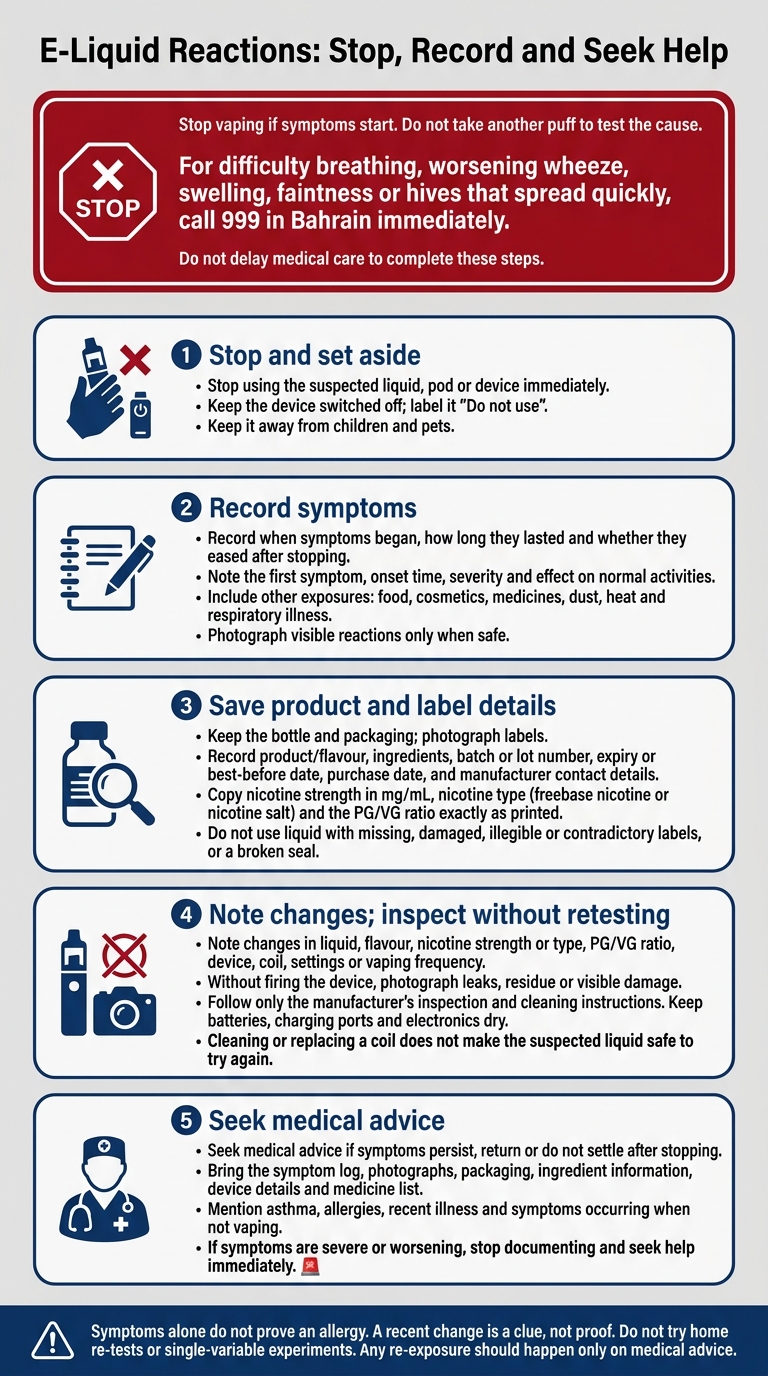
E-Liquid Reactions: Stop, Record and Seek Help
Check Ingredients and Labels
Compare the exact liquid you used with your symptom log, including when each reaction occurred. Use label details to narrow down possible triggers – not to diagnose the cause.
Check the bottle, outer box and label together. Record the batch or lot number, expiry or best-before date, PG/VG ratio, and manufacturer’s name and contact details. These details help link a particular liquid to a reaction pattern. Add the purchase date and take photos of the labels to bring to a medical appointment.
Check that the label matches what you used.
Do not use liquid with missing, damaged, illegible or contradictory labels, or a broken seal. Ask the manufacturer about missing ingredient or batch details, and keep the bottle and packaging. Never try to identify an unclear liquid by tasting it or taking a puff.
Review PG, VG, Nicotine and Flavourings
| Ingredient to inspect | What it may suggest | Why it is limited |
|---|---|---|
| Propylene glycol (PG) | Can contribute to dryness or throat irritation | Symptoms do not prove PG sensitivity |
| Vegetable glycerine (VG) | Check the stated PG/VG ratio | High VG does not mean PG-free unless the label says so |
| Nicotine | Changes in strength or exposure may accompany nausea, headache or dizziness | These symptoms have several possible causes |
| Flavourings | Record fruit, mint, menthol, spice or nut-related descriptions | Labels may not disclose every compound; flavour names do not establish allergen content |
Write nicotine strength in mg/mL, rather than using a description such as “strong” or “salt”. Note whether the label states freebase nicotine or nicotine salt, and copy the PG/VG ratio exactly as printed.
Flavouring carriers may contain PG, while labels may list only nicotine, PG and/or glycerol. A clinician or pharmacist may need more detailed information from the manufacturer to investigate a suspected reaction.
“Food-grade” does not mean safe to inhale as aerosol. A substance that is suitable to eat is not necessarily safe when heated and inhaled as an aerosol. “Natural” flavouring claims do not settle that uncertainty either.
Keep these details ready before checking for recent product changes.
sbb-itb-837e7ad
Review Recent Changes Without Retesting
If the label and ingredients don’t explain the reaction, look at what changed before symptoms began.
Stop using the suspected e-liquid. Compare your symptom log with changes in flavour, nicotine strength or type, PG/VG ratio, device format, choosing the right coil resistance, power or temperature, and vaping frequency.
A flavour switch may happen alongside other changes, so flavour alone cannot identify the cause. Separate product changes from device changes, and note any dry hits, unusual taste, device heat, or leaks.
Compare Product History
Compare receipts, label photos, packaging, notes, and device history with your last symptom-free use. A recent change is a clue, not proof. Record any repeated symptoms linked to the same product.
Previous tolerance does not guarantee future safety, including with a new flavour or nicotine-free liquid. If symptoms improved after a switch you already made, record it – but don’t treat that improvement as proof of the cause.
Seek urgent medical help for breathing difficulty, chest pain, facial or throat swelling, fainting, or severe vomiting. Do not try home re-tests or single-variable experiments. Any re-exposure should happen only on medical advice.
If product changes still don’t explain the symptoms, check the device and coils next.
Check and Clean the Device
Keep the device switched off and set it aside. A leaking pod or burnt coil can cause irritation that feels like sensitivity. Checking the device helps separate device-related irritation from a possible e-liquid reaction, but cleaning cannot confirm the cause. It only deals with device contamination. Photograph any residue, leaks or visible damage before cleaning.
Follow the Manufacturer’s Cleaning Instructions
Disconnect the charger, detach the tank or pod, and dispose of leftover e-liquid as directed. Remove only parts the manufacturer says you can remove. Wash only removable parts marked as washable, following the method in the manual. Let them air-dry fully before putting the device back together.
Keep batteries, charging ports and electronics dry. Never immerse them. Use a dry cloth or cotton bud on safely accessible contact points, but only where the manufacturer permits it. Do not wash sealed pods, open sealed devices or use household cleaners unless the manufacturer approves them.
Inspect Coils, Pods and Leaks
Without firing the device or test-vaping, look for damaged wicks, cracked glass, loose seals and liquid around filling ports, airflow openings and beneath the pod. Leaks and burnt coils can mimic a sensitivity reaction. Residue, leaks and burnt wicks can also change what you taste and feel.
Follow the manufacturer’s replacement guidance for vape accessories if you notice a burnt taste, lingering flavour residue, damage or repeated leaks. A pod with an integrated coil generally needs replacing as a whole unit. Cleaning cannot restore burnt cotton.
Wash e-liquid off exposed skin promptly with soap and water. Stop handling any vape device that is hot, swollen or electrically damaged. Check the instructions for your exact model to confirm the correct parts and cleaning method. Replacing a coil or pod does not make a suspected e-liquid safe to try again.
If the device looks intact and symptoms continue, record them before speaking to a clinician.
Track Symptoms and Seek Medical Advice
If a safety check of your device did not explain your symptoms, record what happened before seeking medical advice. Do not delay care to complete your notes.
A symptom log helps a healthcare professional assess timing and possible triggers. It cannot prove that an ingredient caused your symptoms.
Keep a Short Symptom Log
Copy this template into your phone or notebook. Use dates and 24-hour times, and copy product details exactly as printed.
Date/time | Product/flavour/batch | Nicotine mg/mL and PG/VG | Device, coil/pod age | Puffs or sessions before stopping | Symptoms and onset | Mild/moderate/severe | Duration and what you did | Other exposures Note your first symptom, its exact start time and whether it changed after you stopped vaping. Describe how symptoms affected your normal activities, using the severity rating only as a brief summary.
Include food, cosmetics, medicines, dust, heat and respiratory illness, with the timing of each exposure. Photograph visible reactions when safe, and keep the packaging and batch details – but never delay medical care to do so.
Use the log to show whether symptoms follow use of a particular liquid or device, or another exposure.
Prepare for a Medical Appointment
Seek medical advice if symptoms persist, return or do not settle after stopping. Bring your log, photographs, ingredient information, packaging, device details and medicine list.
Mention asthma, allergies and recent illness. Explain whether symptoms also happened when you were not vaping. These records help a clinician assess ingredient sensitivity, nicotine effects, infection or other causes, and decide whether you need specialist investigation.
If symptoms are severe or worsening, stop documenting and seek help immediately.
Seek prompt assessment for shortness of breath or chest pain after vaping. Call 999 in Bahrain for sudden mouth, tongue or throat swelling; difficulty breathing or swallowing; blue, grey or very pale lips or skin; confusion or collapse. These can be signs of anaphylaxis. Get emergency help immediately.
Stop, Record and Avoid Re-Exposure
Stop using the suspected liquid, pod or device immediately. Set it aside, label it “Do not use” and keep it away from children and pets.
Note when you stopped using it and how your symptoms changed. Keep the bottle, packaging and ingredient list, and follow essential safety tips for handling e-liquids. Do not try it again to test whether it caused your symptoms.
Seek medical advice if symptoms persist or return. These steps can help narrow down possible causes, but they cannot provide a diagnosis.
If symptoms worsen, seek emergency help straight away. For difficulty breathing, worsening wheeze, swelling, faintness or hives that spread quickly, call 999 in Bahrain immediately. Do not drive yourself if symptoms are severe.
FAQs
How soon can e-liquid sensitivity symptoms appear?
Symptoms may start soon after use. Sensitivity to propylene glycol or certain flavourings can cause immediate throat irritation, coughing or dry mouth. Mild nicotine reactions, such as hiccups or a warm feeling in the throat, usually fade within 30–60 minutes.
When trying a new e-liquid, start with a small amount and monitor how you feel over the next few hours. Stop using the product if you notice unusual symptoms. If they persist, consult a healthcare provider.
Can a sensitivity develop after months of symptom-free vaping?
Yes. Sensitivity to e-liquid ingredients, such as propylene glycol (PG) or certain flavourings, can develop over time – even after months without symptoms. Signs can include throat irritation, coughing or other breathing discomfort.
If symptoms appear unexpectedly, stop using the product, note your usage patterns and speak to a healthcare professional. VapeShop.bh offers e-liquids and guidance on choosing a formulation.
Can allergy tests identify an e-liquid trigger?
A healthcare provider can help work out whether your symptoms point to an allergy to specific e-liquid ingredients, a sensitivity, an intolerance or another issue. Describe your symptoms and tell them you use vaping products so they can give you appropriate guidance.
Related Blog Posts
- How Vaping Affects Lung Health
- DIY E-Liquid Safety Guide: 10 Rules
- Vape Battery Blinks: What It Means
- 7 E-Liquid Additives and What Each One Does
{“@context”:”https://schema.org”,”@type”:”FAQPage”,”mainEntity”:[{“@type”:”Question”,”name”:”How soon can e-liquid sensitivity symptoms appear?”,”acceptedAnswer”:{“@type”:”Answer”,”text”:”Symptoms may start soon after use. Sensitivity to propylene glycol or certain flavourings can cause immediate throat irritation, coughing or dry mouth. Mild nicotine reactions, such as hiccups or a warm feeling in the throat, usually fade within 30–60 minutes. When trying a new e-liquid, start with a small amount and monitor how you feel over the next few hours. Stop using the product if you notice unusual symptoms. If they persist, consult a healthcare provider.”}},{“@type”:”Question”,”name”:”Can a sensitivity develop after months of symptom-free vaping?”,”acceptedAnswer”:{“@type”:”Answer”,”text”:”Yes. Sensitivity to e-liquid ingredients, such as propylene glycol (PG) or certain flavourings, can develop over time – even after months without symptoms. Signs can include throat irritation, coughing or other breathing discomfort. If symptoms appear unexpectedly, stop using the product, note your usage patterns and speak to a healthcare professional. VapeShop.bh offers e-liquids and guidance on choosing a formulation.”}},{“@type”:”Question”,”name”:”Can allergy tests identify an e-liquid trigger?”,”acceptedAnswer”:{“@type”:”Answer”,”text”:”A healthcare provider can help work out whether your symptoms point to an allergy to specific e-liquid ingredients, a sensitivity, an intolerance or another issue. Describe your symptoms and tell them you use vaping products so they can give you appropriate guidance.”}}]}
Frequently Asked Questions
Dryness, coughing, rash, headache or nausea may occur after vaping, but these symptoms alone do not prove an allergy. Stop vaping if symptoms start and do not take another puff to test the cause. Seek medical advice if symptoms persist or return.
Stop vaping immediately and set the device aside without firing it. Record when the symptoms began, how long they lasted and whether they eased after stopping. For breathing difficulty, worsening wheeze, mouth or throat swelling, faintness or rapidly spreading hives, call 999 in Bahrain.
Symptoms such as a rash, cough, dryness, headache or nausea do not confirm an e-liquid allergy. Save the bottle and outer box, then record the ingredients, nicotine strength in mg/mL, PG/VG ratio, batch number, expiry or best-before date and label details for a clinician.
PG/VG irritation is one possible explanation for coughing or dryness after vaping, but symptoms can have several causes. Note the exact liquid, flavour, device, coil, settings and vaping frequency, and use the information to help a clinician assess the reaction rather than diagnosing it yourself.
Dryness, coughing, rash, headache and nausea should be noted, especially if they return after vaping. Stop using the product and seek medical advice if symptoms persist or recur. Breathing difficulty, worsening wheeze, mouth or throat swelling, faintness or rapidly spreading hives require an immediate call to 999.
Do not take another puff to test what caused the symptoms. Check the device for leaks or damage without firing it, and follow the maker’s cleaning instructions without treating cleaning as permission to vape again. Keep the product packaging and symptom notes for medical advice.
Nausea or headache after vaping can have several causes, so the symptom alone does not identify a nicotine reaction. Record the nicotine strength in mg/mL, when symptoms began and whether they improved after stopping, then seek medical advice if symptoms persist or return.
Set the device aside and check for leaks or damage without firing it. Record the liquid’s ingredients, nicotine strength in mg/mL, PG/VG ratio, batch number and label details, but do not vape again to test whether the leak caused the symptoms. Seek medical advice if symptoms continue or return.