
How Airflow Affects Flavor and Clouds


If I open the airflow, I get cooler vapour and bigger clouds. If I close it, I get warmer vapour, a stronger hit, and more flavour. That is the whole trade-off in one line.
Here’s the short version:
- Tight airflow = more flavour, warmer vapour, stronger throat hit, smaller clouds
- Open airflow = cooler vapour, smoother inhale, larger clouds
- MTL usually sits around 1.0–1.8 Ω at 8–15 W
- RDL often works around 0.4–0.8 Ω at 20–40 W
- DL usually uses 0.15–0.4 Ω at 40–100 W+
- In Bahrain’s hot weather, I’d often open airflow a little more to keep the vape from feeling too hot
One small airflow change can affect four things at once: flavour, vapour heat, throat hit, and cloud size. That’s why I don’t treat airflow as a minor setting. I use it as the main control for how the vape feels from puff to puff.
If I want a simple starting point, I do this:
- 10–30% open for MTL and flavour-first use
- 40–60% open for RDL and a middle ground
- 70–100% open for DL and cloud-first use
And if something feels off, the signs are usually easy to spot:
- Too tight: hot vapour, harsh pulls, dry hits
- Too open: muted flavour, thin vapour, gurgling
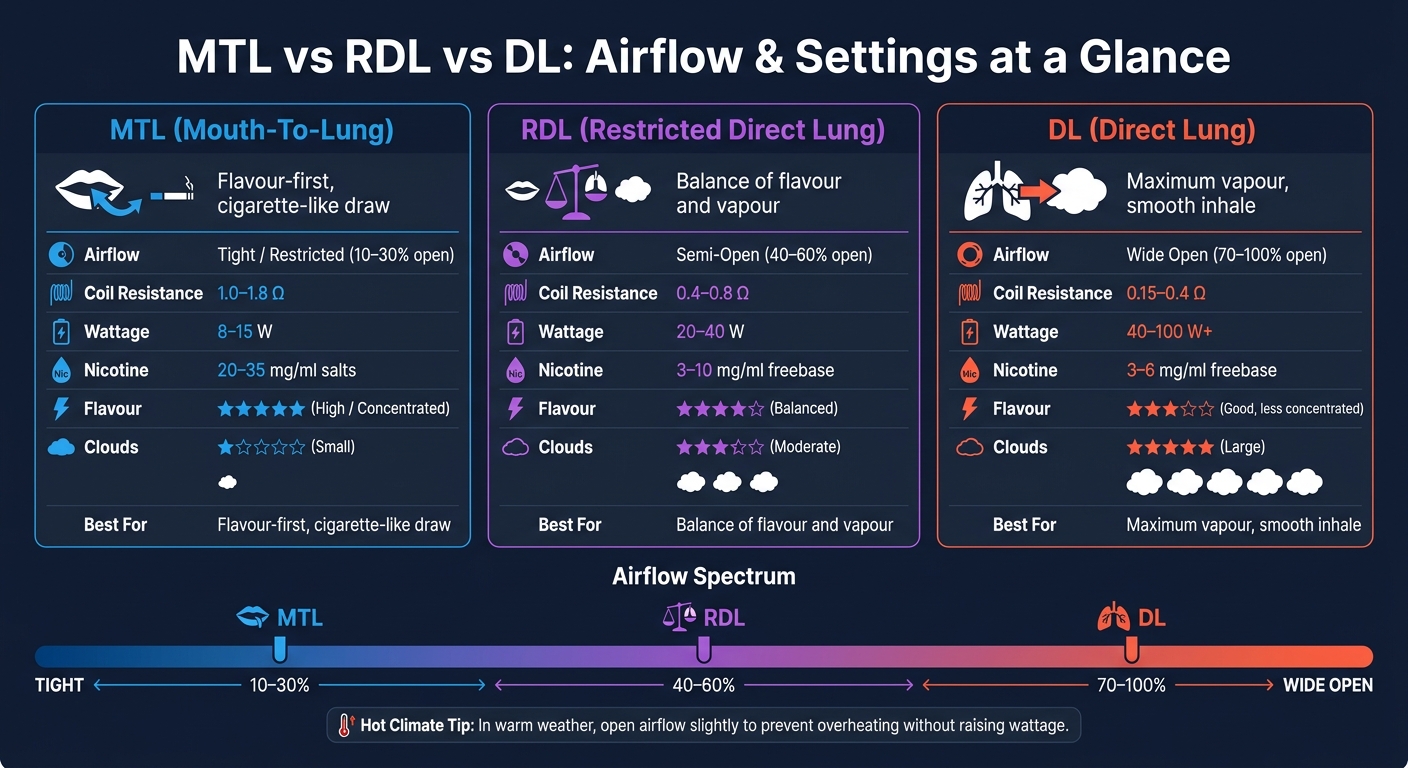
MTL vs RDL vs DL Vaping Styles: Airflow, Coil & Wattage Comparison
Why use airflow on your vape device?
sbb-itb-837e7ad
Quick Comparison
| Style | Airflow | Coil Range | Wattage | Nicotine | Main Result |
|---|---|---|---|---|---|
| MTL | Tight | 1.0–1.8 Ω | 8–15 W | 20–35 mg/ml nicotine salts | Strong flavour, small clouds |
| RDL | Semi-open | 0.4–0.8 Ω | 20–40 W | 3–10 mg/ml freebase | Balance of flavour and vapour |
| DL | Wide open | 0.15–0.4 Ω | 40–100 W+ | 3–6 mg/ml freebase | Large clouds, smoother inhale |
My rule is simple: start in the middle, change airflow in small steps, and stop as soon as the vape feels right. That gets me to the best setting faster than making big jumps.
How Airflow Works Across MTL, RDL, and DL Styles
To get airflow right, start with the draw style and nicotine strength you want. That gives you your baseline.
Each style needs its own airflow range to match coil resistance, wattage, and nicotine strength. So the draw style tells you where to begin, and the rest tells you how much to open things up.
MTL: tight draw, stronger flavour, smaller clouds
MTL uses a tight mouth-to-lung draw, a firmer throat hit, and smaller clouds. It’s the closest feel to a cigarette, which is one reason many people start here.
MTL coils usually run at 1.0–1.8 Ω and 8–15 W. That lower power, paired with restricted airflow, keeps the vapour warm without turning harsh. MTL also pairs well with higher nicotine strengths. Nicotine salts in the 20–35 mg/ml range are a common fit.
RDL and DL: open airflow for balance or maximum vapour
RDL sits between MTL and full DL. You inhale straight to the lungs, but the airflow is still a bit restricted rather than fully open.
Coils for RDL usually fall in the 0.4–0.8 Ω range at around 20–40 W, and nicotine strength usually drops to 3–10 mg/ml freebase. The result is a smoother pull with more vapour, while flavour still stays fairly concentrated. For many users, RDL hits the sweet spot on adjustable pod mods and compact sub-ohm devices.
DL is built for maximum vapour. Airflow is very open, coils use low resistance at around 0.15–0.4 Ω, and wattage usually climbs to 40–100 W or more. Nicotine strength needs to stay low, with 3–6 mg/ml freebase being typical. Using high-strength nicotine salts in a DL setup at high wattage can cause extreme throat irritation and excessive nicotine intake.
Comparison table: draw styles at a glance
| Draw Style | Airflow Setting | Coil Resistance | Wattage Range | Nicotine Strength | Flavour | Clouds |
|---|---|---|---|---|---|---|
| MTL | Tight / restricted | 1.0 Ω – 1.8 Ω | 8 W – 15 W | 20–35 mg/ml salts | High / concentrated | Small |
| RDL | Semi-open | 0.4 Ω – 0.8 Ω | 20 W – 40 W | 3–10 mg/ml freebase | Balanced | Moderate |
| DL | Wide open | 0.15 Ω – 0.4 Ω | 40 W – 100 W+ | 3–6 mg/ml freebase | Good, less concentrated | Large |
Use these ranges as starting points, then fine-tune airflow in small steps.
How to Adjust Airflow to Get the Right Balance
Once you know whether you want MTL, RDL, or DL, airflow is what helps you fine-tune the draw.
Start at the middle and move in small steps
When you set up a new device or coil, start with the airflow about halfway open. It’s a solid middle ground for most pod mods and sub-ohm tanks. Take two or three short puffs, then pay attention to three things: flavour intensity, vapour temperature, and how tight or loose the draw feels.
After that, make changes in small 5–10% steps. If the vapour feels hot or harsh, or the draw feels too tight, open the airflow a little. If the flavour feels weak or muted, or the vapour feels too cool and airy, close it a little. Then test again before changing anything else.
That simple pattern – adjust a little, then test – makes it much easier to find your sweet spot without going too far.
In Bahrain’s heat, devices tend to run warmer. So it often makes more sense to open the airflow slightly instead of pushing the wattage higher.
Match airflow to your coil, wattage, and e-liquid ratio
More airflow cools the vape and makes it softer. Less airflow gives you more flavour concentration and more heat. If you’re using more heat or a thicker liquid, you’ll usually want a more open airflow. Cooler MTL setups often work better with tighter airflow and thinner 50/50 blends.
Thick 80/20 liquid can wick poorly in tight MTL airflow, especially in Bahrain’s heat.
Quick settings table: flavour, balance, and clouds
Use this table as a starting point, then fine-tune based on how your own device feels.
| Draw Style | Airflow Opening | Expected Result |
|---|---|---|
| MTL – Flavour Focus | 10–30% | Best flavour |
| RDL – Balance | 40–60% | Best balance |
| DL – Clouds | 70–100% | Most clouds |
If the draw still feels off, the next section covers the most common airflow problems and how to fix them. This includes troubleshooting issues like vape juice leaks caused by incorrect airflow settings.
Common Airflow Problems and How to Fix Them
Most airflow issues come back to one thing: not enough air or too much of it. The fix is usually simple. You’re just nudging the draw back toward the flavour-cloud balance you want.
Use the settings for your vape device type as the starting point. From there, make small changes.
Too little airflow: hot vapour, dry hits, and harsh pulls
When airflow is too tight, heat gets trapped inside the coil area. That can dry the wick out faster and lead to a harsh pull or a burnt taste. You may also notice the mouthpiece getting hot.
Open the airflow a little. If the vape still feels too hot, lower the wattage slightly. If the cotton is scorched, swap to one of the best vape coils. It also helps to pause between puffs so the wick has time to soak up more e-liquid.
Too much airflow: weak flavour, thin vapour, and gurgling
When airflow is too open, the vapour gets overcooled. That can make flavour feel muted and clouds look thin. Gurgling often means e-liquid has collected in the airflow path.
Hold the device mouthpiece-down, wrap the base in tissue, and give it a few downward shakes. Then close the airflow a bit and make sure your wattage stays within the coil’s stated range.
Troubleshooting table: symptom, cause, and fix
Use the table below to match the symptom to the cause fast.
| Symptom | Likely Cause | Quick Fix |
|---|---|---|
| Burnt taste / dry hit | Airflow too tight; wick drying out | Open airflow; lower wattage a little; replace coil if cotton is scorched |
| Hot, harsh vapour | Restricted airflow; chain-vaping | Increase airflow; take shorter puffs; allow a short pause between draws |
| Weak flavour / thin vapour | Airflow too open; wattage below coil’s recommended range | Close airflow gradually; raise wattage to the middle of the coil’s rating |
| Gurgling / flooding | Excess liquid in airflow path; airflow too wide | Shake out excess liquid; close airflow slightly; avoid overfilling |
| Whistling | Airflow slots misaligned or blocked; avoid covering vents with fingers, as it restricts airflow the same way a closed ring does | Rotate airflow ring until slots align cleanly; clean vents with a dry cotton swab |
Conclusion: Set Your Airflow for the Experience You Want
Airflow is the trade-off. A tighter draw gives you warmer vapour, stronger flavour, and smaller clouds. A more open draw gives you cooler vapour and bigger clouds. Both can work well. It just depends on what you want from the vape.
In Bahrain, the heat can make a slightly more open draw feel better, especially during warmer parts of the year.
Use that trade-off as your starting point. The best airflow setting usually comes from small tweaks, not big jumps.
Key points to remember before making changes
- Start in the middle and move in small steps. Take a few puffs, see how it feels, then adjust again if needed.
- Match your airflow to coil resistance and wattage together. Tight coils work better with tighter airflow. Sub-ohm coils need more open airflow. If you change one and ignore the others, you can end up with harsh hits or weak flavour. And don’t turn up the wattage to make up for restricted airflow. That often leads to hot vapour, dry hits, and faster coil wear.
FAQs
How do I know my airflow is set right?
Your airflow is set right when flavour and cloud production feel balanced, with no gurgling, leaking, or dry or overly wet hits.
A good place to start is with the airflow about 25% to 50% closed. Then take short, gentle puffs and see how it feels.
If you hear gurgling or spot leaking, make small changes one step at a time until the draw feels right for your device and e-liquid.
Should I change airflow or wattage first?
Start with your coil and e-liquid pairing. That sets the baseline for everything else.
From there, use the device’s recommended wattage range and make small tweaks until you find the balance of flavour and cloud production that suits you.
Once the power feels right, adjust the airflow to fine-tune how tight or open the draw feels for your inhale style.
Which airflow is best in Bahrain’s hot weather?
In Bahrain’s hot weather, don’t leave the airflow fully open. Heat can thin the e-liquid and lead to leaks. A gentle, slightly firm setting that matches the way you inhale usually works best.
When you refill or store the device, close the airflow all the way. That helps cut down the chance of flooding. If leaking starts, tighten the airflow a little to limit how much liquid gets into the coil chamber.
Related Blog Posts
- Advanced VG/PG Ratio Tips for Cloud Chasers
- How Airflow Control Works in Vape Mods
- Checklist for Cloud Chasing Competitions
- Beginner’s Checklist for Cloud Chasing
Frequently Asked Questions
This guide explains that tighter airflow gives warmer vapour, stronger throat hit, and more intense vape flavour, but with smaller clouds. Opening the vape airflow makes the vapour cooler and smoother, with larger vape clouds but a softer hit and slightly less flavour.
Airflow adjustment is the small ring or slider on your device that controls how much air mixes with the vapour as you inhale. Even a tiny change in airflow can shift four things at once: flavour, vapour heat, throat hit, and cloud size, so this guide treats it as the main control for how each puff feels.
The guide shows that MTL usually uses tight airflow with coils around 1.0–1.8 Ω at 8–15 W for strong flavour and small clouds. RDL runs semi-open airflow with 0.4–0.8 Ω coils at roughly 20–40 W, while DL uses wide-open airflow with 0.15–0.4 Ω coils at about 40–100 W or more for bigger clouds and a more open inhale.
This guide suggests that tighter airflow usually boosts flavour, warms the vapour, and gives a stronger throat hit, especially when the opening is around 10–30% for flavour-first MTL use. If the draw feels too hot, harsh, or gives dry hits, that is a sign the airflow may be too tight and needs opening slightly.
To chase more vape clouds, the guide recommends opening the airflow wider, typically 70–100% open for DL style, combined with lower-resistance coils in the 0.15–0.4 Ω range and higher wattage like 40–100 W+. If the airflow is too open and you notice muted flavour, thin vapour, or gurgling, slightly closing it can balance clouds and taste.
According to the guide, MTL vaping usually works best with 1.0–1.8 Ω coils at 8–15 W, which supports a tighter draw and stronger flavour. RDL is typically done on 0.4–0.8 Ω coils at about 20–40 W, while DL uses 0.15–0.4 Ω coils at around 40–100 W+ with more open airflow for larger clouds.
The guide pairs MTL with about 8–15 W, RDL with roughly 20–40 W, and DL with around 40–100 W or higher, always matched to the listed coil ranges. It also suggests using 10–30% airflow open for MTL, 40–60% for RDL, and 70–100% for DL so the wattage and airflow work together for a balanced vape.
The guide mentions that in hot weather it often helps to open the airflow a little more so the vapour feels less hot and the inhale stays comfortable. If you notice harsh pulls or very hot vapour, that is a sign the airflow is too tight, so slightly opening it can make vaping smoother even in Manama temperatures.