
Advanced VG/PG Ratio Tips for Cloud Chasers


If I want bigger clouds in Bahrain, I start with one rule: match the liquid to the hardware, then adjust for the heat. For most sub-ohm setups, 70/30 VG/PG is the safe first step. For RDAs and RTAs built for high wattage, 80/20 often makes more sense. And in Bahrain’s hot weather, moving one step higher in VG can help cut leaking and flooding.
Here’s the short version:
- More VG = denser vapour
- More PG = faster wicking, sharper throat hit, and stronger flavour lift
- Sub-ohm tanks usually start at 70/30
- RDAs/RTAs often handle 80/20 to Max VG
- Advanced RDL pods are usually happier at 60/40 or 70/30
- In Bahrain heat, thin liquid can leak more
- For cloud chasing, 3 mg freebase is the usual starting point
- If I get dry hits, I lower VG or thin the cotton
- If I get weak clouds, I increase VG or wattage
- If I get gurgling or leaking, I move up in VG and check wicking
The main point: I don’t treat VG/PG ratio as a stand-alone setting. I tune it with coil resistance, airflow, wattage, cotton density, and outside temperature. That’s what keeps clouds thick without turning the setup into a leaking or burnt mess.
A quick look:
| Setup | Best starting range | What I watch first |
|---|---|---|
| Sub-ohm tank | 70/30 | Dry hits at high wattage |
| RDA / RTA | 80/20 | Cotton density and juice flow |
| Advanced RDL pod | 60/40 to 70/30 | Slow wicking with thick liquid |
| Hot outdoor use in Bahrain | + more VG | Leaking, flooding, spit-back |
So if I had to sum up the whole article in one line, it’s this: pick the ratio for the device first, then fine-tune for Bahrain’s heat and your vaping style.
PG & VG In E-Liquid Explained
sbb-itb-837e7ad
VG and PG basics for larger, denser clouds
Use VG and PG to balance cloud size, flavour, and wick speed. The trade-off is pretty simple: more VG means denser vapour, while more PG helps the wick keep up.
How higher VG increases cloud volume and wicking demand
VG makes thicker vapour and bigger clouds. That’s why mixes such as 70/30, 80/20, and Max VG are so common for cloud chasing. The catch is that they’re thicker, so they move through cotton more slowly.
Once you get into 70% VG or more, your setup needs room to handle it. Choosing the best vape coils with larger wicking ports and plenty of surface area helps keep the wick wet at higher wattage. If the liquid can’t feed the coil fast enough, dry hits are usually next. Prime the coil well, then let it soak for 5–10 minutes before the first fire.
How PG improves flow, flavour carry and throat hit
If VG builds the cloud, PG helps keep the wick supplied between pulls. It flows fast, carries flavour well, and gives more throat hit. Because it’s thinner, it can re-saturate the wick more quickly, which matters if you take repeated pulls close together.
PG also does a better job with bright flavour notes such as citrus, menthol, and mint. High-VG blends tend to round those notes off a bit, which is why they often pair better with cream, bakery, and dessert flavours.
If chain vaping starts to leave dry spots, shifting from 80/20 to 70/30 can help.
VG/PG ratio comparison table: cloud output, throat hit and wicking
| VG% | PG% | Cloud Volume | Throat Hit | Wicking Difficulty | Typical Use |
|---|---|---|---|---|---|
| 50% | 50% | Low to Moderate | Strong/Sharp | Very Easy | Pods, MTL tanks, starter kits |
| 60% | 40% | Moderate | Defined | Easy | Open pods, RDL devices |
| 70% | 30% | High | Smooth/Mild | Moderate | Sub-ohm tanks, RTAs |
| 80% | 20% | Very High | Very Smooth | High | High-wattage mods, RDAs |
| Max VG | ~0–5% | Maximum | Minimal | Very High | Specialised drippers, cloud chasing |
From here, the next step is to match the ratio to your tank, airflow, and Bahrain’s heat.
Choosing the right VG/PG ratio for your device and Bahrain conditions
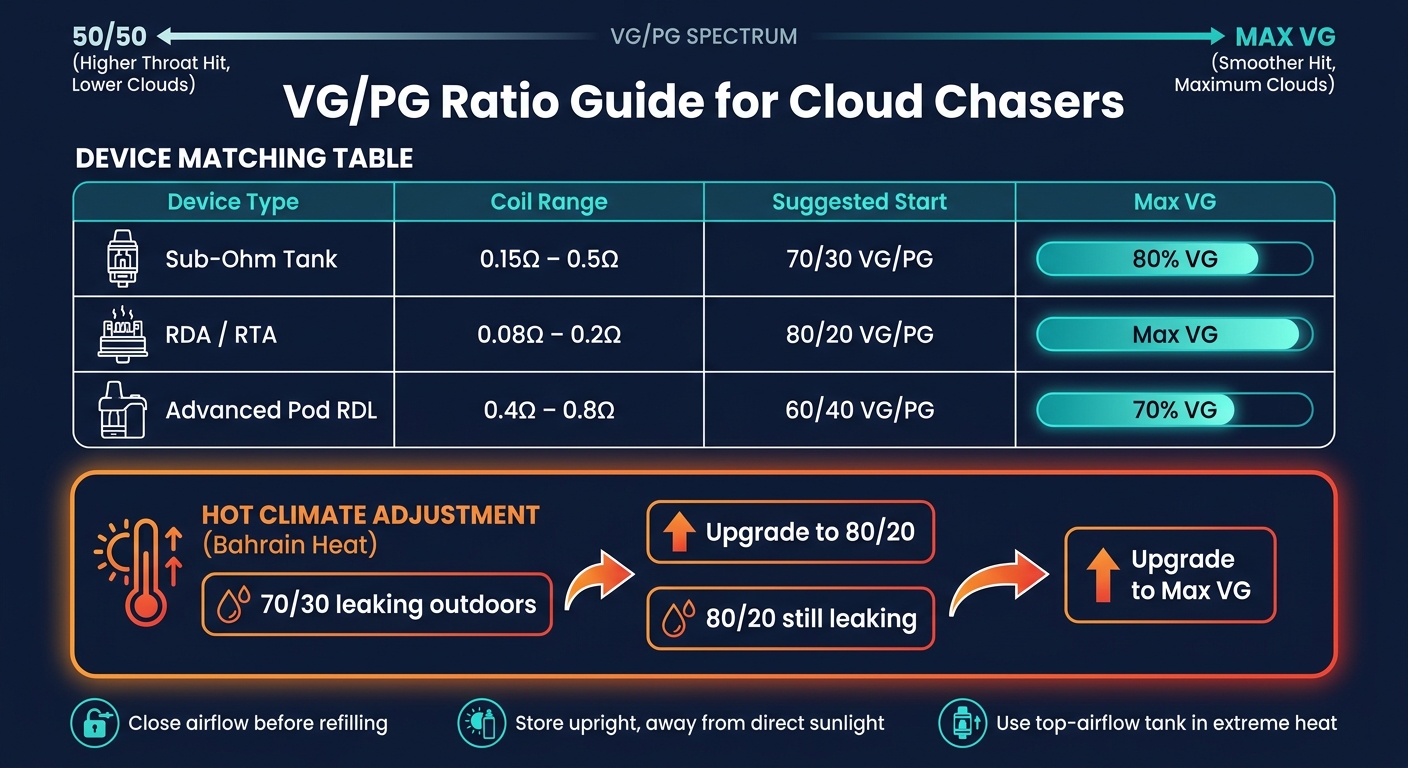
VG/PG Ratio Guide for Cloud Chasers: Device & Condition Matching
Start with the device, then fine-tune for Bahrain’s heat. The ratio has to suit your hardware first. After that, temperature and airflow decide how well it works day to day.
Starting ratios for sub-ohm tanks, RTAs, RDAs and advanced pods
Your device type changes more than most vapers think.
Sub-ohm tanks with mesh coils in the 0.15Ω – 0.5Ω range usually work best with 70/30 as the standard starting point at 70–110W. That setup gives you a solid middle ground between wicking speed and liquid thickness. You can move to 80/20 if the tank has large wick ports, but with smaller ports, thick liquid can dry out fast.
RDAs and RTAs are where high-VG blends tend to work best. Since you wick them yourself and the deck stays open, these atomisers can handle 80/20 up to Max VG at 90–150W or more. Builds in the 0.08Ω–0.2Ω range vaporise thick liquid far more easily.
Advanced open pods with RDL mesh coils sit somewhere in between. A 60/40 or 70/30 mix at 15–25W is usually the safe range. Push them to 80/20, and you may run into slow wicking or dry hits, especially on smaller coil heads.
How Bahrain’s heat affects leaking, flooding and liquid thickness
Bahrain’s heat can thin e-liquid on its own. That means a 70/30 mix that works fine indoors can start flooding or leaking once it’s out in high outdoor temperatures or left inside a hot car.
A simple fix is to move one step higher in VG. If 70/30 starts leaking, try 80/20. The thicker mix helps the liquid keep its shape and can cut down flooding.
A few small habits help too:
- Close the airflow before refilling to cut down flooding
- Store devices upright and away from direct sunlight to slow the thinning effect
- If leaking keeps happening in hot weather, a top-airflow tank can help
Use that heat adjustment as your starting point for the table below.
Device matching table: practical VG/PG starting points
Use these starting points as your baseline.
| Device Type | Typical Coil Range | Suggested VG/PG Start | Max Practical VG% |
|---|---|---|---|
| Sub-Ohm Tank | 0.15Ω – 0.5Ω | 70/30 | 80% VG |
| RDA / RTA | 0.08Ω – 0.2Ω | 80/20 | Max VG |
| Advanced Pod (RDL) | 0.4Ω – 0.8Ω | 60/40 | 70% VG |
Fine-tuning ratio with wicking, airflow and nicotine strength
Once you’ve picked your VG/PG ratio, the job isn’t done. Wicking, airflow and nicotine strength decide how that liquid behaves in actual use. They fine-tune the base setup; they don’t replace it.
Wicking methods that help thick high-VG liquid keep up
The most common mistake with high-VG liquid is simple: too much cotton. When VG goes past 70/30, tightly packed cotton can slow the feed instead of helping liquid move through.
Keep the cotton tails trimmed so they rest lightly in the juice channels. As you move from 70/30 to 80/20 or higher, use a bit less cotton. That small change can make a big difference.
After fitting a new wick, drip liquid straight onto the exposed cotton ports. Then let the tank sit for at least 10 minutes before firing. When you start, take slow pulls of around 3–5 seconds so the wick has time to resaturate.
If the wick is keeping up but the clouds still feel thin, airflow is usually the next thing to adjust.
Airflow and low nicotine settings for denser direct-lung vapour
Start with airflow fully open. Then close it little by little until the vapour feels thicker, but not hot. That slight restriction is often the sweet spot for denser vapour.
For cloud chasing, use 3 mg freebase nicotine. Avoid nicotine salts in high-wattage sub-ohm builds. Keep it to freebase at 3 mg or lower, and if the inhale still feels rough, increase the VG level to smooth it out.
Use the table below to match each symptom with the right fix.
Troubleshooting table: dry hits, thin clouds, leaking and harshness
| Symptom | Likely Cause | Suggested VG/PG Adjustment | Other Fix |
|---|---|---|---|
| Dry hits | Liquid too thick or cotton too dense | Decrease VG (e.g., 80/20 → 70/30) | Thin cotton tails; lower wattage |
| Weak clouds | Too much PG or low power | Increase VG (70/30 or 80/20) | Raise wattage; open airflow |
| Flooding / gurgling | Liquid too thin for large ports | Increase VG (e.g., 50/50 → 70/30) | Add more cotton to ports; check O-rings |
| Leaking in Bahrain heat | Heat thinning the liquid | Increase VG to 80/20 or Max VG | Store device upright, away from direct sunlight |
| Spitting / spit-back | Coil oversaturated | Increase VG percentage | Clear chimney and drip tip of condensation |
| Harsh hit | Too much PG or nicotine | Increase VG; drop nicotine to 3 mg or lower | Drop wattage; use fresh coils |
Step-by-step method to dial in your ideal cloud setup safely
Build a baseline, then increase VG in small steps
Pick your starting ratio and test it in one fixed setup before you touch anything else. Begin with a known baseline: your chosen VG/PG ratio, airflow fully open, and the coil set at the lower end of its rated wattage.
Take several 4–5 second DL pulls. Then check three things:
- dry hits
- overheated vapour
- unstable cloud size
If all three are fine, your baseline is solid.
From there, if the setup stays stable, move to 75/25 or 80/20. Change only the ratio. Then re-prime and run the same test again. If the clouds get thicker without dry hits or a loss of flavour, the setup has taken the change well. If not, the wick or wattage needs sorting before you push any further.
Keep a test log and watch safety limits at high power
Once the baseline holds steady, log every change so you can compare results properly. A simple table like this works well:
| Field | What to Note |
|---|---|
| Date | dd/mm/yyyy |
| VG/PG ratio | e.g., 75/25 |
| Coil resistance | e.g., 0.18 ohm |
| Wattage | e.g., 65W |
| Airflow | e.g., fully open |
| Nicotine strength | e.g., 3 mg freebase |
| Notes | Cloud density, flavour, vapour warmth, and any dry hits, wicking issues or leaking |
Use that log to spot which ratio stays most stable for your device and your day-to-day conditions.
For safety, check an Ohm’s law calculator to make sure your battery’s current draw stays below its tested continuous discharge rating (CDR). Don’t trust pulse ratings printed on the cell. Stay inside the coil’s rated wattage range – overpowering the coil adds heat stress, not extra vapour. Use high-drain 18650 or 21700 cells rated for sustained high-wattage use.
Conclusion: How to maximise clouds without losing consistency
After a few controlled tests, the right ratio usually stands out. Move in small jumps – 70/30 to 75/25 to 80/20 – and re-check wicking, airflow, and vapour temperature after each change. In Bahrain’s heat, a ratio that works indoors in January may leak or flood by July, so seasonal conditions matter. It also helps to be ready to re-wick when moving to a thicker blend.
FAQs
How do I know if my device can handle 80/20 or Max VG?
Look for large wicking ports, open airflow, and low-resistance coils, usually below 0.6 ohm. These thicker, high-VG liquids tend to work best in high-powered sub-ohm tanks or rebuildable atomisers that can soak the cotton fast enough.
In small pod systems or high-resistance MTL coils, the wick can struggle to keep up, which may lead to dry, burnt hits. On the other hand, if your device leaks or gurgles, the liquid may be too thin for that setup. For setup-specific advice, contact VapeShop.bh via WhatsApp.
What should I change first if my vape leaks in Bahrain heat?
First, switch to an e-liquid with a higher VG ratio, such as 70/30 VG/PG. In Bahrain’s heat, e-liquid can thin out and become too runny for your tank seals, which often leads to leaks.
A higher VG mix stays thicker in hot weather, so it’s less likely to slip through weak points in the tank. It also helps to store your e-liquid away from direct sunlight and heat, which can reduce thinning and slow down degradation.
When should I adjust VG/PG instead of wattage or airflow?
Adjust your VG/PG ratio based on two things above all: your device’s wicking ability and your own comfort. It’s not the main fix for wattage or airflow issues.
If vaping feels harsh, dry, or irritating on the throat, a higher VG ratio can help because it gives a smoother hit. Your device matters too.
- Use higher VG like 70/30 or 80/20 with powerful sub-ohm tanks
- Use higher PG like 50/50 with smaller pod kits
Think of it like matching the liquid to the hardware. A thick e-liquid works better in devices built to handle it, while thinner mixes suit smaller kits much better.
Related Blog Posts
- 5 طرق لإطالة عمر كويلات الفيب
- حل مشكلة الطعم المحروق في الفيب
- Ultimate Guide to Seasonal E-liquid Flavors
- Mesh vs Regular Coils: E-liquid Efficiency
Frequently Asked Questions
For sub-ohm tanks focused on bigger clouds, a 70/30 VG/PG mix is the safest starting point. It gives you dense vapour while still wicking well enough to handle higher wattage without constant dry hits. In hotter Bahrain weather, moving slightly higher in VG can also help reduce leaking and flooding from thinner liquids.
On RDAs and RTAs built for high wattage, an 80/20 VG/PG ratio often makes more sense because the thicker liquid can feed big coils and produce denser clouds. With rebuildables, you control cotton density and juice flow, so you can tune the wick to keep up with the thicker juice. If wicking feels slow or you get dry hits, slightly lowering VG or thinning the cotton usually fixes it.
Most advanced RDL pods are happiest between 60/40 and 70/30 VG/PG, which balances extra vapour with reliable wicking. Going too thick too fast can make the pod struggle to pull liquid through the coil, especially at lower wattages. If you notice slow wicking or dry hits, step slightly down in VG rather than jumping straight to very high VG blends.
In hot conditions, thinner liquids move faster, so a low-VG blend can leak, flood the coil, or cause spit-back more easily. Bumping your mix one step higher in VG (for example from 60/40 to 70/30) thickens the liquid and helps keep it from seeping through seals and cotton too quickly. Always check your wicking when you change ratios, because heat plus thin cotton can amplify leaking issues.
For cloud chasing with high vapour intake, 3 mg freebase is the usual starting point mentioned by experienced users. Lower nicotine reduces throat harshness and makes it easier to take long, deep pulls without discomfort. This works especially well with high VG mixes in sub-ohm tanks, RDAs, and RTAs.
If you get dry hits, the liquid is usually too thick for your setup, so lowering VG slightly or thinning the cotton helps juice reach the coil faster. Weak clouds often mean you need more VG or a bit more wattage, as long as your coil and wicking can handle it. Gurgling or leaking usually points the other way: move up in VG and recheck your wicking to make sure it isn’t too loose or over-saturated.
VG/PG ratio works best when tuned together with coil resistance, airflow, wattage, cotton density, and the temperature around you. Higher VG gives denser vapour, while higher PG speeds up wicking, boosts throat hit, and can sharpen flavour. Matching the liquid to the hardware first, then adjusting a step at a time based on how your tank, RDA, or pod behaves, is what keeps clouds thick without leaks or burnt cotton.