
510 vs. 810 Drip Tips


If you want the short answer: 510 is for a tighter, flavour-led draw, while 810 is for more airflow and bigger vapour output. The size gap is small on paper – about 8.5 mm vs. 12.5 mm – but it changes fit, heat, airflow, and the type of device each tip suits.
If I were choosing one, I’d keep it simple:
- Pick 510 for MTL, lower power, nicotine salts, and a warmer, more focused vape
- Pick 810 for DTL, 40 W+ setups, high-VG liquid, and a cooler, airier vape
- Check fit first, because 510 and 810 do not swap directly without the right adapter
- Choose cooler materials like Delrin, resin, or Ultem, especially in Bahrain’s heat
- Clean the tip weekly, since 510 tips can collect more condensation
That’s the whole decision in plain terms: match the tip to your tank, power level, and draw style.
How to use 510 drip tip on 810 port atomizer by adapter|VaporFan.com

sbb-itb-837e7ad
Quick Comparison
| Feature | 510 Drip Tip | 810 Drip Tip |
|---|---|---|
| Base size | ~8.5 mm | ~12.5 mm |
| Draw style | MTL | DTL |
| Airflow feel | Tight | Open |
| Flavour | More focused | Less concentrated |
| Vapour output | Lower | Higher |
| Vapour temperature | Warmer | Cooler |
| Best with | Lower-power tanks, nicotine salts or freebase | Sub-ohm tanks, high-VG juice |
| Heat on lips | Lower with Delrin/resin | Can get hotter at high power |
| Fit | For 510 connections | For 810 top caps |
| Adapter use | Can fit some 810 setups with adapter | Usually won’t fit 510 tanks |
If you vape in Bahrain, comfort matters a bit more in hot weather. A metal tip can heat up fast, so the material matters almost as much as the size.
510 Drip Tips: Narrower Bore, Tighter Draw
The 510 drip tip has a narrow bore. That gives you a tighter draw and more concentrated vapour. In plain terms, it’s a better fit for controlled, flavour-first vaping.
When to Use a 510 Drip Tip
Use a 510 tip with low-wattage, flavour-focused setups and nicotine salt liquids. You’ll often see it on compact tanks and atomisers made for a tight draw.
Materials, Heat, and Comfort on 510 Tips
Comfort matters just as much as the draw. Delrin and resin stay cooler than stainless steel, which can make longer sessions more pleasant. A longer tip also gives vapour a bit more time to cool before it reaches your mouth.
One thing to watch: the narrow bore can collect condensation over time. So it’s worth cleaning the tip regularly to keep the draw smooth and comfortable.
810 Drip Tips: More Airflow, Bigger Clouds
If 510 tips lean more towards control, 810 tips are built for airflow. The wider bore cuts down resistance and lets more vapour pass through.
When to Use an 810 Drip Tip
The 810 tip is made for direct-to-lung vaping. It works best with high-wattage setups, usually 40W+, where stronger airflow helps move vapour through the device. That’s why many modern sub-ohm tanks, RDAs, and RDTAs use 810 as the standard fit.
Put simply: if your setup is built for bigger vapour output, an 810 tip usually makes more sense.
Materials, Heat, and Comfort on 810 Tips
810 tips tend to run hotter. Because of that, Delrin and Ultem are often a better pick than stainless steel if you want the mouthpiece to stay cooler on the lips.
Comfort matters too. Many 810 tips have tapered or rounded edges, which can make the draw feel smoother and more natural.
There’s one fit detail that’s easy to miss. Some 810 tips seal with O-rings on the base, while others seal with O-rings inside the top cap. Check the seal type before you buy. It can affect airflow, flavour, and how well the tip fits, which sets up the next comparison.
510 vs 810: Size, Performance, and Compatibility
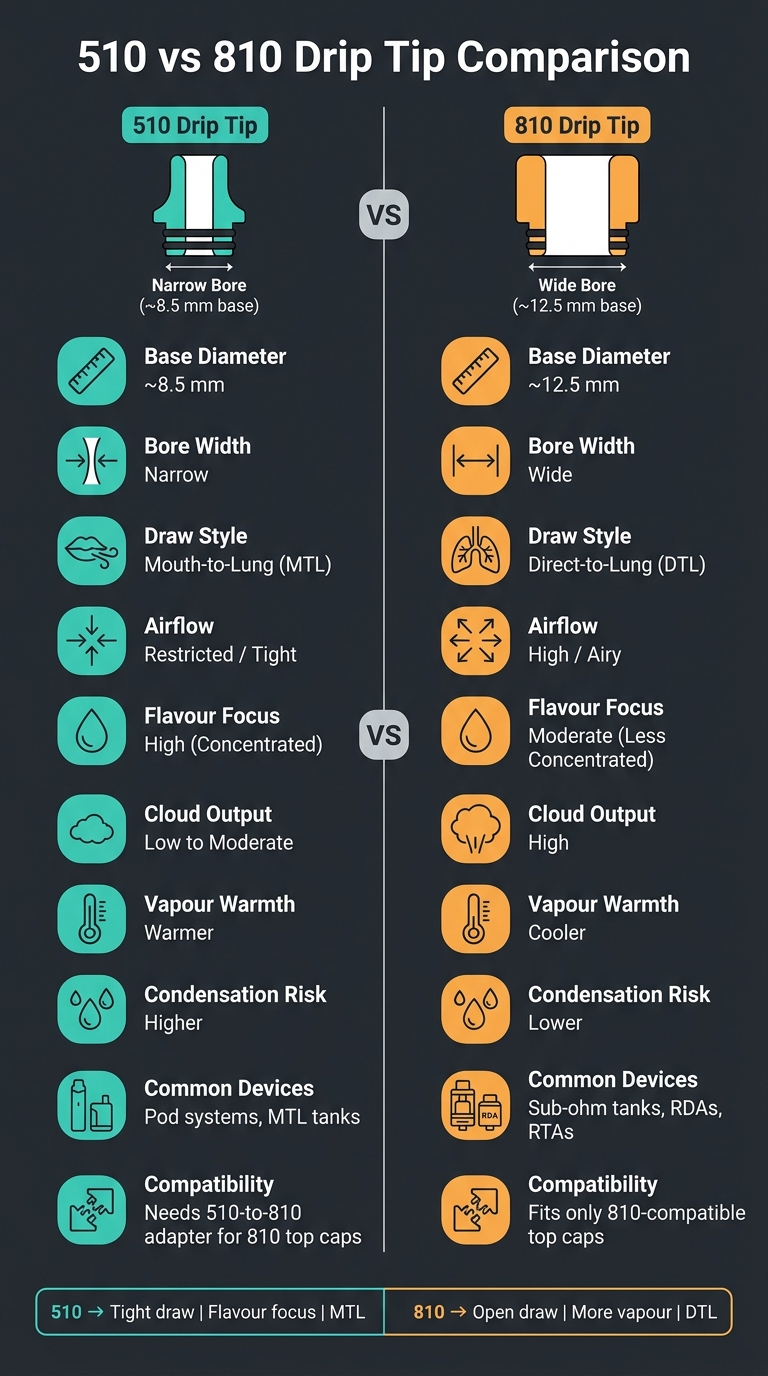
510 vs 810 Drip Tip: Side-by-Side Comparison
The main difference comes down to fit. And that one size change affects airflow and the way the vape feels. Here’s the simplest side-by-side view.
| Feature | 510 Drip Tip | 810 Drip Tip |
|---|---|---|
| Base Diameter | ~8.5 mm | ~12.5 mm |
| Bore Width | Narrow | Wide |
| Draw Style | Mouth-to-Lung (MTL) | Direct-to-Lung (DTL) |
| Airflow | Restricted / Tight | High / Airy |
| Flavour Focus | High (concentrated) | Moderate (less concentrated) |
| Cloud Output | Low to moderate | High |
| Vapour Warmth | Warmer | Cooler |
| Condensation Risk | Higher | Lower |
| Common Devices | Pod systems, MTL tanks | Sub-ohm tanks, RDAs, RTAs |
| Compatibility | Needs a 510-to-810 adapter on 810 top caps | Fits only 810-compatible top caps |
Airflow, Flavour, and Vapour Output
A 510 drip tip usually feels tighter, warmer, and more focused on flavour. An 810 feels cooler, airier, and better suited to bigger clouds. That makes it a good match for high-VG liquids and high-wattage coils, where more airflow helps keep the draw smooth and comfortable.
Neither one is better across the board. They’re just built for different vaping styles.
Fit comes first. Airflow comes after that.
Fit, Adapters, and Cleaning
510 and 810 tips are not interchangeable unless you have the right adapter or a top cap made for that size. If you want to use a 510 tip on an 810 tank, a 510-to-810 adapter can bridge the gap. Going the other way is usually not practical, because a 510 tank opening is too small for the wider 810 base.
Before you buy, check where the O-rings sit. On some setups, the O-rings are on the base of the drip tip itself. On others, they sit inside the tank’s catch cup. That small detail matters more than people think. A poor seal can lead to air leaks or a loose mouthpiece, and both can affect how the device performs.
If the tip feels loose, slightly thicker O-rings often sort it out. For cleaning, rinse the tip with warm water and mild soap, then dry it fully before using it again. A weekly rinse is a good habit, especially if you switch liquids often.
Once fit is sorted, the last part is simple: pick the tip that matches your draw style and the device you use.
Which Drip Tip to Choose in Bahrain
Once size and airflow are clear, the choice is pretty simple: match the drip tip to your device and the way you like to vape.
If you like a tight, controlled draw with more concentrated flavour and you use an MTL tank or a lower-power device, go with a 510 drip tip. It suits tighter airflow and lower-wattage vaping.
If you’re using a sub-ohm tank or another high-power setup and you want more open airflow with bigger clouds, an 810 drip tip makes more sense. Its wider bore is made for sub-ohm, high-power vaping.
Before you buy, check your tank or atomiser’s connection standard. Then browse compatible drip tips at VapeShop.bh.
Key Takeaway
- 510 drip tip → tight draw, flavour focus, MTL
- 810 drip tip → open draw, more vapour, DTL
Match the drip tip to your tank or atomiser first, then pick the airflow style you want. The right size means a secure fit and a better vaping experience.
FAQs
Can I use an adapter safely?
Yes, as long as the adapter matches your drip tip and atomiser sizes.
For example, an 810 to 510 adapter allows you to use a 510 drip tip on an 810 atomiser.
The main thing is fit. The adapter should sit securely and work with your device. That helps reduce the chance of leaks or airflow problems.
Used the right way, a well-made adapter should keep a stable connection without affecting safety.
Which drip tip feels better in hot weather?
In hot weather, 810 drip tips often feel better to use. Their larger 12.5 mm diameter helps disperse heat and gives you a cooler vape.
By contrast, 510 drip tips funnel vapour through a smaller opening. That usually makes them feel warmer on the lips, which can be less comfortable in hotter conditions.
Does drip tip material change flavour?
Yes, drip tip material can affect flavour, but size and shape usually matter more.
Materials like PMMA and Delrin are often picked for flavour. Metal tips are usually less favoured for that. The reason is simple: different materials can change how heat feels during a draw, and that can shift the overall vaping experience.
Drip tip size matters too. Wide-bore tips can improve flavour because they allow more airflow and create less restriction.
Related Blog Posts
- كيفية اختيار الفيب المناسب للمبتدئين
- Freebase vs Salt Nic: Device Compatibility Guide
- Best Wattage for MTL vs. DTL Vaping
- Best Coils for Temperature Control Vaping
Frequently Asked Questions
The key difference is size and airflow: a 510 drip tip has a base of about 8.5 mm and gives a tighter, more restricted draw, while an 810 drip tip is around 12.5 mm wide and allows much more airflow. This affects flavour, vapour output, and how warm or cool the vape feels at your lips.
For MTL (mouth-to-lung)</strong) vaping, a 510 drip tip is the go-to because its narrow bore gives a tighter pull, stronger flavour focus, and suits lower power setups with nicotine salts or standard freebase. For DTL (direct-to-lung)</strong) vaping, 810 tips are better, as the wide bore is made for higher wattage, more airflow, and bigger clouds with high-VG liquid.
510 and 810 tips do not swap directly because the base diameters are different, so a 510 will not simply click into an 810 top cap. With a suitable drip tip adapter, you can run a 510 mouthpiece on some 810 atomizers, but the reverse (810 on 510 tank) usually is not practical.
A 510 drip tip usually gives more focused flavour because the narrow bore compresses the vapour and tightens the airflow. An 810 drip tip is built for higher airflow and cloud production, so you get bigger, airier vapour with slightly less concentrated taste.
In hot climates, cooler-feeling materials such as Delrin, resin, or Ultem are usually more comfortable than metal because they do not hold as much heat at the lips. Pairing these materials with the right size (510 for a warmer, tighter draw or 810 for a cooler, airier vape) helps keep your setup comfortable during long sessions in Manama and the rest of Bahrain.
It is a good idea to clean any vape mouthpiece about once a week, as condensation and residue can build up inside, especially in narrower 510 tips. Regular rinsing and wiping helps keep the draw smooth, the flavour clean, and the tip feeling fresh on the lips.
A 510 drip tip pairs best with lower-power tanks, tighter airflow, and liquids like nicotine salts or balanced VG/PG blends, giving a warmer and more concentrated vape. An 810 drip tip is designed for higher-wattage, sub-ohm setups using thicker high-VG e-liquid, where extra airflow keeps vapour cooler and lets clouds expand more easily.