
Best Coils for Temperature Control Vaping

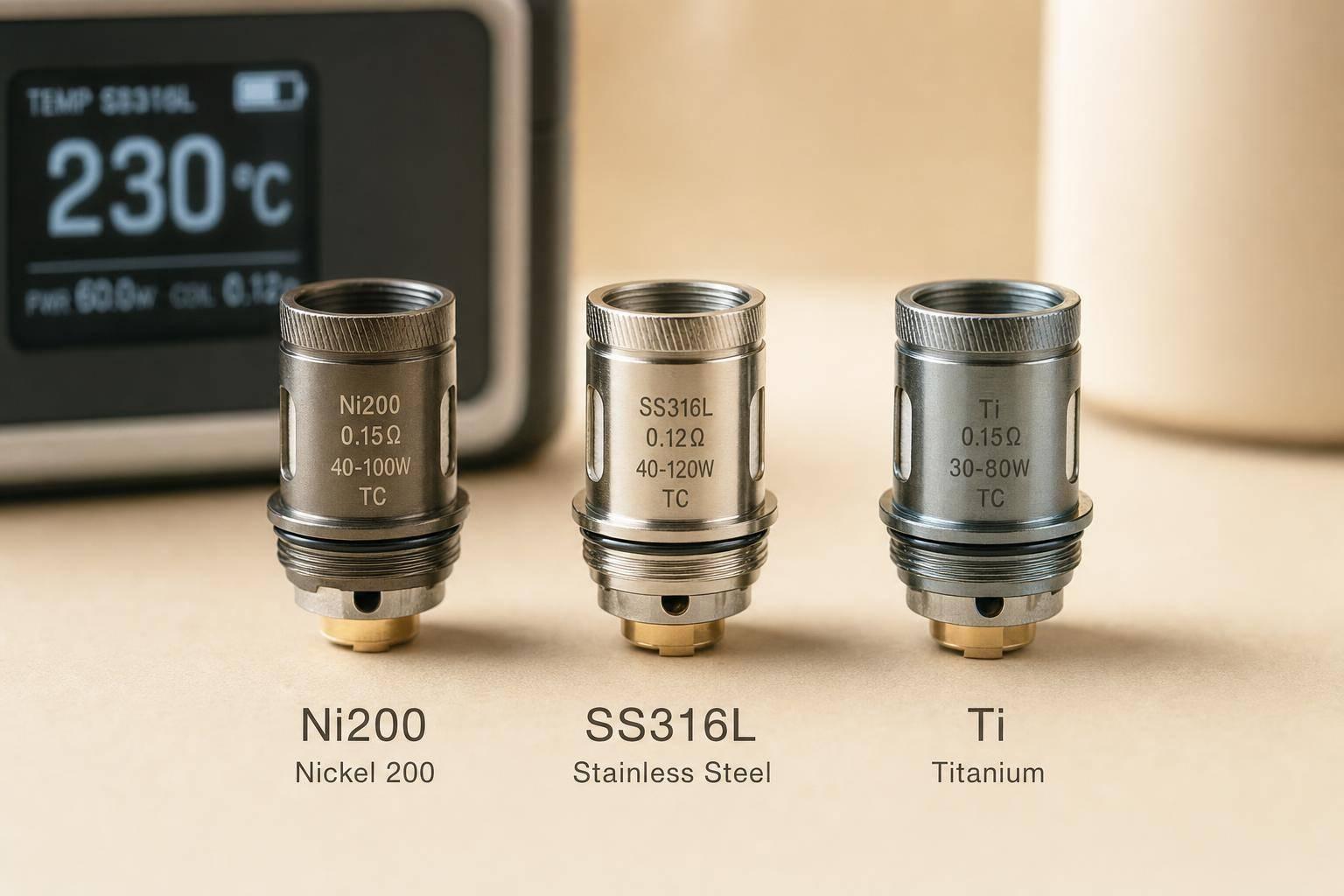
If I want the short answer: SS316L is the best pick for most people, Ni200 is for tight TC control, and titanium suits experienced users only. TC vaping works by keeping coil heat around 200°C–250°C (390°F–480°F), which helps cut dry hits and burnt puffs.
Here’s what I’d keep in mind straight away:
- Ni200: made for TC mode only and gives very tight temperature tracking
- Titanium: also TC-only, with close heat control, but needs more care
- SS316L: works in TC and wattage mode, so it fits most daily setups
- Kanthal: not for TC
If I’m buying coils in Bahrain, where packs often cost around BHD 4.500–BHD 7.500, the material matters for both vape feel and coil value. The main things to compare are:
- TC accuracy
- Device support
- Safety and setup
- Coil life
- Best match by device type
Basic guide to pre-made rebuildable coils | Kanthal vs Ni80 vs SS vs Titanium & my preferences.
sbb-itb-837e7ad
Quick Comparison
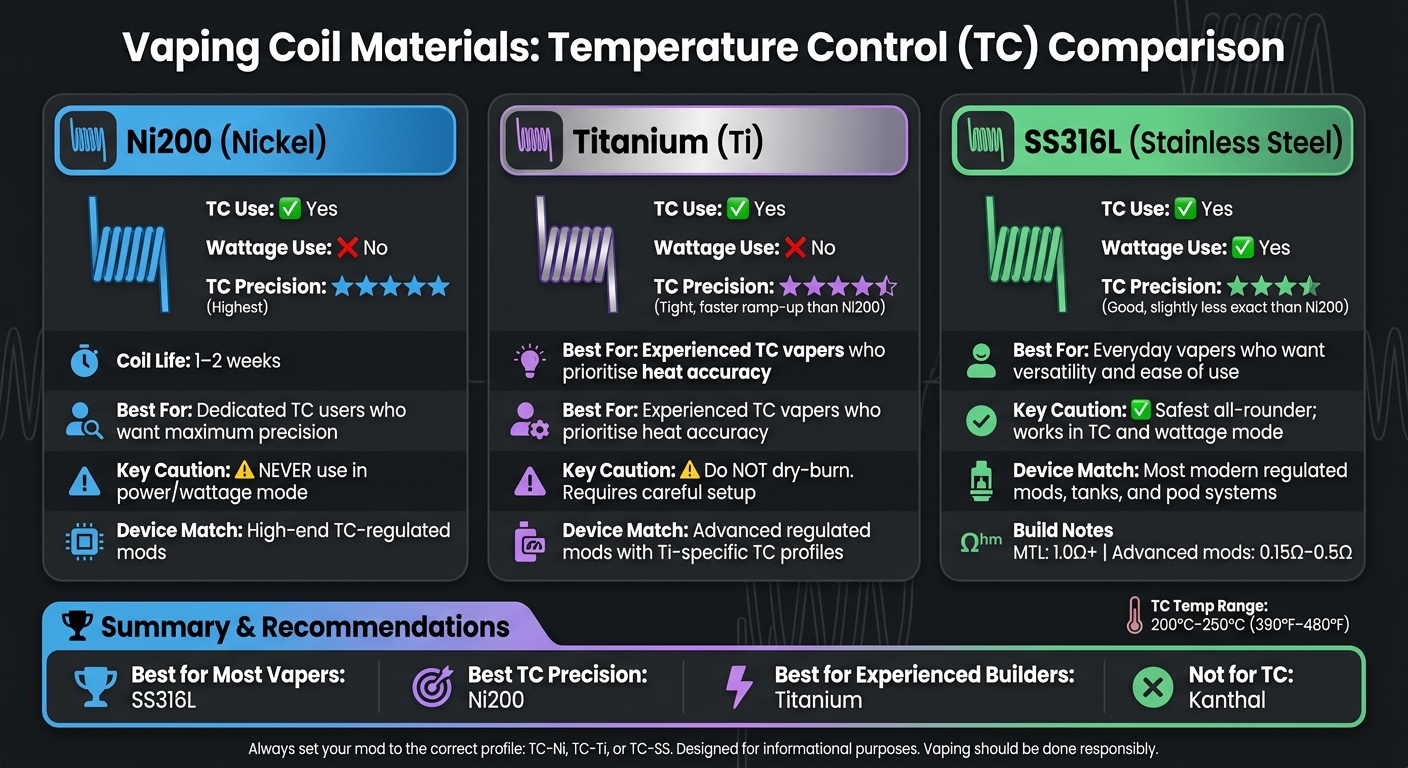
Best Coils for TC Vaping: Ni200 vs Titanium vs SS316L Compared
| Coil | TC use | Wattage use | Best for | Main caution |
|---|---|---|---|---|
| Ni200 | Yes | No | Pure TC use | Never use in power mode |
| Titanium | Yes | No | Skilled TC users | Do not dry-burn |
| SS316L | Yes | Yes | Most vapers | TC can be less exact than Ni200 |
| Kanthal | No | Yes | Standard wattage vaping | Won’t work for TC |
My takeaway: if you want the safest and simplest day-to-day choice, go with SS316L. If you want the closest heat control and use a proper regulated TC mod, look at Ni200 or titanium with care.
1. Ni200 (Nickel) Coils
Ni200 is pure nickel wire made for TC vaping. As the coil heats up, its resistance climbs fast, which gives the mod a clear temperature reading.
Use Ni200 only in TC mode. If you run it in wattage mode, the coil can overheat and may produce harmful compounds. After you pick the best vape coils and the right mode, prime the coil before using it.
Set your device to Ni/Nickel TC, fully soak the wick, and then wait 5–10 minutes before taking the first puff. Ni200 works only with TC-capable devices that have a dedicated Ni or Nickel setting. Most coils last around 1–2 weeks, though sweetened e-liquids can shorten that lifespan.
Ni200 suits dedicated TC users who want very tight temperature control. If you want more flexibility with device settings, SS316L is the next coil to look at.
2. Titanium (Ti) Coils
Titanium gives you tighter TC control than SS316L, but it also asks more from your setup. Your device needs a dedicated Ti or TC-Ti mode. If you use the wrong profile, temperature control won’t work as well.
In day-to-day use, Ti coils tend to give steady, tight TC performance from the first puff to the last. That makes them a more precise pick for vapers who care most about accuracy.
There’s a catch, though: Titanium is TC-only. So it’s better suited to experienced TC vapers who want precision and don’t mind a bit less convenience. Compared with SS316L, it’s less forgiving for daily use.
A couple of setup points matter here:
- Prime the wick fully before firing.
- Do not dry-burn titanium coils.
If you want a coil material that gives you more room to move, SS316L is the better all-round choice.
3. Stainless Steel (SS316L) Coils
If Titanium is the precision pick, SS316L is the flexible one. It’s the most flexible option in this group because it works in both TC and wattage mode. That gives you room to switch setups while still letting the mod control temperature and cut down dry hits.
TC Accuracy
SS316L leans more toward flexibility than pure precision, but it still delivers dependable TC performance. In plain terms, you get steady temperature control without being locked into a single style of vaping.
Flavour and Durability
SS316L gives clean flavour and strong coil life. That mix is a big part of why so many vapers stick with it. It’s simple, reliable, and easy to live with day to day.
Device Compatibility
Its main edge is broad chipset and device support. It works especially well on high-end chipsets such as the Evolv DNA series, including the DNA250C and DNA100C, and the YiHi SX series. It also runs in wattage mode on most mods, so moving between setups is pretty straightforward.
Use Case Fit
For pod systems, use 1.0Ω+ builds if you want a cool MTL draw. For advanced mods, 0.15Ω–0.5Ω builds suit higher-wattage vaping better.
It’s a bit like the all-rounder in the lineup: maybe not the laser-focused choice, but easy to use across a wide range of devices and build styles.
Pros and Cons by Coil Type
This quick comparison shows the trade-offs that matter most: precision, safety, and device support.
| Coil Material | Main Pros | Main Cons | Ideal Vaper | Common Device Match |
|---|---|---|---|---|
| Ni200 (Nickel) | Highest TC precision; strong resistance response | Unsafe in power mode; soft wire, difficult to wrap | Dedicated TC users who prioritise precision | High-end TC-regulated mods |
| Titanium (Ti) | Tight TC precision; faster ramp-up than Ni200 | Must not be dry-burned; higher setup demands than SS316L | Experienced vapers who prioritise heat accuracy | Advanced regulated mods with Ti-specific TC profiles |
| SS316L | TC and wattage flexibility; strong durability; clean flavour | Lower TC precision than Ni200 on some chipsets | Everyday vapers who want versatility and ease of use | Most modern regulated mods and tanks |
Here’s why that matters in day-to-day use.
Ni200 has to stay in TC mode. Never use Ni200 in power mode. It gives very precise temperature control, but there’s not much room for error.
Titanium also suits TC use, but it needs more care during setup. It must never be dry-burned, which makes it less forgiving than SS316L.
SS316L is the easy one to live with. You can switch between TC and wattage mode without changing coils. For many vapers, that makes it the most practical daily pick.
Next, compare which coil fits your device type best.
Best Coil by Device Type and Final Verdict
The best coil depends on your device and how much control you want. If you want a fast way to match the right material to the right setup, use the table below.
| Device Type | Recommended Material | Why It Fits | Key Caution / Setup Note |
|---|---|---|---|
| Regulated TC Mods | Ni200 (Nickel) | Offers the most precise and sensitive TC performance for accurate regulation | TC mode only. Never use in power mode |
| Rebuildable Atomisers (RBAs) | Titanium (Ti) | Provides excellent TC accuracy for experienced builders | Avoid dry-burning. Requires careful pulsing and cleaning |
| Pod / Stock-Coil Tanks | SS316L (Stainless Steel) | Best for availability and safety; works in both TC and power modes | Works in TC and wattage mode, so it suits mixed-use devices |
Set your mod to the right profile – TC-Ni, TC-Ti, or TC-SS – so the chipset can read resistance changes with accuracy.
FAQs
How do I know if my mod supports TC coils?
Check your mod’s menu or spec sheet for a dedicated TC mode. If it has one, the next step is simple: make sure it works with TC coil materials like nickel (Ni), titanium (Ti), or stainless steel (SS).
It also helps if the device lets you adjust temperature and resistance. That gives you better control and more accurate TC performance.
If your mod supports those materials and settings, it can use TC coils.
What temperature should I start with for TC vaping?
Start between 200°C and 250°C for TC vaping. Then tweak it based on what feels right to you and what your device supports.
Which coil lasts longest in daily use?
The GeekVape Z Series Coils are often said to last longer than many standard coils in day-to-day use. Some users report getting several months out of a single coil.
That said, actual coil life can vary depending on how often you vape, the wattage you use, and the type of e-liquid in your tank.
Related Blog Posts
- Mesh Coil vs. Regular Coil Disposable Vapes
- How to Match E-Liquids with Vape Devices
- Best Wattage for MTL vs. DTL Vaping
- Advanced Coil Building: Wire Properties Guide
Frequently Asked Questions
For most people, SS316L is the easiest all-round choice because it works in both TC and wattage mode. Ni200 is for tight temperature control, while titanium is better suited to experienced users who know TC setup well. Kanthal is not used for TC vaping.
Yes, SS316L coils can be used in both TC and wattage mode. That makes them a practical pick if you want one coil type for everyday use. For Bahrain customers comparing coil value, that flexibility is one reason SS316L is often the most convenient option.
Yes, Ni200 coils are made for TC mode only and should not be used in power mode. They are chosen when you want very tight temperature tracking. If your mod supports TC properly, Ni200 gives a more controlled vape feel.
Titanium is used for TC-only vaping and offers close heat control. It needs more care than SS316L, so it fits experienced users better. The key is to use it only in a proper regulated TC setup.
TC vaping usually keeps coil heat around 200°C–250°C or 390°F–480°F. That range helps reduce dry hits and burnt puffs by limiting how hot the coil gets. The exact setting still depends on the coil material and the device.
SS316L is the simplest daily-use choice because it works in TC and wattage mode. That gives more setup flexibility if you switch between modes. In a Bahrain vape shop context, it is usually the most straightforward recommendation for regular use.
The main check is whether your device supports the coil material you want to use in TC mode. Also confirm whether the coil is Ni200, titanium, or SS316L, since each behaves differently. For local support, VapeShop.bh can be contacted on WhatsApp at +973 66324432, and payment options include COD, BenefitPay, and card.