
How to Build Coils for Competitive Cloud Chasing


If I want big clouds without pushing my setup into unsafe territory, I need four things lined up first: a regulated mod rated around 80W–200W, a dual-coil target of 0.1Ω–0.4Ω, high-VG e-liquid at 70% VG or more, and batteries that stay within amp limits at 4.2V.
That’s the short answer.
This guide boils cloud chasing down to a few clear steps: I check device limits, match battery load with resistance, pick the right wire and coil style, build two matching coils, then wick and tune for Bahrain’s hot weather. In local heat, thinner e-liquid can leak more, so cotton fit and airflow setting matter just as much as wattage.
The main points are simple:
- I use RDAs, RTAs, or RDTAs with enough deck space
- I keep builds in the 0.15Ω to 0.40Ω range for most dual-coil setups
- I check current draw with I = V ÷ R
- I use 0–6mg freebase e-liquid, not nicotine salts, for high-power use
- I aim for 3.0mm–3.5mm inner diameter coils for more wick space
- I pulse at low power, fix hotspots, then wick snugly
- I increase power in 5W steps until vapour output levels off
A couple of numbers matter straight away. Two 0.30Ω coils in parallel give a final build of 0.15Ω. And at 4.2V, a 0.15Ω load means about 28A of current draw on a direct calculation, which is why battery choice is not something I guess on, so I follow essential vape safety tips to stay protected.
Quick comparison
| Part of the build | What I look for | Typical range or pick |
|---|---|---|
| Mod | Regulated device | 80W–200W |
| Resistance | Dual-coil cloud build | 0.1Ω–0.4Ω |
| Coil ID | Wick room and liquid flow | 3.0mm–3.5mm |
| E-liquid | Dense vapour | 70/30 or 80/20 VG/PG |
| Nicotine | High-power use | 0–6mg freebase |
| Power tuning | Step-by-step testing | +5W each step |
| Airflow | Dense but smooth draw | About 75% open |
If I keep those points in check, the rest of the build becomes far more straightforward.
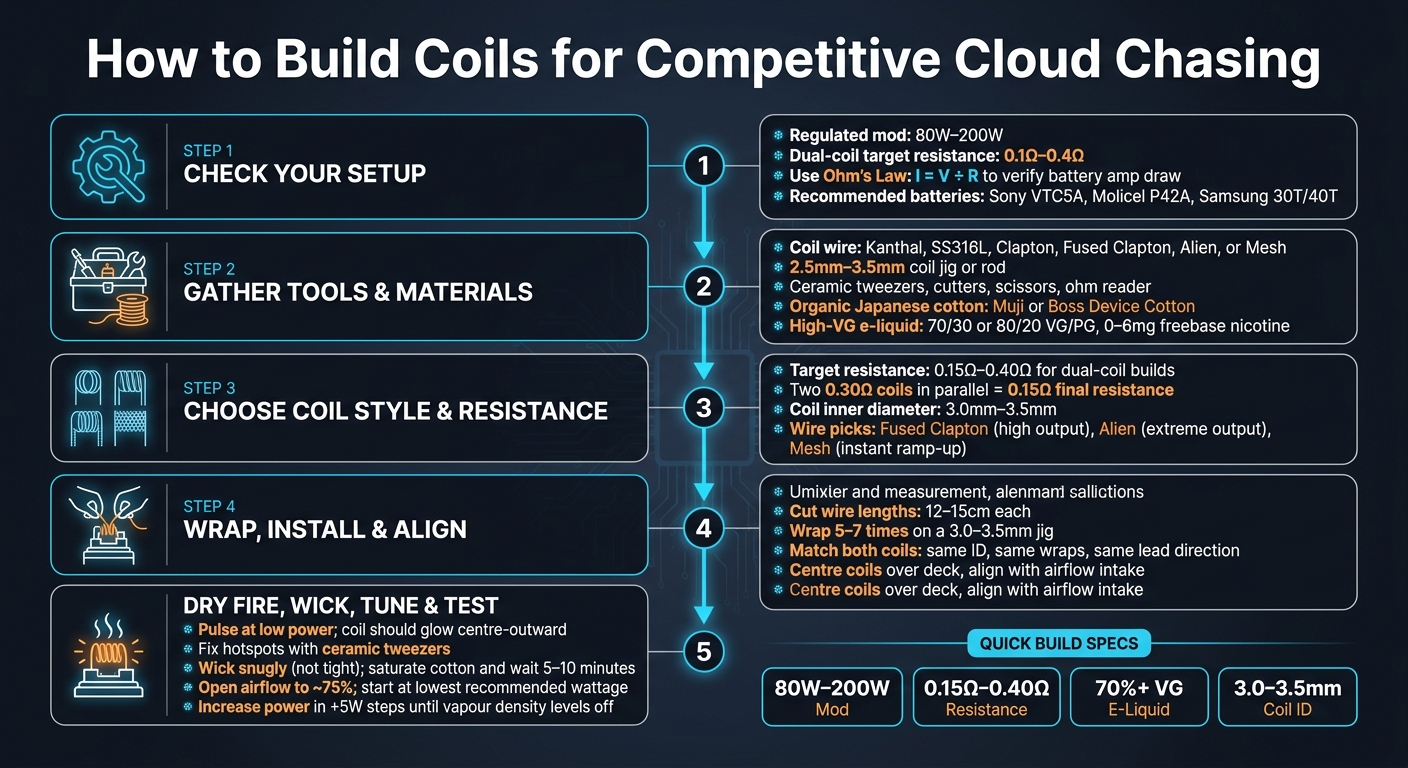
How to Build Coils for Cloud Chasing: 5-Step Visual Guide
#CloudChasing w/ .35 ohm SOAKER build: VAPEHAPPY Vapor Production
sbb-itb-837e7ad
1. Check Your Setup Before You Build
Before you start wrapping wire, check your hardware. It sounds basic, but this step can save you from a bad build, a misfire, or worse.
Target Build Range and Device Compatibility
Your mod, RDA, and battery all need to line up with the resistance you’re aiming for. Start with the device spec sheet and make sure it can fire down to about 0.05Ω to 0.1Ω. Then pair it with an RDA that gives you enough room to work, ideally one with a wide build deck and large adjustable airflow channels.
The battery matters just as much. Use Ohm’s Law to work out amp draw, then make sure it stays below the battery’s continuous discharge rating. High-drain cells like the Sony VTC5A, Molicel P42A, and Samsung 30T or 40T are common picks for this kind of setup. Capacity alone doesn’t tell the full story. The battery has to meet the device’s amp demand.
Once those parts check out, you can move on to your tools and wire.
Safety Checks Table
Always measure final resistance on a dedicated ohm reader or 510 tab before you activate the build. If the resistance jumps around or falls outside your device’s safe range, don’t use it.
| Safety Check | What to Do | Risk if Skipped |
|---|---|---|
| Battery Load | Calculate amps (I = V/R) and stay below battery CDR. | Thermal runaway, venting, or fire. |
| Resistance | Check resistance on an ohm reader before activating. | Short circuits or chipset damage. |
| Coil Material | Use wire suited to wattage mode. | Toxic fumes or melting. |
| Post Screws | Tighten firmly and evenly without overtightening. | Fluctuating ohms and uneven heating. |
| Airflow Clearance | Align coils with the airflow path and clear obstructions. | Overheating coils and burnt wicks. |
| Battery Wraps | Inspect for tears; rewrap if metal is exposed. | Hard short against the mod body. |
2. Gather the Right Tools and Materials
Getting your kit ready before you start wrapping makes the whole job smoother. It saves time, cuts down on small mistakes, and helps you build with more confidence.
At a minimum, you’ll need coil wire, a 2.5 mm–3.5 mm jig or rod, ceramic tweezers, cutters, scissors, cotton, an ohm reader, and an RDA or RDTA. A small screwdriver or Allen key is also part of the setup, since you’ll need it to tighten post screws. Ceramic-tipped tweezers matter for one main reason: they let you fix hotspots during low-power pulses without causing trouble. After that, your wire choice shapes ramp-up, vapour density, and how hard the build feels.
For wicking, organic Japanese cotton is still the standard pick. Muji and Boss Device Cotton are both widely used because they’re unbleached and soak up e-liquid fast. In Bahrain’s heat, fast-wicking organic cotton can help cut down on dry hits and leaking.
For e-liquid, use a high-VG formula – at least 70% VG. In most cloud-focused builds, 70/30 or 80/20 VG/PG is the usual mix. VG is the part that gives you thick, dense vapour.
Wire Types for Bigger Clouds
Wire choice has a direct effect on vapour output and on how fast your coil gets up to temperature. Here are the main options for cloud chasing:
| Wire Type | Vapour Volume | Ramp-Up Speed | Ease of Building |
|---|---|---|---|
| Kanthal A1 | Moderate | Moderate | Excellent |
| Stainless Steel (SS316L) | High | Fast | Good |
| Clapton | High | Slower | Moderate |
| Fused Clapton | Very High | Moderate | Advanced |
| Alien | Maximum | Moderate | Advanced |
| Mesh | Maximum | Near-instant | Easy |
A simple way to think about it:
- Kanthal A1 works well if you want a straightforward build.
- Fused Clapton or Alien suits maximum vapour.
- Mesh is a strong pick if you want near-instant ramp-up.
Once you’ve picked the wire, the next job is deciding on coil style and target resistance.
Where to Buy Coils, Cotton, and Mods in Bahrain
VapeShop.bh stocks coils, cotton, mods, and high-VG e-liquids, with same-day delivery across Bahrain and WhatsApp ordering for quick compatibility checks. With the materials sorted, the next step is choosing coil style and resistance.
3. Choose Your Coil Style and Resistance
For competitive cloud chasing, aim for a resistance between 0.15Ω and 0.40Ω. Before you build, check your battery’s CDR and make sure your estimated current draw stays under the cell’s limit at 4.2V. The quick way to check is with I = V/R.
Once you’ve picked your target resistance, the next step is wire shape. That choice affects how much e-liquid the coil can heat at once, and how fast the coil gets there.
For dual-coil setups – the usual pick for cloud chasing – two identical coils installed in parallel cut the total resistance in half. So if you use two 0.30Ω coils, the full build will read 0.15Ω.
How Wire Geometry Affects Vapour and Ramp-Up
Wire geometry has a big effect on vapour output and ramp-up. Textured wires like Claptons and Aliens have more surface area than plain round wire. That extra area holds more e-liquid, so each puff can vapourise more liquid.
But there’s a catch: more metal means more mass. And more mass takes longer to heat, which slows ramp-up. That’s why Nichrome 80 (Ni80) is a common pick for competitive builds. It heats up fast. Stainless Steel (SS316L) also heats up fast, and you can use it in both wattage and temperature control modes.
For coil inner diameter, 3.0 mm to 3.5 mm is a solid range. It gives you enough space for cotton to keep up with high-wattage builds.
Coil Style Comparison Table
Use the table below to compare output, speed, flavour, and build difficulty.
| Coil Style | Vapour Output | Ramp-Up Speed | Flavour Performance | Build Difficulty |
|---|---|---|---|---|
| Clapton | High | Slow | Enhanced | Moderate |
| Fused Clapton | Very High | Moderate | Excellent | Advanced |
| Alien | Extreme | Moderate to Slow | Superior | Expert |
| Framed Staple | Very High | Fast | Excellent | Very Hard |
Fused Claptons hit a sweet spot between strong output and a ramp-up that’s still manageable. Alien coils can push vapour density even further, but they heat more slowly, so Ni80 helps keep those heavier builds more responsive.
If your goal is very fast heat with very high output, Framed Staple builds are worth a look. They use flat ribbon wire cores, and those cores heat up faster than a Fused Clapton built to the same resistance because ribbon wire reaches temperature faster than round wire cores.
After you choose the style, wrap both coils evenly and install them at the same height.
4. Wrap, Install, and Align the Coils
Once you’ve picked the coil style and target resistance, cut two wire lengths at 12–15 cm each. Use the same 3.0–3.5 mm jig setting for both coils, then wrap each one 5 to 7 times. Keep the wraps tight and close together.
Wrap Evenly and Match Both Coils
Both coils need to match exactly. That means the same inner diameter, the same number of wraps, and the same lead direction. If one coil is even a little off, the build can heat unevenly.
Insert the legs into the post holes and tighten the post screws evenly. Tighten them enough to hold the wire in place, but not so much that you strip the screws. Then trim the leads flush to the posts.
Once the leads are cut, coil height becomes the main thing that shapes airflow and heat balance.
Set Coil Height and Airflow Position
After tightening the coils, set their position before wicking. Centre each coil over the deck and line it up directly with the airflow intake. This helps with cooling and can improve vapour density.
Make sure both coils stay clear of the deck, posts, and cap. If a coil sits too low, it can short against the deck. If it sits too high, it may touch the cap. Keep both coils at the same height so the build stays balanced.
5. Dry Fire, Wick, Tune, and Test
Once the coils are lined up, pulse them before you add cotton. Keep the power low and use short bursts. That makes hotspots easy to spot before the wick goes in and hides the problem.
Remove Hotspots and Wick for High-VG Liquid
Pulse at low wattage in short bursts. The coil should glow from the centre outwards. If one part glows first or another part stays dark, you’ve got a hotspot to sort out. Use ceramic tweezers to strum or gently compress the wraps while pulsing. Keep going until both coils glow evenly across every wrap.
As soon as the coils are glowing evenly, wick them right away. Cut your cotton and pull it through each coil. It should feel snug, not tight. That part matters more than people think. Too much cotton can choke the flow of thick high-VG liquid and lead to dry hits, even when the tails still look wet. Too little cotton can flood the deck. Trim the tails to the juice well, fluff them a bit, and rest them on the deck.
Then saturate the cotton with VGOD E-Liquids FreeBase and let it sit for 5–10 minutes before firing.
Adjust Airflow and Power for Dense Vapour
After priming, set your power and airflow based on output, not flavour balance. Start at the lowest recommended wattage for your vape coils. Take a few short puffs first, then move up from there. Increase power in 5 W steps until the vapour feels dense and smooth.
For airflow, open it to around 75%. A little restriction helps give the vapour more body instead of letting it spread out too fast.
Conclusion: Key Points for Safe, Dense Cloud Builds
After wrapping, installing, and tuning, the last step is making sure everything is safe and consistent. Good cloud builds come down to a handful of exact choices. Use a regulated mod so you get built-in safety features and accurate resistance checks.
Check the final resistance on an ohmmeter or on the mod before you fire it, and make sure the battery CDR fits the build. Keep the coils centred on the airflow, and wick them snugly with high-VG cotton without stuffing it in too tightly. That part matters more than many people think.
Once airflow and wicking are dialled in, power setting does the rest. Start low, then increase power in 5W steps until vapour density levels off. Slow increases help protect the wick and keep performance steady. Put simply, the best cloud builds are stable, matched, and controlled.
For coils, mods, and e-liquid in Bahrain, VapeShop.bh offers same-day delivery and WhatsApp ordering.
FAQs
How do I know if my batteries are safe for my build?
Understand Ohm’s Law and work out how much current your build pulls. If you’re using a mechanical mod, keep it well below your battery’s continuous discharge rating to help prevent overheating or venting.
Use high-drain batteries from reputable sources. Regulated mods come with built-in protections, but mechanical mods rely on what you know. Always check your resistance before firing.
Which coil wire is best for faster ramp-up and bigger clouds?
For faster ramp-up and denser clouds, mesh coils are usually the top pick. The main reason is simple: their larger surface area heats more evenly, which helps produce more vapour in less time.
If you make your own coils, Ni80 and SS316L heat up much faster than Kanthal. Kanthal is durable and easy to work with, so a lot of people still like it. But its slower ramp-up makes it a weaker fit for high-performance cloud chasing.
Why does my cloud-chasing build leak or give dry hits in Bahrain’s heat?
In Bahrain’s extreme heat, leaks and dry hits often come down to two things: e-liquid thickness and coil priming.
Heat makes e-liquid thinner. And when the liquid gets too thin, it can flood the coil and start leaking. That’s why a lower VG/PG ratio tends to cause more trouble in hot weather. If you’re cloud chasing, go with 70% VG or higher.
Dry hits are a different headache. They happen when the cotton inside the coil isn’t fully soaked with e-liquid. The fix is simple:
- Add a few drops to the mesh when fitting a new coil
- Let the coil soak for 5–10 minutes
- Start at a lower wattage first, then ease up as the coil beds in
It’s a small step, but it can save you from that harsh burnt taste and help the coil settle in without trouble.
Related Blog Posts
- Advanced Coil Building: Wire Properties Guide
- Best Coils for Temperature Control Vaping
- Advanced VG/PG Ratio Tips for Cloud Chasers
- What Is Coil Resistance in Vaping?
Frequently Asked Questions
This guide explains that safe cloud chasing starts with a regulated mod rated around 80W–200W, paired with dual-coil builds in the 0.1Ω–0.4Ω range. It also stresses using high-VG e-liquid at 70% VG or more and batteries that stay within their amp limits at 4.2V, so vapour production goes up without pushing the setup into unsafe territory.
The guide breaks coil building into clear steps: check device limits, match battery load with resistance, pick the right wire and coil style, then build two matching coils. It focuses on dual-coil builds kept in the 0.15Ω–0.40Ω range, using 3.0mm–3.5mm inner diameter for more wick space, and then pulsing at low power to fix hotspots before final tuning.
The guide keeps most dual-coil sub-ohm builds in the 0.15Ω to 0.40Ω range to balance vapour production and safety. It gives a clear example: two 0.30Ω coils in parallel result in a final build of 0.15Ω, which is then used to calculate current draw at 4.2V.
For bigger clouds, the guide recommends high-VG e-liquid at 70% VG or more combined with 0–6mg freebase nicotine, not nicotine salts, when running high power. It also notes that in hot weather like Bahrain, thinner liquids can leak more, so cotton fit and airflow settings need to be adjusted carefully.
The guide uses Ohm's law with the formula I = V ÷ R to check current draw before firing a build. One example is a 0.15Ω build at 4.2V, which works out to about 28A of current, showing why resistance and voltage must be matched with suitable batteries.
The guide emphasises that batteries must stay within their amp limits at 4.2V and that current draw should be calculated before using any build. By showing how a 0.15Ω coil load can reach about 28A at full charge, it underlines that battery choice and following basic vape safety tips are essential, not optional.
This guide suggests aiming for 3.0mm–3.5mm inner diameter coils to create enough space for cotton and then wicking them snugly. It explains that in local heat, thinner e-liquid can leak more, so cotton density and airflow settings are as important as wattage when tuning for smooth cloud chasing.
The product description talks about choosing the right wire and coil style for cloud chasing but does not list specific materials like Ni80 or mesh coils. It focuses more on resistance range, coil inner diameter, and safe power levels, so any decision about particular wire types needs to follow those general principles.