
How Compact Sub-Ohm Kits Boost Flavour


Better flavour comes from matching the coil, liquid, power and airflow – not from a smaller kit or higher wattage. For adult vapers in Bahrain, a useful starting point is choosing the best vape coils, a fully soaked wick and power set at the lower end of the coil’s rated range.
- Match the liquid: 70/30 VG/PG is common for sub-ohm use, but the kit’s guidance comes first.
- Set up with care: Allow 5–10 minutes for priming, or longer if instructed, then adjust power in 1–2 W steps.
- Change one setting at a time: Test airflow separately from wattage to find a suitable balance of warmth and taste.
- Check faults and upkeep: Clean washable tank parts, replace worn coils and stop using damaged or unusually hot equipment.
- Account for Bahrain’s heat: Keep the kit and liquids out of parked cars and direct sunlight, and follow storage and charging limits.
The aim is steady flavour from a well-matched, clean setup – not maximum vapour.
Match the Coil to the E-Liquid
Flavour depends on the coil, airflow and power. Choose a liquid your coil can wick properly, and use only coils listed for your exact kit. A physical fit isn’t enough.
Compare Coil Designs and Power Ratings
Resistance alone won’t tell you the best wattage or liquid match. Start within the coil’s rated wattage range, then account for how your liquid and airflow affect flavour.
Coil Design Resistance Rated wattage Draw style Possible flavour effect Vaporesso GTX Mesh 0.2 Ω 45–60 W Direct-to-lung Dense vapour and pronounced flavour Vaporesso GTX Mesh 0.3 Ω 32–45 W Restricted direct-to-lung Balanced vapour and flavour at moderate power Vaporesso GTX Regular wire 1.2 Ω 8–12 W Mouth-to-lung Cooler vapour and less liquid consumption
Choose a Suitable VG/PG Ratio
Vegetable glycerine (VG) is thick and mildly sweet. It produces denser vapour and generally feels smoother on the throat. Propylene glycol (PG) is thinner, carries flavour efficiently and gives a more noticeable throat sensation. 70/30 VG/PG is a common sub-ohm blend, not a rule.
Thick liquid may struggle to pass through small wicking ports, leaving draws dry or muted. Thin liquid can oversaturate some coils, leading to flooding, gurgling or leaks. Follow your kit’s liquid guidance rather than choosing by resistance alone.
Once you’ve matched the liquid, prime the coil and fine-tune the wattage.
sbb-itb-837e7ad
Prime the Coil and Set Up the Kit
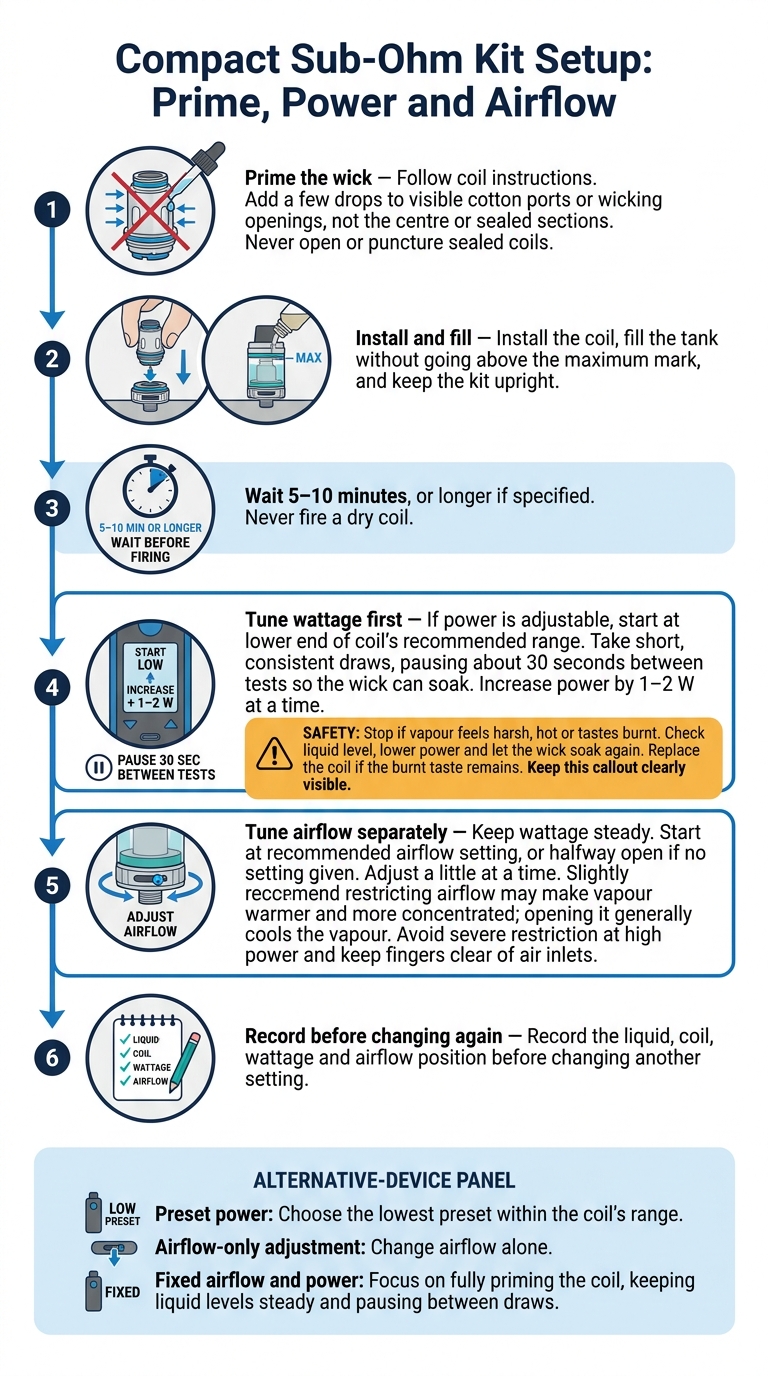
Compact Sub-Ohm Kit Setup: Prime, Power and Airflow
Once you’ve matched the coil and liquid, priming and small setup changes help bring out the flavour. Compact kits respond quickly, so even a slight adjustment can change the taste.
Saturate the Wick Before Use
Priming helps prevent dry hits. Follow the coil’s instructions: add a few drops to the visible cotton ports or wicking openings, not the centre or sealed sections. Never open or puncture sealed coils.
Install the coil, fill the tank without going above the maximum mark, and keep the kit upright. Wait 5–10 minutes, or longer if specified, before firing. Never fire a dry coil.
Adjust Wattage in Small Steps
Wattage controls heat. If your kit has adjustable power, start at the lower end of the coil’s recommended range. Take short, consistent draws, pausing about 30 seconds between tests so the wick can soak up more liquid. Increase power by 1–2 W at a time. Keep airflow unchanged and stay within both the coil and device limits.
Too little power can leave liquid poorly vaporised. Too much can heat it faster than the wick can supply it, scorching the cotton. Stop if the vapour feels harsh, hot or tastes burnt. Check the liquid level, lower the power and let the wick soak again. Replace the coil if the burnt taste remains.
Adjust Airflow to Control Warmth
Airflow controls vapour temperature and density. Start at the recommended setting, or halfway open if no setting is given. Keep wattage steady and adjust airflow a little at a time. Slightly restricting it may make vapour warmer and more concentrated; opening it generally cools the vapour. Avoid severe restriction at high power, and keep your fingers clear of the air inlets.
Record the liquid, coil, wattage and airflow position before changing another setting. On preset devices, choose the lowest preset within the coil’s range. If only airflow adjusts, change that alone. If both airflow and power are fixed, focus on fully priming the coil, keeping liquid levels steady and pausing between draws.
If flavour still seems weak or tastes burnt after these changes, check whether you need to clean your vape tank or the coil needs replacing.
Fix Flavour Problems and Care for the Kit
Find the Cause of Flavour Problems
If flavour changes after setup, check the cause before replacing parts. Start with the liquid level, coil rating, airflow, seals and liquid compatibility.
| Problem | Likely causes | Corrective action | Replace or stop-use trigger |
|---|---|---|---|
| Dry or burnt taste | Low liquid, excessive wattage or poor saturation | Check wicking ports, lower power within the coil’s range and let the wick soak again | Replace a scorched coil or one that still tastes burnt |
| Muted flavour | Residue, a worn coil, unsuitable airflow or wattage | Check settings and clean removable tank parts | Replace the coil if flavour stays weak |
| Gurgling | Flooding, overfilling, a loose coil or damaged seals | Check the fill level, coil seating and O-rings; wipe away condensation | Replace damaged seals or a coil that keeps flooding |
| Spitback | Pooled liquid, condensation or unsuitable liquid | Clean the mouthpiece and airflow path | Replace the coil if spitback persists; stop use if liquid reaches electrical areas |
| Overheating | Repeated firing, surrounding heat, charging or a battery fault | Stop use and disconnect charging if safe. Follow the manufacturer’s safety guidance | Do not keep testing equipment with unusual heat, swelling, damage or an abnormal smell. |
If these checks do not solve the problem, clean the tank and inspect the coil.
Clean the Tank and Replace Worn Coils
If settings and liquid checks do not restore flavour, switch off the kit, detach the tank where possible and remove the coil. Follow the manufacturer’s instructions: rinse only washable parts, clean the mouthpiece, and check the glass and O-rings. Let every part dry fully before putting the tank back together. Never immerse the battery unit or let moisture enter electrical connections.
Sweetened liquids can leave deposits faster. Replace the coil if flavour loss, burning or flooding continues after cleaning.
Protect the Kit From Bahrain’s Heat
Bahrain’s heat can affect flavour and encourage leaks. Keep the kit upright and store e-liquids sealed in a cool, shaded place – not in a parked car or on a sunny windowsill. Heat can thin the liquid, so follow the manufacturer’s storage and charging limits rather than relying on one temperature threshold.
Check the battery casing for cracks, swelling, dents or damaged wraps. Use compatible charging equipment on a clean, flat surface where you can see it, and avoid overnight or unattended charging. Do not use damaged equipment. Keep devices, spare batteries and liquids away from children and pets.
Conclusion: Keep Your Setup Consistent
Once you’ve matched the coil, liquid and airflow, keep your setup consistent. Change wattage and airflow one at a time, and keep the tank and airflow path clean.
Note the coil, liquid, wattage, airflow and coil installation date so you can return to settings that worked well. Better flavour comes from a setup you can repeat, not higher wattage. Small, controlled changes help keep flavour steady from one tank to the next.
FAQs
Why do coils with the same resistance taste different?
Coils with the same resistance can taste different because their designs vary. Surface area, wick structure and materials affect how heat spreads and how efficiently e-liquid turns into vapour.
Mesh coils, for example, spread heat over a larger surface than wire coils, changing how flavour notes come through. Wicking port size and material mass also affect heat and e-liquid saturation, which can change the flavour.
Should I adjust wattage when changing e-liquids?
Yes, consider adjusting the wattage when you switch flavours or change the VG/PG ratio. E-liquids can taste sweeter or richer at different power levels, so treat wattage settings as flavour guides, not fixed numbers.
Start at the lowest wattage recommended for your coil, then increase it in small steps. Wattage and airflow both affect heat and vapour quality, so change one setting at a time.
How can I distinguish a worn coil from flavour fatigue?
Try an e-liquid with a completely different flavour profile. If you can taste it clearly but your usual flavour stays muted, you likely have flavour fatigue – a temporary loss of sensitivity to a taste you’ve used repeatedly.
If everything tastes muted or burnt, the hardware is more likely at fault. Check the coil for residue, damage or scorching. A burnt taste that won’t go away, weak flavour or leaking can point to coil wear. Before replacing the coil, make sure the tank is clean and the wick is fully soaked with e-liquid.
Related Blog Posts
- Checklist for Cloud Chasing Competitions
- How to Choose the Right Coil for Your Vape Mod
- Sub-Ohm Vaping for Flavor: Guide
- Beginner’s Checklist for Cloud Chasing
{“@context”:”https://schema.org”,”@type”:”FAQPage”,”mainEntity”:[{“@type”:”Question”,”name”:”Why do coils with the same resistance taste different?”,”acceptedAnswer”:{“@type”:”Answer”,”text”:”Coils with the same resistance can taste different because their designs vary. Surface area, wick structure and materials affect how heat spreads and how efficiently e-liquid turns into vapour. Mesh coils, for example, spread heat over a larger surface than wire coils, changing how flavour notes come through. Wicking port size and material mass also affect heat and e-liquid saturation, which can change the flavour.”}},{“@type”:”Question”,”name”:”Should I adjust wattage when changing e-liquids?”,”acceptedAnswer”:{“@type”:”Answer”,”text”:”Yes, consider adjusting the wattage when you switch flavours or change the VG/PG ratio. E-liquids can taste sweeter or richer at different power levels, so treat wattage settings as flavour guides, not fixed numbers. Start at the lowest wattage recommended for your coil, then increase it in small steps. Wattage and airflow both affect heat and vapour quality, so change one setting at a time.”}},{“@type”:”Question”,”name”:”How can I distinguish a worn coil from flavour fatigue?”,”acceptedAnswer”:{“@type”:”Answer”,”text”:”Try an e-liquid with a completely different flavour profile. If you can taste it clearly but your usual flavour stays muted, you likely have flavour fatigue – a temporary loss of sensitivity to a taste you’ve used repeatedly. If everything tastes muted or burnt, the hardware is more likely at fault. Check the coil for residue, damage or scorching. A burnt taste that won’t go away, weak flavour or leaking can point to coil wear. Before replacing the coil, make sure the tank is clean and the wick is fully soaked with e-liquid.”}}]}
Frequently Asked Questions
Flavour depends on matching the coil, e-liquid, power and airflow rather than choosing a smaller kit or using higher wattage. Start with a coil listed for the exact kit, use the kit’s guidance, and set power at the lower end of its rated range.
Use only coils listed for the exact device because physical fit alone does not confirm compatibility. Resistance, coil design, rated wattage, liquid and airflow all affect the resulting flavour.
A 70/30 VG/PG ratio is common for sub-ohm use, but the kit’s own guidance should come first. Choose an e-liquid that the installed coil can wick properly.
Allow 5–10 minutes for priming coils, or wait longer if the product instructions specify more time. The wick should be fully soaked before use to support steady flavour and reduce the risk of a dry hit.
Start within the coil’s rated wattage range and adjust power in 1–2 W steps. Change one setting at a time so wattage can be tested separately from airflow.
Airflow affects flavour alongside the coil and power settings. Test airflow separately from wattage to find a suitable balance of warmth and taste instead of changing both settings at once.
Clean washable tank parts, replace worn coils and stop using equipment that is damaged or unusually hot. In Bahrain, keep the kit and liquids away from parked cars and direct sunlight, and follow the device’s storage and charging limits.