DIY E-Liquid Safety Guide: 10 Rules


Nicotine concentrate can harm you in minutes, so I treat DIY mixing like handling a hazardous chemical, not a hobby task. If I make vape juice at home in Bahrain, I need to follow 10 clear rules: protect my skin and eyes, use a clean ventilated space, label bottles before filling, measure with care, store everything locked away, clean spills at once, use the right ingredients only, and dispose of waste the right way.
I also need to stay within Bahrain’s limits:
- Nicotine strength: up to 20 mg/ml
- Refill container size: up to 10 ml
- Bottled e-liquid size: up to 50 ml
- Storage: cool, dark place, away from Bahrain heat that can pass 45°C
Here’s the full safety checklist in one view:
- Handle nicotine concentrate with care
- Wear nitrile gloves, long sleeves, and sealed goggles
- Mix in a clean, ventilated, dedicated area
- Label every bottle before adding ingredients
- Store bottles straight away in a locked place
- Measure with a 0.01 g scale or calibrated syringe
- Keep spill supplies and water close by
- Follow one mixing order every time
- Use only vaping-suitable ingredients
- Bag and discard nicotine-contaminated waste safely
A few details matter more than most people think. Even a small measuring mistake can leave me with the wrong nicotine strength. A shared table can spread residue to other surfaces. And poor storage in Bahrain’s heat can damage bottles or the liquid inside.
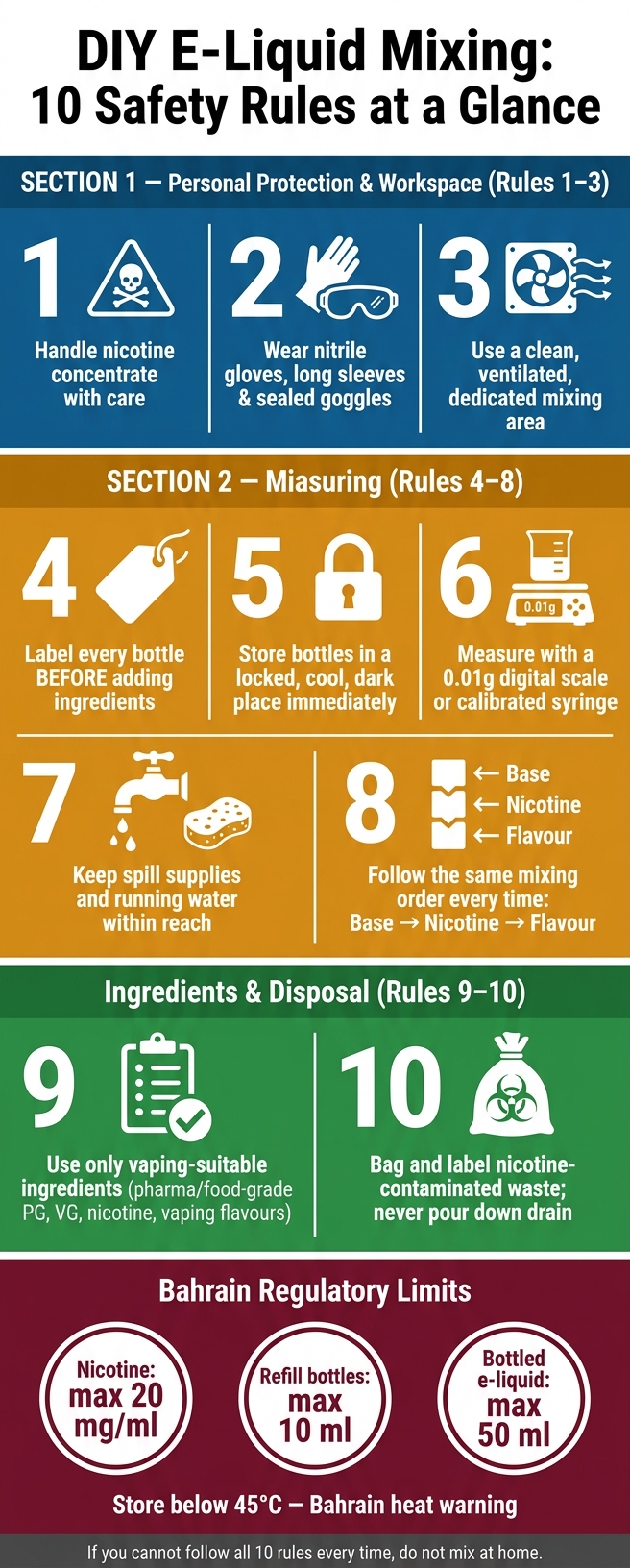
DIY E-Liquid Mixing: 10 Safety Rules at a Glance
How To Make Your Own Vape Juice Quickly & Easily TODAY (DIY E-Juice!)
sbb-itb-837e7ad
Quick comparison
| Rule | What I do | Main risk if I skip it |
|---|---|---|
| 1 | Handle nicotine with care | Skin exposure, poisoning |
| 2 | Wear gloves and eye protection | Burns, splashes, eye contact |
| 3 | Use a dedicated mixing space | Cross-contact with food or family areas |
| 4 | Label first | Bottle mix-ups |
| 5 | Lock bottles away after use | Child access, heat damage, leaks |
| 6 | Measure with care | Wrong nicotine strength |
| 7 | Prepare for spills | Delayed cleanup, more exposure |
| 8 | Follow the same order | Missed ingredient or wrong amount |
| 9 | Use vaping-suitable ingredients only | Unsafe inhalation risks |
| 10 | Dispose of waste safely | Household exposure, drain contamination |
If I cannot follow all 10 rules every time, I should not mix at home.
Personal protection and workspace setup
Before you open a single bottle, follow essential safety tips to protect yourself and set up the space properly. That bit matters more than people think. If your setup is sloppy, mixing can go wrong fast.
Rule 1: Handle nicotine concentrate with care
Concentrated nicotine is highly toxic. It can pass through skin within minutes. Use the lowest-strength nicotine base that works for your recipe, and treat it like a hazardous liquid. Keep nicotine sealed and away from heat while you mix, and never mix near food or drinks.
Watch for nausea, dizziness, headache, sweating, or a rapid heartbeat. If exposure happens, wash skin with soap and water for 15 minutes, move to fresh air, and call 999 if symptoms continue.
Rule 2: Wear gloves, protective clothing, and eye protection
Wear nitrile gloves. They hold up better against nicotine solutions than latex, and they don’t come with latex allergen risks. Add long sleeves and sealed safety goggles. Goggles sit around the eyes and stop droplets that ordinary glasses can’t block.
If gloves get contaminated, replace them at once. If liquid gets into your eyes, flush them with running water for at least 15 minutes and get medical advice if irritation continues.
Once you’re protected, turn to the mixing area.
Rule 3: Use a clean, ventilated, dedicated mixing area
Use a stable, non-porous surface in a well-ventilated room. A spare room or another well-ventilated room can work well. In Bahrain, air conditioning often means windows stay closed, so use a fan to move air without blowing across open bottles. Kitchen counters, dining tables, and majlis areas are a bad idea. Those spaces are shared with food, children, and guests, and even small traces of nicotine residue can transfer to hands, plates, or surfaces.
Set paper towels over the surface, keep a small sealed waste bag nearby for contaminated items, and make sure running water is close by. Use separate tools for nicotine, flavours, and base liquids to avoid cross-contamination. Label each set clearly with coloured tape or a permanent marker, so there’s no mix-up halfway through.
Keep labels, tools, and waste containers ready before you start.
The 10 safety rules for mixing and storage
With your workspace ready and your protective gear on, the main risk shifts to measuring, mixing, storage, and cleanup. Rules 4 to 10 walk through that process in order. Stick to the same routine every time: label, measure, mix, seal, store.
Rules 4 to 6: Label every bottle, store securely, measure accurately
Rule 4 is simple: label every bottle before you add anything to it. A clear label should include: flavour name | nicotine strength (mg/ml) | PG/VG ratio | volume (ml) | date (DD/MM/YYYY) | batch number | warning.
Rule 5 covers where bottles go the second you’re finished with them. Every bottle should have a child-resistant cap, and both finished e-liquid and nicotine base should go straight into a locked cabinet or metal box in a cool, dark place, away from heat and children. Heat and sunlight increase the risk of leaks and product breakdown. So don’t leave bottles sitting on the desk. Put each one back into storage as soon as you’ve used it.
Rule 6 is about precision. Every single time. Use a digital scale with 0.01 g resolution, tare it after placing the empty bottle, and add each ingredient one at a time. If you’re using a syringe, make sure it’s calibrated and read the markings at eye level. Never guess by sight. A nicotine strength error isn’t small; it affects both safety and the final mix. Save your recipes and check the numbers again before sealing the bottle.
Rules 7 and 8: Prepare for spills and follow the correct mixing order
Rule 7 means being ready before something goes wrong. Keep absorbent paper towels or pads, a sealable waste bag or bin, and running water within reach before you begin. If a spill happens, you don’t want to scramble around looking for supplies.
Rule 8 is about using the same mixing order every time: base ingredients first, nicotine second, flavour concentrates last. When everything is in the bottle, compare it with your recipe before sealing. Then seal it firmly and shake for at least 30–60 seconds. That fixed order helps you avoid skipped steps and wrong amounts.
Rules 9 and 10: Use only suitable ingredients and dispose of waste properly
Rule 9 gets ignored more often than it should: use only ingredients made for vaping. That includes pharmaceutical or food-grade PG and VG, nicotine solutions made for e-liquids, and flavour concentrates clearly labelled for vaping. Do not use:
- Essential oils
- Cooking oils
- Vitamin E acetate
- Food colourings
- Household extracts
Rule 10 deals with cleanup after the mixing session ends. Leftover nicotine and any contaminated materials should be treated as hazardous waste. Put them in a sealable bag labelled "Nicotine-contaminated waste – keep out of reach of children and pets" and dispose of them safely. Do not pour nicotine down the drain or onto soil. To cut waste, mix only what you need – usually 30 to 60 ml batches instead of large volumes.
Next, match these rules to Bahrain’s labelling and storage requirements.
Bahrain-specific checks before and after mixing
Use Bahrain-specific labelling
Once you’ve finished mixing, do a quick Bahrain-specific check before the batch goes into storage.
Label each bottle in a standard Bahrain format. Write the date as DD/MM/YYYY, the volume in ml, and the nicotine strength in mg/ml. Your log entry should include the batch number, date, volume, nicotine strength, and PG/VG ratio.
Batch 04 – 28/08/2026 – 30 ml – 3 mg/ml – 70/30 VG/PG.
Check Bahrain limits
Then check the batch against Bahrain’s local caps under BH 2:2021. There are three hard limits for DIY mixers:
- Nicotine concentration: max 20 mg/ml
- Refill bottles: max 10 ml
- Bottled e-liquid: max 50 ml
BH 2:2021 also says nicotine and solvent must meet European Pharmacopoeia purity standards, so make sure your ingredients meet those standards.
Store finished bottles in a cool, dark cabinet to extend their shelf life. That matters in Bahrain, where outdoor heat can go above 45°C.
Conclusion: The DIY e-liquid safety checklist at a glance
DIY mixing only makes sense when safety comes first. Nicotine is hazardous, and one small mistake can hurt someone or spoil the whole batch.
Use the same routine every single time. Before mixing, put on gloves, check your ingredients, and get your labels ready. During mixing, measure with care, follow the right order, and wipe up spills straight away. After mixing, label the bottle, store it in a secure place, and get rid of waste safely.
Protective gloves are a must when handling concentrated nicotine.
A clean, orderly process does two jobs at once: it helps keep you and your household safe, and it helps maintain the quality of your batch. If you can’t mix safely, use a ready-made e-liquid from VapeShop.bh.
Print the checklist and tick off each step during every session.
FAQs
What strength of nicotine base is safest for DIY mixing?
If you’re new to vaping, start low. A nicotine strength of 0 mg/ml to 3 mg/ml is usually the safest place to begin, as it can help lower the chance of side effects like dizziness or nausea.
Also, check the label before you buy or use any e-liquid. Nicotine strength should match your device type, or the experience can feel too harsh. In Bahrain, e-liquids are capped at 20 mg/ml nicotine.
How can I tell if my ingredients are suitable for vaping?
Use only ingredients made specifically for e-liquid. Skip household oils, random additives, and food flavourings that aren’t meant for vaping.
Always check the label for nicotine strength and ingredients before you buy. It also helps to buy from trusted sellers such as VapeShop.bh, where you can see clear safety details, batch numbers, and expiry dates. If anything on the label seems unclear, ask the supplier to confirm that the ingredient is safe for e-liquid use.
What should I do if nicotine spills on my skin?
Wash the affected area straight away with soap and water. Don’t wait, because this helps cut down nicotine absorption and skin irritation.
Small spills usually lead to only minor absorption. But if the exposure is more than that, or you start to feel dizzy, nauseous, or notice a faster heart rate, get medical help. Keep the product label or bottle with you.
Related Blog Posts
- Vape Devices vs. E-Liquids: Bahrain Customs Policies
- 5 Signs of High-Quality E-Liquids
- E-Liquid Ingredients Explained
- Checklist for Picking E-Liquid Flavors
Frequently Asked Questions
This guide explains that nicotine concentrate can harm you in minutes, so DIY mixing must be treated like handling a hazardous chemical, not a casual hobby. It lays out 10 clear rules: protect skin and eyes, mix in a clean ventilated space, label every bottle before filling, measure carefully, store everything locked away, clean spills immediately, stick to vaping-suitable ingredients, and bag and discard nicotine-contaminated waste safely. It also reminds you to stay within Bahrain’s legal limits of up to 20 mg/ml nicotine, up to 10 ml refill container size, and up to 50 ml bottled e-liquid size.
The checklist stresses that nicotine concentrate must be handled with special care because exposure can harm you quickly. It advises wearing nitrile gloves, long sleeves, and sealed goggles, and always mixing in a clean, ventilated, dedicated area rather than on a shared household table. You are told to keep spill supplies and water close by, follow one consistent mixing order every time, and store bottles straight away in a locked place to reduce accidental contact.
For measuring, the guide recommends using a 0.01 g scale or a calibrated syringe so your final nicotine strength stays within the intended level and Bahrain’s 20 mg/ml limit. It highlights that even a small measuring mistake can leave you with the wrong nicotine strength, so careful weighing and volume control are essential. Following one fixed mixing order every time also helps keep your ratios of PG, VG, and nicotine consistent.
The guide clearly lists Bahrain’s key DIY limits: nicotine strength up to 20 mg/ml, refill container size up to 10 ml, and bottled e-liquid size up to 50 ml. It ties these legal limits into practical steps, such as labeling bottles before filling, measuring with a precise scale or calibrated syringe, and using only vaping-suitable ingredients. Proper storage in a cool, dark place and locking bottles away are also included to keep your DIY setup safer and more compliant with local expectations.
The checklist tells you to keep spill supplies and water close by so you can clean any nicotine spills at once instead of letting residue spread. It warns that a shared table can carry leftover liquid to other surfaces if spills are not handled quickly and carefully. For waste, it advises bagging and discarding nicotine-contaminated materials safely, treating them like hazardous chemical waste rather than normal household trash.
The guide recommends storing all bottles straight away in a locked place that is cool and dark, because Bahrain heat can pass 45°C and damage both bottles and the liquid inside. It explains that poor storage conditions can affect the quality of your DIY e-liquid and increase safety risks. Keeping a dedicated, ventilated mixing area and locking everything away after use helps protect both your liquids and anyone else in the home.
This guide insists that every bottle must be labeled before adding ingredients, so you always know what nicotine strength and contents are inside each container. It also tells you to use only vaping-suitable ingredients, avoiding anything not designed for inhalation. Clear labels, consistent mixing order, and proper storage work together to reduce mistakes and keep your DIY e-liquid safer to use.