Custom Engraving for Vape Mods: Guide


If I want a vape mod engraved, I need to keep the design on outer panels only, remove batteries and parts first, and match the engraving method to the mod material. That is the short answer.
In plain terms, this guide comes down to five checks:
- Pick a simple design that still looks clear at small size
- Keep away from safety parts like vents, buttons, ports, screens, threads, airflow paths, and the 510 connection
- Match the material to the method such as laser for steel or anodised aluminium
- Send exact files and measurements in mm, plus clear photos
- Inspect the mod after engraving for heat marks, poor alignment, or damage near working parts
I’d also keep the cost and timing in mind from the start. In Bahrain, one-off jobs often start around BHD 5.000 and may go past BHD 15.000, while lead time is often 2 to 5 working days. Rush work may cut that to 1 to 3 working days with an added fee.
A few details matter more than most:
- Vector files like AI, EPS, and SVG are usually the better pick
- If I use PNG or JPG, I’d keep them at 300 DPI or more
- Stainless steel and anodised aluminium often give the cleanest result
- Brass and copper can look good, but they may need a clear coat to slow tarnish
- On curved tube mods, a rotary setup may be needed for even marking
Hand Engraving & Carving a Tudor Rose On Stainless Steel Vape Mod
Quick comparison
| Area | What I’d do | What I’d avoid |
|---|---|---|
| Design | Short text, date, monogram, simple pattern | Tiny detail, busy art, low-resolution files |
| Placement | Outer shell and removable panels | Vents, buttons, ports, screen, threads, 510, airflow |
| Method | Laser for fine detail, rotary for deeper cuts | Random method without checking material |
| Prep | Remove battery, tank, atomiser, e-liquid | Sending a full working device without stripping parts |
| After check | Look for clean edges and no warping | Using it before checking fit and function |
So if I had to sum it up in one line: good vape mod engraving is less about style and more about safe placement, the right material-method match, and a careful final check.
2. Plan the Design Before You Engrave
Start with the layout. After you’ve marked the safe surfaces, lock in the artwork to match the mod’s exact size.
2.1 Choose the purpose, style, and file format
Use engraving for either decoration or identification. That could mean monograms, geometric or floral motifs, minimalist line art, quotes, serial numbers, or asset IDs.
Keep the design simple so it still reads well when scaled down to fit a vape mod. Tiny details may look fine on screen, then turn muddy once engraved at that size.
Stick with single-colour artwork and clean edges. Vector files like AI, EPS, and SVG are the preferred choice because they scale without losing quality. PNG or JPEG should only be used when needed, and they should be at 300 DPI or higher. Anything below that can leave the engraving looking soft or blurred.
2.2 Map the design to the mod and mark safe zones
Flat artwork doesn’t always sit well on a curved surface. On tube mods, a rotary attachment is often needed to keep the engraving even.
Print a full-size mock-up on paper or masking tape, then test the placement, alignment, and orientation. It’s a simple step, but it can save you from an expensive mistake. Make sure the mock-up stays inside the approved engraving area.
Once the layout is set, move on to the material and the engraving method.
3. Match the Material to the Engraving Method
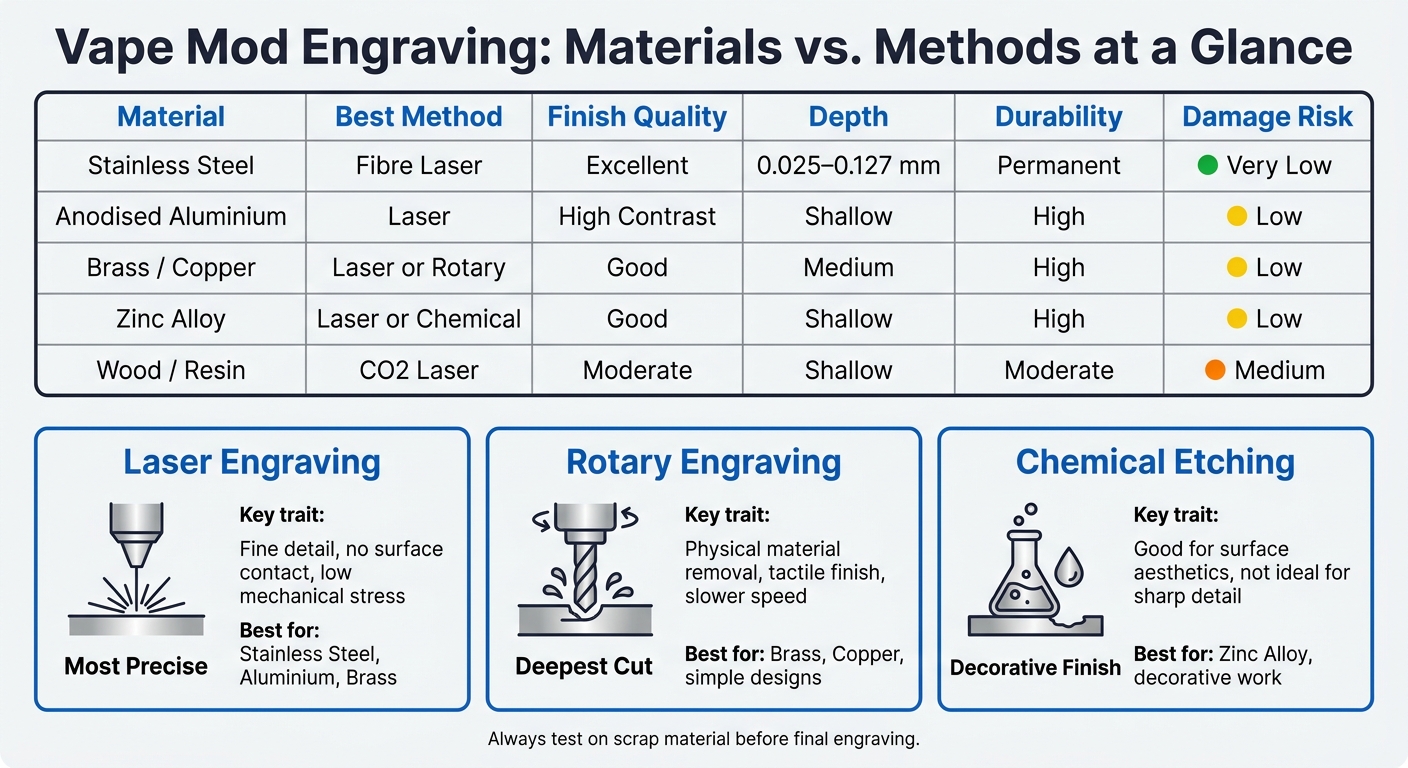
Vape Mod Engraving: Materials vs. Methods Comparison Chart
The material your mod is made from shapes the final result. It affects how sharp the engraving looks, how deep it can go, and how well it holds up over time. Get this sorted before you contact a service, and you’ll save time and avoid costly mistakes.
3.1 How common vape mod materials respond to engraving
Once the artwork is mapped, the material becomes the main factor. It decides how crisp the lines look, how much depth you can get, and how well the mark stands up to daily use.
Stainless steel and anodised aluminium usually give the cleanest finish. Brass, copper, zinc alloy, wood, and resin can still work well, but they’re better for simpler designs and need a bit more care.
3.2 Laser, rotary, and chemical etching compared
Laser engraving is the most precise choice. It can handle fine detail without physically touching the surface, which lowers the chance of mechanical stress. If you want clean lines and small details, this is often the safest bet.
Rotary engraving works differently. It uses a cutting tool to remove material, so the result is deeper and you can feel it with your fingers. The trade-off is speed and detail. It’s slower, and it doesn’t suit very fine work as well as laser.
Chemical etching is better for decorative finishes than sharp detail. It can look good, but it’s not the first pick for crisp, detailed engraving.
| Material | Best Method | Finish Quality | Depth | Durability | Damage Risk |
|---|---|---|---|---|---|
| Stainless Steel | Fibre Laser | Excellent | 0.025–0.127 mm | Permanent | Very Low |
| Anodised Aluminium | Laser | High Contrast | Shallow | High | Low |
| Brass / Copper | Laser or Rotary | Good | Medium | High | Low |
| Zinc Alloy | Laser or Chemical | Good | Shallow | High | Low |
| Wood / Resin | CO2 Laser | Moderate | Shallow | Moderate | Medium |
3.3 Finish, wear resistance, and aftercare
Surface finish matters just as much as the base material. Anodised surfaces usually give the strongest contrast, which helps the engraving stand out. Painted surfaces may need stripping before engraving, or the result can look uneven.
Brass and copper look great when engraved, but they tarnish over time. A thin clear coat can help slow that down and keep the finish looking cleaner for longer.
Once you’ve fixed the material and method, send the engraver the exact mod details and any finish notes. That small step can stop a lot of back-and-forth later.
sbb-itb-837e7ad
4. Work With an Engraving Service in Bahrain
4.1 What to send the engraver and how to prepare the mod
Once you’ve fixed the material and engraving method, send the engraver the exact details of the mod. Be clear from the start. That saves time and helps avoid mistakes.
Share clear photos from a few angles, the exact material type, and any coating details. For example, say whether it’s anodised aluminium or stainless steel. You should also include the exact engraving area in mm. If you can’t send vector art, use a clean black-and-white PNG or JPG instead. Keep it high-contrast and free of gradients.
Before handing over the mod, remove the battery, tank, atomiser, and e-liquid. If the mod has detachable panels, it’s better to send only those parts, or the empty shell, instead of the full device. Give the surface a quick wipe too, so the technician gets a clean, dry area to work on.
Always ask for a digital proof before engraving begins. Once you approve the proof, ask for the final quote and the lead time.
4.2 Cost, turnaround time, and Bahrain-specific details
Engraving is usually priced per item or by engraved area. For a one-off piece, prices often start at BHD 5.000 and can go to BHD 15.000+ for larger designs or deeper engraving. Bulk work usually comes in at a lower per-unit rate.
| Service Type | Estimated Cost (BHD) | Typical Lead Time |
|---|---|---|
| Single custom design | BHD 5.000 – 15.000 | 2 – 5 working days |
| Expedited / rush service | Standard + surcharge | 1 – 3 working days |
| Bulk branding (100+ units) | BHD 0.200 – 0.500 per unit* | 2 – 4 weeks |
Excluding initial setup and artwork fees.
Before you head out for drop-off or collection, check local business hours. Once the quote and proof are approved, the job moves to artwork and engraving.
5. Step-by-Step Process From Design File to Finished Mod
5.1 Create, approve, and test the artwork
Once the proof is approved, the job moves from planning into production.
Send over the final artwork in the approved production format. Keep the file clean and ready for proofing so there’s no mix-up later.
Review the digital proof closely for spelling, scale, and placement. It’s also smart to ask for a test pass on matching scrap material before the final engraving. That small check can help spot issues before they end up on the finished mod.
After the final pass, inspect the finished mod before use.
5.2 Inspect the engraving and maintain the finish
Check the engraved mod as soon as it comes back. Look for clean edges, strong contrast, and no heat discolouration or warping. Make sure the engraving hasn’t affected the 510 connection, airflow channels, battery door, or LED indicators.
Wipe the engraved area on a regular basis and store the mod away from heat and direct sunlight. If the material is prone to tarnishing, like brass, apply a thin protective clear coat over the etched area to slow oxidation.
6. Key Points to Remember
Before you approve the job, do one last pass through the basics.
Use simple shapes and clean fonts. Small panels usually look best with simple shapes and clean fonts, and busy artwork can turn messy once it’s engraved.
Never engrave over battery vents, fire buttons, airflow channels, 510 connections, or regulatory safety markings. These are safety-critical areas, so mark them out clearly before handing the mod over.
Match the method to the material. Stainless steel and anodised aluminium usually give the cleanest finish, while brass may need extra protection against tarnish. Remove lithium batteries and electronics before the work starts.
When the method and material are locked in, send the engraver the final file and exact dimensions. Share a vector file such as AI, EPS, or SVG, along with the precise engraving area in mm. Confirm the total cost in BHD upfront, and ask if there’s a rush option if you need it done faster.
After delivery, inspect the finish before regular use. Look for heat marks or uneven depth, then check the 510 connection, battery door, and the nearby surfaces for any accidental damage or debris.
FAQs
Can any vape mod be engraved?
Yes, most vape mods can be engraved if they’re made from materials that work well with the process, such as metal, wood, or stabilised resin. Laser engraving is the most common method because it gives clean, precise, permanent designs on surfaces like aluminium, brass, stainless steel, and titanium.
That said, the job needs a bit of care. To keep the device working as it should, avoid engraving near 510 connections or airflow channels. It’s also important to make sure internal batteries and sensitive electronic parts are handled properly during the process.
Will engraving affect safety or performance?
When it’s done the right way, engraving shouldn’t affect your vape mod’s safety or how it performs. Professional non-contact laser engraving, handled properly, does not weaken the device or damage its structure.
For safe work, the technician should remove lithium batteries and LED parts first. They should also avoid engraving near airflow channels or the 510 connection.
What files should I send for engraving?
For the best results, send vector files like AI, EPS, SVG, PDF, or DXF. These file types keep lines sharp and clean, no matter the size.
Only have a JPG or PNG? That can still work, but make sure it’s at least 300 DPI. Skip screenshots and low-resolution images, since they can lead to blurry or poor-quality engraving.
Related Blog Posts
- الفيب المستعمل مقابل الفيب الجديد: أيهما أفضل؟
- How Arabic Vape Brands Cater to Bahrain’s Market
- Product Descriptions vs. Reviews: What Helps More?
- How to Swap Vape Mod Panels Easily
Frequently Asked Questions
Yes, the design should stay on the outer panels only. Keep it away from vents, buttons, ports, screens, threads, airflow paths, and the 510 connection so the mod still works safely. A simple design is easier to keep clean at small size.
Yes, batteries and removable parts should be taken out first. That helps reduce the risk of heat damage and keeps the engraving area clear. It also makes it easier to check the mod before and after the work.
The method should match the mod material, and laser engraving is commonly used for steel and anodised aluminium. Stainless steel and anodised aluminium are also described as giving a clean result. For curved tube mods, a rotary setup may be needed for even marking.
Vector files like AI, EPS, and SVG are usually the better choice. If you only have PNG or JPG, they should be at 300 DPI or more. Sending exact measurements in mm and clear photos helps avoid alignment mistakes.
For one-off jobs in Bahrain, the guide says pricing often starts around BHD 5.000 and may go past BHD 15.000. The final cost depends on the design, material, and method used. Rush work can add a fee.
Lead time is often 2 to 5 working days. Rush work may shorten that to 1 to 3 working days with an added fee. After the job is done, the mod should be checked for heat marks, poor alignment, or damage near working parts.
Yes, brass and copper can look good with engraving. The guide says they may need a clear coat to slow tarnish after the work is finished. That helps protect the look of the engraved surface.