

Built-In vs External Vape Batteries


I’d choose built-in batteries for simple charging, or external batteries for replaceable cells and charged spares. Your device decides which type you can use, so check its exact battery and charging requirements before buying.
Here’s what I’d weigh up:
- Runtime: mAh is only part of the picture. Power settings, puff length and battery wear also affect time between charges.
- Handling: Built-in models mean fewer loose parts. External cells need checks for damage, correct installation and rigid cases for spares.
- Cost: Compare the device, cells, charger and eventual replacement – not just the starting price.
- Safety in Bahrain: Keep both types out of parked cars and direct sunlight. Charge where you can watch the device, and use an authorised collection service for disposal.
Quick Comparison
| Factor | Built-in batteries | External batteries |
|---|---|---|
| Common devices | Pods, pens and compact kits | Compatible regulated mods |
| Charging | Through the device | Separate charger or approved device charging |
| Downtime | Wait for charging | Swap in compatible charged spares |
| Replacement | Authorised service or a new device | Replace worn cells; replace matched sets together |
| Equipment | Usually fewer parts | Cells, protective cases and a suitable charger |
| Checks before buying | Charging specifications and service options | Cell format, chemistry, count, polarity and safe current rating |
| Best suited to | Beginners or those wanting less handling | Users comfortable checking and handling cells |
My rule: <u>fit does not mean safe</u>. For a 2-cell mod, use a matched pair and keep it together through use and charging. Neither setup is automatically safer or longer-lasting – the exact device, cells and care matter.
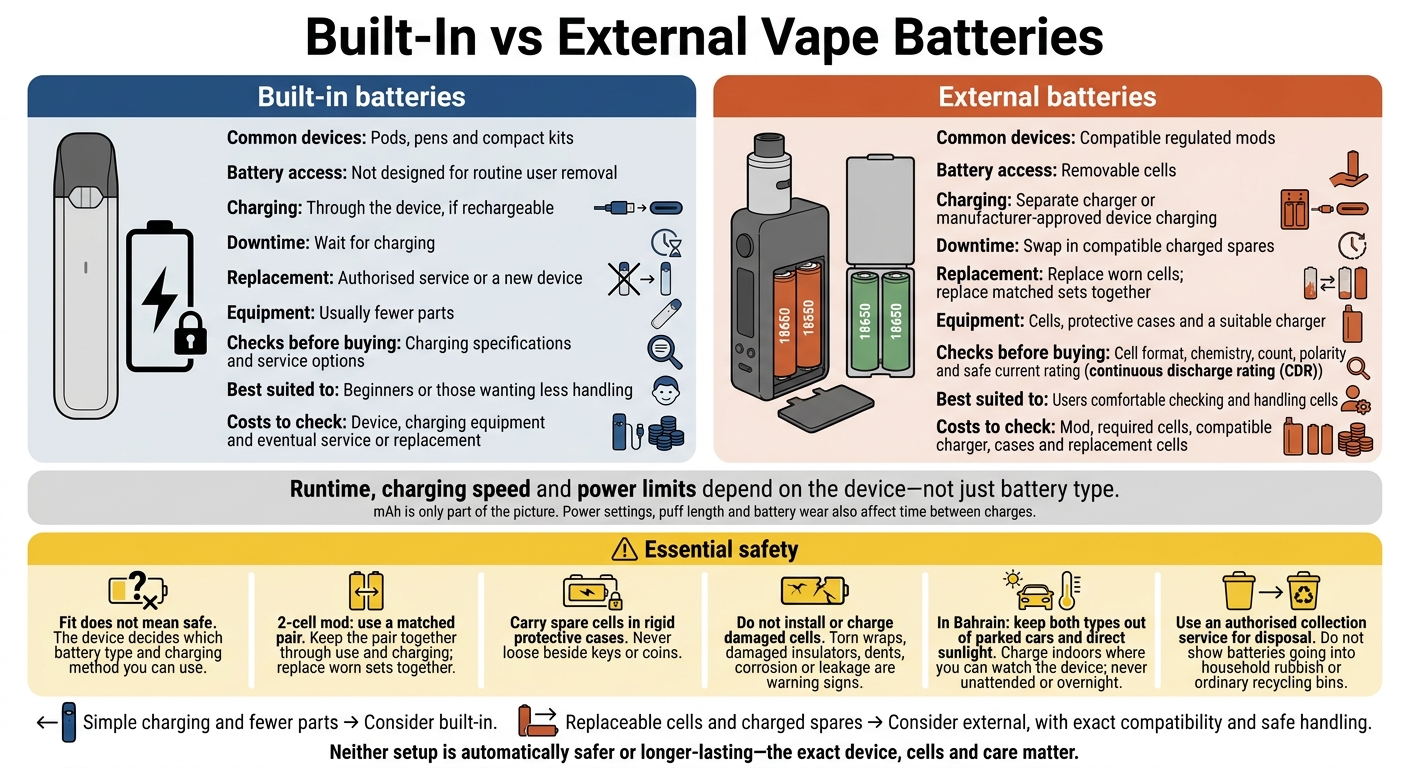
Built-In vs External Vape Batteries
Built-In Batteries: How They Work
Compact pod kits, vape pens and some pod mods use built-in batteries. The battery is sealed inside the device and isn’t meant to be removed.
USB Charging and Daily Use
With no spare cell to swap in, charging habits matter. For rechargeable models, use the specified USB-C or other charging port, a supplied or manufacturer-approved cable, and a compatible power supply. A plug that fits doesn’t guarantee safe charging.
Charge on a hard, flat surface where you can see the device, away from flammable materials. Never charge on a bed or sofa, or leave it charging unattended or overnight.
Only vape while charging if the manufacturer expressly allows pass-through use. Otherwise, wait until charging finishes. Check your model’s stated charging time – USB-C devices don’t all charge at the same rate. Charge before leaving home rather than relying on car charging in Bahrain’s heat.
Runtime, Battery Wear and Replacement
Battery capacity in mAh and power output affect runtime. Higher wattage and frequent long puffs can mean fewer puffs per charge. As the cell ages, you may need to charge more often, or it may no longer hold its charge well.
A worn internal battery normally needs authorised servicing or replacement of the whole device. Don’t pry the device open, puncture the cell or attempt a soldered replacement.
Stop using the device if it overheats, swells, leaks, smells burnt or has physical damage. If it hisses, smokes or sparks, stop using and charging it immediately.
In Bahrain, take it to a municipal or authorised e-waste collection service. Never put devices with built-in lithium batteries in household rubbish or ordinary recycling bins.
External-cell devices let you replace a worn cell rather than the whole device. With a worn internal battery, replacing the device is usually necessary.
sbb-itb-837e7ad
External Batteries: Removable Cells
Removable lithium-ion cells give you more flexibility, but you need the right cells, a suitable charger and safe handling. Start by checking compatibility.
Cell Compatibility and Charging
For a regulated mod, check the required cell format, chemistry, cell count and continuous discharge rating (CDR). A cell that fits or has a high mAh rating is not necessarily suitable. Use an 18650 adapter sleeve only with the manufacturer’s approval. This guidance does not apply to mechanical mods, which require advanced electrical knowledge.
Choose a charger that supports the cell’s format and chemistry and has reverse-polarity and overcharge protection. Follow the charger’s instructions. Use in-device USB charging only if the mod manufacturer permits it. Neither charging method makes an unsuitable cell safe.
Runtime, Spare Cells and Replacement
Runtime depends on total battery energy, output power, puff frequency, device efficiency and cell configuration. Charged spare cells – or a complete matched spare set – can reduce time spent waiting for batteries to charge.
For multi-cell devices, keep cells of the same brand, model, capacity, age, condition and charge level together. Keep paired cells together throughout use and charging, and replace worn sets together rather than replacing individual cells.
Cell Inspection, Storage and Disposal
Before installing a cell, check its wrap, positive-terminal insulating ring and casing. Do not install or charge cells with torn wraps, damaged insulators, dents, corrosion or leakage. Leave any rewrapping to a qualified battery professional.
Carry each spare cell in a rigid protective case, never loose beside keys or coins. In Bahrain, store cells indoors in a cool, dry place – not in a parked car or direct sunlight.
Tape the terminals of retired, undamaged cells and follow an authorised local battery collection service’s disposal instructions. If a cell is hot, leaking or venting, avoid handling it and seek guidance from emergency or waste authorities.
Built-In vs External Batteries: Side-by-Side Comparison
The device details above help put these trade-offs in context. Runtime, charging speed and power limits depend on the device, not just its battery type.
| Factor | Built-in batteries | External batteries |
|---|---|---|
| Battery access | Not designed for routine user removal | Removable cells |
| Charging method | Device port, if rechargeable | External charger or manufacturer-approved USB charging |
| Compatibility checks | Device charging specifications and approved cable/adapter | Exact cell type, size, polarity and charging specifications |
| Typical devices | Pods, pens and compact pod mods | Compatible regulated mods |
| Runtime | Limited to the installed battery | Can be extended with charged spares |
| Charged-cell swapping | Generally unavailable | Possible with matched spare cells |
| Battery replacement | Authorised service or device replacement | Worn batteries or cells replaced separately |
| Portability | Usually fewer components | May require spare-cell cases and a charger |
| Beginner suitability | Usually simpler | Requires more knowledge and care |
| Experienced-user suitability | Suits those who want convenience | Suits those who want replaceable cells and less charging downtime |
Pros, Cons and Costs
Compare the full setup cost – not just the device price.
| Setup | Advantages | Limitations | Costs to check |
|---|---|---|---|
| Built-in | Simple charging, fewer loose parts and often a compact design | Charging downtime and limited battery replacement options | Device, charging equipment and eventual service or replacement |
| External | Replaceable cells and charged-spare swapping | More battery handling and extra equipment | Mod, required cells, compatible charger, cases and replacement cells |
Look beyond the price tag to what’s in the box and how you’ll replace power later. A mod-only price may exclude cells and charging equipment. For a built-in device, check the authorised service route before assuming you can replace its battery.
Safe Charging in Bahrain
In Bahrain, charge indoors, away from direct sunlight and the heat inside parked cars. Check Bahrain’s product and charger requirements: an online listing does not prove compliance.
The next section uses this comparison to help beginners and experienced users choose.
Conclusion: Which Battery Setup Suits You?
Choose based on your charging habits and how comfortable you are handling removable cells. Built-in batteries keep things simple; external batteries give you more flexibility.
Focus on three things: handling, downtime and compatibility.
| Priority | Setup to consider | Main condition |
|---|---|---|
| Simple charging and fewer parts | Built-in | Follow the device’s charging instructions |
| Separate battery replacement | External | Use exactly compatible cells |
| Less charging downtime | External with charged spares | Store and handle spare cells safely |
Choosing as a Beginner or Experienced User
For beginners, a built-in battery usually means fewer things to manage and a straightforward charging routine.
Experienced users may prefer a regulated mod with external batteries. It lets you replace batteries separately and swap in charged spares, giving you more flexibility.
Either way, you need to match the device with the correct battery format and charging method.
Check Compatibility Before Ordering in Bahrain
Once you’ve chosen a setup, check the exact model before ordering in Bahrain.
Before ordering from VapeShop.bh, confirm the device model, battery format and cell count. Also check the charging method, power range, coil or pod compatibility and included accessories so you know what you’ll need to charge and maintain it safely.
FAQs
How can I estimate battery life at my usual wattage?
Check your battery’s capacity in mAh (milliampere-hours). To estimate current draw, divide wattage by the nominal battery voltage, typically 3.7 V. At 80 W, that works out to about 21.6 A.
To estimate runtime, keep wattage, coil resistance and puff frequency consistent. Track elapsed time or count puffs from a full charge to the first low-battery warning. Battery ageing and Bahrain’s heat can shorten runtime; a lasting drop often points to capacity loss.
How do I check a cell’s genuine discharge rating?
Check the manufacturer’s official manual or product page for the cell’s continuous-discharge rating (CDR). Give CDR priority over pulse ratings because it reflects safe, sustained performance.
Avoid rewrapped cells and unknown brands. Choose trusted manufacturers such as Samsung, Sony, Molicel and LG. Before buying or using a cell, compare its specifications with independent test data to check that it meets your device’s power requirements.
Can I charge my vape straight after being outdoors in Bahrain?
No. Bahrain’s intense heat can make your vape batteries hot. Charging them while they’re hot can speed up wear and shorten their lifespan. Let your device or batteries cool to room temperature before charging.
Charge on a hard, non-flammable surface, away from direct sunlight and heat sources.
Related Blog Posts
- Beginner vs. Advanced Vapes: Which Is Right for You?
- Battery Capacity for Vape Mods: Ultimate Guide
- Single vs Dual Mod: Battery Life Guide
- 7 Vape Battery Safety Tips for Daily Use
{“@context”:”https://schema.org”,”@type”:”FAQPage”,”mainEntity”:[{“@type”:”Question”,”name”:”How can I estimate battery life at my usual wattage?”,”acceptedAnswer”:{“@type”:”Answer”,”text”:”Check your battery’s capacity in mAh (milliampere-hours). To estimate current draw, divide wattage by the nominal battery voltage, typically 3.7 V. At 80 W, that works out to about 21.6 A. To estimate runtime, keep wattage, coil resistance and puff frequency consistent. Track elapsed time or count puffs from a full charge to the first low-battery warning. Battery ageing and Bahrain’s heat can shorten runtime; a lasting drop often points to capacity loss.”}},{“@type”:”Question”,”name”:”How do I check a cell’s genuine discharge rating?”,”acceptedAnswer”:{“@type”:”Answer”,”text”:”Check the manufacturer’s official manual or product page for the cell’s continuous-discharge rating (CDR). Give CDR priority over pulse ratings because it reflects safe, sustained performance. Avoid rewrapped cells and unknown brands. Choose trusted manufacturers such as Samsung, Sony, Molicel and LG. Before buying or using a cell, compare its specifications with independent test data to check that it meets your device’s power requirements.”}},{“@type”:”Question”,”name”:”Can I charge my vape straight after being outdoors in Bahrain?”,”acceptedAnswer”:{“@type”:”Answer”,”text”:”No. Bahrain’s intense heat can make your vape batteries hot. Charging them while they’re hot can speed up wear and shorten their lifespan. Let your device or batteries cool to room temperature before charging. Charge on a hard, non-flammable surface, away from direct sunlight and heat sources.”}}]}
Frequently Asked Questions
Built-in batteries are integrated into the device and usually involve fewer loose parts. External batteries use replaceable cells, which can allow charged spares but require checking compatibility, installation, polarity and safe current rating.
Built-in models charge through the device, while external-cell devices use a separate charger or approved device charging. Check the exact charging requirements of the vape before buying or charging it.
Yes, external batteries can be replaced when worn, provided the replacement cells match the device’s required format, chemistry, count, polarity and safe current rating. Matched sets should be replaced together where applicable.
A built-in battery may require authorised service or replacement of the entire device when its battery wears out. Service options and charging specifications should be checked for the exact device.
External cells should be checked for damage and kept in rigid protective cases when carried as spares. Keep batteries away from parked cars and direct sunlight, and charge them where the device can be watched.
For a built-in device, check its charging specifications and available service options. For external batteries, confirm the cell format, chemistry, number of cells, polarity and safe current rating before purchase.
Used batteries and devices should be taken to an authorised collection service rather than placed in household rubbish. In Bahrain, municipal or authorised e-waste services can provide current disposal instructions.