
Best Power Curve For Flavour Chasing


If I want better flavour, I do not run max wattage from start to finish. I get better taste by using a curve that starts a bit lower, stays steady in the middle, and drops near the end.
Here’s the short answer:
- Desserts and sweet liquids: softer start, flat middle, cooler finish
- Fruit blends: balanced curve or a short opening push
- Icy liquids: lower, steadier power with a cool end
- Low-ohm coils (0.15–0.6 Ω): controlled start because they heat fast
- Higher-ohm coils (0.8–1.4 Ω): small opening lift can help because they heat slower
- Long puffs: lower the last 10–20% to cut harshness and coil gunk
- Hot weather in Bahrain: I’d stay about 3–5 W below the top of the coil range for a cooler vape
The article breaks it down into 7 curve styles:
- Low-Ramp
- Balanced
- Short-Boost
- Steady-Mid Output
- Cooler-Finish
- Sweet E-Liquid
- Icy E-Liquid
It also covers:
- how each part of the puff changes flavour
- how to match the curve to coil resistance
- how sweet and icy liquids need different heat control
- what to look for in a curve-capable mod in Bahrain
My main takeaway: for flavour chasing, the best setup is usually a gentle start + steady middle + lower finish, not a hard hit at the coil’s top rating.
Quick Comparison
| Curve | Best for | Main idea | Watch out for |
|---|---|---|---|
| Low-Ramp | Custard, cream, dessert | Soft start, smooth build | Can feel too soft for some fruit blends |
| Balanced | Mixed use | Even heat through the puff | Too much power can flatten lighter notes |
| Short-Boost | Fruit, punchy inhale | Brief opening hit, then lower hold | Too much boost can feel rough |
| Steady-Mid | Long, even draws | Flat middle for stable taste | Weak start if set too low |
| Cooler-Finish | Longer puffs, sweet mixes | Drop power near the end | Finish may still feel warm if taper is too small |
| Sweet E-Liquid | Candy, bakery, custard | Lower, flatter heat control | Sweeteners still gunk coils fast |
| Icy E-Liquid | Menthol, ice fruit | Cooler plateau, cooler finish | Too much heat can dull the chill |
So if you want the simple version: build the curve around choosing the right vape coil, your puff length, and your liquid type – then keep every point inside the coil’s rated wattage.
sbb-itb-837e7ad
How Power Curves Change Flavour
A power curve shapes how heat builds at the start, sits through the middle, and tapers at the end of a puff. And each part changes flavour in its own way.
Start of the Puff: Ramp-Up Speed and First Flavour Notes
The opening wattage sets how fast the coil reaches vapourising temperature. If you start a bit lower – around 10–20% below the coil’s mid-rated wattage – dessert and custard e-liquids tend to come in softer and smoother. The flavour feels rounder instead of rushing in all at once.
A faster ramp-up does the opposite. It brings the first notes forward with more punch, which works well for fruit or icy liquids when you want those brighter top notes straight away. But there’s a catch. If the opening power is too high, the first half-second can feel sharp or harsh before the draw settles.
Once the coil is up to temperature, the middle of the puff does most of the work.
Middle of the Puff: Stable Output and Flavour Consistency
The coil spends most of the draw in the mid-puff phase, so this is where steady wattage matters most. Keeping output near the middle of the coil’s rated range helps hold temperature in a tight band, where flavour compounds vapourise cleanly.
If mid-puff power is too low, the flavour can taste thin. Too high, and softer notes start to fade into the background. For example, on a 0.3 Ω coil rated for 35–45 W, holding 40–42 W for 2–3 seconds through the middle gives the most steady and repeatable flavour.
As the puff runs on, heat build-up becomes the main issue.
End of the Puff: Lower Finish Power and Heat Control
Coil temperature tends to creep up as the draw continues. Dropping power by 10–20% in the last 0.5–1.0 seconds helps keep the finish cooler and cleaner.
Take a 0.25 Ω coil running 55–58 W through the middle. If you taper that down to 45–50 W at the end, you can keep more of the top notes on the exhale and cut back that sticky sweetness that sometimes hangs on too long. It also slows coil build-up and may help you choose and maintain the best vape coils for longevity.
| Curve phase | Primary effect | Risk if ignored |
|---|---|---|
| Start | Flavour opening speed | Too fast: harshness; too slow: delayed flavour |
| Middle | Flavour consistency | Too low: muted taste; too high: overheated sweetness |
| End | Heat control on the finish | Burnt sweetness, flavour fade, faster coil build-up |
1. Low-Ramp Flavour Curve
This is the simplest flavour-first curve to use: a soft start, a steady middle, and a cooler finish.
A low-ramp curve opens the puff gently. It starts at about 60–70% of the coil’s target wattage, then climbs bit by bit over the first 0.5–1.0 seconds. The goal is simple: don’t hit the coil with a sharp burst of power. Let it warm up in stages.
Ramp-Up Shape
The ramp should feel smooth from start to finish, not jumpy. For a 0.15–0.3 Ω coil rated 60–80 W, a good starting point is to open at 40–50 W for the first 0.3–0.5 seconds, move up to 60–65 W by 1.0 second, and only touch 70–75 W on longer draws. For pod coils around 0.8–1.2 Ω rated 10–18 W, start at 9–10 W for the first 0.3 seconds, then climb to 12–14 W by 0.8 seconds.
That middle section matters just as much as the opening.
Mid-Puff Wattage Stability
Once the coil reaches temperature, the mid-puff – about 1–3 seconds into the draw – should stay steady at just under the coil’s top rated wattage. On a 70 W coil, that usually means holding around 60–65 W. That steady hold helps stop the flavour from swinging back and forth between bright and dull during the same puff.
Coil Heat Behaviour
With a low-ramp curve, coil heat builds slowly, settles into a controlled plateau, and then eases off as you release the fire button. Too much heat makes sweeteners caramelise on the coil, which creates build-up and can spoil flavour within a few days. A gentler heat pattern slows that build-up and may help the coil last longer.
That’s why this curve works well for flavour-first setups.
Best Flavour Profile
It’s best for layered blends where you want a softer opening note and a clean finish.
2. Balanced Flavour Curve
The balanced flavour curve is the go-to option for most setups. It gets the coil up to temperature fast enough, stays steady through the middle of the puff, and eases off in a controlled way at the end. Put simply, it sits in the middle: not as soft as a low-ramp style, and not as hard-hitting as a more aggressive curve.
Ramp-Up Shape
The opening part of the puff should climb fast, but it shouldn’t feel harsh. On a 0.2 Ω coil, that often lands in the 70–85 W sweet spot. For 0.8 Ω mesh coils, a balanced setting is often around 15–18 W. For 1.2 Ω MTL coils, it usually sits around 10–12 W.
Mid-Puff Wattage Stability
The middle of the puff should stay flat. That steady output helps keep flavour even and evaporation predictable, so the vape stays clear instead of turning sharp. On longer pulls, this matters a lot, because even a small heat drift can change the flavour faster than people expect.
Coil Heat Behaviour
A balanced curve keeps the coil in a steady heat range – warm enough for efficient vapourisation, but not so hot that lighter flavour notes start to fade. If you push the same coil into 85–100 W, coil life gets shorter and delicate notes can start to flatten.
Best Flavour Profile
This curve works well for best e-liquids in Bahrain for fruit, dessert, and mixed sweet-icy profiles. It’s a handy pick when you want one setting that can handle a few flavour styles without needing constant adjustment.
3. Short-Boost Curve
The short-boost curve puts most of the heat right at the start, then drops to a cooler hold for the rest of the puff. The idea is simple: you get a faster flavour hit without keeping the whole puff hot. It sits between balanced and aggressive curves – sharper on the inhale, but still controlled enough to keep flavour in good shape.
Ramp-Up Shape
The opening spike is what makes this curve work. For a 0.2–0.3 Ω coil rated at 35–45 W, a practical setup is 27–30 W for the first 0.5 seconds, then 20–22 W for the rest of the draw. For a 0.6–0.8 Ω coil rated at 15–25 W, start at 20–22 W for the first 0.7 seconds, then drop to 16–18 W.
Keep that spike short. If it drags on, sweet flavours can start to dull, and icy liquids may lose that clean chill that makes them feel fresh.
Mid-Puff Wattage Stability
After the opening boost, the wattage should stay steady. That steady hold stops the puff from feeling strong at the start and weak in the middle. The result is a more even flavour from the first hit to the last.
Coil Heat Behaviour
Because the boost only lasts a moment, the coil heats up fast and then settles down. In many cases, that leads to less gunk build-up and slower coil wear than running high power all the way through the puff.
Best Flavour Profile
This curve works well with sweet, fruity, and dessert e-liquids. If you’re using icy or strong menthol liquids, keep the boost modest. That helps the first hit stay crisp instead of turning rough.
For a softer option with less punch at the start, the next curve keeps the output more even.
4. Steady-Mid Output Curve
If the last curve felt a bit too punchy, this one keeps things far more even through the middle. Use it when you want a long, steady centre instead of a hard hit at the start. It works best when you want flavour to stay the same from start to finish, with each puff feeling consistent.
Ramp-Up Shape
The ramp-up is gentle here. Power climbs bit by bit over the first 0.3–0.7 seconds until it reaches the target wattage. For a 0.2 Ω mesh coil rated at 40–60 W, a sensible starting point is 35 W for the first 0.2 seconds, then a smooth climb to 50 W by 0.5 seconds, holding there for the rest of the puff. Avoid sharp spikes. They can dry out the first hit, especially with sweet liquids.
Mid-Puff Wattage Stability
This is the whole point of the steady-mid curve. Once the plateau is reached, wattage should stay within about ±5–10% of the target. So, if you’re running 50 W, the actual output should stay between 45–55 W through the middle of the puff. That stable window usually lasts 1.5–3.0 seconds, and that’s where flavour tends to come through most clearly. Fruit notes stay bright, dessert layers stay rounded, and tobaccos keep their depth.
Coil Heat Behaviour
A flat plateau puts the coil into a steady heat balance. In simple terms, the heat going in roughly matches the heat lost through airflow and vaporisation. The coil reaches its working temperature during ramp-up, then stays there instead of getting hotter as the puff goes on.
That steady heat helps stop flavour from drifting mid-puff. In Bahrain’s heat, this kind of plateau can also help stop the coil from running hotter than planned, which cuts down sweetener caramelisation during the puff and slows early coil gunk build-up.
Best Flavour Profile
This curve suits:
- Fruits
- Custards
- Tobaccos
- Sweet-icy blends
For sweet-icy blends, keep the plateau a touch lower so the cool note stays clean.
If you want the finish to feel cooler too, the next curve brings power down near the end.
5. Cooler-Finish Curve
A cooler-finish curve keeps the middle of the puff steady, then pulls power down in the last 1–2 seconds. The result is a smoother exhale on longer draws. If a steady-mid curve starts to feel a bit too warm near the end, this is usually the cleaner move.
Ramp-Up Shape
For a 0.2–0.3 Ω coil rated 50–70 W, start at about 45–50 W for the first 0.3 seconds. Then climb to 60–65 W by 0.5 seconds and hold that level through the middle of the puff. That gentler lift can help avoid a harsh first hit, which matters even more with a fresh wick.
Mid-Puff Wattage Stability
The middle of the puff should stay near the centre of the coil’s rated range. For a 0.15 Ω mesh coil rated 60–80 W, that often means holding around 65–70 W for 1.5–2.0 seconds.
Coil Heat Behaviour
Drop the last 1–2 seconds by 5–10 W to cut peak heat and slow caramelisation on the coil and cotton. In Bahrain’s heat, that small drop can also help the device feel cooler during longer sessions.
Best Flavour Profile
This curve tends to suit desserts, custards, creamy blends, and sweetened fruit flavours. It helps stop the last part of the puff from tasting burnt or overly sweet. If the finish still feels warm, lower the final wattage point by 3–5 W and test again. Next, fine-tune the same shape for sweet or icy liquids.
6. Sweet E-Liquid Curve
Sweet blends need the tightest heat control. Sugars scorch faster than fruit or icy flavours, and sweeteners caramelise fast, which cuts coil life. In practice, heavily sweetened dessert liquids are the clearest test of curve control. You’re managing two things at once: flavour detail and how long the coil stays clean.
Ramp-Up Shape
Use a gentle ramp. Start at 70–80% of the target wattage for the first second, then reach full target by 1.5–2 seconds.
For a 0.2 Ω coil rated at 40–60 W, open at about 30–35 W, then climb to 45–50 W as the puff settles. That softer start helps cream, vanilla, and bakery notes come through without a harsh opening hit.
Mid-Puff Wattage Stability
Mid-puff wattage needs to stay flat. If power keeps climbing, sweeteners brown too much and the vape starts to feel dense instead of layered.
For a 0.15 Ω mesh coil rated at 60–80 W, start at 50 W, hold 60 W through the middle of the puff, then make a small drop at the end. That stable middle section helps separate the flavour notes. Instead of one blurred hit, you get cream first, then the custard base, then the sweetness.
Coil Heat Behaviour
Heavily sweetened blends can gunk a coil in 3–5 days at normal sub-ohm wattages. A simple way to slow that down is to vape in the lower half of the coil’s rated range.
A 3–5 W step-down in the final 1–2 seconds also cuts leftover heat on the wick during longer draws. That matters even more in Bahrain’s heat. As a practical habit, keep wattage 5–10 W below the coil’s maximum rating, because warm ambient conditions already speed up sweetener breakdown on a hot coil.
Best Flavour Profile
This curve keeps vanilla, cream, and bakery notes distinct, and it softens throat hit. It works well with custards, creams, caramel, and candy fruit blends.
If the finish still tastes scorched, drop the final wattage by 2–3 W.
Icy liquids need the opposite balance: lower heat keeps the chill clean.
7. Icy E-Liquid Curve
Icy mixes need the opposite treatment: less heat and a cleaner chill. Keep the power cooler and steadier. Push too hard, and the cooling effect can feel flat while the menthol turns harsh.
Ramp-Up Shape
Begin at 60–70% of your target mid-puff wattage for 0.3–0.5 seconds, then climb in a smooth line until you hit your plateau at around 1 second.
For a 0.2 Ω coil rated at 40–60 W, that means starting at about 26–30 W and easing up to roughly 42–48 W.
Mid-Puff Wattage Stability
Keep the middle of the puff flat and steady, with power sitting in the lower half of the coil’s rated range.
Take a 0.8 Ω MTL coil rated at 12–18 W. A plateau of 14–16 W through the middle of the puff gives you a steady chill without muting the fruit or candy notes underneath. Menthol feels most refreshing when coil temperature stays around 93–149 °C, so there’s not much point in going hotter.
Coil Heat Behaviour
At the end of the puff, pull the power down by 10–20% over the last 0.5–1 second. On a sub-ohm setup, that could mean dropping from 36 W to around 30–32 W.
Icy blends also tend to carry much less sugar than dessert liquids, so the flavour stays cleaner for longer. With a controlled icy curve, performance can often hold for up to 14 days before the flavour starts to dull.
Best Flavour Profile
When this curve is dialled in, you get crisp cooling on the inhale, a steady chill through the middle, and a smooth exhale without a dry or scratchy finish. The fruit or drink notes stay clear instead of getting buried under a generic cold hit.
A couple of small tweaks can help:
- If the chill feels too sharp, lower the ramp.
- If the fruit starts to fade, lift the plateau by 1–2 W.
This curve works well for menthol, icy fruit blends like mango ice or grape ice, cold beverage profiles, and WS-23 mixes. Use these settings as a starting point for the comparison table below.
How to Match the Curve to Coil Resistance
Coil resistance changes how fast heat builds. That means the same curve can taste smooth on one setup and rough on another. Get the match wrong, and you can dull bright notes or burn sweeter ones. The curve shapes above are a starting point. Resistance tells you how hard each shape should run. Start with the coil’s resistance, then tweak the curve from there.
Lower-Resistance Coils: Controlled Ramp-Up
Lower-resistance sub-ohm coils (0.15–0.6 Ω) heat up fast, so they usually need a more controlled ramp-up.
For a 0.2 Ω coil rated at 40–60 W, a flavour-led curve could look like this:
- 0.0–0.3 s: 42–45 W
- 0.3–0.8 s: rise slowly to 50–52 W
- 0.8–1.5 s: hold at 50–52 W
- 1.5 s+: optional soft taper to 45–48 W for longer pulls
This gives you full flavour without slamming straight into max power.
Higher-Resistance Coils: Mild Opening Lift When Needed
Higher-resistance MTL coils (0.8–1.4 Ω) heat more slowly and usually run at 10–18 W. If the first half-second feels a bit thin, a small opening lift can bring the flavour forward without making the vape harsh.
For a 0.9 Ω coil rated at 12–18 W, try 15–16 W for the first 0.5 seconds, then drop to 13–14 W for the main part of the puff.
Stay Within the Coil’s Rated Wattage Range
Think of the coil’s printed wattage range as the ceiling for the whole curve. Keep the start, middle, and end inside that range. Even a short spike can overheat the wick and dull the flavour.
A simple way to dial it in:
- Start around the middle of the rated range
- Adjust in 2–3 W steps
- In Bahrain’s hot weather, many users stay 3–5 W below the top end for a cooler, more comfortable vape
These ranges matter because flavour drops off when heat builds too fast or runs too hot. Here are the usual pairings:
| Coil Resistance | Typical Wattage Range | Curve Approach |
|---|---|---|
| 0.15–0.25 Ω | 50–80 W | Controlled ramp-up, no opening spike |
| 0.3–0.5 Ω | 25–50 W | Moderate start, smooth rise to a mid-plateau |
| 0.6–0.9 Ω | 15–25 W | Balanced ramp, mild lift only if needed |
| 1.0–1.6 Ω | 8–18 W | Gentle lift at the start, flat and cool through the middle |
Use these pairings as starting points, then fine-tune for your liquid and puff length.
Sweet vs Icy E-Liquids: How Curve Choice Differs
Once you’ve picked a curve shape, the next step is matching it to the liquid. Sweet blends usually do better with cooler, steadier heat. Icy blends need a cool finish so the chill stays clean instead of turning rough.
Sweet Liquids: Controlled Heat for Better Detail
Sweet blends tend to work best on low-ramp or balanced curves. The goal is simple: keep the heat steady. A good rule is to run sweet liquids 3–5 W below the coil’s top end. That helps keep layered notes intact and can cut down on gunk buildup.
Push sweet liquids too hard and things can go south fast. You start losing flavour detail, and the sweetener can leave more residue on the coil.
Icy Liquids: Cooler Curves for Cleaner Chill
Icy blends need a different setup. They usually perform best on steady-mid or cooler-finish curves. Cooler vapour keeps the chill crisp. If the curve spikes late, the icy edge can feel harsher and less clean.
That’s the main trade-off. Too much heat doesn’t just warm the vape, it can flatten the cooling effect you were after in the first place.
Coil Life
Sweet liquids leave residue faster, while icy liquids usually keep coils cleaner for longer.
| Factor | Sweet Liquids | Icy / Menthol Liquids |
|---|---|---|
| Ideal curve shape | Low-ramp or balanced | Steady-mid or cooler-finish |
| Wattage position | Mid-range, 3–5 W below max | Lower end of rated range |
| Main heat risk | Sweetener caramelisation, burnt notes | Warm vapour dulling the chill |
| Typical coil lifespan | 2–4 days (heavy use) | 7–14 days |
Comparison Table
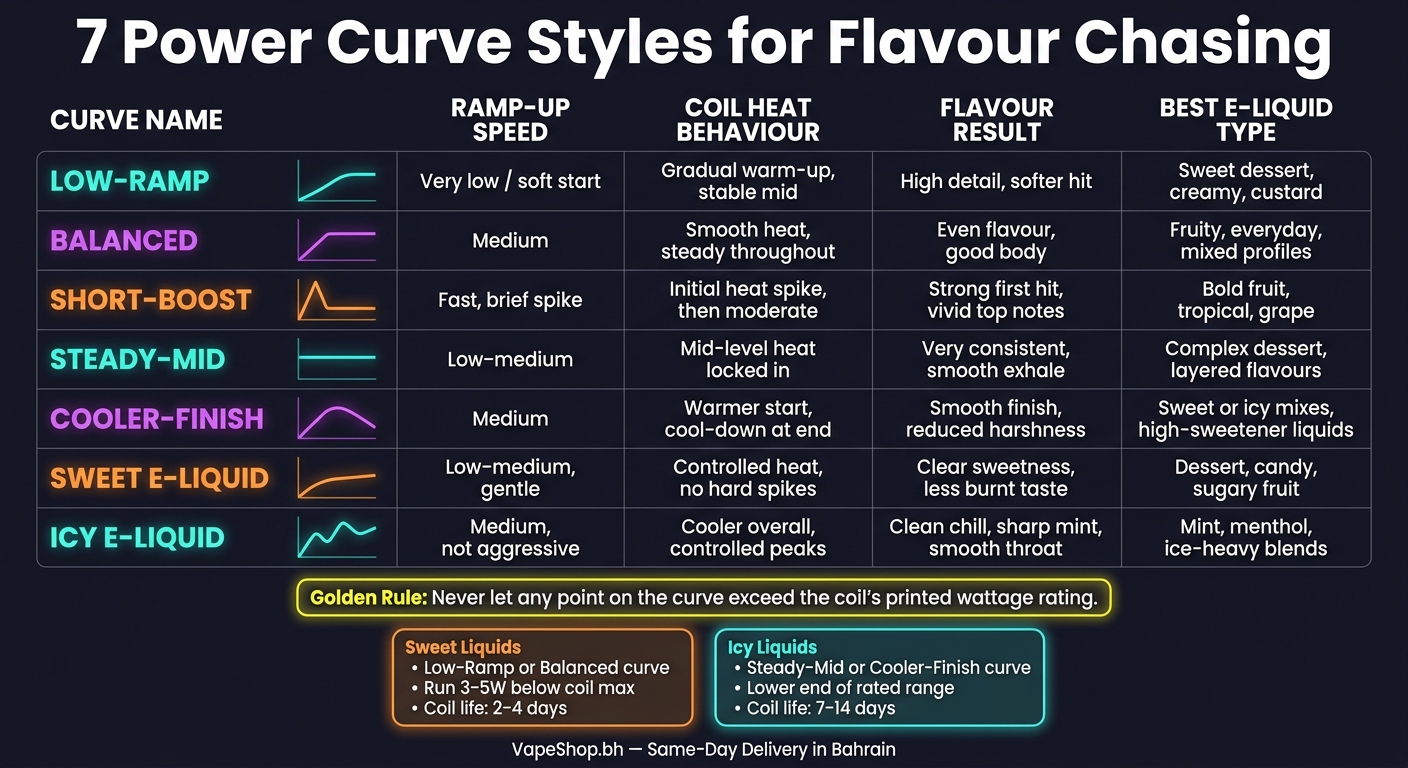
7 Power Curve Styles for Flavour Chasing: Quick Visual Guide
Here’s a side-by-side look at all seven curves. Use it to quickly spot which one suits your coil, your liquid, and the type of flavour you want.
| Curve | Ramp-Up Speed | Coil Heat Behaviour | Flavour Result | Best E-Liquid Type |
|---|---|---|---|---|
| Low-Ramp | Very low / soft start | Gradual warm-up, stable mid | High detail, softer hit | Sweet dessert, creamy, custard |
| Balanced | Medium | Smooth heat, steady throughout | Even flavour, good body | Fruity, everyday, mixed profiles |
| Short-Boost | Fast, brief spike | Initial heat spike, then moderate | Strong first hit, vivid top notes | Bold fruit, tropical, grape |
| Steady-Mid | Low–medium | Mid-level heat locked in | Very consistent, smooth exhale | Complex dessert, layered flavours |
| Cooler-Finish | Medium | Warmer start, cool-down at end | Smooth finish, reduced harshness | Sweet or icy mixes, high-sweetener liquids |
| Sweet E-Liquid | Low–medium, gentle | Controlled heat, no hard spikes | Clear sweetness, less burnt taste | Dessert, candy, sugary fruit |
| Icy E-Liquid | Medium, not aggressive | Cooler overall, controlled peaks | Clean chill, sharp mint, smooth throat | Mint, menthol, ice-heavy blends |
Use this table as a starting point, then tweak based on how your coil reacts and how your liquid tastes in daily use. After that, match the curve with a mod and coil that can keep the output clean and steady.
Where to Buy Curve-Capable Mods and Coils in Bahrain
The right curve only helps if your mod, coils, and e-liquids are easy to replace and test. Once you’ve dialled things in, local stock becomes a big deal. Flavour testing works best when you can swap mods, coils, and liquids without waiting around.
What to Look for in a Curve-Capable Mod
Not every mod lets you build custom power curves. Check for modes like Power Curve, Wattage Curve, VPC, or CCW.
After that, focus on the basics that make day-to-day testing smoother:
- A clear screen
- Responsive firing
- Precise control over each curve step
That last point matters more than it may seem. If each step can’t be adjusted cleanly, it’s much harder to fine-tune the vape the way you want.
Why Coil and E-Liquid Availability Matters
Curve tuning depends on repeat testing, so spare coils and a few different liquid types matter. It’s best to keep coils in the same resistance range. That way, you can compare curves on a like-for-like setup instead of chasing results caused by hardware changes.
It also helps to keep extra coils ready for sweet, fruit, and icy blends on the same setup. One small change in liquid can shift the whole feel of a curve, so having stock on hand saves time and hassle.
Bahrain Buying Tip: Fast Reorders for Testing Setups
Fast local reorders make curve testing much easier to repeat. VapeShop.bh is a practical Bahrain option for advanced vape mods, replacement coils, pods, e-liquids, and accessories, with same-day delivery across Bahrain. If a coil burns out or you want to switch flavours mid-test, you can reorder fast via WhatsApp.
Conclusion
The best curve is the one that pushes flavour to the front without overheating the coil.
Start at the lower end and dial it in there first. Then tweak the mid-puff based on how long your puff usually lasts. Once the curve feels steady, the liquid style shapes the final feel. It helps to save separate profiles for sweet liquids and icy liquids.
Never let any point on the curve go above the coil’s printed wattage.
FAQs
How do I choose the right curve for my coil?
Check the coil’s recommended wattage range and begin at the low end. Then increase the power in small steps, like 5W at a time, until the flavour hits its sweet spot.
Match the setting to your e-liquid and airflow. Sweet flavours often work better with a bit more wattage, while menthol and tobacco may taste better at lower settings. A tighter draw usually needs less power. An open DTL draw usually needs more.
What curve works best for short puffs?
For short puffs, use a curve that starts at higher wattage. That gives the coil a fast heat-up, so you get better flavour before the puff finishes.
Then bring the power down near the end of the puff. This helps reduce the chance of overheating or scorching the wick.
If you want help setting this up, you can contact VapeShop.bh on WhatsApp at +973 66324432.
How do I know if my wattage curve is too hot?
Your wattage curve is probably too high if the vapour feels uncomfortably hot, the flavour starts tasting harsh or burnt, or the flavour drops off fast. If your device gives any feedback, pay attention to that too. If it gets unusually warm during light use, that’s a sign something may be off.
To stay safe, check your coil’s recommended wattage range first. Start at the lower end, then increase in small steps until you land on the flavour sweet spot.
Related Blog Posts
- Best Wattage for MTL vs. DTL Vaping
- How to Build Coils for Competitive Cloud Chasing
- How to Choose the Right Coil for Your Vape Mod
- Power Curve Guide for Vape Mods
{“@context”:”https://schema.org”,”@type”:”FAQPage”,”mainEntity”:[{“@type”:”Question”,”name”:”How do I choose the right curve for my coil?”,”acceptedAnswer”:{“@type”:”Answer”,”text”:”Check the coil’s recommended wattage range and begin at the low end. Then increase the power in small steps, like 5W at a time, until the flavour hits its sweet spot. Match the setting to your e-liquid and airflow. Sweet flavours often work better with a bit more wattage, while menthol and tobacco may taste better at lower settings. A tighter draw usually needs less power. An open DTL draw usually needs more.”}},{“@type”:”Question”,”name”:”What curve works best for short puffs?”,”acceptedAnswer”:{“@type”:”Answer”,”text”:”For short puffs, use a curve that starts at higher wattage. That gives the coil a fast heat-up, so you get better flavour before the puff finishes. Then bring the power down near the end of the puff. This helps reduce the chance of overheating or scorching the wick. If you want help setting this up, you can contact VapeShop.bh on WhatsApp at +973 66324432.”}},{“@type”:”Question”,”name”:”How do I know if my wattage curve is too hot?”,”acceptedAnswer”:{“@type”:”Answer”,”text”:”Your wattage curve is probably too high if the vapour feels uncomfortably hot, the flavour starts tasting harsh or burnt, or the flavour drops off fast. If your device gives any feedback, pay attention to that too. If it gets unusually warm during light use, that’s a sign something may be off. To stay safe, check your coil’s recommended wattage range first. Start at the lower end, then increase in small steps until you land on the flavour sweet spot.”}}]}
Frequently Asked Questions
For dessert and sweet e-liquid, the recommended power curve is a softer start, a flat middle, and a cooler finish. This setup lets the coil warm up gently, keeps the sweetness stable through the puff, and then drops power at the end to reduce harshness and coil gunk.
Fruit blends respond well to either a balanced curve with even power through the puff or a short opening boost. A short boost at the start brings out a punchy inhale, while a more even wattage curve keeps lighter fruit notes clear without overcooking them.
Low-ohm coils in the 0.15–0.6 Ω range need a controlled start because they heat up quickly, so a gentler ramp avoids harshness. Higher-ohm coils around 0.8–1.4 Ω benefit from a small opening lift, giving them time to reach temperature and improving flavor without burning the liquid.
For sweet e-liquid and long puffs, the guide recommends a gentle start, steady middle, and then lowering power in the last 10–20% of the puff. This cooler finish helps cut harshness, reduces caramelized buildup on the coil, and keeps sweetness tasting clean through the entire inhale.
Icy e-liquid performs best with a lower, steadier power curve and a cool end to the puff. Keeping wattage controlled avoids overpowering the cooling notes, while the gentle finish keeps the icy effect comfortable rather than sharp.
In hot weather, the guide suggests staying about 3–5 W below the top of the coil’s range for a cooler vape, combined with a gentle start and lower finish. This approach keeps flavor strong while reducing heat buildup, which is especially helpful for longer puffs in Bahrain.
A curve-capable mod should let you shape the puff into styles like Low-Ramp, Balanced, Short-Boost, Steady-Mid Output, Cooler-Finish, Sweet E-Liquid, and Icy E-Liquid. With these options, you can match the curve to coil resistance and liquid type to fine-tune flavor instead of using one flat power level.