

Single vs Dual Mod: Battery Life Guide


I’d choose a single-battery mod for lighter carry, or a dual-battery mod for roughly twice the energy with the same cells. That means longer runtime at the same wattage and puff pattern – not a guaranteed full day.
I’d compare daily watt-hours, cell ratings and size, rather than mAh or coil resistance alone. For example, one 3,000 mAh cell at 3.7 V stores 11.1 Wh; two store 22.2 Wh before losses.
Quick Comparison
| Factor | Single-battery mod | Dual-battery mod |
|---|---|---|
| Cells | One compatible 18650 or 21700 | Two compatible, matched cells |
| Carry size | Smaller and lighter | Larger and heavier |
| Energy with identical cells | One cell’s reserve | About twice the reserve |
| Power | Less wattage headroom | More wattage headroom |
| Swap plan | One spare cell per set | One spare matched pair per set |
Before choosing, I’d log wattage, puff count and puff length for 3–7 normal days, then allow for battery ageing and energy losses. Series and parallel packs have different voltage and mAh figures, so I’d compare them in Wh.
In Bahrain, my rule is simple: <u>keep mods and cells out of parked cars and direct sunlight</u>. I’d also check device and coil compatibility, use correctly rated cells, carry spares in protective cases and charge only while supervised.
Series Vs Parallel? Milliamp Hours Vs Watt Hours? – Battery Life In Mods Explained
sbb-itb-837e7ad
Single vs Dual Mods: Energy, Power and Size
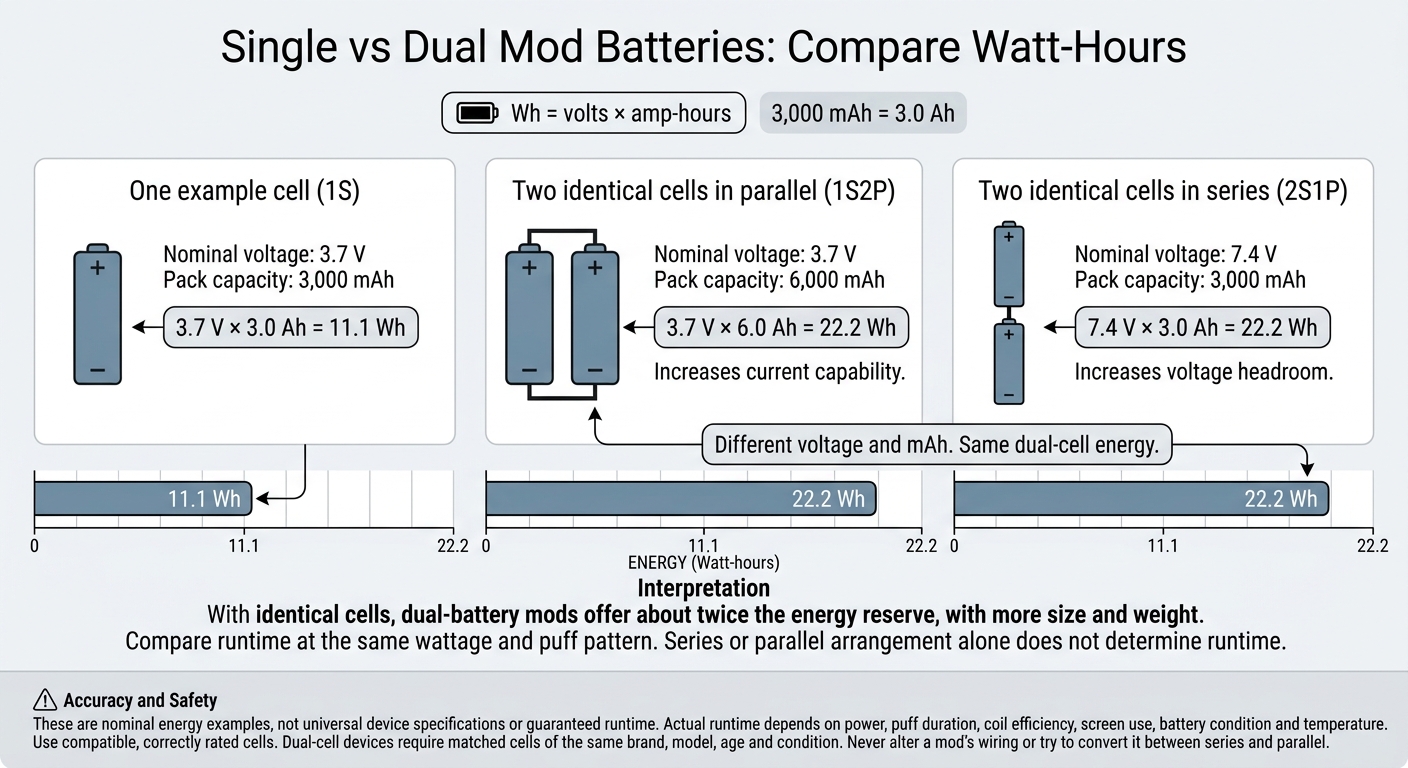
Single vs Dual Mod Batteries: Compare Watt-Hours
The main trade-off is simple: more stored energy means more size and weight.
| Factor | Single-battery mod | Dual-battery mod |
|---|---|---|
| Cell count | One compatible 18650 or 21700 | Two matched cells |
| Example cell capacities | One 3,000 mAh 18650 or 4,000 mAh 21700 | Two cells, each rated at 3,000 mAh or 4,000 mAh |
| Example nominal energy at 3.7 V per cell | 11.1 Wh or 14.8 Wh | 22.2 Wh or 29.6 Wh |
| Advertised wattage headroom | Some models: around 80–100 W | Higher wattage headroom |
These capacities and energy figures are examples, not specifications for every device. Actual runtime depends on power, puff duration, coil efficiency, screen use, battery condition and temperature.
Single-Battery Mods: Smaller Size, Moderate Power
Single-cell mods use one 18650 or 21700 cell. Check which format your device accepts before use. More capacity doesn’t always mean more current capability: a higher-capacity cell can have a lower continuous-discharge rating (CDR) than a lower-capacity high-drain cell. Follow the manufacturer’s battery requirements, not just the wattage printed on the box.
Frequent or long puffs may mean recharging during the day or carrying a spare in a protective battery case. Never carry a loose cell with keys or coins. Dual-cell mods offer more reserve for longer runtime or higher wattage.
Dual-Battery Mods: More Energy and Power
A second cell adds weight and bulk. In return, you get more stored energy and higher wattage headroom. Many models advertise around 200 W or more, depending on the device and cells.
Use two cells of the same brand, model, age and condition as a matched pair. The pack’s voltage and mAh figures depend on whether those cells are wired in series or parallel.
Series vs Parallel: Voltage, Capacity and Energy
mAh alone cannot compare battery packs. Use watt-hours instead: Wh = volts × amp-hours; 3,000 mAh = 3.0 Ah. Two identical cells store the same nominal energy in either arrangement, even though their voltage and mAh figures differ.
| Configuration | Nominal voltage | Pack capacity | Nominal energy |
|---|---|---|---|
| One example cell | 3.7 V | 3,000 mAh | 11.1 Wh |
| Two identical cells in parallel, 1S2P | 3.7 V | 6,000 mAh | 22.2 Wh |
| Two identical cells in series, 2S1P | 7.4 V | 3,000 mAh | 22.2 Wh |
Parallel increases current capability; series increases voltage headroom. Neither arrangement changes runtime on its own. Never alter a mod’s wiring or try to convert it between series and parallel.
Use Wh to estimate how many battery sets you need each day.
Estimate Your Daily Battery Needs
To compare single and dual mods, turn your daily vaping use into battery sets needed. This helps you estimate how often you’ll need to recharge or swap batteries.
How Coil Power and Puff Length Affect Demand
Start by converting your usual vaping pattern into daily energy use. In regulated wattage mode, battery drain depends on wattage and total firing time, not coil resistance alone. The mod adjusts voltage and current to deliver your chosen power.
Stay within the coil manufacturer’s recommended wattage range. Higher-power coils usually use more battery energy.
Calculate Daily Watt-Hours and Battery Sets
A set means one cell in a single-battery mod or one matched pair in a dual-battery mod. Convert mAh to Ah by dividing by 1,000, then use these calculations:
Firing hours = daily puffs × seconds per puff ÷ 3,600
Daily firing Wh = watts × firing hours
Usable output Wh per set = cell count × nominal voltage × capacity in Ah × usable-capacity allowance × converter efficiency
Set-equivalents = daily firing Wh ÷ usable output Wh per set
Battery sets needed = set-equivalents rounded up.
Use nominal voltage, not the 4.2 V full-charge voltage. The usable-capacity allowance accounts for energy you can’t access before voltage cut-off and under actual discharge conditions. Converter efficiency accounts for energy lost during conversion.
This estimate excludes standby and screen drain. Round up, then leave extra reserve for ageing and changes in use. In Bahrain, keep cells out of parked cars and direct sunlight: high heat speeds up ageing.
3 Example Daily Battery Calculations
These examples assume 3.6 V nominal voltage, 85% usable capacity and 90% converter efficiency, with suitably rated cells. They estimate energy needs, not guaranteed runtime.
Measure Single 18650 Single 21700 Dual 18650 Cell capacity 3,000 mAh 4,000 mAh 2 × 3,000 mAh Power 35 W 35 W 80 W Daily puffs 150 × 3 seconds 150 × 3 seconds 250 × 4 seconds Firing time 7.5 minutes 7.5 minutes 16.67 minutes Daily demand 4.38 Wh 4.38 Wh 22.22 Wh Usable energy per set 8.26 Wh 11.02 Wh 16.52 Wh Estimated puffs per set 283 378 186 Set-equivalents 0.53 0.40 1.35 Battery sets needed 1 1 2 Extra set needed from a full charge 0 0 1
Check these estimates against your logged wattage, coil type, puff count and average puff length. If runtime is consistently shorter, reduce the usable-capacity assumption or carry more reserve. In the dual-cell example, one replacement means a second matched pair, not one loose cell.
The result gives you a basis for weighing lighter carry weight against fewer daily charging stops.
Choose Your Mod and Plan Safe Charging
Decision Table: Portability vs Fewer Cell Swaps
Use your battery-set estimate above to choose the smallest setup that covers your daily demand with reserve to spare. These categories are planning guides, not runtime promises. Higher wattage and frequent long puffs can use up the extra energy in a dual-cell mod.
| Setup | Portability and weight | Best for | Swap/charge plan | Best fit |
|---|---|---|---|---|
| Single 18650 | Smallest carry option | Moderate power | Plan swaps using your estimate; carry a spare in a protective case if needed | Low-to-moderate demand |
| Single 21700 | Balance of size and runtime | Moderate power with fewer swaps | May need fewer swaps than a single 18650; carry a compatible spare if needed | Moderate demand |
| Dual 18650 | Best suited to higher daily demand | Higher power and frequent long puffs | May cover a full day; carry a spare matched pair if your estimate calls for it | Moderate-to-high demand; all-day use is not guaranteed |
For a Manama–Riffa working day, charge indoors before leaving. Carry enough spares in protective cases to cover your demand plus reserve. If you can’t charge at work, plan for cell swaps rather than a charging stop. Never leave your mod or spare cells in a parked car or direct sunlight, even during short stops.
Once you’ve chosen the size class, match the cell rating and charging method to your mod.
Cell Ratings, Matched Pairs and Safe Charging
More cells only help when they’re correctly matched and rated. Use the cell format listed in your device manual, and check that the wraps and positive-terminal insulating rings are intact. The cells must meet the manual’s continuous-discharge rating (CDR) requirement.
In regulated mods, battery current depends on wattage, battery voltage, cell arrangement and efficiency – not coil resistance alone. For dual-cell devices, use a married pair. Mismatched cells or unequal charge can overstress the pair. Follow polarity markings, never alter wiring or bypass protections, and carry spare cells in rigid protective cases.
Use a compatible external charger and follow both the device and charger manuals, including their temperature limits. Charge indoors on a hard, non-flammable surface, away from bedding, children and pets. Never leave cells charging unattended or overnight. Let warm cells cool before charging.
Stop using cells that are damaged, dented, swollen, leaking or unusually hot. Do not recharge damaged cells. If a married pair becomes weakened or damaged, replace both cells together.
Check Mod and Coil Compatibility in Bahrain
Before ordering, check the supported cell format and count, required CDR, coil wattage range, tank fit and charging requirements. Then confirm availability.
VapeShop.bh stocks advanced mods, coils and accessories, with same-day delivery across Bahrain and WhatsApp ordering.
Conclusion: Choose by Daily Energy Demand
Choose by daily watt-hours: single-battery mods are easier to carry, while dual-battery mods offer more energy and power headroom. Use the Wh estimate above to compare your daily demand with usable battery energy. Check whether your setup can cover a normal day with some charge to spare.
Test your estimate over three to seven normal days. Log your wattage, puff count, starting and ending battery levels, and battery swaps, then compare those records with the Wh estimate. If you often run short, change your spare-battery or charging plan. If you regularly finish with plenty of charge left, a smaller setup may suit you.
Plan for safely carried spares or supervised charging before you need them. Never trade safety for extra runtime: do not use damaged or mismatched cells, or exceed cell ratings.
FAQs
Why does my dual-battery mod drain unevenly?
Uneven battery drain usually comes from mismatched cells or not swapping their positions. Use a matched pair with the same model, age and usage history. Don’t mix brands or charge levels, as this can cause voltage imbalances and damage.
Label the batteries as a set and swap their positions each time you recharge. This helps them age evenly. Replace both batteries if you notice large voltage differences.
Will a higher-resistance coil extend battery life at the same wattage?
Not necessarily at the same wattage. Higher-resistance coils are usually designed for lower-power mouth-to-lung vaping. Using them at a lower power setting uses less battery energy, so you can go longer between charges.
For a personalised estimate based on your coil and wattage settings, use the battery life calculator at VapeShop.bh.
How can I tell when ageing batteries need replacing?
Check the battery’s performance and physical condition. If it holds roughly 25% less charge than when new, replace it. External 18650 cells typically last 300–500 charge cycles, or about 8–12 months with daily use.
Check the casing and wrap for tears, nicks, swelling or other physical damage. Any of these signs means the battery needs immediate replacement for safe use.
Related Blog Posts
- Mechanical Mods vs Regulated Mods: Beginner’s Guide
- 18650 vs 21700 Vape Batteries: Comparison
- Battery Capacity for Vape Mods: Ultimate Guide
- Married Batteries for Vape Mods: Guide
Frequently Asked Questions
A single-battery mod is smaller and lighter, and it uses one compatible 18650 or 21700 cell. Its runtime depends on wattage, puff count, puff length, cell rating, battery ageing, and energy losses, so a full day is not guaranteed.
With identical cells, a dual-battery mod has roughly twice the energy reserve of a single-battery mod and can provide longer runtime at the same wattage and puff pattern. Actual battery life still varies with usage and losses, so twice the runtime is not guaranteed.
Watt-hours provide a more useful comparison than mAh alone because series and parallel packs can have different voltage and mAh figures. For example, one 3,000 mAh cell at 3.7 V stores 11.1 Wh, while two store 22.2 Wh before losses.
The guide identifies both 18650 and 21700 cells as compatible options for a single-battery mod, while a dual-battery mod uses two compatible, matched cells. Cell ratings, device compatibility, size, and the required protective case should be checked before use.
Use correctly rated cells, keep spare cells in protective cases, and charge only while supervised. Keep the mod and cells out of parked cars and direct sunlight, and check device and coil compatibility before use.
Log wattage, puff count, and puff length over 3–7 normal days to understand typical usage. Then allow for battery ageing and energy losses when comparing the expected runtime of a single- or dual-battery setup.
A dual-battery mod requires two compatible, matched cells, while a single-battery mod uses one compatible cell. Carry one spare matched pair per set for a dual-battery setup, and store spare cells in protective cases.