How Sweeteners Affect Coils and Pods


Sweetened e-liquids can shorten coil and pod life by leaving sticky residue on the coil and wick. Choosing a compatible, lower-sweetener liquid, priming correctly and staying within the stated wattage range can help slow the build-up.
Fading flavour, weaker vapour and repeated dry hits can signal trouble – but sweetness is not the only cause. Liquid thickness, airflow and puff frequency also affect performance.
- Check compatibility: match the liquid ratio, best vape coils and power range to the device.
- Track liquid used in mL, rather than judging coil life by days alone.
- Clean only approved removable parts. Never open sealed pods.
- Stop if a burnt taste persists: replace the coil, or the whole pod if its coil is built in.
Less residue does not mean risk-free vaping. Nicotine is addictive, and e-cigarette aerosol can contain harmful substances.
Burnt Vape Coils and Flooded Vape Coils | How to prevent or solve them.
sbb-itb-837e7ad
How Sweeteners Form Coil Gunk
How Sweeteners Cause Coil Gunk
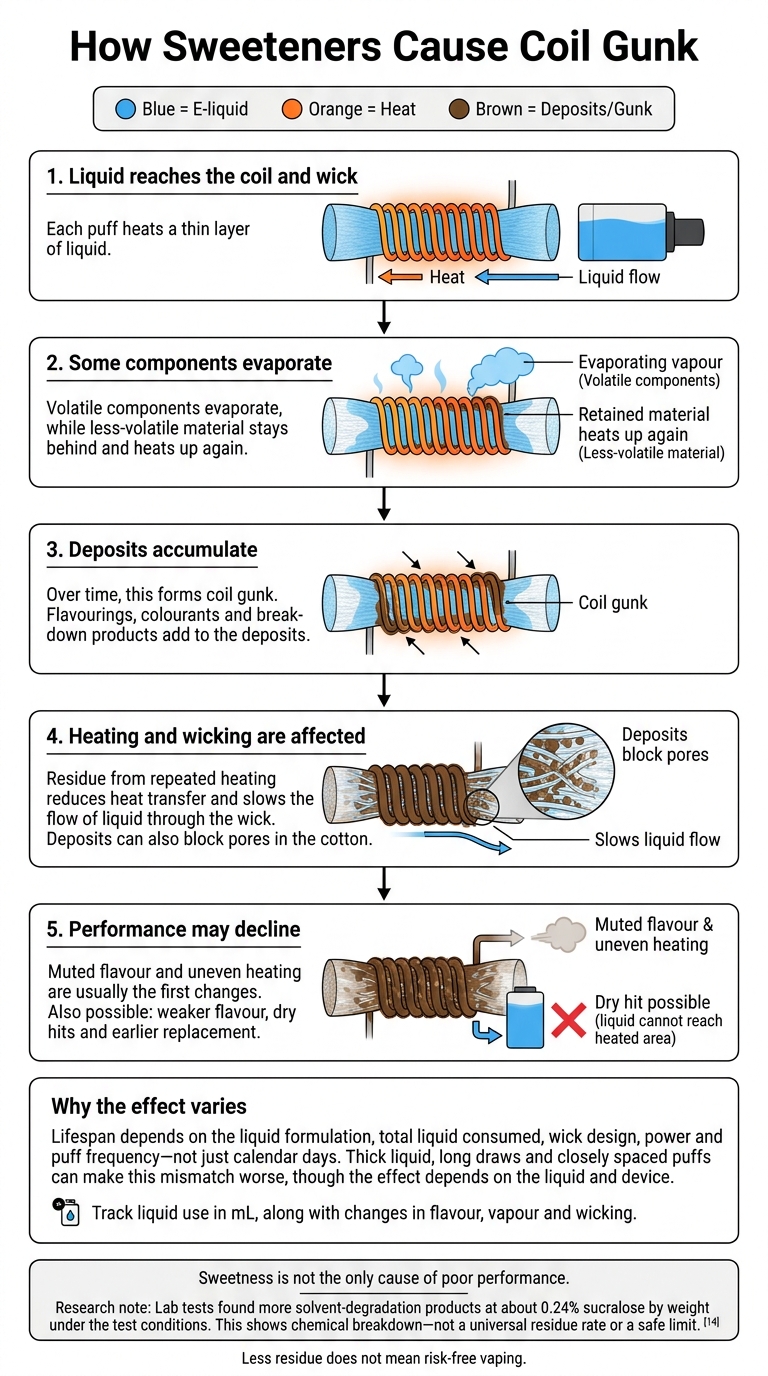
Sweetened e-liquid leaves residue on the coil and wick. Each puff heats a thin layer of liquid: volatile components evaporate, while less-volatile material stays behind and heats up again. Over time, this forms coil gunk. Flavourings, colourants and breakdown products add to the deposits. As the layer thickens, muted flavour and uneven heating are usually the first changes.
Lab tests found more solvent-degradation products at about 0.24% sucralose by weight under the test conditions. This shows chemical breakdown – not a universal residue rate or a safe limit.
How Buildup Affects Heating and Wicking
Residue from repeated heating reduces heat transfer and slows the flow of liquid through the wick. This can mean weaker flavour, dry hits and earlier replacement.
Deposits can also block pores in the cotton. Even a full tank or pod can produce a dry hit if liquid cannot reach the heated area fast enough. Thick liquid, long draws and closely spaced puffs can make this mismatch worse, though the effect depends on the liquid and device.
Why Coil and Pod Lifespan Varies
With a replaceable-coil tank or pod, you replace the coil head and keep the tank or pod body. With a built-in coil pod, you replace the whole pod – do not open it.
Lifespan depends on the liquid formulation, total liquid consumed, wick design, power and puff frequency – not just calendar days. To compare performance under similar conditions, track liquid use in mL, along with changes in flavour, vapour and wicking.
E-Liquid Flavours and Residue
Treat these tendencies as a guide, not a diagnosis. Any flavour category can contain sweeteners, and neither colour nor flavour complexity proves what a liquid contains. Check the manufacturer’s information: “sugar-free” does not necessarily mean sweetener-free or residue-free.
| Profile | Possible residue tendency | Maintenance needs | Limitations |
|---|---|---|---|
| Unsweetened or verified low-sweetener | Often lower | Monitor wicking | Other ingredients can leave deposits |
| Fruit | Low to high | Watch for darkening | Sweetener content varies |
| Menthol or mint | Often low to moderate | Monitor performance | Blends may contain sweeteners |
| Tobacco | Often low to moderate | Check wick condition | Sweeteners or extracts may contribute |
| Dessert, custard or bakery | Moderate to high | Inspect more closely | Formulations vary |
| Candy or bar-style | Often high when heavily sweetened | Track mL used | Sucralose is not always present |
Muted flavour, darker residue and weaker vapour are early clues that the coil or pod needs attention. These changes may mean it is time to clean parts approved for cleaning or replace worn parts.
Signs Your Coil or Pod Needs Attention
As residue builds up, watch for fading flavour, less vapour and a harsher draw before a burnt taste develops. Poor wicking can cause repeated dry hits, but ageing coils, unsuitable e-liquid viscosity, excessive power and restricted airflow can produce similar symptoms.
The pattern of changes can help you tell coil gunk apart from flooding or poor priming.
Dark liquid alone tells you little. Nicotine oxidation, flavourings, heat and light can also darken it. Check whether performance has declined too.
Coil Gunk, Flooding or Poor Priming?
Timing offers clues. A gradual drop in performance differs from a burnt first puff or a leak straight after filling. But no single symptom confirms the cause: residue, liquid level, airflow and power settings can all produce overlapping signs.
| Symptom | Possible cause | Appropriate response |
|---|---|---|
| Gradual flavour loss with visible residue | Coil gunk, an ageing coil or unsuitable liquid | Check liquid compatibility and power settings; replace worn parts if performance does not recover. |
| Reduced vapour or repeated dry hits | Poor wicking, restricted airflow, low liquid or closely spaced puffs | Check liquid level, airflow and settings; pause between puffs. |
| Leaking after filling | Overfilling, an unsealed fill plug or damaged seals | Stop firing; check the fill limit and seals; replace damaged parts. |
| Gurgling or spitting | Flooding or excess liquid in the airflow | Stop firing; clear excess liquid as instructed; take slower draws. |
| Immediate burnt taste after installation | Poor saturation or excessive power | Stop using it; allow the stated saturation time; replace it if the burnt taste remains. |
Inspect Safely and Replace Burnt Wicks
Switch the device off where possible and let it cool. Inspect only removable parts. Look for brown or black deposits, damaged seals, warped pods or visibly charred wick material. Wipe accessible contacts with a dry cloth. Never open sealed disposables or prise open integrated-coil pods. Stop using any device that overheats or has liquid near its contacts.
If you notice a burnt taste, stop and check the liquid level, wick saturation and power before using it again. If the taste remains after these checks, replace the coil or integrated-coil pod. Refilling or cleaning cannot restore a burnt wick, and repeated firing can make the damage worse.
If the problem keeps returning, take steps to reduce residue and adjust how you use the device before replacing parts again.
How to Reduce Buildup and Wick Wear
When flavour fades or residue appears, these habits can help slow further buildup and wick wear.
Choose Compatible, Lower-Sweetener Liquids
Choose liquids that disclose their sweetener content and use a PG/VG ratio approved for your device. Small pods often suit 50/50 liquids. Thick, high-VG blends may not wick well unless your device is built for them.
Liquid choice matters most, but device settings also affect how fast residue builds up.
Use the Right Power, Priming and Fill Level
Follow the manual’s priming instructions, fill the pod or tank, and wait the stated soak time before firing. Start at the lower end of the stated wattage range.
| Recommended practice | Practice to avoid | Effect on residue or wick wear |
|---|---|---|
| Stay within the approved wattage range | Turning up the power to overcome weak flavour | Limits overheating and wick stress |
| Let the wick re-saturate between puffs | Taking repeated long puffs in quick succession | Reduces wick dehydration |
| Refill before the wicking slots run dry | Letting liquid fall below the slots | Reduces dry spots |
| Follow the marked fill limit | Overfilling or filling the centre chimney | Helps prevent flooding |
Clean Only Approved Parts
Clean only removable parts that the manufacturer permits you to clean. Let them dry fully before reassembly, and keep liquid away from batteries, charging ports and contacts.
Find Compatible Pods, Coils and Liquids in Bahrain
VapeShop.bh stocks pods, coils and e-liquids in Bahrain. Before ordering, check the exact device model, pod type, coil resistance, approved wattage range and liquid ratio.
Conclusion: Reduce Residue and Replace Worn Parts
Sweeteners can make coil gunk build up faster, but liquid thickness, power and how often you puff also affect wear.
For maintenance, focus on liquid choice, power and wick saturation. Where possible, choose a compatible liquid labelled as lower-sweetener. Keep the wick saturated, stay within the manufacturer’s power range and pause between draws.
Less residue can help with maintenance, but it does not remove vaping’s health risks.
A burnt taste that returns may point to wear, not just residue. Stop using the device if a burnt taste persists; replace the coil, or the whole pod if the coil is integrated.
FAQs
Will switching to less-sweet e-liquid save my current coil?
No. If your coil tastes burnt because the cotton is scorched or coated in thick sweetener residue, switching e-liquids or cleaning won’t restore it.
For your next coil, choose a less-sweet e-liquid to help it last longer by reducing caramelisation and gunk build-up. Stay within your device’s recommended wattage and leave 20–30 seconds between puffs so the cotton has time to soak up more e-liquid.
How can I check for sweeteners if the label is unclear?
Flavour profiles can offer clues about sweetener content. Dessert, bakery and candy-style e-liquids generally contain more sweetener, while fruit, mint and menthol options tend to be cleaner and gentler on coils.
Muted flavour, a burnt taste or darkened e-liquid within 3 to 5 days may point to high sweetener content. Before buying, message our VapeShop.bh team on WhatsApp to ask about a specific e-liquid.
How can I compare coil life between e-liquids fairly?
Use the same device and wattage for each e-liquid to keep comparisons consistent. Keep a simple flavour log: record how long each coil lasts and when the taste turns muted or burnt.
Compare dessert, fruit and mint flavours, noting residue and changes in performance. Sweetness and thickness vary, and flavour names don’t always tell you how much sweetener an e-liquid contains. Base your comparison on daily observations and coil performance, recorded consistently.
Related Blog Posts
- 7 Signs Top E-Liquid Flavor Fits Your Vape
- Ultimate Guide to Vape Coils and Maintenance
- How to Prime Pod Coils and Avoid Mistakes
- How to Prime Pod Coils for Longer Use
{“@context”:”https://schema.org”,”@type”:”FAQPage”,”mainEntity”:[{“@type”:”Question”,”name”:”Will switching to less-sweet e-liquid save my current coil?”,”acceptedAnswer”:{“@type”:”Answer”,”text”:”No. If your coil tastes burnt because the cotton is scorched or coated in thick sweetener residue, switching e-liquids or cleaning won’t restore it. For your next coil, choose a less-sweet e-liquid to help it last longer by reducing caramelisation and gunk build-up. Stay within your device’s recommended wattage and leave 20–30 seconds between puffs so the cotton has time to soak up more e-liquid.”}},{“@type”:”Question”,”name”:”How can I check for sweeteners if the label is unclear?”,”acceptedAnswer”:{“@type”:”Answer”,”text”:”Flavour profiles can offer clues about sweetener content. Dessert, bakery and candy-style e-liquids generally contain more sweetener, while fruit, mint and menthol options tend to be cleaner and gentler on coils. Muted flavour, a burnt taste or darkened e-liquid within 3 to 5 days may point to high sweetener content. Before buying, message our VapeShop.bh team on WhatsApp to ask about a specific e-liquid.”}},{“@type”:”Question”,”name”:”How can I compare coil life between e-liquids fairly?”,”acceptedAnswer”:{“@type”:”Answer”,”text”:”Use the same device and wattage for each e-liquid to keep comparisons consistent. Keep a simple flavour log: record how long each coil lasts and when the taste turns muted or burnt. Compare dessert, fruit and mint flavours, noting residue and changes in performance. Sweetness and thickness vary, and flavour names don’t always tell you how much sweetener an e-liquid contains. Base your comparison on daily observations and coil performance, recorded consistently.”}}]}
Frequently Asked Questions
Sweetened e-liquid can leave sticky residue on the coil and wick. As the residue heats repeatedly, it may build up into coil gunk, causing muted flavour and uneven heating over time.
Yes, sweeteners can contribute to a shorter coil life by leaving residue on the coil and wick. Liquid thickness, airflow and puff frequency also affect performance, so coil life should be tracked by liquid used in mL rather than days alone.
Choosing a compatible, lower-sweetener liquid may help slow e-liquid residue build-up. Priming correctly and staying within the device’s stated wattage range can also help protect the coil and wick.
Clean only approved removable parts and never open sealed pods. Match the liquid ratio, coil type and power range to the device, and replace the coil or the whole pod if its coil is built in and a burnt taste persists.
Using a compatible liquid with fewer sweeteners can help reduce wick gunk. Correct priming, suitable wattage and attention to liquid thickness can also slow residue build-up.
Fading flavour, weaker vapour and repeated dry hits can indicate coil or wick residue. Sweetness is not the only possible cause, because airflow, liquid thickness and puff frequency can also affect performance.
Vaping maintenance depends on the device, liquid and usage rather than a fixed number of days. Track the amount of liquid used, clean only approved removable parts, and stop using the device if a burnt taste continues after checking the coil or pod.