
How Airflow Control Works in Vape Mods


If your vape feels too harsh, too weak, too hot, or too airy, airflow is often the first thing I’d check. In most setups, a small change to the airflow can shift draw tightness, vapour warmth, flavour strength, and throat hit within a few puffs.
Here’s the short version:
- More open airflow = cooler vapour, bigger clouds, softer throat hit
- More closed airflow = warmer vapour, denser flavour, tighter draw
- MTL setups often sit around 10%–30% open
- Restricted DL often works around 30%–60% open
- Open DL often works around 70%–100% open
- High-resistance coils usually pair with tighter airflow
- Sub-ohm coils usually need more airflow and more power
- In Bahrain’s heat, thinner e-liquid can seep more, so storage and refill habits matter
I’d keep the process simple:
- Start around half open
- Move the ring or slider in small steps
- Take 2–3 test puffs
- If it feels hot or harsh, open it a bit
- If it feels thin or flat, close it a bit
One more thing: airflow does not work alone. It has to match the coil resistance, wattage, and e-liquid ratio. For example, opening airflow without enough power can make the vape feel thin. Closing airflow too much at high wattage can make it feel hot and rough.
A quick view:
| Setup | Airflow | Feel |
|---|---|---|
| MTL | 10%–30% | Tight draw, warmer vapour, stronger throat hit |
| Restricted DL | 30%–60% | In-between pull, balanced warmth and cloud |
| Open DL | 70%–100% | Loose draw, cooler vapour, bigger clouds |
So if I had to sum it up in one line: start with the coil, then fine-tune the airflow until the draw feels right for the way you vape.
Why use airflow on your vape device?
sbb-itb-837e7ad
How Airflow Control Works Through the Tank or Atomiser Attached to a Vape Mod
When you inhale, suction pulls air through the tank or atomiser. Air comes in through the intake slots, moves along the internal channels towards the coil, picks up vapour, then travels up the chimney to the mouthpiece. That route can shift from one device to another, which is exactly why the intake position makes such a big difference.
Parts That Shape the Airflow Path
Each part in that route does a specific job. The airflow control ring or slider opens or closes the intake ports, so it directly changes how tight or loose the draw feels. Internal channels steer the air towards the coil in a controlled way. The coil and wick assembly is where vaporisation happens: air passes over the heated surface, picks up vapour, and the mix moves up through the chimney to the mouthpiece. A narrower chimney keeps vapour warmer and more concentrated, while a wider one lets it cool and spread out a bit more. Put all of that together, and each part affects draw resistance and the way the vapour tastes.
Mesh coils need steady airflow to help prevent dry hits.
Top, Bottom, and Side Airflow Designs
The main airflow layouts change three things more than anything else: flavour, leak risk, and draw resistance.
| Airflow Design | Flavour Intensity | Leak Resistance | Best For |
|---|---|---|---|
| Bottom | Highest – direct path to the coil | Low – prone to leaking through base holes | Flavour chasers, traditional tanks |
| Top | Slightly muted – longer air path | Highest – least prone to leaks | Travel, beginners, Bahrain’s heat |
| Side | Balanced – direct coil hit with less travel | Moderate – less prone than bottom airflow | Modern pod mods, versatile use |
So, there’s always a bit of give and take. Bottom airflow usually gives the most direct flavour, but it can leak more easily. Top airflow tends to be cleaner and less messy, which helps in hot conditions like Bahrain’s. Side airflow sits somewhere in the middle, giving a mix of flavour and day-to-day ease.
How Airflow Affects Flavour, Vapour, and Throat Hit
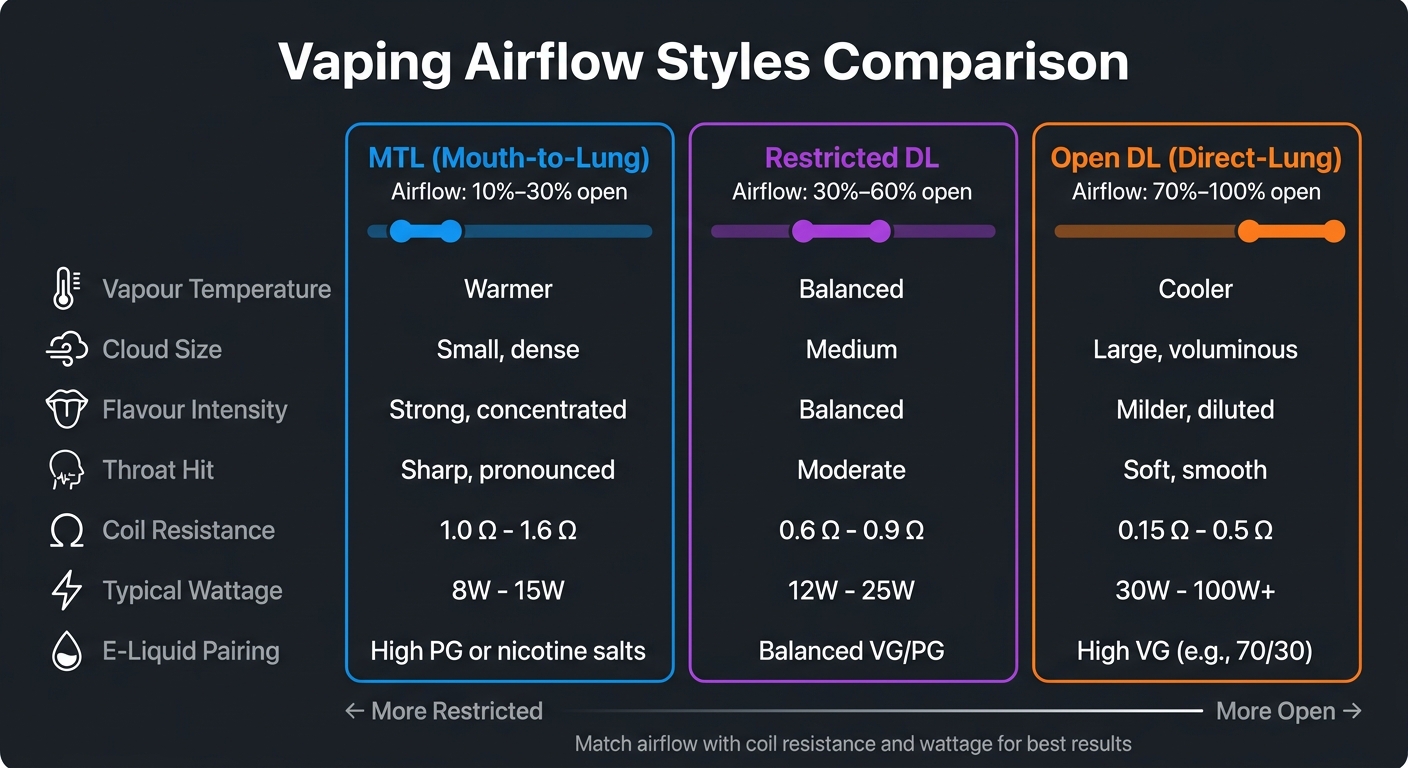
Vape Airflow Settings by Style: MTL vs Restricted DL vs Open DL
More air dilutes vapour. Less air makes it feel more concentrated. That’s why the same mod can feel loose and airy in one setup, then tight and focused in another. Once the air reaches the coil, that airflow setting shapes how warm, dense, and flavour-packed the vapour feels.
Open Airflow: Cooler Vapour and Larger Clouds
With the airflow wide open, more air mixes with the vapour before you inhale. You usually get cooler vapour, larger clouds, and a softer throat hit.
This setup tends to suit people who like a looser pull and more cloud production. It feels less intense on the throat, which can make each puff smoother.
Restricted Airflow: Stronger Flavour and a Tighter Draw
Tighten the airflow and the vapour becomes denser, warmer, and more concentrated when you inhale. The throat hit also feels sharper. This suits mouth-to-lung (MTL), which uses a tighter draw style. Nicotine salts vs freebase e-liquid also fit this style, especially at 20 mg/mL or above.
In plain terms, less air means a more focused vape. That can make flavours stand out more, especially if you prefer a firmer, cigarette-like draw.
To get the best result, match airflow with coil resistance, wattage, and nicotine strength.
Balancing Airflow with Wattage, Coil Resistance, and E-Liquid
Airflow doesn’t work on its own. It needs to match your wattage, coil resistance, and e-liquid thickness. Open the airflow without increasing wattage, and the vape can feel too airy and a bit flat. Tighten the airflow without reducing power, and the vapour can get hot and harsh.
Thinner, higher-PG e-liquids tend to work well with restricted airflow because the tighter draw brings out flavour and throat hit.
Here’s a quick side-by-side view:
| Feature | Open Airflow | Restricted Airflow |
|---|---|---|
| Vapour Temperature | Cooler | Warmer |
| Cloud Size | Larger, more voluminous | Smaller, denser |
| Flavour Intensity | Milder, more diluted | Stronger, more concentrated |
| Throat Hit | Softer and smoother | Sharper and more pronounced |
| Ideal Style | Direct-Lung (DL) | Mouth-to-Lung (MTL) |
| Coil Type | Sub-ohm (below 0.6 Ω) | High-resistance (1.0 Ω – 1.2 Ω) |
| E-Liquid Pairing | High VG (e.g., 70/30 VG/PG) | High PG or nicotine salts |
Next, adjust airflow step by step to match your coil and vaping style.
How to Adjust Airflow on a Vape Mod: Step by Step
Find the Airflow Control and Adjust in Small Steps
Airflow controls usually sit at the tank base, top cap, or pod body. Once you’ve found it, start in the middle. A half-open setting gives you a good baseline for flavour and warmth without pushing too far in either direction.
From there, adjust one notch at a time. After each change, take a few short, light test puffs before moving it again. That small pause matters. It gives the coil and wick time to stabilise, so you can judge the change properly instead of chasing mixed results.
Set Airflow for MTL, Restricted DL, and Open DL
Use these ranges as a starting point, then line them up with your coil rating.
| Vaping Style | Airflow Opening | Coil Resistance | Typical Wattage |
|---|---|---|---|
| MTL | 10% – 30% open | 1.0 Ω – 1.6 Ω | 8W – 15W |
| Restricted DL | 30% – 60% open | 0.6 Ω – 0.9 Ω | 12W – 25W |
| Open DL | 70% – 100% open | 0.15 Ω – 0.5 Ω | 30W – 100W+ |
A tight MTL setup usually works best with less air, higher-resistance coils, and lower wattage. Restricted DL sits in the middle, giving you a bit more vapour without going fully airy. Open DL needs much more airflow and is usually paired with sub-ohm coils running at higher power.
Match Airflow to Your Coils and Products
As a rule, wide airflow suits sub-ohm coils, while tighter airflow suits high-resistance coils. Before you adjust anything, check the coil’s wattage range on the product page. That’s your guardrail.
Also, don’t pull too hard on a tight MTL setting. It can flood the chamber and lead to gurgling or leaks. If the draw still feels off after a few small changes, the next step is to check for burnt hits, weak vapour, leaks, and condensation.
Common Problems, Bahrain Conditions, and Key Takeaways
How to Avoid Burnt Hits, Weak Vapour, Leaks, and Condensation
If the airflow still feels off, the problem is usually the match between the airflow setting, the coil, and the e-liquid. When airflow, wattage, and coil resistance don’t line up, the signs show up fast.
| Symptom | Likely Cause | Fix |
|---|---|---|
| Burnt or harsh hit | Airflow too tight or wattage too high | Open airflow or lower wattage |
| Weak, thin vapour | Airflow too open, diluting the vapour | Gradually tighten airflow until density improves |
| Gurgling or spitting | Tight airflow combined with hard pulls | Open slightly; use shorter, lighter puffs |
| Leaking vents | Vacuum loss or thin e-liquid | Close airflow during refills; store upright |
A small bit of upkeep helps too. Wipe the chimney and drip tip often to cut down on condensation and spit-back. Bottom-airflow tanks also tend to leak more easily when seals start to wear out.
Adjusting for Bahrain’s Heat and Daily Use
Bahrain’s heat and humidity can make e-liquid thinner, which means it’s more likely to seep through airflow vents and seals. If you’re using a high-PG e-liquid, it may help to move to a higher-VG blend, such as an 80/20 VG/PG ratio, during hotter weather. Thicker liquid tends to resist seepage better in heat.
It also helps to store the device upright and close the airflow before refilling so the tank stays sealed.
Conclusion: start with choosing the right vape coils, Then Fine-Tune Airflow
Airflow controls draw resistance, vapour temperature, and flavour intensity. The best setup usually starts with the coil, then the airflow follows. Open airflow suits sub-ohm DL use, while a more restricted setting works better for flavour-focused MTL. Match that with the right wattage and e-liquid thickness, and the setup becomes much easier to dial in.
FAQs
How do I know if my airflow is set wrong?
Signs of poor airflow are usually easy to spot. If the vapour feels harsh or too warm, the airflow is often too tight.
If the flavour seems muted, thin, or watery, the airflow is probably too open. You might also notice a whistling sound, an airy draw, or vapour that changes from puff to puff. Make small adjustments until everything feels balanced.
Should I change wattage when I adjust airflow?
Yes – wattage and airflow work hand in hand. Tweaking both usually helps keep vapour quality steady and coil temperature under control.
Higher wattage often needs more airflow. That extra air helps stop the coil from getting too hot, which can lead to overheating, a burnt taste, or a harsh throat hit.
Lower wattage usually pairs better with tighter, more restricted airflow. That helps the coil stay warm enough and keeps the vapour dense instead of thin and weak.
Which airflow style leaks least in Bahrain’s heat?
Top-airflow designs are usually the best pick for Bahrain’s hot, humid climate because they’re almost leak-proof. When the heat ramps up, e-liquid can get thinner and slip out through old-style bottom vents. Top-airflow designs help stop that by keeping air away from the bottom seals.
Bottom-airflow designs can give you better flavour and help keep the coil cooler, but they rely on intact O-rings and precise coil seating to prevent leaks.
Related Blog Posts
- Best Wattage for MTL vs. DTL Vaping
- AI-Powered Vapes: How They Work
- How to Swap Vape Mod Panels Easily
- Advanced VG/PG Ratio Tips for Cloud Chasers
Frequently Asked Questions
Airflow control on vape mods usually works through a small ring or slider that opens or closes the air slots around your tank or pod. When you open the airflow more, you get cooler vapour, bigger clouds, and a softer throat hit; closing it gives warmer vapour, denser flavour, and a tighter draw. A simple way to tune it is to start around half open, adjust in small steps, and take 2–3 puffs after each change to see how it feels.
For classic MTL (mouth-to-lung) draws, airflow is usually quite tight, often around 10%–30% open, giving a cigarette-like pull, warmer vapour, and a stronger throat hit. Restricted DL often sits around 30%–60% open for a balanced pull, while open DL is usually 70%–100% open for a loose draw, cooler vapour, and bigger clouds. You can start in these ranges, then fine-tune based on how warm the vapour and how strong the throat hit feel.
High-resistance coils generally work better with tighter airflow, lower wattage, and a more MTL-style draw, which helps keep the vapour warm and the flavour solid. Sub-ohm coils usually need more open airflow and more power so the coil is cooled properly while still making good clouds. If a sub-ohm setup feels too hot or harsh, open the airflow a bit; if a high-resistance setup feels too airy or weak, close it slightly.
Airflow, coil resistance, and wattage always work together, so changing one affects the others. If you open the airflow without enough wattage, the vape can feel thin and flat because the coil is not heating the e-liquid strongly enough. If you close the airflow too much at high wattage, the vapour can become hot and rough, so it is usually better to either open the airflow or lower the power until the draw feels smooth.
More open airflow mixes in extra fresh air, which cools the vapour and boosts cloud size but can soften both flavour and throat hit. More closed airflow keeps the vapour denser and warmer, usually giving stronger flavour and a more pronounced throat hit with a tighter draw. Most vapers find a comfortable middle setting where the vapour is not too hot, the flavour is clear, and cloud size feels right for their style.
Thinner e-liquids generally need a bit less airflow and lower power, especially on higher-resistance coils, to avoid a hot, spitty vape. Thicker juices often pair better with more open airflow and higher wattage, so the coil can wick and vaporise the liquid properly without feeling dry. In Bahrain’s heat, it helps to avoid leaving tanks in direct sun and to store your device upright, as thinner liquids can seep more if airflow and fill level are not managed well.
A quick method is to set the airflow ring or slider around halfway, then adjust in small steps based on how each 2–3 puffs feel. If the vape is hot or harsh, open the airflow slightly; if it feels weak, thin, or too airy, close it a bit. This trial-and-error approach works for most vape mods, as long as your coil resistance, wattage, and e-liquid are already in a sensible range.