
E-Liquid Ingredients Explained


Most e-liquids come down to four parts: VG, PG, nicotine, and flavourings. If I want to pick the right bottle fast, I check four things on the label: VG/PG ratio, nicotine type, nicotine strength, and bottle size.
Here’s the short version:
- High VG means thicker liquid, more vapour, and a smoother inhale
- More PG means stronger flavour, more throat hit, and faster wicking
- Freebase nicotine feels sharper
- Nicotine salts feel smoother, even up to 20 mg/mL
- 50/50 usually fits pods and MTL kits
- 70/30 usually fits sub-ohm tanks and higher-power devices
- Sweet flavourings can shorten coil life
- In Bahrain, nicotine e-liquids are capped at 20 mg/mL, and sales are 18+ only
If I’m using a small pod, I’d usually look for 50/50 and a salt nicotine strength that suits me. If I’m using a sub-ohm device, I’d usually go for 70/30 and lower nicotine, often 3–6 mg/mL.
A quick check like this saves time, helps avoid burnt coils, and makes it easier to buy a liquid that suits both the device and the vape style.
| Label item | What I check | What it tells me |
|---|---|---|
| VG/PG ratio | 50/50 or 70/30 | Wicking, vapour, throat hit |
| Nicotine type | Freebase or salt | How smooth or sharp it feels |
| Strength | 0 to 20 mg/mL | How strong the vape feels |
| Flavouring | Fruit, mint, tobacco, dessert | Taste and possible coil wear |
Below, I’d break down each ingredient in simple terms so it’s easier to read any e-liquid label in Bahrain.
EVERYTHING You Need to Know About E-Liquid! – Vaping 101
sbb-itb-837e7ad
VG and PG: the base liquids that shape vapour, flavour, and coil performance
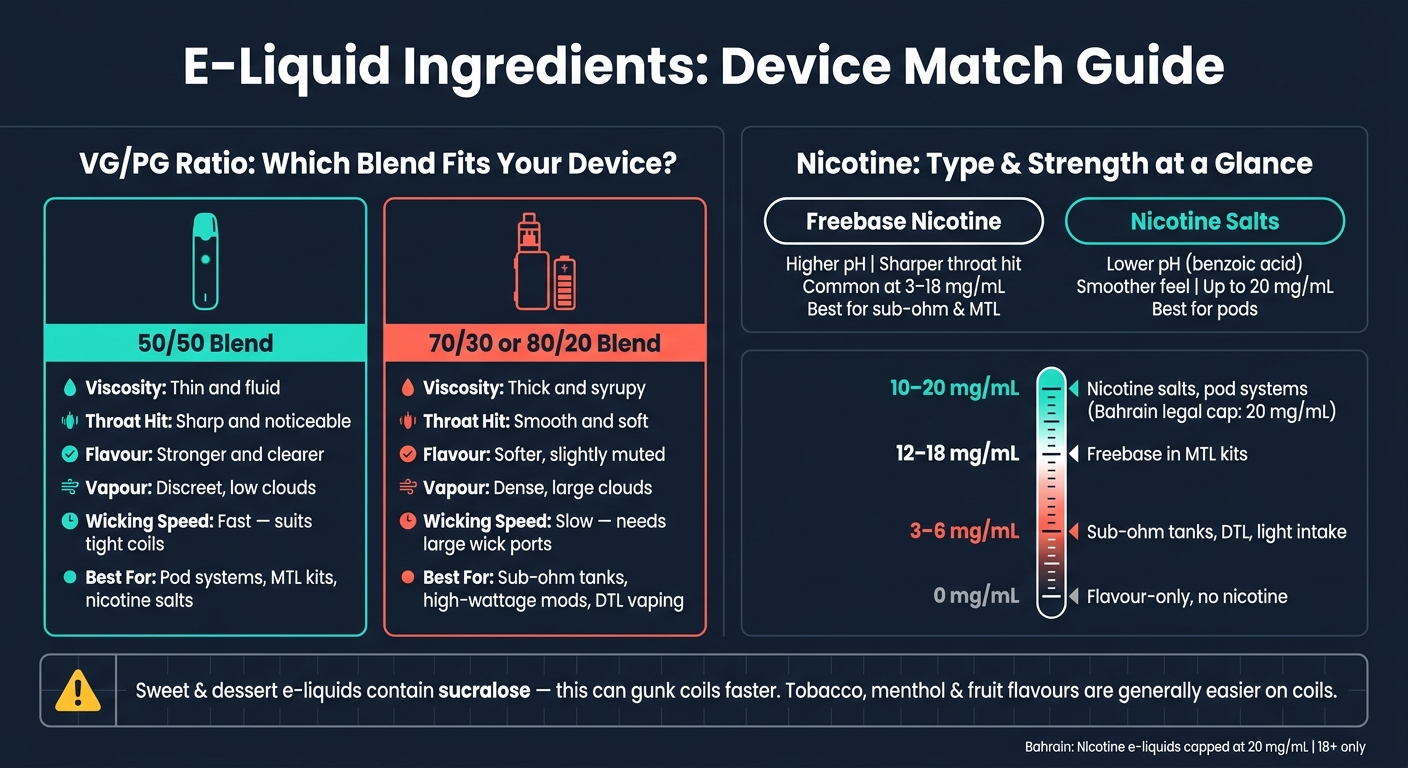
E-Liquid VG/PG Ratios & Nicotine Types: Quick Device Match Guide
With the basics covered, the next step is the base mix. This is what controls most of the e-liquid’s behaviour. VG and PG carry the nicotine and flavourings, and they make up most of the liquid. The balance between them also helps decide which devices the liquid works best with.
Vegetable glycerin (VG): thicker liquid, smoother inhale, denser clouds
VG is a clear, thick liquid. Because it’s thicker, it produces denser vapour and gives a smoother inhale with a softer throat hit. That’s why high-VG blends are a good fit for vapers who want bigger clouds from sub-ohm tanks and direct-to-lung (DTL) devices.
Common high-VG ratios include 70/30, 80/20, and Max VG (about 80% to 90% VG). These are usually paired with larger coils, open airflow, and higher-wattage setups.
The downside comes down to wicking speed. VG moves through cotton more slowly than PG. In a small pod with narrow wicking ports, a high-VG liquid may not wick fast enough. When that happens, dry hits and burnt coils can follow.
Propylene glycol (PG): stronger flavour delivery and sharper throat hit
PG is a thin, nearly odourless liquid. In e-liquid, it mainly carries flavour and adds a more noticeable throat hit. That sharper sensation often feels familiar to smokers who are moving to vaping.
Because PG is much less viscous than VG, it wicks fast through the small ports used in compact pod coils. That makes it a strong match for low-power devices.
Some users find PG irritating on the throat or notice dry mouth. If that happens, switching to a higher-VG blend often helps.
How VG/PG ratios affect device choice
The simplest rule is to match the ratio to the device. High-VG liquids suit sub-ohm devices, while 50/50 blends suit pod systems and MTL kits. In fact, 50/50 is the standard for pod systems and nicotine salts (see how they compare to nicotine salts vs freebase).
| Property | High VG blend (70/30, 80/20) | Balanced blend (50/50) |
|---|---|---|
| Viscosity | Thick and syrupy | Thin and fluid |
| Throat hit | Smooth and soft | Sharp and noticeable |
| Flavour intensity | Softer, slightly muted | Stronger and clearer |
| Vapour volume | Dense, large clouds | Discreet, low vapour |
| Wicking speed | Slow; needs large wick ports | Fast; suits small, tight coils |
| Typical device | Sub-ohm tanks, high-wattage mods | Pod systems, MTL kits, nicotine salt e-liquids |
Once the base is set, nicotine strength and flavourings complete the mix.
Nicotine and flavourings: what they add to the vaping experience
Nicotine types and strengths on e-liquid labels
Nicotine is optional. If you pick a 0 mg/mL liquid, you’re vaping for flavour only.
When nicotine is included, it mostly changes two things: throat hit and how strong the vape feels. That’s why the label matters.
You’ll usually see nicotine shown as mg/mL or %, and the two match up like this: 10 mg/mL = 1.0%. In Bahrain, nicotine-containing e-liquids stay at or below 20 mg/mL.
The two main nicotine types are freebase and nicotine salts, and they don’t feel the same in use.
Freebase nicotine has a higher pH. In plain terms, that tends to give a sharper throat hit, especially at higher strengths. Nicotine salts are mixed with an acid, usually benzoic acid, to lower the pH. That makes them smoother at higher strengths. Put simply: nic salts feel smoother, while freebase feels sharper.
Common strength ranges include:
- 0 mg/mL for flavour-only vaping
- 3–6 mg/mL for sub-ohm tanks, DTL, and lighter nicotine intake
- 12–18 mg/mL for freebase in MTL kits
- 10–20 mg/mL for nic salts in Bahrain
| Strength range (mg/mL) | % | Common format | Typical use case |
|---|---|---|---|
| 0 mg/mL | 0% | 0 mg | Flavour-only vaping, no nicotine |
| 3–6 mg/mL | 0.3%–0.6% | mg/mL | Sub-ohm tanks, DTL, light nicotine intake |
| 12–18 mg/mL | 1.2%–1.8% | mg/mL | Freebase in MTL kits, moderate satisfaction |
| 10–20 mg/mL | 1.0%–2.0% | mg/mL or % | Nicotine salts, pod systems, higher satisfaction |
After nicotine, flavourings shape the taste. Small additives can also affect how long your coil lasts.
Flavourings, sweeteners, and small additives
Flavourings decide what the liquid tastes like. That might be fruit, tobacco, dessert, mint, or beverage blends. Then you have sweeteners and other small ingredients, which can change how the liquid behaves in the device.
A common example is sucralose. It makes e-liquid taste sweeter, but there’s a trade-off: it can gunk up coils and shorten coil life. If a liquid tastes very sugary, your coil may pay the price.
Some e-liquids also include distilled water or ethyl alcohol. These are used to thin the mix or help carry flavour.
One point is non-negotiable: oil-based ingredients and essential oils should not be vaped. E-liquids are not made with oil-based ingredients, and vaping any oil – including essential oils or vitamin E acetate – carries serious respiratory risks. Clear ingredient lists are a good sign. If the label is vague, treat that as a warning sign.
How to read an e-liquid bottle and match ingredients to your device
Reading labels: ratio, strength, bottle size, and flavour profile
Once you know what’s in an e-liquid, the next step is simple: match the label to your device. Most bottles give you four things to check, and each one matters.
VG/PG ratio is the first. A 50/50 blend works well with pods and MTL kits. A 70/30 blend fits sub-ohm tanks and higher-wattage mods better.
Next is nicotine type and strength. Nicotine salt is a common fit for low-power pods and can go up to 20 mg/mL in Bahrain. Freebase nicotine shows up more often in larger tanks at lower strengths like 3–6 mg/mL. One thing to avoid: don’t use high-strength nicotine salt in a sub-ohm mod. It can feel harsh very fast.
Then look at bottle size. This gives you a rough sense of how long the liquid may last. A 30 ml bottle is often enough for pod users. A 60 ml or 120 ml bottle tends to make more sense for sub-ohm mods, since those devices use more liquid.
The last check is flavour profile. Tobacco, menthol, and fruit flavours are often easier on coils. Dessert and candy blends can shorten coil life, so if you find yourself changing vape coils too often, that may be the reason.
Buying e-liquids in Bahrain: age rules and product availability
If you’re buying in Bahrain, start with the legal side and the packaging. Vaping products are for adults aged 18 and over and are regulated in a similar way to tobacco products. Packs must show an 18+ restriction symbol and this statement:
"It is prohibited to sell and consume this product by individuals under the age of 18, and non-smokers are not advised to use it"
Buy only from sellers that check age and show clear, compliant labels on the products they sell.
Quick-reference summary of e-liquid ingredients
Use this table as a quick label check.
| Ingredient | What it is | What it does in e-liquid |
|---|---|---|
| Vegetable glycerin (VG) | Plant-derived thick liquid | Produces vapour and softens the inhale |
| Propylene glycol (PG) | Thin, odourless liquid | Carries flavour and adds throat hit |
| Nicotine | Stimulant (freebase or salt form) | Delivers nicotine satisfaction |
| Flavourings | Taste additives | Determines the taste profile |
Conclusion: the key points to remember about e-liquid ingredients
The main point is simple: most e-liquids contain four ingredients – VG, PG, nicotine, and flavourings. Each one does a different job.
VG and PG affect vapour, throat hit, and how flavour comes through. Nicotine decides the strength. Flavourings decide the taste.
Final points for choosing the right e-liquid
Pick a VG/PG ratio and nicotine strength that suit your device. Before you buy, check:
- the VG/PG ratio
- the nicotine strength in mg/mL
- the nicotine type (freebase or salt)
- the bottle size
- the flavour description
In Bahrain, vape products are for adults 18+ only. Treat that as the last thing to check before buying.
Go for the mix that matches your device, the nicotine strength you want, and the flavour you’re after.
FAQs
How do I choose the right VG/PG ratio?
Choose your VG/PG ratio based on your device and the kind of vape you want.
For pod systems and mouth-to-lung (MTL) tanks, 50/50 is usually the best fit. It’s a thinner liquid, so it moves more easily through small wicking ports. That helps cut down the chance of dry hits and burnt coils.
For sub-ohm or direct-to-lung (DTL) tanks, go with higher-VG e-liquids like 70/30 or 80/20. These blends are better suited to larger coils and higher power settings, helping with proper wicking, thicker vapour clouds, and less leaking.
Which nicotine strength should I start with?
For most beginners in Bahrain, 20mg to 25mg salt nicotine is the usual place to start. That said, Bahrain limits nicotine concentration to 20mg/ml, so anything above that may not be available locally.
If you used to smoke more than 15 cigarettes a day, 50mg might feel more satisfying in general. But again, 20mg/ml is the local cap in Bahrain.
Some beginners prefer to start lower, at 0mg to 3mg, to help avoid dizziness or nausea. It also helps to match the nicotine strength to your device. High-powered devices work better with lower nicotine levels, while compact pod systems are a better fit for higher strengths.
Why do some e-liquids burn coils faster?
Usually, the e-liquid doesn’t match the coil design very well. Thick, high-VG liquids often wick too slowly in MTL coils with small wicking ports. That can lead to dry hits and burnt coils. On the flip side, 50/50 liquid in high-wattage sub-ohm tanks can flood the coil.
Sweeter flavour profiles can also leave gunk on the heating element faster, which can shorten coil life.
Related Blog Posts
- أسئلة شائعة عن السولت نيكوتين وإجاباتها
- Nicotine Strength Guide for Smokers Switching to Vaping
- Top 5 Factors Driving Vape Sales in Bahrain
- 5 Signs of High-Quality E-Liquids
Frequently Asked Questions
The quickest check is the VG/PG ratio, nicotine type, nicotine strength, and bottle size. These four details tell you how the liquid may feel, how it may wick, and whether it suits your device. For shoppers in Bahrain, that makes it easier to pick the right bottle without guessing.
A 50/50 mix is commonly used for pod-style devices and mouth-to-lung vaping. It balances flavour, vapour, and throat hit more evenly than a higher-VG blend. If the bottle is for a small pod, 50/50 is usually the first label detail to check.
A 70/30 ratio means the liquid has more VG than PG, so it is generally thicker and makes more vapour. Higher VG also tends to feel smoother on the inhale. This style is commonly associated with sub-ohm devices and higher-power setups.
Nicotine salts are generally described as smoother, while freebase nicotine is usually sharper on the throat. That difference is one reason people choose one type over the other based on their preferred vape feel. The label should clearly show which nicotine type is inside the bottle.
Bahrain nicotine e-liquids are capped at 20 mg/mL. The right strength depends on the label, the nicotine type, and the device being used. Checking the bottle before buying helps avoid choosing something that does not suit the setup.
Some flavourings can make coils wear out faster than others. Sweet liquids are often the ones people notice most for coil buildup. If coil life matters, it is worth checking the flavour profile before choosing a bottle.
VG usually makes the liquid thicker, smoother, and more vapour-heavy. PG typically carries flavour better and gives a stronger throat hit. That balance is what many Bahrain vapers check first when comparing labels.