

7 E-Liquid Additives and What Each One Does


I check the device match first, then the flavour. For existing adult vapers, a 50/50 PG/VG liquid is often suited to pods, while 70/30 VG/PG often suits sub-ohm tanks – but your device instructions come first. This helps when comparing nicotine salts and freebase e-liquids for your setup.
Here’s how I separate the seven entries: PG and VG are bases, not additives. The other ingredients change sweetness, flavour or cooling.
Quick Comparison
| Ingredient | Main effect | What to watch |
|---|---|---|
| PG | Carries flavour; gives a sharper throat hit | Thin mixes may leak |
| VG | Produces denser vapour with a softer feel | Thick mixes may wick poorly |
| Ethyl maltol | Adds light sweetness and rounds off flavour | Too much can mute flavour |
| Sucralose | Adds strong sweetness | Coil deposits and breakdown during heating |
| Menthol | Adds mint flavour and cooling | Can mask flavours or irritate |
| Koolada / WS-23 | Adds cooling with little or no mint flavour | Product strengths differ; excess can irritate |
| Vanillin / creamy flavourings | Adds vanilla, cream or dessert notes | Residue depends on the whole recipe |
I check nicotine strength in mg/mL separately from the base ratio, and keep power within the coil’s stated range. If mixing, I measure accurately, change one ingredient at a time and record the result. In Bahrain’s heat, I keep bottles cool, out of sunlight and locked away from children and pets.
<u>Food-grade does not mean safe to inhale.</u> Smooth, sweet or cool vapour is not safer vapour. Stop use if irritation persists, and replace burnt coils.
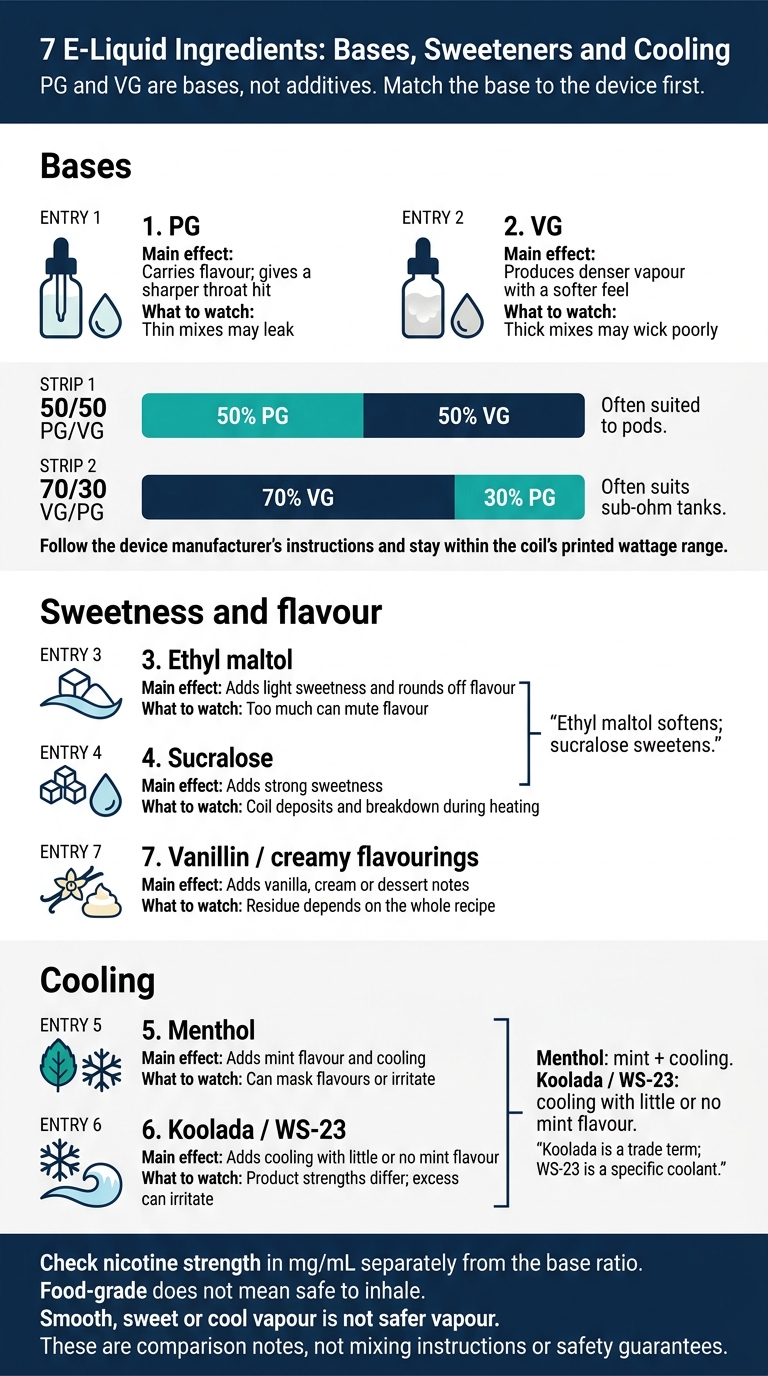
7 E-Liquid Ingredients: Bases, Sweeteners and Cooling
E-Liquid Bases and Device Compatibility
A 50/50 PG/VG blend contains equal parts PG and VG. A 70/30 VG/PG blend contains 70% VG and 30% PG. PG carries flavour, while VG is thicker, feels smoother and produces denser vapour. Many concentrates use PG as a carrier, so they increase the final PG content. The ratio matters: each ingredient below affects flavour, throat hit, cooling or how the vapour feels.
Thinner, higher-PG mixes suit refillable pods and mouth-to-lung (MTL) coils. Thicker, higher-VG mixes suit sub-ohm tanks. A mix that’s too thick can wick slowly and taste burnt; one that’s too thin can flood or leak.
Follow the device manufacturer’s instructions and stay within the coil’s printed wattage range. Let new coils saturate fully before vaping, and replace burnt coils. Salt nicotine uses an acid, often benzoic acid, and higher strengths usually suit low-power MTL pods.
Keep within the supplier’s mixing limits for each concentrate, and avoid household oils or unverified flavourings. Once the base suits the device, the ingredients below adjust sweetness, cooling, flavour and texture.
sbb-itb-837e7ad
1. Propylene Glycol (PG)
PG is a base liquid that shapes flavour, throat hit and wicking.
Flavour and sweetness effects
PG is a thin, colourless liquid that helps keep flavour notes distinct. Higher-PG blends sharpen fruit, tobacco and menthol notes. It improves flavour clarity, not sweetness.
Throat sensation and vapour feel
PG generally gives a sharper throat hit and less dense visible vapour than VG. Higher-PG liquids can feel drier or harsher, particularly with strong nicotine, concentrated flavourings or high power. If coughing or irritation continues, stop use and seek medical advice.
Device and nicotine-blend compatibility
PG changes how nicotine feels and how flavour comes through – not nicotine strength. Nicotine format affects harshness more than the PG percentage does. Check nicotine strength in mg/mL separately from the PG percentage.
Formulation cautions and coil impact
If a thin liquid leaks, check the pod seals or fix the leak before changing the ratio. In Bahrain’s heat, store e-liquid somewhere cool and dark, as thin liquids leak more easily.
PG also helps liquid wick faster and gives sharper flavour, especially in thinner mixes.
2. Vegetable Glycerin (VG)
Flavour and sweetness effects
VG is thicker and slightly sweet. That sweetness can work well with creamy or dessert-style flavours, but it may soften delicate fruit notes. More VG doesn’t automatically mean better flavour.
Throat sensation and vapour feel
VG-rich blends usually create denser vapour with a softer throat feel. Nicotine strength, flavouring and device settings also shape how each puff feels.
Device and nicotine-blend compatibility
Higher-VG liquids need wicking that can keep up with their thickness. Match salt-nic liquids to low-power pods, and follow your device’s guidance on nicotine strength and viscosity.
Formulation cautions and coil impact
After filling a new coil, wait 5–10 minutes for the wick to saturate, or follow the manufacturer’s stated waiting time. Dry or burnt hits may mean the wick isn’t absorbing liquid fast enough. Stop using it, switch to a thinner blend that suits the device, and replace the coil if it’s scorched. Strong sweeteners make residue build up faster.
| Characteristic | Higher PG | Higher VG |
|---|---|---|
| Viscosity | Thinner; faster wicking | Thicker; slower wicking |
| Throat sensation | Sharper | Softer |
| Vapour | Lighter, less dense | Thicker, denser |
| Flavour perception | More defined | Mildly sweeter; may mute subtle notes |
| Device fit | Many pod systems and mouth-to-lung (MTL) devices; small pods usually prefer 50/50 | Sub-ohm tanks and rebuildable atomisers |
Treat the table as a guide; follow the coil specifications first.
Once the base ratio is set, the next additives fine-tune sweetness, cooling and flavour.
3. Ethyl Maltol
Flavour and sweetness effects
Ethyl maltol adds soft candyfloss sweetness with a light caramel edge. In fruit, bakery and dessert blends, it smooths sharp or mismatched notes rather than serving as the main flavour. A little smooths the mix; too much flattens it.
Throat sensation and vapour feel
Ethyl maltol can slightly soften the flavour profile, but it has little direct effect on throat hit or vapour volume.
Device and nicotine-blend compatibility
Ethyl maltol works best in fruit and dessert mixes for low-power pod systems, including salt-nic blends. Only use it when the base ratio and nicotine strength already suit the device, following safe vaping practices. For stronger sweetness rather than smoothing, the next additive does that job.
Formulation cautions and coil impact
Use only ingredients labelled for e-liquid formulation. Higher flavour loads can darken the liquid, weaken the flavour or cause coils to lose performance sooner, depending on the recipe and device.
Measure accurately – not by eye – and test small batches. A common guide is about 0.25%–1% of the finished mix. Check whether the recipe calls for ethyl maltol or a diluted premix, as they aren’t interchangeable.
Shake, let the mix rest, then reassess before adding more. Cream, bakery and dessert blends may need 2–4 weeks to steep; adding more too soon can mute their flavours.
4. Sucralose
Flavour and sweetness effects
Sucralose delivers strong sweetness in small doses. Unlike ethyl maltol, it doesn’t smooth flavour. Ethyl maltol softens; sucralose sweetens. It works well in fruit, dessert and candy profiles, making fruit taste riper and desserts taste richer. Too much can flatten tartness, hide delicate notes and leave an artificial aftertaste. High vaping temperatures can cause sucralose to break down.
Throat sensation and vapour feel
Sucralose adds sweetness, not throat hit or cooling. It can soften a harsh or dry-tasting fruit blend, but vapour feel still depends on the base, power, airflow and nicotine type.
Device and nicotine-blend compatibility
Light sweetness suits refillable pods and salt-nic blends. Heavier sweetness shortens coil life in sub-ohm tanks. Match the sweetness level to your coil and wattage range. Lower power helps, but poor wicking can still cause coils to overheat.
| Factor | Advantage | Limitation |
|---|---|---|
| Sweetness | Strong in small doses | Can overpower |
| Flavour impact | Supports fruit and desserts | Can mask subtle notes |
| Frequent use | Suits sweet-flavour preferences | More maintenance |
Formulation cautions and coil impact
Watch for fading flavour, dark residue and a burnt taste. Replace burnt coils or pods.
Laboratory studies report sucralose breakdown, increased solvent degradation and chloropropanol formation during heating. These studies don’t establish a safe level for every liquid. Long-term inhalation effects remain unclear. Avoid household sweeteners and unnecessary extra sucralose.
For cooling rather than sweetness, menthol is next.
5. Menthol
Flavour and sweetness effects
Unlike sucralose, menthol changes both flavour and throat feel. It adds mint flavour and cooling, not sweetness. It suits mint, menthol tobacco, fruit and “ice” profiles when you want a clear mint note. Too much can mask delicate flavours or taste bitter and medicinal. For cooling with little or no mint taste, a non-mint coolant is usually a better fit.
Throat sensation and vapour feel
Menthol activates TRPM8 receptors, producing a cooling sensation without changing the vapour’s temperature. It can make nicotine feel less harsh, but it can also sharpen the throat sensation.
In one sensory study, 0.5% menthol did not increase irritation, while 3.5% did at low nicotine levels. These were study levels, not mixing targets. Cooling does not reduce nicotine strength.
Device and nicotine-blend compatibility
Moderate menthol suits low-power MTL pods and salt-nic liquids, where the cooling stays controlled. Sub-ohm tanks produce more vapour per puff, which can make both the mint flavour and cooling feel stronger.
Start at the low end of the coil’s wattage range. If the hit still feels sharp, reduce the menthol rather than increase the power.
Formulation cautions and coil impact
Use only menthol intended for e-liquid formulation, and follow the supplier’s dilution instructions. Never add household peppermint oil or cosmetic menthol products.
Menthol can linger in coils and wicks. Replace the pod or coil if the mint note persists.
For cooling without mint flavour, move to the next section on Koolada and WS-23.
6. Koolada and WS-23 Cooling Agents
Koolada- or WS-23-based additives add cooling without a mint flavour.
Flavour and sweetness effects
Koolada is a trade term; WS-23 is a specific coolant. Koolada products may contain WS-3, WS-23 or a blend, so they aren’t interchangeable.
These additives cool without menthol’s mint note. They work with fruit, iced-drink and ice-cream profiles, but too much can dull fruit, vanilla and cream notes. The main difference is how they cool, not how sweet they taste.
Throat sensation and vapour feel
WS-23 delivers a clean, fast cooling effect, usually felt most on the tongue and at the front of the mouth. Koolada and WS-3 products often linger longer or feel stronger in the throat, depending on the blend.
At modest levels, cooling can make vapour feel smoother. Stop use if cooling feels harsh, numb or irritating.
Device and nicotine-blend compatibility
Modest cooling can work with compatible refillable pods and salt-nicotine blends. Higher-VG fruit-ice mixes can suit sub-ohm tanks, where the extra vapour makes cooling more intense.
Follow the same PG/VG ratio and wattage rules as for any other mix. Cooling strength changes how the vapour feels, not which device suits it.
Formulation cautions and coil impact
Before mixing, check the exact compound, dilution strength and carrier. Follow the supplier’s recommended range rather than copying the percentage used for another concentrate. Test a small batch and compare it with the uncooled version. Count any PG carrier in your final PG/VG calculation.
Sweeteners, dark concentrates, high power and poor wicking affect coils more than cooling agents do. Use only prepared e-liquid concentrates; never add undiluted crystals. Food-use status does not establish inhalation safety.
The next additives change flavour differently: vanillin and creamy flavourings add vanilla and cream notes.
7. Vanillin and Creamy Flavour Additives
Flavour and sweetness effects
Unlike menthol or coolant additives, vanillin adds warmth rather than cooling. It adds a clear vanilla flavour, not just sweetness, giving dessert, bakery, coffee and tobacco profiles a warm, rounded finish. Creamy blends suggest milk, custard, cream or butter. They may contain vanillin or ethyl vanillin alongside other flavourings.
Throat sensation and vapour feel
Vanillin adds more to a smooth, warm flavour profile than to throat hit. Creamy blends can give vapour more body, especially in high-VG sub-ohm mixes. But smooth flavour does not always mean a mild throat hit: PG, nicotine strength and the complete formula still matter.
Device and nicotine-blend compatibility
Lighter vanilla flavours suit refillable pods and salt-nicotine blends, while richer creams suit compatible sub-ohm tanks. For that extra body, the device needs to wick thicker liquid well. Thick cream liquids may wick poorly in small pods.
Formulation cautions and coil impact
Cream concentrates can leave deposits faster than simple flavours, especially when sweeteners are involved. Residue depends on the whole recipe, not vanillin alone. Choose the best vape coils for your device and replace them if a burnt taste persists.
Heat, light and storage conditions can darken the liquid and increase residue. Stop using it if a colour change comes with an off smell, separation or altered taste. Colour alone cannot tell you whether a liquid is safe. Store bottles in a cool, dark place, away from Bahrain’s heat and direct sunlight.
Long-term inhalation safety remains unclear. Start with a low amount, increase gradually, and track vanilla flavour, creaminess and sweetness separately.
Ingredient and Device Comparison Table
Compare how each ingredient affects flavour, throat hit, cooling and vapour feel, and see which devices it tends to suit.
| Ingredient | Main effect | Flavour impact | Throat sensation | Vapour feel | Typical device fit |
|---|---|---|---|---|---|
| Propylene Glycol (PG) | Thin base carrier; reduces viscosity | Carries flavour and nicotine clearly | Generally sharper; may irritate sensitive users | Lighter, less dense | Higher-PG blends often suit tight-draw mouth-to-lung (MTL) pod systems. |
| Vegetable Glycerin (VG) | Thick base carrier; increases viscosity and vapour density | Mild sweetness; may soften delicate notes | Generally smoother | Denser clouds | Higher-VG blends often suit sub-ohm tanks with suitable wicking ports and coils. |
| Ethyl maltol | Sweet flavour modifier | Adds candy-like notes and rounds off sharp flavours | Usually neutral to smoother | Mostly depends on the base | Best in low-power pods and salt-nic blends. |
| Sucralose | Adds sweetness | Boosts sweetness; may contribute to coil deposits | Little effect on its own | Mostly depends on the base | Best in pods and low-sweetness blends; use sparingly in sub-ohm tanks. |
| Menthol | Adds cooling and mint flavour | Clear mint-like character | Cool, sometimes sharp | Cooling sensation; density still depends on PG/VG | Best in pods and salt-nic blends. |
| Koolada / WS-23 | Cooling agents | Cold sensation with little or no mint flavour | Chilled or icy | Cooling sensation; density still depends on PG/VG | Best in pods and ice-style fruit blends; stronger in sub-ohm tanks. |
| Vanillin / creamy flavour additives | Shape vanilla, custard and dessert flavours | Vanilla, custard or cream notes | Usually smooth; depends on the recipe | A richer mouthfeel, rather than extra vapour density | Best in pods for lighter vanilla; richer creams suit sub-ohm tanks. |
Read ratios carefully: 70/30 VG/PG means 70% VG and 30% PG. Check the manufacturer’s recommended liquid range, coil resistance and wattage. The wrong viscosity can cause leaking or poor wicking.
Salt nicotine is a nicotine type, not a device type. Match strength, airflow and wattage to the device.
These are comparison notes, not mixing instructions or safety guarantees.
Next, use the mixing and device-matching checklist to check your ratio, coil and wattage together.
Mixing and Device-Matching Checklist
Use the comparison table’s device notes, then check your mix against the steps below. Before measuring, check each label’s stated use, concentration range and warnings. Use a graduated measure or precise scale – not drops – and double-check nicotine calculations before adding anything.
Start small and change one thing at a time. Make a 10–30 mL test batch, adjusting only one variable between trials. Record each ingredient’s percentage, total volume, VG/PG ratio, nicotine strength, mixing date, rest time, device and coil. This helps you identify which flavor profiles work best with specific additives.
Match liquid thickness, nicotine strength, coil resistance and wattage before filling. Use salt nicotine at higher wattage only when both the liquid label and device specifications support it. Follow the filling and coil-priming instructions. Stop if you notice flooding, dry hits, unusual heat or unexpected harshness. Do not increase power to compensate.
Label bottles, close them tightly and lock them away. Include the contents, additive concentrations, nicotine strength, VG/PG ratio and mixing date on each label. Store bottles in a locked cabinet away from children and pets, parked cars and direct sunlight. Wash nicotine spills off skin with soap and water. Seek medical or veterinary help immediately for swallowing, eye exposure or any exposure involving a child or pet.
Conclusion: Match Ingredients to Your Device
Use the table above to match each ingredient to your coil, wattage and VG/PG ratio. Match the base to the device: higher-PG liquids suit tighter pods and MTL setups, while higher-VG liquids suit sub-ohm tanks with stronger wicking. Follow the device maker’s guidance – there’s no single best ratio.
Once the base suits your device, use additives only to fine-tune flavour, sweetness or cooling. Ethyl maltol smooths flavour, while sucralose adds sweetness. Menthol gives mint cooling; Koolada and WS-23 provide cooling with little or no mint flavour. Vanillin adds vanilla depth and creaminess, not cooling.
Keep adjustments small to control flavour and keep coil life predictable. Avoid sweetening the same e-liquid repeatedly. Record each change and test it over time. Sweeteners can speed up residue build-up and dull coils. Cooling can also change how harsh the vapour feels, so check performance as well. Replace the coil if you notice a burnt taste or persistent flavour fade.
Smooth, sweet or cool vapour is not safer vapour. These effects can mask harshness, but they don’t remove nicotine or other inhaled chemicals.
FAQs
How can I tell if an e-liquid contains added sweeteners?
Keep an eye on coil performance and flavour. Heavily sweetened e-liquids can leave dark, sticky residue (‘gunk’) on coils. If your coils burn out within 5 days instead of the typical 7–14 days, that strongly suggests high sweetener content. Less vapour or a muted, burnt taste can also point to residue build-up.
Before buying, check product reviews for comments on how long coils last. This can help you gauge sweetener levels.
Can I reduce cooling without changing nicotine strength?
Yes. Cooling additives are separate from nicotine, so you can reduce the cooling effect without changing your preferred nicotine strength. Choose e-liquid blends with no cooling agents, or flavours based on sweetness or other taste profiles rather than menthol or synthetic cooling compounds.
How can I distinguish additive irritation from a burnt coil?
A burnt coil usually produces a dry, acrid, scorched taste caused by poor wicking or coil wear. Stop vaping immediately to prevent permanent coil damage.
Irritation from additives, such as sensitivity to PG, may cause persistent throat irritation, dry mouth or an allergic reaction rather than a scorched taste. If a new, properly saturated coil still causes discomfort, the e-liquid’s ingredients or nicotine strength may be responsible.
Related Blog Posts
- 5 Signs of High-Quality E-Liquids
- E-Liquid Ingredients Explained
- Checklist for Picking E-Liquid Flavors
- 7 Signs Top E-Liquid Flavor Fits Your Vape
Frequently Asked Questions
E-liquid additives change sweetness, flavour or cooling, while PG and VG form the liquid’s base rather than acting as additives. The product guide covers ethyl maltol, sucralose, menthol, Koolada, WS-23 and vanillin, with cautions for each.
Ethyl maltol adds light sweetness and can round off flavour. Using too much may mute the overall flavour, so accurate measurement matters when mixing e-liquid.
Sucralose adds strong sweetness to e-liquid. The guide notes that it can contribute to coil deposits and breakdown during heating, so it should be handled carefully when mixing.
Menthol provides mint flavour as well as cooling, while Koolada and WS-23 provide cooling with little or no mint flavour. Excess cooling or menthol may irritate or mask other flavours.
Koolada is used to add a cooling effect without necessarily adding a mint flavour. Product strengths differ, and excess may cause irritation, so the amount should be measured accurately.
Vanillin and creamy flavourings add vanilla, cream or dessert notes to a recipe. Residue depends on the complete recipe, not only on the vanillin or creamy flavouring.
A 50/50 PG/VG liquid is often suited to pods, while a 70/30 VG/PG liquid often suits sub-ohm tanks. Device instructions come first because thin mixes may leak and thick mixes may wick poorly.
Measure accurately, change one ingredient at a time and record the result when mixing e-liquid. Keep bottles cool, away from sunlight and locked away from children and pets; food-grade does not mean safe to inhale.