What Is Coil Resistance in Vaping?

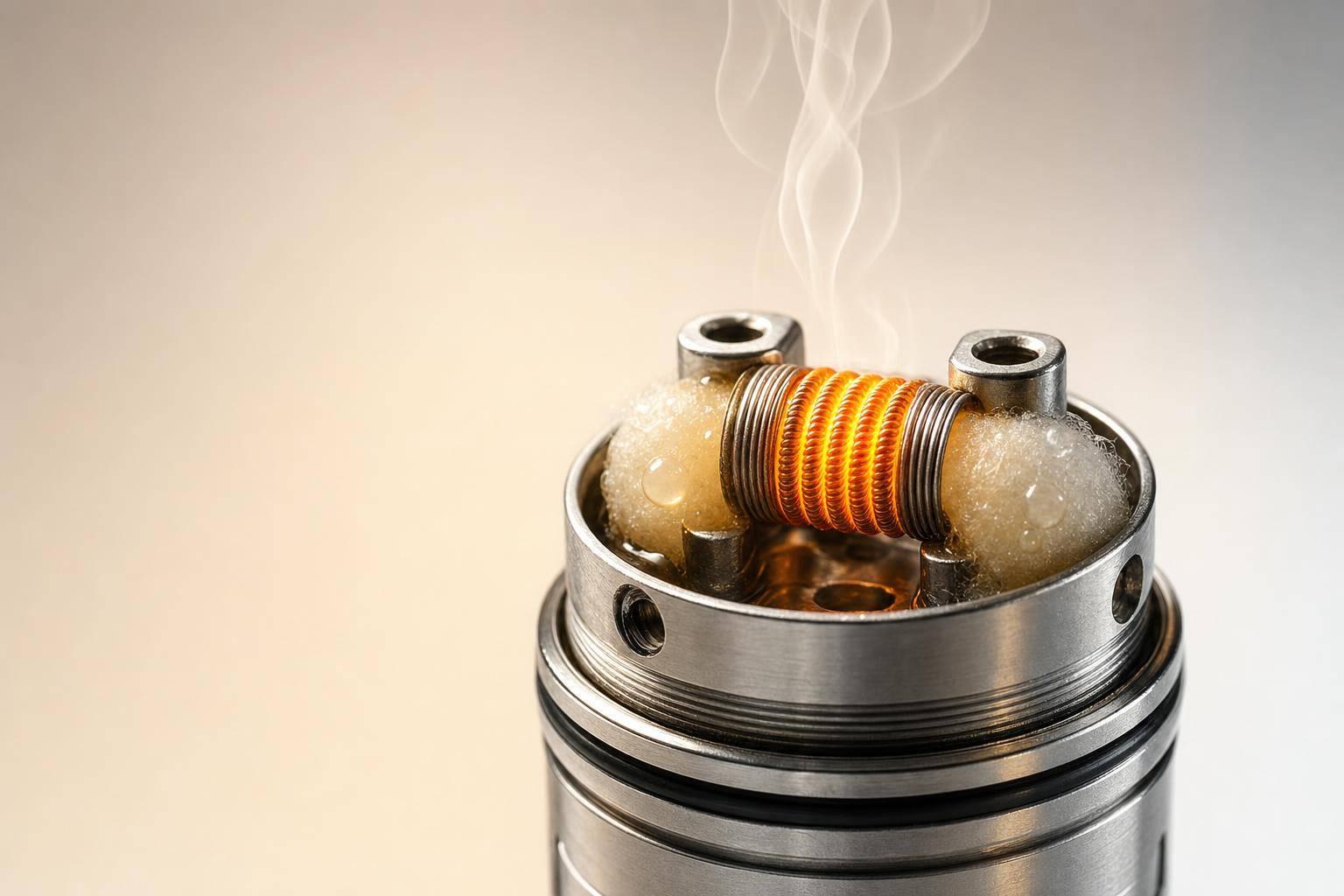
Coil resistance tells me how hot my vape runs, how much vapour I get, how strong the throat hit feels, and how fast the battery drains. If I want a simple rule, it’s this: low ohms mean more heat and more vapour; high ohms mean a cooler, tighter draw and less battery use.
If I’m choosing a coil, I only need to check four things first:
- Resistance:
- 0.15–0.5 Ω = more vapour, warmer draw, lower nicotine freebase
- 0.6–1.0 Ω = balanced draw, mixed use
- 1.0–1.8 Ω = tighter MTL draw, smoother nic salts
- Wattage range: stay within the printed range on the coil
- E-liquid match:
- High-VG (70%+) suits lower-resistance coils
- 50/50 VG/PG suits higher-resistance coils
- Nicotine match:
- 3–6 mg freebase suits sub-ohm coils
- 10–20 mg salts suit higher-ohm MTL coils
A wrong match often shows up fast. I may notice a burnt taste, leaking, spitback, gurgling, or a hot mouthpiece. In many pod systems sold in Bahrain, the most common coil choices are 0.6 Ω, 0.8 Ω, 1.0 Ω, and 1.2 Ω, with 1.0–1.2 Ω often giving better battery life and a cigarette-like draw.
Here’s the short version:
| Coil range | Best for | Usual feel |
|---|---|---|
| 0.15–0.5 Ω | DTL | Warm, airy, high vapour |
| 0.6–1.0 Ω | RDL / loose MTL | Balanced |
| 1.0–1.8 Ω | MTL | Cooler, tighter, smoother with salts |
So when I pick a coil, I’m not just picking a number. I’m picking draw style, vapour level, nicotine fit, e-liquid type, and battery use all at once.
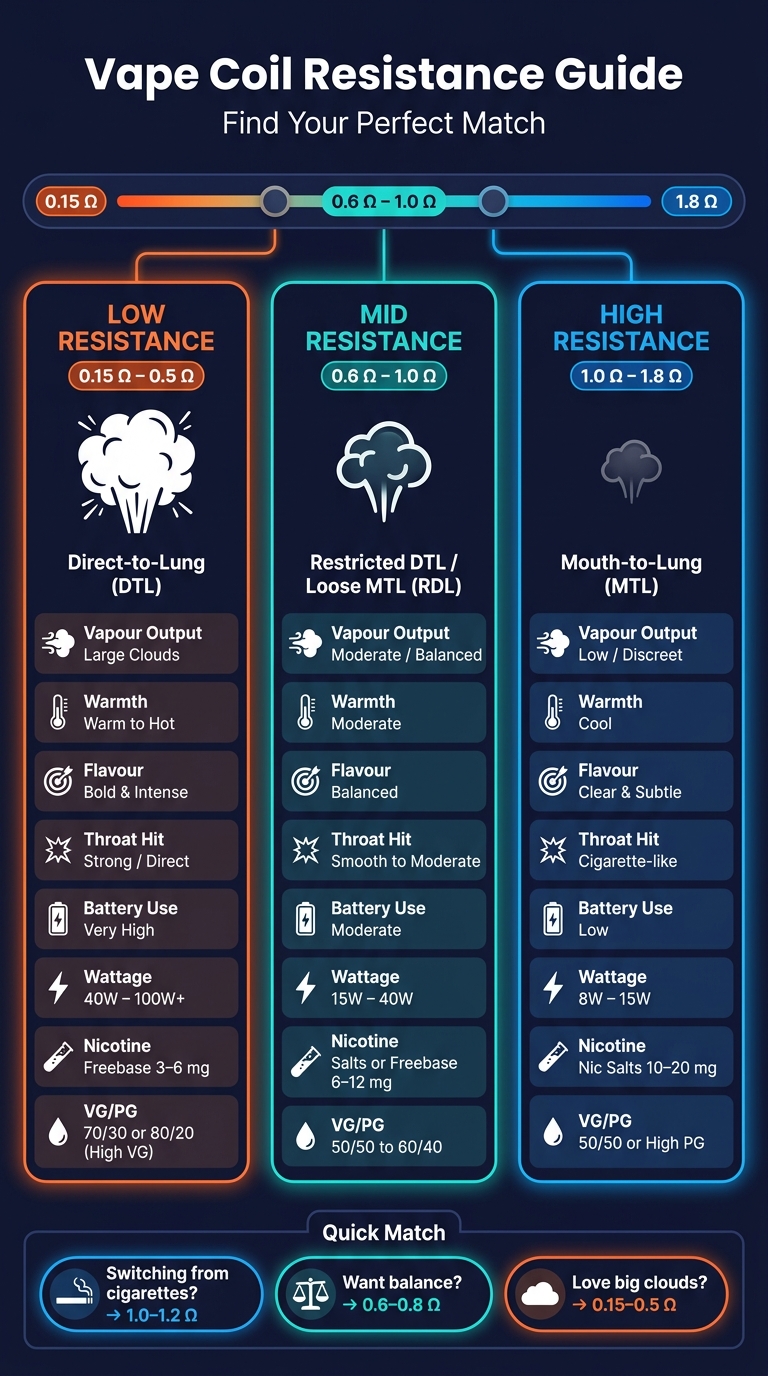
Vape Coil Resistance Guide: DTL vs RDL vs MTL
Vape Coils Explained: How Ohmage, Wicking & Sub Ohm Coils Work
sbb-itb-837e7ad
How Coil Resistance Affects Flavour, Vapour, and Throat Hit
Resistance affects four things straight away: vapour, warmth, flavour, and throat hit. Once you know the ohm rating, the next step is simple – understand how that number changes the draw.
Low-Resistance Coils: More Vapour and Warmer Draws
Low-resistance coils pull more power and generate more heat. More heat means e-liquid turns into vapour faster, so you get bigger, denser clouds and a much warmer inhale.
These coils tend to give you bold flavour, which works well with sweet or heavier blends. But there’s a trade-off. Because they vaporise more liquid with each puff, they go through e-liquid much faster than higher-resistance coils. They’re also better suited to lower nicotine strengths, usually 3 mg to 6 mg. If you use high-strength nicotine salts with a sub-ohm coil, the throat hit can feel far too harsh.
Higher-Resistance Coils: Tighter Draws and Smoother Nicotine
Coils at 1.0 Ω and above run at lower wattages and produce cooler vapour. The draw feels tighter, much closer to a cigarette, which is why they’re a natural fit for mouth-to-lung (MTL) vaping.
The flavour tends to come through cleaner and lighter, which suits layered e-liquids well. These coils pair nicely with 10 mg to 20 mg nicotine salts, giving a smooth throat hit without the harsh feel that comes from mixing high nicotine with high heat. They also use less e-liquid per puff.
| Feature | Low (0.15 Ω – 0.5 Ω) | Mid (0.6 Ω – 1.0 Ω) | High (1.0 Ω – 1.8 Ω) |
|---|---|---|---|
| Vapour Output | Large clouds | Moderate / Balanced | Low / Discreet |
| Warmth | Warm to Hot | Moderate | Cool |
| Flavour Style | Bold, Punchy, Intense | Balanced | Clear, Subtle, Rich |
| Throat Hit | Strong / Direct | Smooth to Moderate | Cigarette-like / Sharp |
| Nicotine Strength | Low (3 mg – 6 mg) | Medium (6 mg – 12 mg) | High (10 mg – 20 mg nicotine salts) |
| Typical Use Style | Direct-to-Lung (DTL) | Restricted DTL / Loose MTL | Mouth-to-Lung (MTL) |
That makes coil matching the next step.
Matching Coil Resistance to Your Device and E-Liquid
Once you know the ohm rating, the next step is simple: match it to how you inhale and the e-liquid you use.
Matching Resistance to MTL, RDL, and DTL Vaping
Your inhale style and coil resistance need to line up. A 1.0 Ω to 1.8 Ω coil suits MTL, a 0.5 Ω to 0.8 Ω coil suits RDL, and a 0.15 Ω to 0.4 Ω coil suits DTL.
Airflow matters just as much as the resistance. Tight airflow works with MTL coils, while open airflow fits DTL coils. If those two don’t match, the vape can feel off even if the ohm rating looks right.
Pairing Coils with Salt Nicotine, Freebase, and VG/PG Ratios
After inhale style comes e-liquid. Coil resistance also needs to match nicotine levels and liquid thickness. Higher-resistance coils (1.0 Ω+) pair well with nicotine salts at 10 mg/mL to 20 mg/mL and thinner 50/50 VG/PG liquids. Lower-resistance coils work best with freebase nicotine at 3 mg/mL to 6 mg/mL and thicker high-VG blends (70%+).
Why does this matter? Because the coil has to wick liquid at the right speed. Use a high-VG liquid in a tight MTL coil, and you may get dry hits because the liquid doesn’t soak into the wick fast enough. Run high-strength nicotine salts through a sub-ohm coil, and it can feel harsh.
| Resistance | Vaping Style | Wattage Range | Nicotine Type | VG/PG |
|---|---|---|---|---|
| 1.0 Ω – 1.8 Ω | MTL | 8W – 15W | Nicotine salts | 50/50 or high PG |
| 0.5 Ω – 0.8 Ω | RDL | 15W – 40W | Salts or freebase | 50/50 to 60/40 |
| 0.15 Ω – 0.4 Ω | DTL | 40W – 100W+ | Freebase | 70/30 or 80/20 |
Reading the Coil Label Before You Vape
Before you fill the pod, check the coil’s ohm rating and wattage range. Too low can weaken flavour. Too high can burn the wick.
It’s also worth checking whether the coil is marked for MTL, RDL, or DTL use, and whether the coil series matches your exact device. Coils are often device-specific, and even models from the same brand may use different, non-interchangeable coils. If you’re ordering replacement coils in Bahrain, check the series name on your device’s original packaging before placing the order.
Power, Battery Life, and Safe Coil Use
Why Lower-Resistance Coils Draw More Power
After you match the coil resistance to the way you vape, the next thing to check is power draw and battery safety.
Here’s the simple version: the lower the resistance, the more current moves through the coil. That means the device needs more wattage to run it, and the battery drains faster. So while low-resistance coils can give you more vapour, they also use more power.
| Coil Resistance | Typical Wattage Range | Battery Consumption | Vaping Style |
|---|---|---|---|
| 1.4 Ω – 1.8 Ω | 8W – 12W | Very Low | MTL (Discreet) |
| 1.0 Ω – 1.2 Ω | 10W – 15W | Low | MTL (Cigarette-like) |
| 0.6 Ω – 0.8 Ω | 15W – 25W | Moderate | RDL / MTL |
| 0.3 Ω – 0.5 Ω | 25W – 50W | High | DTL / RDL |
| 0.15 Ω – 0.25 Ω | 50W – 80W+ | Very High | DTL (Clouds) |
A high-ohm coil is usually easier on your battery. A sub-ohm coil, on the other hand, asks more from the device. That matters if you want longer battery life between charges.
Warning Signs of a Wrong Wattage or Coil Match
When the wattage and coil don’t suit each other, the device tends to let you know almost at once.
Common signs include:
- burnt taste
- gurgling
- leaking
- spitback
- a hot mouthpiece
These signs often mean the coil is running too hot. A safe way to dial things in is to start at the lowest recommended wattage for the coil, then move up slowly in 2W–5W steps until the vape feels right.
It also helps to slow down with low-resistance coils. Back-to-back puffs can dry the wick out before it has time to soak up more e-liquid. Give it a few seconds between draws, or you may end up with a dry hit.
Basic Safety and Responsible Use in Bahrain
In Bahrain, vaping products are strictly for adults aged 18 and above. For day-to-day use, stick with the charging cable recommended by the maker, and don’t leave your device charging overnight.
Heat is another thing to watch. Avoid leaving devices in hot cars or under direct sunlight. High temperatures can damage the battery, and they can also thin the e-liquid, which may lead to leaking.
That’s the basic routine for safer everyday use.
Picking Coil Resistance for Pod Systems in Bahrain
Once you get past the basics, pod systems make things much simpler. In most cases, you’re choosing between a small set of resistance ranges that each suit a different vaping style.
Common Pod Coil Options: 0.6 Ω to 1.2 Ω
Most pod systems in Bahrain use 0.6–0.8 Ω or 1.0–1.2 Ω coils.
| Resistance | Draw Style | Wattage | Battery Life | Best Pairing |
|---|---|---|---|---|
| 1.2 Ω | Tight MTL | 8–15W | Maximum | Nic salts (10–20 mg), 50/50 |
| 1.0 Ω | Classic MTL | 10–16W | High | Nic salts / 50/50 freebase |
| 0.8 Ω | MTL / RDL | 12–20W | Medium | Nic salts / 50/50 |
| 0.6 Ω | RDL (airier) | 18–25W | Lower | Freebase, 60/40 VG/PG |
Here’s the simple version: if you want a tighter, cigarette-like draw and longer battery life, go for 1.0–1.2 Ω. If you prefer a warmer and airier draw, 0.6–0.8 Ω is usually the better fit.
What to Check When Buying Coils Online in Bahrain
Before you place an order, match the coil to your exact pod series, not just the resistance number. That’s where people often slip up. A 0.8 Ω coil from one series may not fit another pod from the same brand.
Check these four things before buying:
- The resistance value
- The recommended wattage range
- The coil series name that matches your pod system
- The e-liquid type the coil is made for
VapeShop.bh offers same-day delivery across Bahrain, and its WhatsApp support can help you confirm compatibility before you order.
Conclusion: The Right Coil Resistance Comes Down to Your Style
Pick a resistance that fits your draw style, use it with the right e-liquid, and stay within the wattage range printed on the coil.
FAQs
How do I know which coil suits my vaping style?
Choose your coil based on how you vape and the type of nicotine you use:
- 1.0 ohm or above: a cigarette-like draw, mouth-to-lung vaping, and a good fit for nicotine salts
- 0.6 to 0.9 ohm: a middle ground for vapour and flavour
- Below 0.6 ohm: bigger clouds, warmer vapour, and direct-to-lung vaping
One more thing: make sure the coil fits your device’s wattage range and matches your pod or tank model. If it doesn’t, you can end up with poor performance or a burnt coil far sooner than expected.
Can I use nic salts in a low-ohm coil?
Generally, no. Nicotine salts work best with higher-resistance coils, usually 0.8 to 1.2 ohms or above. Those coils give you a tighter draw and run at lower wattage.
If you use high-strength nic salts in a low-ohm, high-power sub-ohm coil, the device can produce too much vapour. That can make the hit feel harsh and may cause discomfort.
Why does my coil taste burnt or leak?
A burnt taste usually means the cotton wick has dried out. In plain terms, the coil is heating cotton that isn’t soaked well enough. That tends to happen when the wattage is set wrong, a new coil wasn’t primed before use, or the e-liquid doesn’t match your coil resistance.
Leaking usually comes down to e-liquid thickness that doesn’t suit your device, or a worn coil that no longer seals as it should. The fix is pretty simple: prime new coils, change them on a regular basis, and use an e-liquid that matches your coil resistance.
Related Blog Posts
- How to Match E-Liquids with Vape Devices
- Best Wattage for MTL vs. DTL Vaping
- Mesh vs Regular Coils: E-liquid Efficiency
- Mesh Coils vs Regular Coils: Pros and Cons
Frequently Asked Questions
Coil resistance is the ohm (Ω) value printed on your vape coil and it tells you how much the coil resists the power coming from the battery. Low resistance coils (around 0.15–0.5 Ω) run hotter, make more vapour and drain the battery faster, while higher resistance coils (around 1.0–1.8 Ω) give a cooler, tighter draw and use less power. When you choose a coil, you are really choosing your draw style (DTL, RDL, MTL), vapour level, nicotine match and how long your battery will last.
For sub-ohm vaping and bigger clouds (DTL), coils in the 0.15–0.5 Ω range work best and are usually paired with lower nicotine freebase e-liquid around 3–6 mg. For a tighter mouth-to-lung (MTL) draw similar to a cigarette, higher resistance coils in the 1.0–1.8 Ω range are better and are typically used with smoother nicotine salts between 10–20 mg. In between, 0.6–1.0 Ω coils give a balanced RDL or loose MTL draw, so you can fine-tune how airy or tight your vape feels.
Direct-to-lung (DTL) vaping usually uses lower-resistance coils between 0.15–0.5 Ω for a warm, airy draw and high vapour output. Restricted direct lung (RDL) or loose MTL typically sits around 0.6–1.0 Ω, giving a balanced feel that is neither too tight nor too open. Classic MTL vaping works best with 1.0–1.8 Ω coils, which provide a cooler, tighter draw and pair well with nicotine salts.
Each coil has a recommended wattage range printed on it, and staying within that range is key to avoiding burnt taste, leaking or spitback. Lower-resistance coils (sub-ohm) usually run at higher wattages to produce more heat and vapour, while higher-resistance coils need less power and give a gentler throat hit. When you change resistance, you should adjust your wattage accordingly and increase slowly so the coil can bed in without damage.
High-VG e-liquids (around 70% VG or more) suit lower-resistance coils because these coils run hotter and can handle the thicker liquid without dry hits. A 50/50 VG/PG mix works better with higher-resistance coils in the 0.6–1.8 Ω range, where the cooler vape and tighter draw complement the thinner liquid. Matching your VG/PG ratio to coil resistance helps prevent problems like burning, flooding, gurgling or a hot mouthpiece.
For pod coils in the sub-ohm range (0.15–0.5 Ω), lower freebase nicotine strengths around 3–6 mg are usually recommended because the warmer draw and higher vapour make stronger nicotine feel harsh. Higher-resistance MTL coils from 1.0–1.8 Ω work best with nicotine salts between 10–20 mg, giving a smoother throat hit and cigarette-like satisfaction. Many pod systems in Bahrain use 0.6 Ω, 0.8 Ω, 1.0 Ω and 1.2 Ω coils, where 1.0–1.2 Ω often offers better battery life and a familiar, tight draw.
Burnt taste, leaking, spitback or a very hot mouthpiece often mean the coil resistance, wattage, e-liquid type and nicotine strength are not matched correctly. Using thick high-VG liquid in a high-resistance coil can cause dry hits, while using strong salts in a very low-resistance sub-ohm coil may feel harsh and flood the pod. If problems continue with a correctly matched setup, customers in Manama and across Bahrain can reach VapeShop.bh support on WhatsApp: +973 66324432 to double-check coil choice, payment options (COD, BenefitPay, Card) and get a quick fix.