
Advanced Coil Building: Wire Properties Guide


Choosing the right wire for your vape coil directly impacts your vaping experience. Different wire materials offer unique performance characteristics, such as resistance, heat-up time, and compatibility with wattage or temperature control modes. Here’s a quick breakdown of the most popular options:
- Kanthal A1: Durable, nickel-free, and ideal for wattage mode. Best for beginners and mouth-to-lung (MTL) builds but has slower heat-up times.
- NiChrome (Ni80): Heats up faster than Kanthal, making it great for sub-ohm and cloud-chasing builds. However, it contains nickel, which may cause allergies.
- Stainless Steel 316L: Works in both wattage and temperature control modes. Offers fast heat-up times and delivers clean flavor, but contains trace amounts of nickel.
- Nickel (Ni200): Designed exclusively for temperature control. Extremely low resistance and fast heating but tricky to work with and unsuitable for wattage mode.
- Titanium: Also for temperature control only. Offers fast heating and cooling but requires careful handling to avoid harmful emissions at high temperatures.
Key takeaway: Beginners should start with Kanthal for its ease of use, while advanced users can explore Stainless Steel or Nickel for temperature control setups. Always consider safety, especially with Nickel and Titanium wires, and match the wire type to your vaping goals. For high-quality materials in Bahrain, check out VapeShop.bh for same-day delivery.
1. Kanthal A1
Kanthal A1 is a FeCrAl alloy composed of 20–30% chromium and 4–7.5% aluminium, known for its durability and impressive melting point of around 1,425°C. Its ability to withstand high temperatures makes it a reliable option for wattage mode applications. However, to maintain its protective oxide layer, prolonged dry burns should be avoided.
Here’s a closer look at the key features that make Kanthal A1 a popular choice for coil builds and accessories.
Resistance Levels
Kanthal A1 offers higher resistance per foot, which is ideal for achieving high ohm readings with fewer wraps. This makes it a great match for mouth-to-lung (MTL) setups and other high-resistance builds, typically 1.0 ohm or more. With a resistivity of approximately 1.4 μΩ·m and a temperature coefficient of +49 ppm/K, it delivers stable performance even under demanding conditions.
Heat-Up Time
One downside of Kanthal A1 is its slower ramp-up time compared to materials like nichrome or stainless steel. The higher mass and resistance mean it takes longer to heat up, which can be advantageous for those who prefer longer, low-intensity puffs. However, when used in complex multi-strand builds like Claptons, the added wire mass further increases ramp-up time. For simpler MTL builds, 26–28 gauge Kanthal wire strikes a good balance between resistance and performance.
Suitability for Builds
Kanthal A1 is strictly for wattage mode use and doesn’t work with temperature control mods. Its stiffness makes it easier to handle and shape, especially for beginners. When heated, the wire forms a protective aluminium oxide layer, which is beneficial for durability but also acts as an electrical insulator. To ensure proper functionality, connections to the atomiser posts must be clean and secure.
Another advantage is that Kanthal A1 is nickel-free, making it an excellent option for those with nickel allergies. This sets it apart from other materials like NiChrome and stainless steel, highlighting its specialised role in wattage mode builds.
sbb-itb-837e7ad
2. NiChrome
NiChrome is an alloy primarily made up of 80% nickel and 20% chromium, especially in its popular vaping grade, Ni80. It has a melting point of about 1,400°C and forms a protective chromium oxide layer when heated, which helps prevent oxidation.
Resistance Levels
NiChrome’s electrical properties play a big role in its performance. Compared to Kanthal, it has lower resistance for the same gauge and length, with an electrical resistivity of approximately 1.12 μΩ·m – about 66 times higher than copper. This lower resistance means that creating higher-resistance coils often requires thinner wire or more wraps. However, this characteristic is a bonus for complex builds like Fused Claptons or Aliens, as it allows for increased wire mass without drastically increasing resistance.
Its temperature coefficient of resistance is another standout feature, sitting at around 0.015% – much lower than copper’s 0.4%. This means the resistance only increases by about 7% when heated from 20°C to 400°C.
Heat-Up Time
NiChrome heats up faster than Kanthal but is slightly slower than stainless steel. This quick ramp-up time makes it a favourite for cloud-chasing setups, where immediate vapour production is key. However, its lower melting point compared to Kanthal can be a drawback. Aggressive dry-burning may cause the wire to fail prematurely. To avoid this, start with a low wattage and pulse the coils gently to spot hotspots, rather than applying continuous power.
Suitability for Builds
NiChrome is a top choice for exotic builds and cloud-chasing setups due to its fast heat-up, excellent shape retention, and ease of use. It’s particularly well-suited for advanced coil configurations where minimal ramp-up time is crucial.
That said, its high nickel content requires caution for users with nickel allergies. A 1984 study by the University of Puerto Rico revealed that 28.5% of participants showed allergic reactions to nickel. If you’re sensitive to nickel, Kanthal is a safer alternative.
NiChrome’s combination of quick ramp-up, durability during wicking, and availability makes it a strong contender for competition vaping and advanced builds. However, always consider potential nickel sensitivities before use.
3. Stainless Steel 316L
Stainless Steel 316L, often called "medical grade" or "surgical-level" wire, stands out as one of the most adaptable materials for coil building. Its key advantage lies in its dual-mode compatibility – it works seamlessly in both standard wattage and temperature control (TC) modes. This means you can switch between these modes without needing to rebuild your coil, offering impressive flexibility.
Resistance Levels
SS316L has a lower resistance compared to Kanthal A1, making it a popular choice for sub-ohm builds that focus on high vapour output. One of its standout features is how its resistance predictably increases as it heats up. This characteristic is especially useful for temperature control, as devices with custom Temperature Coefficient of Resistance (TCR) settings can take full advantage of this behavior. This predictable resistance change ensures precise performance in TC mode and complements its ability to heat up quickly.
Heat-Up Time
When it comes to heating speed, SS316L outperforms Kanthal A1 and even NiChrome 80, offering faster heat-up times for immediate vapour production. This rapid ramp-up is especially beneficial for complex builds like Claptons or multi-strand coils, which tend to heat more slowly due to their higher mass. In TC mode, the device adjusts power to maintain a consistent temperature, reducing the risk of dry hits or burnt cotton. Additionally, SS316L works exceptionally well with mesh coils, which are known for their efficient heating.
Suitability for Builds
SS316L is a favorite among advanced builders for its versatility and ease of use. Its dual-mode compatibility and pliability make it perfect for creating intricate coil designs. The wire holds its shape well during installation and has minimal springiness, which is essential for detailed builds. Compared to Titanium or Ni200, which can be too soft or springy, SS316L is stronger and generally easier to handle.
Many users also praise SS316L for delivering a cleaner and purer flavor, as opposed to the slightly metallic taste that some associate with Kanthal. With proper maintenance, an SS316L coil can last up to two months, making it both durable and cost-effective. However, since it contains a small amount of nickel, individuals with nickel allergies should take precautions.
4. Nickel
Nickel, particularly Nickel wire (Ni200), holds a special place in the world of Temperature Control (TC) vaping. It was the first material designed for TC vaping, thanks to Evolv‘s DNA mod chips. While it’s not as commonly used today, understanding Nickel’s properties is key for advanced coil builders aiming for precision.
Resistance Levels
Nickel has an extremely low resistance, which means you’ll need more wraps to hit your desired resistance level. This low resistance is actually a strength when it comes to TC vaping because it makes Nickel highly predictable as its resistance shifts consistently with temperature changes. This predictability is what makes Nickel shine in temperature-regulated setups.
Heat-Up Time
Nickel is the fastest-heating wire among common vaping materials. This quick heat-up means instant vapor production, which is a major plus for vapers seeking quick performance. However, there’s a catch. As Marcus Chen from The Vapers Guide points out, Nickel must be used exclusively in TC mode. Using it in wattage mode can lead to dangerous overheating and release harmful emissions. Its rapid heat response is one of the reasons it pairs so well with TC mode, where precise resistance changes are crucial.
Suitability for Builds
Working with Nickel can be tricky. It’s soft and springy, which makes it harder to work with compared to materials like Kanthal or Stainless Steel. When building with Nickel, it’s best to create spaced coils rather than contact coils. Why? Because touching wraps can cause hotspots or even shorts. If the wire feels too soft to handle, twisting it before wrapping can make it sturdier.
There’s one more thing to keep in mind: Nickel allergies. Roughly 17% of women and 3% of men are allergic to Nickel, and this can lead to what’s often called "vape rash." Symptoms include redness, itching, or scaling on the skin, particularly on the hands or face. If you notice these signs, it’s a good idea to switch to a nickel-free wire like Kanthal.
5. Titanium
Titanium stands out as a solid choice for those who prefer Temperature Control (TC) vaping, especially when using Grade 1 Titanium wire. However, it requires careful handling and strict safety practices to ensure proper use in advanced builds.
Resistance Levels
Titanium’s resistance is about twice that of Ni200, but it’s still lower than Kanthal A1. This balance makes it a reliable option for TC mode, offering predictable performance. Its higher resistance allows you to use fewer wraps to achieve your desired target, making the coil-building process simpler compared to Nickel. This predictability is a major advantage when precision is key.
Heat-Up Time
One of Titanium’s most appealing traits is its incredibly fast ramp-up and cool-down times. This quick response is perfect for precise temperature adjustments, which is why it’s often used in premium sub-ohm tank coils. The result? Consistent vapour production and accurate temperature control.
Suitability for Builds
Titanium is not only functional but also user-friendly. Its strength and reduced springiness make it easy to work with, helping coils maintain their shape during installation. Whether you prefer spaced or contact coils, Titanium accommodates both styles. That said, spacing your wraps is recommended for even heat distribution.
It’s crucial to use Titanium exclusively in TC mode. If the coil exceeds 600°C (1,200°F), it can produce harmful titanium dioxide. Signs of overheating include a bright orange glow or the appearance of white powder – if you notice these, discard the coil immediately. When pulsing Titanium, stick to low wattage (15–20 watts) to check for hotspots. Always ensure your coil is properly wicked and wet before firing at higher temperatures.
Pros and Cons
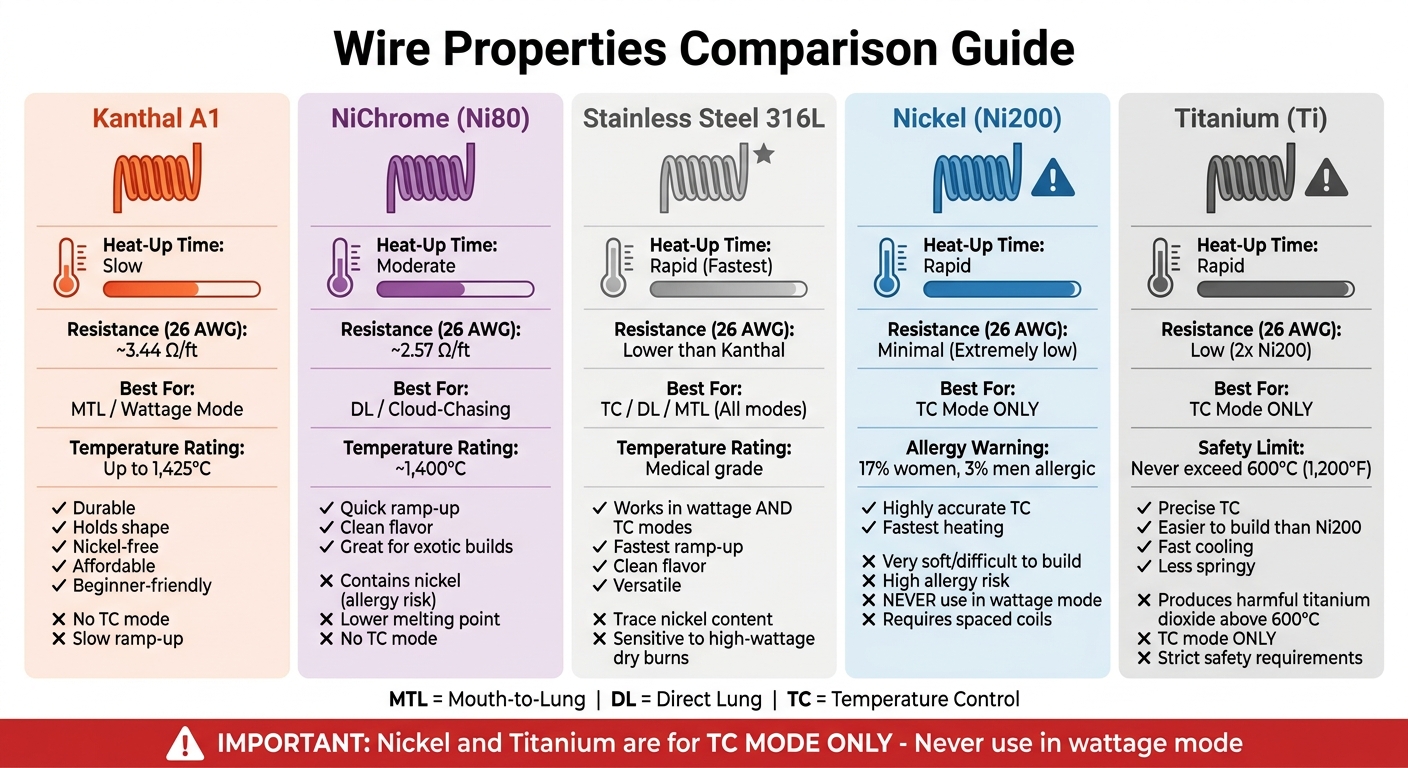
Vape Wire Comparison Chart: Kanthal vs NiChrome vs Stainless Steel vs Nickel vs Titanium
Choosing the best vape coils for your needs depends on your build style, device compatibility, and safety considerations. Each wire type has its strengths and limitations, which directly influence your vaping experience.
Kanthal A1 is a popular choice for beginners because of its durability and ability to retain its shape during wicking. It can handle temperatures up to 1,400°C (2,550°F), making it a reliable option. However, its high resistance leads to slower ramp-up times, restricting it to wattage mode.
NiChrome (Ni80) heats up faster and has lower resistance, making it a favourite for sub-ohm and cloud-chasing builds. On the downside, its nickel content could cause allergic reactions, and its lower melting point compared to Kanthal limits its resilience.
Stainless Steel 316L stands out for its versatility, working in both wattage and temperature control (TC) modes. It offers the fastest ramp-up time among power-mode wires and delivers clean flavour. However, it requires careful use – dry burning at high wattages can release harmful compounds.
Nickel (Ni200) excels in temperature control due to its minimal resistance, providing highly accurate performance. However, its extreme softness makes it tricky to shape, and it should never be used in wattage mode, as it can overheat rapidly and release harmful substances.
Titanium offers precise temperature control with higher resistance than Nickel, making coil building easier. It heats and cools quickly, but safety concerns are a major drawback – temperatures above 648°C (1,200°F) can produce harmful titanium dioxide. Titanium is strictly for temperature control use.
Here’s a quick-reference table to compare the performance of these materials:
| Material | Resistance (26 AWG) | Heat-Up Time | Best Builds | Pros | Cons |
|---|---|---|---|---|---|
| Kanthal A1 | ~3.44 Ω/ft | Slow | MTL / Wattage | Durable, holds shape, nickel-free, affordable | No TC mode, slow ramp-up |
| NiChrome (Ni80) | ~2.57 Ω/ft | Moderate | DL / Cloud-Chasing | Quick ramp-up, clean flavour | Nickel allergy potential, lower melting point, no TC mode |
| Stainless Steel 316L | Lower than Kanthal | Rapid | TC / DL / MTL | Works in wattage and TC modes, fastest ramp-up, versatile | Contains trace nickel, sensitive to high-wattage dry burns |
| Nickel (Ni200) | Minimal | Rapid | TC Only | Highly accurate in TC | Very soft, hard to build, nickel allergy potential, unsafe in wattage mode |
| Titanium (Ti) | Low | Rapid | TC Only | Precise TC, easier to build than Ni200, fast cooling | Safety risks (titanium dioxide at high temperatures), strictly for TC mode |
This table highlights how each wire material has unique attributes that can affect both performance and safety, helping you choose the best option for your vaping needs.
Conclusion
To get the most out of your build, it’s all about matching the wire to your goals. For beginners, Kanthal A1 is a fantastic starting point. It’s durable, easy to work with, and performs consistently in wattage mode on any device. If you’re chasing massive clouds, NiChrome (Ni80) is your best friend, thanks to its quick ramp-up time and ability to handle low-resistance sub-ohm builds between 0.15Ω and 0.5Ω. On the other hand, if you’re all about flavour, Stainless Steel 316L is the way to go. It delivers clean, crisp taste and works in both wattage and temperature control modes.
For advanced builders using temperature control setups, the choice depends on your specific needs. Stainless Steel is versatile, working seamlessly in both modes. Nickel (Ni200), with its extremely low resistance and high Temperature Coefficient of Resistance, offers precise temperature control. Meanwhile, Titanium is easier to build with due to its higher resistance but must be used strictly in temperature control mode to avoid harmful titanium dioxide formation above 600°C (1,200°F). Keep in mind: Nickel and Titanium wires are for temperature control mode only – never use them in wattage mode. Also, ensure Nickel wire is at room temperature during installation for accurate temperature readings.
"Stainless Steel is a Medical Grade metal that is widely growing in popularity and quickly becoming the go-to wire for temperature control devices." – Misthub
Safety is non-negotiable when working with temperature control wires. Avoid dry-burning Nickel or Titanium until they glow brightly, as this can damage the wire and release harmful compounds.
For vapers in Bahrain, VapeShop.bh provides easy access to high-quality materials, with same-day delivery across the country. Whether you’re a first-time builder experimenting with Kanthal or a seasoned expert perfecting a Titanium temperature control setup, having reliable supplies ensures your vaping experience is smooth and enjoyable.
FAQs
How do I choose the right wire for my mod mode?
Choosing the right wire for vaping involves considering resistance, gauge, and material.
Resistance, measured in ohms, plays a key role in both vapor production and safety. Lower resistance wires produce more vapor but may require careful handling to avoid overheating. Gauge, or wire thickness, affects how quickly the wire heats and its durability. Thinner wires heat up faster but are more prone to breaking, while thicker wires are sturdier but take longer to reach the desired temperature.
The material of the wire – such as Kanthal, Nichrome, or stainless steel – also matters. Each type influences resistance, heat-up time, and the flavour profile of your vape. For the best results, ensure your wire choice is compatible with your mod and aligns with your vaping style.
What wire is safest if I have a nickel allergy?
For individuals with a nickel allergy, stainless steel wire is often the safest choice. Variants such as 304 or 316 stainless steel are widely used in temperature-controlled devices and are typically safe for those with sensitivities, thanks to their reduced nickel content.
How can I reduce coil ramp-up time in complex builds?
To speed up ramp-up time in complex builds, opt for wires with lower resistance, such as thicker gauges like 24 or 26. Choosing materials with high thermal conductivity, such as Kanthal, can also help the coils heat up faster. Fine-tune your coil design by adding more wraps, reducing the overall coil mass, and ensuring solid contact with the mod’s terminals. Additionally, proper priming and careful attention to build quality play a key role in reducing resistance and achieving faster heat-up times.
Related Blog Posts
- 5 طرق لإطالة عمر كويلات الفيب
- Mesh Coil vs. Regular Coil Disposable Vapes
- How to Match E-Liquids with Vape Devices
- Best Wattage for MTL vs. DTL Vaping
Frequently Asked Questions
Kanthal A1 is durable, nickel-free, and ideal for wattage mode, making it the top choice for beginners building vape coils. It holds shape well, is easy to work with, and provides consistent performance. VapeShop.bh stocks various gauges like 24-28 AWG for your builds.
Kanthal A1 wire is the most common for rebuildable atomizers in wattage mode due to its high melting point and ease of use. It offers good flavor and vapor production while being simple to dry burn and shape. Thicker gauges like 26 AWG lower resistance for more power.
NiChrome wire has slightly lower resistance than Kanthal of the same gauge, heating up faster for a warmer vape. It performs similarly to Kanthal in wattage mode and is popular for everyday builds. Choose based on your atomizer's space and mod settings.
SS316L is versatile, working in both wattage and temperature control modes while heating faster than Kanthal with less flavor interference. It provides a clean taste and durability, though some grades can be springier. Ideal for advanced vapers seeking consistent performance.
Ni200, or Nickel wire, is used primarily in temperature control mode for its high temperature coefficient of resistance. It excels at high temperatures for cloud chasing and intense flavor but is softer, suiting experienced builders. Not ideal for RDA due to malleability.
Titanium wire works only in temperature control mode and maintains shape at high temperatures without losing Ohm resistance. It is easy to build with and great for cloud chasing on advanced sub-ohm devices. Growing in popularity for reliable performance.
Temperature control uses wires like SS316L, Ni200, or Titanium that change resistance predictably with heat for precise temp regulation. This prevents dry hits and enhances flavor consistency compared to wattage mode. Check your mod's compatibility before building.
Coil building involves selecting wire gauge, wraps, and inner diameter to hit your target resistance, like 0.55Ω with 24 AWG Kanthal and 6 wraps on a 3mm jig. Thicker wire or more wraps increase resistance; always check with an ohmmeter. Start simple for best results.