
Vaping Market Size in Bahrain 2026


Bahrain’s vaping market is growing fast, reflecting global trends as more people move away from cigarettes. Here’s what you need to know:
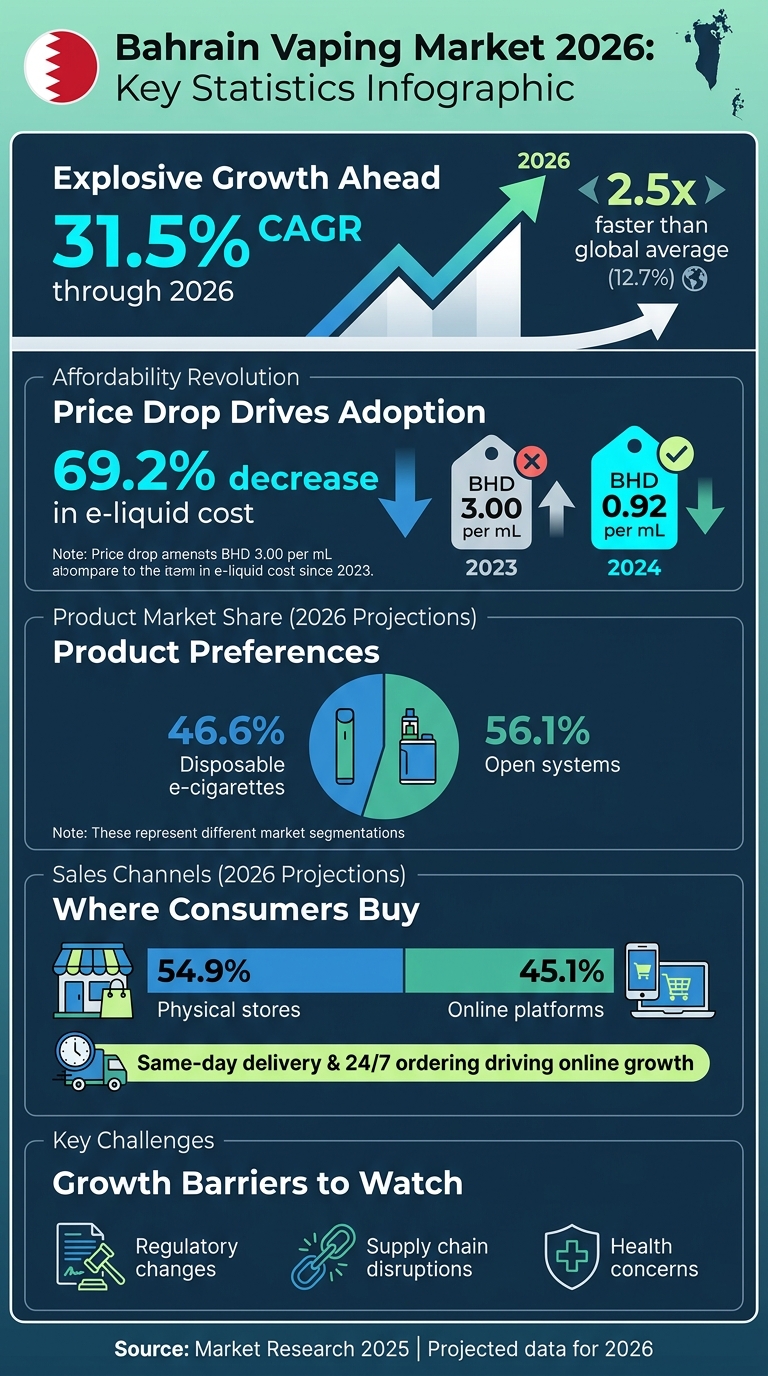
- Projected Growth: Bahrain’s vaping market is expected to grow at a massive 31.5% CAGR through 2026, far outpacing the global average of 12.7%.
- Affordability: The cost of 1 mL of e-liquid dropped by 69.2%, from BHD 3.00 to BHD 0.92, making vaping more accessible.
- Consumer Trends: Disposable e-cigarettes are gaining popularity, expected to make up 46.6% of the market by 2026, while open systems will account for 56.1%.
- Top Sales Channels: Physical stores dominate with 54.9% market share, but online platforms like VapeShop.bh are catching up due to features like same-day delivery and 24/7 WhatsApp ordering.
- Challenges: Regulatory changes, supply chain issues, and health concerns are among the key trends shaping the industry that could impact growth.
Bahrain’s market is driven by affordability, a younger demographic, and new vaping technologies. However, businesses must navigate evolving regulations and supply chain disruptions to succeed.
Bahrain Vaping Market Statistics and Growth Forecast 2026
Bahrain’s Vaping Market Size in 2025-2026
Market Value and Revenue Figures
Pinpointing exact revenue figures for Bahrain’s vaping market is tricky. This is because data for Bahrain is often grouped within broader MEA (Middle East and Africa) or GCC (Gulf Cooperation Council) reports. For smaller markets like Bahrain, analysts rely on global growth trends and regional share estimates rather than isolated national statistics.
Looking at the global market provides some context. Projections for the global vaping market in 2025 range between USD 26–40 billion, with an annual growth rate forecasted at approximately 12.7–18.3% heading into 2026. These global trends help us understand the consumer behaviours shaping Bahrain’s market.
2025 Market Trends
Consumer behaviour in 2025 reveals some clear patterns. Best disposable vapes continue to gain traction, with disposable products expected to make up 46.6% of the market share by 2026. At the same time, more experienced users are gravitating towards open systems, which offer customisation options like adjustable wattage, coil types, and e-liquid choices. These open systems are projected to account for 56.1% of the market share in 2026.
When it comes to distribution, physical retail outlets remain the preferred choice for many consumers. Offline sales channels are expected to hold 54.9% of the market share by 2026. Speciality vape shops and convenience stores dominate due to their ability to offer hands-on demonstrations and immediate product availability. Although online sales are growing, the ability to test products in-store keeps brick-and-mortar shops ahead.
Consumer preferences also differ by demographic. Smokers aged 25–45 tend to focus on nicotine absorption and affordability, while younger adults aged 18–30 are drawn to a variety of flavours and the social appeal of vaping.
sbb-itb-837e7ad
Market Growth Forecast Through 2026
Factors Driving Market Growth
Bahrain’s vaping market is poised for impressive growth within the GCC, with a projected compound annual growth rate (CAGR) of 31.5%. This figure is nearly three times the global average of 12.7%, making Bahrain a standout in one of the fastest-growing vaping markets globally.
A key factor behind this growth is affordability. The average price of 1 mL of e-liquid plummeted by 69.2% between 2023 and 2024, dropping from BHD 3.00 to BHD 0.92. This sharp decline has made vaping more accessible to a broader audience. Research and Markets highlights this impact:
Greater affordability fuels e-cigarette market growth by providing a lower-cost alternative to traditional cigarettes, allowing consumers to meet their nicotine needs more economically
. As prices fall, more consumers are drawn to vaping as an economical option.
Demographics are another driving force. Bahrain’s expanding expatriate population, rapid urbanisation, and rising disposable incomes among younger consumers are creating fertile ground for market growth. Additionally, the increasing popularity of botanical, herbal, and fruit flavours appeals to health-conscious individuals who see vaping as a lifestyle choice rather than merely a tobacco substitute. Technological advancements, such as improved battery life, modular designs, and compact devices, are also attracting first-time users. These factors collectively create a strong momentum for the market.
Market Barriers and Limitations
Despite the promising growth, several challenges persist. One of the biggest hurdles is regulatory uncertainty. Changing regulations can quickly impact product approvals, marketing strategies, and compliance requirements, leading to higher costs and unpredictability for businesses.
Supply chain issues also pose significant obstacles. Tariffs on imported components, particularly from the Asia-Pacific region, disrupt supply chains and inflate production costs. The global semiconductor shortage and limited availability of lithium batteries are further driving up expenses for advanced vaping devices, such as "smart" vapes and rechargeable products.
Moreover, vaping health facts remain a critical concern. Ongoing debates about the safety of vaping compared to traditional cigarettes continue to influence consumer behaviour, potentially discouraging new users. Regional geopolitical tensions could also affect economic stability and consumer confidence, not just in Bahrain but across neighbouring markets.
Market Breakdown by Product and Channel
Product Categories
Bahrain’s vaping market in 2026 is set to cater to a wide range of consumer preferences through three main product categories. Disposable e-cigarettes, priced between BHD 1.50 and BHD 6.40, are the go-to choice for beginners (see our vaping guide for beginners) due to their ease of use and zero maintenance. For seasoned vapers, open-system (modular) devices are the preferred option, with prices starting at BHD 13.20 and reaching over BHD 450 for high-end, fully customised setups. Meanwhile, pod systems strike a middle ground, offering simplicity and decent performance at prices ranging from BHD 0.75 to BHD 15.00.
These pricing tiers reflect clear consumer segments. Disposable e-cigarettes appeal to those seeking affordability and convenience, especially first-time users. Modular devices, on the other hand, attract enthusiasts who value customisation and performance. Pod systems cater to users who want a straightforward yet effective vaping experience. This segmentation not only shapes consumer preferences but also impacts how these products are sold, as explained in the next section on sales channels.
Sales Channels
The distinction between product types also influences their distribution. Physical stores are expected to dominate Bahrain’s vaping market, accounting for 54.9% of the market share by 2026. Vape shops play a crucial role here, offering in-person demonstrations and expert advice, which are particularly beneficial for newcomers.
At the same time, online platforms are gaining traction, thanks to their convenience and variety. Websites like VapeShop.bh stand out by providing features such as same-day delivery across Bahrain, 24/7 WhatsApp ordering, and a broad selection of products, including disposables, e-liquids, and advanced mods. These platforms also integrate AI-driven tools, such as age verification systems and personalised flavour suggestions, which not only meet regulatory standards but also enhance the shopping experience for consumers.
Regulations Affecting the 2026 Market
Regulatory Framework and Compliance
Bahrain’s vaping industry operates under the guidelines of BH 2:2021 (‘Electronic Nicotine Products (Equivalents of Traditional Tobacco Products)’), which came into effect on 11 November 2021. This regulation treats electronic nicotine delivery systems with the same oversight as traditional tobacco products [](https://bsmd.moic.gov.bh/store/standards/BSMD:797676/BH 2:2021?lang=en). The Ministry of Industry & Commerce, through the Bahrain Standards & Metrology Directorate (BSMD), is responsible for ensuring compliance with these standards.
The regulation outlines clear technical requirements for product composition, labelling, and safety. Businesses must follow these standards, which are detailed in a document available in English (10 pages) and Arabic (9 pages) for BHD 10.5 at the Ministry’s Standards Store [](https://bsmd.moic.gov.bh/store/standards/BSMD:797676/BH 2:2021?lang=en). This framework guarantees that all vaping devices and liquids sold in Bahrain meet national safety and quality benchmarks. By setting these clear rules, the regulation not only ensures product safety but also establishes consistency in how these products are marketed and sold.
Effects on Sales and Marketing
The introduction of BH 2:2021 has had a noticeable impact on Bahrain’s vaping market, influencing both opportunities and challenges. On one hand, the regulation helps eliminate unregulated and counterfeit products, which benefits compliant businesses. On the other hand, the stricter standards often lead to market consolidation, favouring larger brands with the resources to meet regulatory requirements, while smaller, non-compliant companies may find it difficult to compete.
Retailers and importers are required to ensure that all products adhere to Bahraini safety and labelling standards. While this may create some additional administrative work, it ultimately enhances consumer trust and supports market growth. However, since vaping products are classified as tobacco equivalents, they are subject to similar restrictions on marketing and sales as traditional cigarettes. This has pushed businesses, such as VapeShop.bh, to focus on alternative customer engagement strategies. For example, they rely on direct communication channels like WhatsApp ordering and same-day delivery, instead of conventional advertising approaches.
Conclusion
Bahrain’s vaping market is on track for notable growth through 2026, fuelled by a regional move away from traditional tobacco products and a rising preference for advanced nicotine delivery systems. The GCC e-cigarette market, expected to hit BHD 287.7 million by 2025 with a projected growth rate of 13.07% through 2034, provides strong momentum for Bahrain’s market expansion. However, this growth comes alongside challenges that stakeholders must address.
Improved affordability has emerged as a key factor driving market expansion. At the same time, stakeholders face hurdles like tariffs on imported components, which have pushed up production costs, and evolving regulations that continue to shape market dynamics.
Specialist e-cigarette shops still dominate as the leading distribution channel, but online retail is steadily gaining traction as consumer preferences shift towards digital shopping experiences. Retailers such as VapeShop.bh have embraced this change, offering services like same-day delivery and WhatsApp ordering to cater to the growing demand for convenience.
To stay competitive, manufacturers and retailers should focus on features like vape mods, automatic operation modes, and adherence to local standards. These strategies will help appeal to an increasing segment of health-conscious consumers. Staying aligned with local regulations and keeping a close watch on supply chain issues will also be crucial, as these factors directly influence pricing, product availability, and overall market stability through 2026.
While the market holds promising growth opportunities, success will depend on strategic planning and careful compliance with regulatory requirements.
FAQs
How big is Bahrain’s vaping market in BHD by 2026?
Bahrain’s vaping market is projected to hit approximately 4.6 million Bahraini Dinars (BHD) by 2026. This estimate aligns with global growth patterns and regional trends. Notably, the vape market in the Middle East and Africa is expected to expand at an impressive compound annual growth rate (CAGR) of 30.7% between 2024 and 2031.
Will BH 2:2021 change what vape products can be sold in Bahrain?
BH 2:2021 is not expected to have an immediate impact on which vape products are sold in Bahrain. There’s no clear indication of changes to local regulations at this time. However, as international standards and market trends continue to shift, they could play a role in shaping product availability down the line. Regulatory adjustments might emerge as the market evolves.
Will online vape buying overtake physical shops by 2026?
While online vape shopping is gaining momentum, it’s unlikely to completely replace physical stores by 2026. Globally, offline retail still accounted for about 53.9% of the market share in 2025. In Bahrain, traditional brick-and-mortar shops continue to thrive, largely because many consumers prefer the experience of shopping in person. While online sales will keep growing, physical stores are expected to remain essential, offering instant access to products and a more personalised, face-to-face shopping experience.
Related Blog Posts
- دليل شامل للفيب الديسبوزبل في البحرين
- Where to Buy Disposable Vapes in Bahrain
- Top 5 Factors Driving Vape Sales in Bahrain
- Guide to Recycling Disposable Vapes in Bahrain
Frequently Asked Questions
Bahrain's vaping market is part of the broader tobacco and e-cigarette sector expected to grow during 2026-2032, driven by rising imports and demand. Global e-cigarette and vape market estimates place the 2026 size at around USD 48 billion, though specific Bahrain figures reflect regional trends like increasing disposable incomes.
Bahrain's tobacco and e-cigarette market shows strong growth potential through 2026, outpacing global averages due to preferences for e-cigarettes over traditional tobacco. Factors include growing popularity as a less harmful alternative and rising health awareness.
Growth stems from increasing disposable incomes, popularity of e-cigarettes as smoking alternatives, and awareness of traditional tobacco risks. Expanded retail outlets also boost adoption in Bahrain.
Stringent regulations, taxes on e-cigarette products, and anti-smoking campaigns pose challenges. Health concerns and limited long-term vaping research add caution.
Bahrain sees notable import growth and consumer shifts, aligning with global increases valued at USD 48 billion in 2026. Regional Middle East share is about 2% of the global vape market.
Rising demand reflects preferences for e-cigarettes amid health awareness and distribution growth. Bahrain's market benefits from affordability trends making vaping accessible.[query]