

Battery Capacity for Vape Mods: Ultimate Guide


If I want longer vape mod battery life, I don’t just look at mAh. I match capacity, CDR, and wattage first. That’s the short answer.
A single 18650 is often fine for 20–40 W. A single 21700 or dual 18650 setup makes more sense once I move into higher wattage or want more time between charges. And in Bahrain’s heat, battery care matters just as much as battery size, because parked cars can hit around 70 °C in under 25 minutes.
Here’s the article in simple terms:
- mAh = stored charge, but Wh gives a better view of total energy
- Higher wattage drains batteries faster
- Longer puffs use more power than short ones
- 18650, 20700, and 21700 each trade off size, runtime, and output
- CDR matters more than pulse ratings
- Single-battery mods stay smaller; dual-battery mods run longer
- External charging is often the better pick for removable cells
- Heat, damaged wraps, and loose batteries in pockets are common safety risks
Quick comparison
| Option | Typical use | Main point |
|---|---|---|
| Single 18650 | 20–60 W | Smaller mod, less runtime |
| Single 21700 | 40–90 W | More runtime, more size |
| Dual 18650 | 50–120 W+ | Longer use time, more weight |
So if I’m choosing a battery for a vape mod, I keep it simple: pick the cell format that fits my wattage, make sure the CDR is enough, and don’t ignore heat and charging habits.
Vape Batteries – All You Need To Know
Battery Capacity Basics: mAh, Watts, Volts, and Real Runtime
mAh tells you how much charge a battery can store. But if you want a useful comparison, look at watt-hours (Wh), not mAh on its own.
Here’s the simple version. Volts describe pressure, amps describe current, and watts show power draw. Most vape cells run at a nominal 3.7 V. Multiply that by the cell’s amp-hour rating and you get watt-hours (Wh), which gives you a better picture of total battery energy. A 3,000 mAh 18650 cell holds about 11 Wh (3.0 Ah × 3.7 V). That number has more to do with how long your mod runs than the mAh figure by itself.
How mAh translates into runtime at different wattages
The same battery drains much faster at higher wattage. So if you turn the power up, runtime drops – and it can drop fast.
Puff length matters as well. A 4-second pull uses about double the energy of a 2-second pull at the same wattage. That’s why two people using the same device can get very different battery life.
For example, MTL vapers using 0.8–1.2 Ω coils at 12–20 W will get far more from a charge than someone using a 0.2 Ω mesh coil at 70 W. In day-to-day use, runtime is also lower than the maths suggests because of voltage sag, preheat, and cut-offs.
Capacity versus compact size: finding the right balance
The best move is usually to pick the smallest cell that still handles your wattage needs. That way, you’re not carrying more size and weight than you need.
| mAh Range | Typical Format | Wattage Suited For | Pros | Cons |
|---|---|---|---|---|
| 2,000–3,000 mAh | Single 18650 | 10–60 W | Compact, lightweight | Shorter runtime at high wattage |
| 4,000–5,000 mAh | Single 21700 | 40–90 W | Strong runtime, fewer charges | Bulkier, heavier mod chassis |
| 5,000–6,000 mAh total | Dual 18650 | 50–200 W+ | Best endurance, high-power capable | Largest and heaviest option |
In most cases, good 18650 cells fall in the 2,500–3,000 mAh range, while good 21700 cells usually sit at 4,000–5,000 mAh. If you see claims far above those numbers, treat them as a warning sign. Low-grade or counterfeit cells can underperform, and they can also be unsafe.
Bahrain’s heat adds another layer to this. High temperatures can speed up battery wear and cut usable runtime, especially if the device spends time in a hot car or direct sun. So when you’re choosing a vape battery, cell format matters just as much as capacity.
Battery Formats in Vape Mods: Which One Fits Your Power Needs
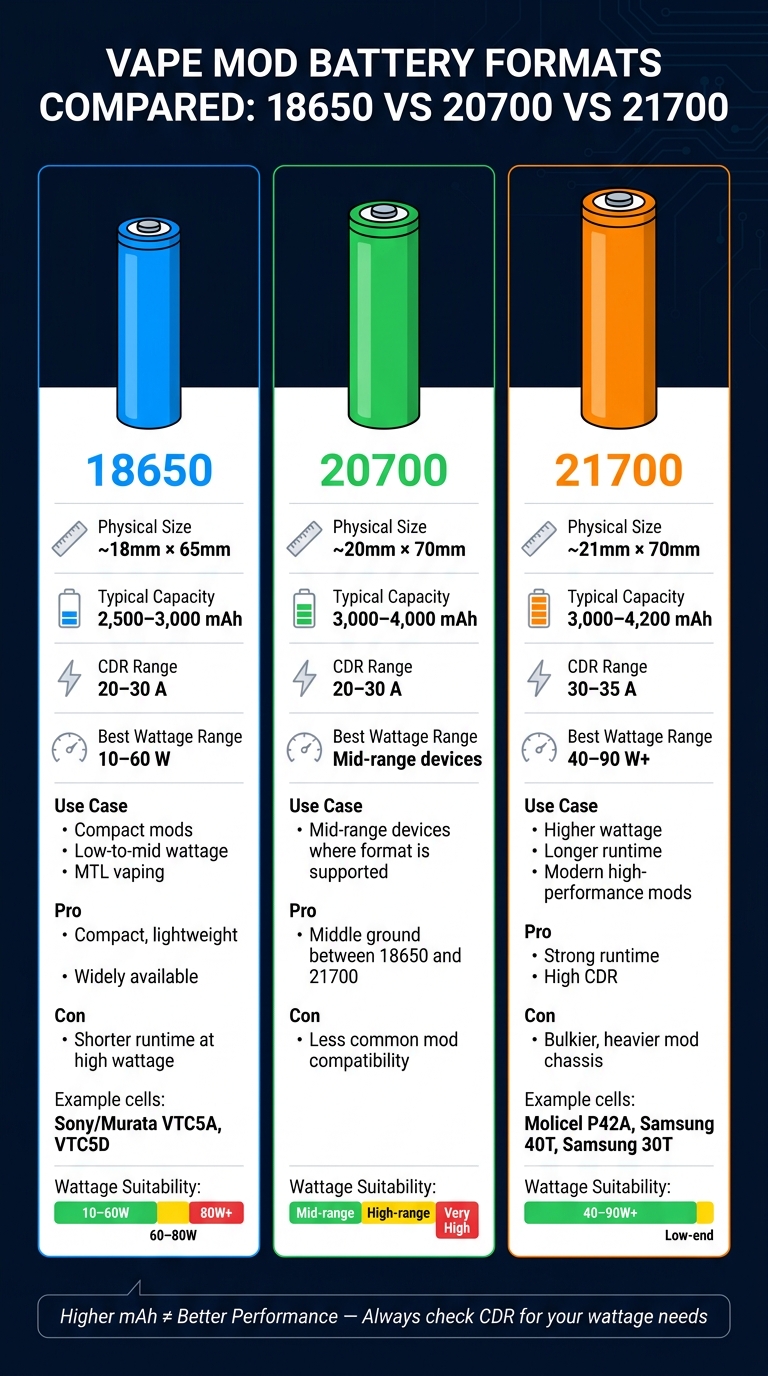
Vape Mod Battery Formats Compared: 18650 vs 20700 vs 21700
Once you know the capacity you need, the next step is picking a battery format that gives you that runtime without making your mod too big or too heavy. The format affects runtime, size, weight, and fit. In vape mods, the main removable-cell formats are 18650, 20700, and 21700. The numbers roughly match the cell size in millimetres: 18650 is about 18 mm × 65 mm, 20700 is about 20 mm × 70 mm, and 21700 is about 21 mm × 70 mm.
18650, 20700, and 21700: a direct comparison
The 18650 is the most established option. It’s compact, easy to find, and works well for low-to-mid wattage setups. Good examples include the Sony/Murata VTC5A and VTC5D.
The 21700 has become the default pick for many modern high-performance mods. Cells such as the Molicel P42A and Samsung 40T offer more capacity and strong discharge, though they also add some size and weight. The 20700 sits in the middle, but support is less common, so it’s worth checking your mod before you buy.
One detail matters more than many people think: higher mAh doesn’t always mean better performance. A battery with more capacity often comes with a lower continuous discharge rating, or CDR. For example, the Samsung 30T 21700 trades some capacity at 3,000 mAh for a 35 A CDR. That makes it a better fit for demanding wattage than a higher-mAh cell with a lower CDR.
Put simply, format is where capacity, runtime, and mod size meet.
| Format | Typical Capacity | CDR Range | Best For |
|---|---|---|---|
| 18650 | 2,500–3,000 mAh | 20–30 A | Compact mods, low-to-mid wattage |
| 20700 | 3,000–4,000 mAh | 20–30 A | Mid-range devices, where supported |
| 21700 | 3,000–4,200 mAh | 30–35 A | Higher wattage, longer runtime |
Single-battery versus dual-battery mods
A single-battery mod usually makes more sense for lower-to-mid wattage vaping and lighter daily carry. It’s smaller, simpler, and easier to pocket, even if you’ll need to recharge sooner.
A dual-battery mod shares the load across two cells, which extends runtime and reduces strain on each battery. In day-to-day use, that usually means more headroom and better endurance for heavier setups.
Where to buy the right battery format in Bahrain
For readers in Bahrain, compatibility and authenticity matter just as much as capacity. Buy cells that are genuine, fit your mod’s battery bay, and match the current draw your setup needs.
sbb-itb-837e7ad
Matching Battery Capacity to Your Wattage and Vaping Style
Pick your cell based on wattage and device setup, not mAh by itself. A battery’s job isn’t just to last longer. It also needs to supply the current your vape asks for. That’s why the main thing to look at is not just capacity, but safe current draw.
Battery choices for low, mid, and high wattage vaping
At 20–40 W, which suits MTL or light RDL, current draw is modest. A single 18650 with a 15–20 A CDR is usually enough for a full day of casual use. In this range, capacity tends to matter more than peak amp output.
In the 40–70 W range, a single 18650 can still do the job, but it should have a higher CDR of about 20–25 A. Even so, a dual-battery mod often makes more sense here. The load is shared between the cells, which cuts heat build-up. In Bahrain’s warmer conditions, that matters.
At 60–120 W and above, for direct lung vaping, a single 21700 with a 25–30 A CDR handles the current with more ease than most 18650 cells. Dual 18650s with 20–25 A CDR each are also a solid fit, since each cell stays well inside its safe operating range.
Think of the ranges below as practical buying bands:
| Wattage range | Best battery/mod choice | Why it fits |
|---|---|---|
| 20–40 W (MTL / light RDL) | Single 18650, 15–20 A CDR | Good all-day runtime; compact and widely available |
| 40–70 W (mid-power range) | Single 18650, 20–25 A CDR; or dual 18650 | Dual setup lowers per-cell stress and runs cooler |
| 60–120 W+ (high-power range) | Single 21700, 25–30 A CDR; or dual 18650/21700 | Less voltage sag; safer sustained output under load |
Why continuous discharge rating matters more than pulse ratings
Once you know your wattage, check the CDR next. CDR is the main safety figure. Pulse ratings are not. CDR tells you how much current a cell can supply on a continuous basis without overheating. And in day-to-day vaping, especially if you take frequent puffs, usage is much closer to continuous demand than to short, isolated bursts.
Pulse ratings are a different story. They’re tested over very short periods, often under ideal lab conditions, and there’s no single standard used across the board. So a battery advertised as "35 A pulse" might only be rated for 20 A continuous in actual safe use. That lower number is the one that counts.
There’s a simple way to sense-check this. Multiply the CDR by 3.2 V, which is the low-voltage point under load, and you get a rough maximum safe wattage per cell. So a 20 A CDR battery works out to about 64 W as a ceiling in a single-cell mod. It’s smart to stay well under that, especially in Bahrain’s heat, because cooler running helps the cell last longer.
Once the battery suits your wattage, the next part is charging. That’s what shapes how well the cell holds up over time.
Charging, Battery Care, and Safety for Vapers in Bahrain
Charging habits that protect battery lifespan
Once you’ve picked the right battery format and CDR, your charging routine plays a big part in how long the cell lasts.
Try to keep batteries between 20% and 80% charge. Running them flat, or leaving them sitting at 100% for long stretches, speeds up chemical wear inside the cell. Most vape batteries last about 300–500 cycles, and charging habits make a clear difference there.
For removable cells, an external charger is usually the better choice. A good charger handles each slot on its own, stops charging at 4.20 V, and helps keep heat down inside the device. USB-C charging on the mod is fine when you’re travelling or just need a quick top-up. But if you keep fast-charging high-drain cells inside the mod, that extra heat can wear them out faster than a well-ventilated external charger would.
It also helps to let batteries cool back to room temperature before charging. And don’t leave them sitting at 100% overnight. That habit can cut lifespan by about 18% over six months.
Safe handling, storage, and transport of removable cells
Charging affects lifespan. Storage and transport affect safety.
Before you insert any removable cell, check the outer wrap and top insulator ring. Even a small tear can expose bare metal and create a short-circuit risk. If you notice damage, stop using that cell until it has been professionally rewrapped, or retire it.
Loose 18650 or 21700 cells should never go into a pocket or bag with keys, coins, or other metal items. That’s asking for trouble. Always use a rigid plastic battery case. And if you use a dual-battery mod, keep both cells as a matched pair: same model, close age, and close usage history. That helps avoid imbalance between the two battery slots.
| Unsafe behaviour | Risk | Safer alternative |
|---|---|---|
| Loose cells in a pocket or bag | Short circuit from metal contact | Use a dedicated battery case |
| Charging with a damaged wrap | Electrical arcing against mod body | Replace the wrap or retire the cell |
| Leaving batteries in a parked car | Venting or fire; car interiors can reach 70 °C in under 25 minutes | Carry the device indoors |
| Charging overnight unattended | Missed overheating or fault | Unplug when full; charge during the day |
| Mismatched cells in a dual-battery mod | Uneven drain and imbalance | Use matched pairs of the same age |
In Bahrain, heat is no joke. A parked car can reach about 70 °C in under 25 minutes, which can push lithium-ion cells well past their safe range. Think of the car as a transit space, not a place to store vape gear. If a battery has been exposed to extreme heat, shows swelling, or starts heating up more than usual during normal use, replace it instead of taking chances.
Conclusion: Choosing the Right Capacity Without Overlooking Safety
mAh tells you how long the battery may run. CDR tells you how much output it can handle safely. From there, the day-to-day habits matter just as much: charge with care, store cells in proper cases, and replace any battery that’s damaged or heat-exposed.
Once that part is sorted, the next step is picking the gear itself. For batteries, chargers, and advanced mods in Bahrain, VapeShop.bh offers same-day delivery and WhatsApp ordering.
FAQs
How do I calculate safe wattage for my battery?
Match your coil’s rated wattage range and don’t go past it. If the coil says 25W–35W, vaping at 40W can wear out the wire faster and increase the risk of overheating.
Use the battery type your mod is made for, such as 18650 or 21700. And steer clear of batteries with damaged wraps or signs of excess heat.
If a hit tastes burnt or starts feeling uneven, turn the wattage down and check both the coil and the battery.
When should I choose a 21700 over an 18650?
Choose a 21700 if you want longer runtime, steadier power, and a more comfortable high-wattage vaping experience, usually around 80–100 W. It’s larger, and that extra size often means more capacity and less voltage drop when you’re pushing the device hard.
Choose an 18650 if you want a smaller, easier-to-carry device for low-to-mid wattage vaping. Just make sure your mod supports the 21700 format before you buy one.
How often should I replace my vape batteries?
External 18650 batteries usually last 300 to 500 charge cycles. For someone who vapes every day, that often works out to about 8 to 12 months.
A good rule of thumb: replace the battery when you notice about a 25% drop in capacity. If it’s not holding charge like it used to, that’s your sign.
If there’s any physical damage, replace it straight away. A tear in the wrap might look minor, but it can turn into a safety issue fast. Even a 2 mm nick can make the cell unsafe in high-performance mods.
Related Blog Posts
- Guide to 18650 Batteries for Vapes
- 18650 vs 21700 Vape Batteries: Comparison
- Vape Battery Storage Guide: Heat, Charge, Cases
- Vape Charging Safety: 8 Rules to Follow
{“@context”:”https://schema.org”,”@type”:”FAQPage”,”mainEntity”:[{“@type”:”Question”,”name”:”How do I calculate safe wattage for my battery?”,”acceptedAnswer”:{“@type”:”Answer”,”text”:”Match your coil’s rated wattage range and don’t go past it. If the coil says 25W–35W, vaping at 40W can wear out the wire faster and increase the risk of overheating. Use the battery type your mod is made for, such as 18650 or 21700. And steer clear of batteries with damaged wraps or signs of excess heat. If a hit tastes burnt or starts feeling uneven, turn the wattage down and check both the coil and the battery.”}},{“@type”:”Question”,”name”:”When should I choose a 21700 over an 18650?”,”acceptedAnswer”:{“@type”:”Answer”,”text”:”Choose a 21700 if you want longer runtime, steadier power, and a more comfortable high-wattage vaping experience, usually around 80–100 W. It’s larger, and that extra size often means more capacity and less voltage drop when you’re pushing the device hard. Choose an 18650 if you want a smaller, easier-to-carry device for low-to-mid wattage vaping. Just make sure your mod supports the 21700 format before you buy one.”}},{“@type”:”Question”,”name”:”How often should I replace my vape batteries?”,”acceptedAnswer”:{“@type”:”Answer”,”text”:”External 18650 batteries usually last 300 to 500 charge cycles. For someone who vapes every day, that often works out to about 8 to 12 months. A good rule of thumb: replace the battery when you notice about a 25% drop in capacity. If it’s not holding charge like it used to, that’s your sign. If there’s any physical damage, replace it straight away. A tear in the wrap might look minor, but it can turn into a safety issue fast. Even a 2 mm nick can make the cell unsafe in high-performance mods.”}}]}
Frequently Asked Questions
Vape battery capacity is commonly expressed in mAh, which indicates stored charge. Wattage, puff length, battery format, and CDR also affect real runtime, so mAh alone does not determine how long a mod will last between charges.
A single 18650 is commonly suited to around 20–60 W and keeps the mod smaller. A single 21700 is generally suited to around 40–90 W, offering more runtime while taking up more space.
CDR means Continuous Discharge Rating and shows how much current a battery can deliver continuously under specified conditions. It matters more for everyday vape mod use than pulse ratings, which are temporary claims and less useful for selecting a cell.
A dual 18650 setup can provide longer use time than a single-cell mod, but it also adds weight. The guide places dual 18650 setups around 50–120 W or higher, depending on the mod and how it is used.
Yes, higher wattage uses more power and normally reduces the time between charges. Longer puffs also consume more power than shorter puffs, so actual runtime depends on both wattage and vaping style.
Keep batteries away from excessive heat, damaged wraps, and loose contact with metal objects such as keys or coins. Bahrain’s heat makes battery care especially important, so avoid leaving a mod or loose cells in a parked car.
For removable cells, external charging is often the better option because it is designed specifically for batteries such as 18650 and 21700 cells. Inspect the wrap before charging and do not use a battery that is damaged or overheated.
VapeShop.bh provides this guide for comparing capacity, CDR, wattage, and battery formats before choosing a vape mod battery.