
Vape Devices vs. E-Liquids: Bahrain Customs Policies


In Bahrain, vape devices and e-liquids are classified and taxed differently under customs regulations. Devices like mods and pods are treated as electronic equipment, while e-liquids are categorized as nicotine products, similar to tobacco. This distinction affects import duties, documentation, and inspections.
Key Points:
- Vape Devices: Classified as electrical apparatus (HS Code Chapter 85). Taxed at 5% import duty + 10% VAT. Lithium battery compliance (UN38.3) is mandatory.
- E-Liquids: Classified as nicotine preparations (HS Code Chapter 24). Taxed at 5% import duty + 100% excise tax + 10% VAT. Bottles must be ≤50ml and nicotine ≤20mg/ml.
- Documents Required: Includes customs declarations, health certificates, and compliance reports.
- Packaging Rules: E-liquids need child-resistant caps, bilingual labels, and health warnings covering 50% of the packaging.
Quick Comparison:
| Factor | Vape Devices | E-Liquids |
|---|---|---|
| HS Code Category | Chapter 85 (Electrical Apparatus) | Chapter 24 (Nicotine Preparations) |
| Import Duty | 5% | 5% |
| Excise Tax | 100% (if nicotine-bearing) | 100% |
| VAT | 10% | 10% |
| Documentation Focus | Battery compliance, CE/RoHS | Nicotine levels, labelling |
| Volume/Nicotine Limits | N/A | ≤50ml, ≤20mg/ml nicotine |
For travelers, devices must be carried in hand luggage, while e-liquids can be packed in carry-on or checked bags. Locally, retailers like VapeShop.bh ensure compliance with Bahrain’s strict regulations.
Bahrain Customs: General Rules for Vaping Products
Bahrain regulates vaping products under the Technical Regulation of Electronic Nicotine Products (BH 2:2021), which became effective in May 2022. This regulation treats vaping products similarly to traditional tobacco, meaning rules on advertising, sales to minors, and public use apply equally to both. It serves as the foundation for all import-related procedures.
The Ministry of Health (MoH) and the National Health Regulatory Authority (NHRA) oversee product registration, enforce safety standards, and approve imports. Meanwhile, Bahrain Customs manages border control and tax collection.
Key Import Regulations for Vape Products
All vaping products – whether devices or e-liquids – must be declared through the Ofoq customs system and approved by the Anti-Smoking & Tobacco Group before they can be released. This declaration process is mandatory for every shipment.
Importers should be aware of the following taxes and duties applied to vaping products:
- 5% import duty on the CIF value
- 100% selective excise tax
- 10% VAT
Additionally, the legal age to purchase or receive vaping products in Bahrain is 21 years.
To ensure compliance, the following documents are required for importing vaping products:
| Mandatory Document | Purpose | Issued By |
|---|---|---|
| Ofoq System Declaration | Electronic customs clearance | Bahrain Customs |
| Tobacco Inspection Form | Required for nicotine product clearance | Anti-Smoking & Tobacco Group |
| Certificate of Conformity | Confirms compliance with BH 2:2021 | MoH / NHRA |
| MoH Fee Receipt | Proof of health inspection payment | Ministry of Health |
| Bill of Lading & Purchase Invoice | Shipment verification | Importer / Freight Agent |
Prohibited vs. Permitted Vaping Items
In addition to proper documentation and taxes, vaping products must meet strict quality and labelling standards.
Products that are unregistered, improperly labelled, or include unverified health claims are likely to be seized at the border. Labels must be bilingual (Arabic and English) and include essential details like health warnings, nicotine concentration, ingredient lists, batch numbers, and expiry dates.
Items that are prohibited include:
- Products with designs targeting youth
- Items containing banned additives (e.g., certain vitamins or stimulants)
- Products making unsupported medical claims
Commercial importers must also hold a valid trade licence specific to nicotine or tobacco-related goods.
"Misdeclared contents or missing nicotine disclosures often trigger these issues for 20k puff disposables. When selecting products, consult a guide on the best disposable vapes in Bahrain to ensure they meet local standards. Always secure written confirmations from authorities before shipping." – VapeShop.bh
sbb-itb-837e7ad
How Bahrain Customs Handles Vape Devices
Vape devices in Bahrain follow a distinct customs process, separate from the regulations for e-liquids. These devices, when free of nicotine, are classified under HS Code Chapter 85, which governs electronic and electrical equipment.
Devices and Components Allowed for Import
Bahrain permits the import of various vape hardware, including refillable pod systems, box mods, tanks, replacement coils, and devices with integrated batteries. However, pre-filled pods that contain nicotine are subject to additional taxes, making their import more tightly regulated.
Here’s a breakdown of the tax treatment for different vape items:
| Item Type | HS Classification | Tax Treatment |
|---|---|---|
| Vape Mods/Devices | Chapter 85 | 5% Duty + 10% VAT |
| Pre-filled Pods | Nicotine Preparations | 5% Duty + 100% Excise + 10% VAT |
| Spare Coils/Parts | Chapter 85 | 5% Duty + 10% VAT |
| Loose Batteries | Chapter 85 | 5% Duty + 10% VAT |
Battery compliance is a critical factor for import approval. Vape devices containing lithium-ion batteries must adhere to IATA/IMDG transportation standards and include a UN38.3 test report. Additionally, devices must meet the GSO IEC 60335-1 safety standard to ensure they comply with local safety regulations.
"If your device includes a charger or electronics, include conformity documentation (e.g., CE/RoHS test reports) and manufacturer’s specifications." – VapeShop.bh
By adhering to these guidelines, importers can help ensure a smoother customs process.
What to Expect at Customs Inspection
At customs, specialists from the Anti-Smoking Group handle inspections to ensure compliance with Law No. 8 of 2009. One common reason shipments face delays or rejection is mismatches between the model numbers on the outer carton and the commercial invoice – this is often flagged as a potential issue.
For a successful inspection:
- Ensure devices with lithium-ion batteries include the UN38.3 report and all required conformity documents.
- Follow Chapter 85 guidelines for documentation.
- For mixed shipments (hardware and e-liquids), declare each item as a separate line on the invoice to ensure proper taxation .
This process highlights the specific focus on hardware, contrasting with the stricter controls applied to e-liquids, which will be discussed in another section.
How Bahrain Customs Handles E-Liquids
When it comes to e-liquids, Bahrain Customs applies stricter scrutiny compared to vape devices. The focus is primarily on nicotine content and liquid volume, both regulated under Technical Regulation BH 2:2021, which oversees electronic nicotine products in the Kingdom.
Volume Limits and Packaging Rules
Bahrain imposes clear limits on e-liquid imports: bottles cannot exceed 50 ml, and pre-filled cartridges or pods are capped at 10 ml. Nicotine concentration is generally limited to 20 mg/mL, though some nicotine salts can reach 50 mg/mL, as permitted by the Ministry of Health guidelines.
Packaging standards are also stringent. Bottles must be child-resistant and tamper-evident. In addition to the bilingual labelling requirements mentioned earlier, e-liquids must feature health warnings that cover 50% of the packaging surface.
Before any new e-liquid product can be imported, samples must be submitted to the Ministry of Health for a process called "Package Label Matching." This review, which ensures compliance with labelling and packaging standards, typically takes 7 working days.
"Prior to importing new tobacco or electronic nicotine products into the Kingdom of Bahrain, it is mandatory to submit product samples. These samples must clearly display packaging dimensions, health warnings, and all data inscribed on the product’s informative label." – Ministry of Health
E-liquids are also subject to heavy taxation. Nicotine-containing liquids fall under the category of nicotine preparations and are charged a 5% import duty, a 100% selective excise tax, and 10% VAT on the total value. Additionally, customs inspection fees for tobacco-related shipments start at BHD 5, with extra charges based on weight.
Carry-On vs. Checked Luggage: E-Liquid Rules
Bahrain has specific rules for carrying e-liquids in luggage, aligning with international standards. Travelers are encouraged to pack e-liquids in carry-on luggage rather than checked bags. This advice stems partly from airline safety policies – since vape devices often include lithium batteries that are banned in checked luggage – and partly from the smoother customs declaration process for carry-on items.
For carry-on luggage, international liquid regulations apply: each e-liquid bottle must be 100 ml or less and stored in a single, clear resealable plastic bag. Since Bahrain limits e-liquids to 50 ml per bottle, compliant products naturally meet these airline requirements.
Regardless of whether e-liquids are packed in carry-on or checked luggage, they must remain in their original retail packaging with all labels intact. Transferring liquids into unlabelled containers or removing bottles from their boxes is a common reason for customs officers to flag or confiscate items. Additionally, quantities exceeding personal use without proper Ministry of Health documentation may be seized at the border.
Vape Devices vs. E-Liquids: Customs Policy Comparison
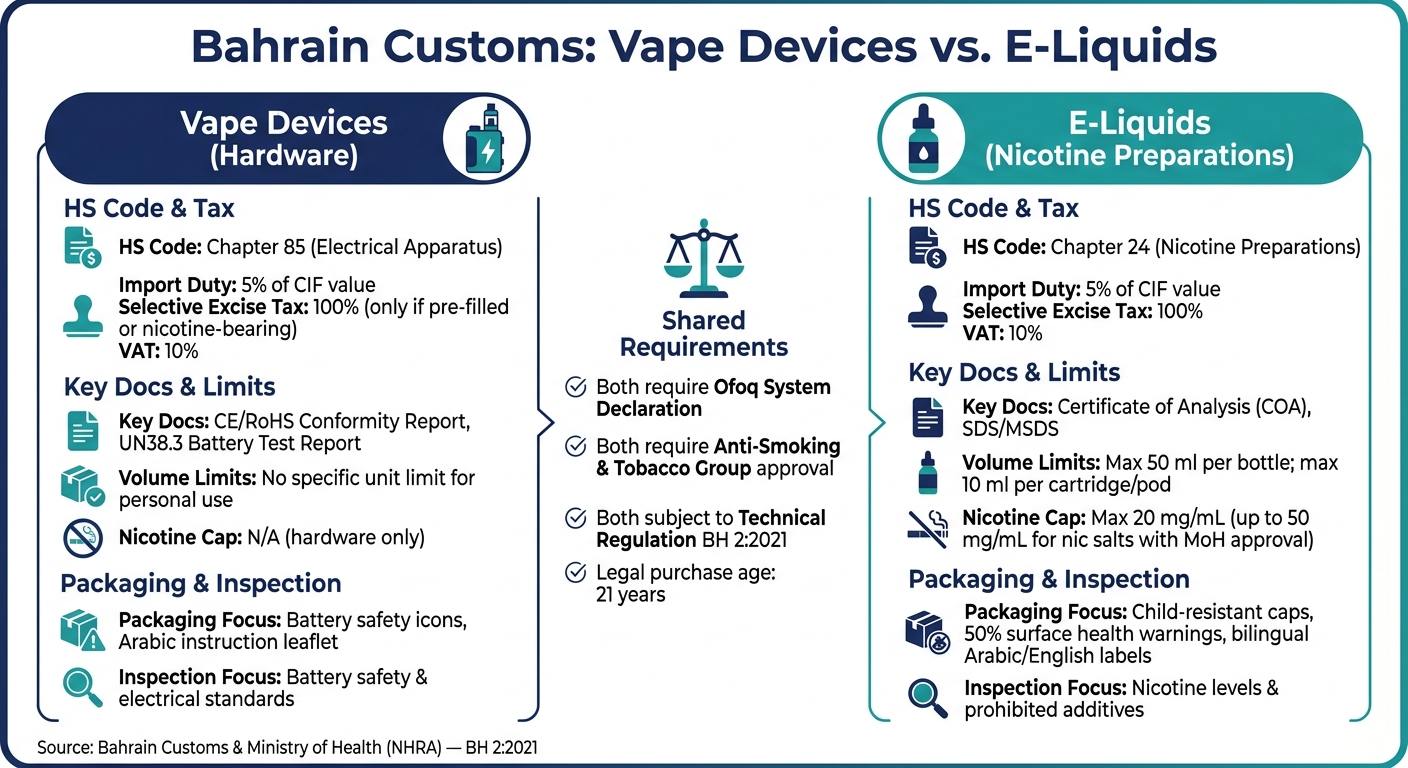
Bahrain Customs: Vape Devices vs. E-Liquids at a Glance
When it comes to customs policies, vape devices and e-liquids are treated quite differently, despite sharing the same tax rates. These differences lie in their customs classifications, required documentation, and the type of inspections they undergo.
Vape devices are classified under Chapter 85 (electrical machinery), which means customs officials focus on aspects like battery safety and compliance with electronics regulations. On the other hand, e-liquids fall under Chapter 24 (nicotine preparations), with inspections prioritizing chemical composition, nicotine concentration, and packaging standards. This distinction plays a crucial role in the import process. For instance, if a vape device shipment is delayed at customs, it’s often due to missing a UN38.3 battery certificate. Meanwhile, e-liquid shipments are more commonly held up over issues like incomplete Certificates of Analysis or improper labeling.
If you’re importing both devices and e-liquids in one shipment, it’s essential to declare them as separate line items on your invoice. Failing to do so can result in the entire shipment being subjected to the stricter inspection protocols applied to nicotine products.
Customs Comparison Table: Devices vs. E-Liquids
| Factor | Vape Devices (Hardware) | E-Liquids (Nicotine/Refills) |
|---|---|---|
| HS Code Category | Chapter 85 (Electrical Apparatus) | Chapter 24 (Nicotine Preparations) |
| Import Duty | 5% of CIF value | 5% of CIF value |
| Selective Excise Tax | 100% (if pre-filled or nicotine-bearing) | 100% |
| VAT | 10% | 10% |
| Key Documentation | CE/RoHS conformity, UN38.3 battery report | Certificate of Analysis (COA), SDS/MSDS |
| Volume/Quantity Limits | No specific unit limit for personal use | Max 50 ml bottles; max 10 ml cartridges/pods |
| Nicotine Cap | N/A (hardware only) | Max 20 mg/mL |
| Packaging Focus | Battery safety icons, Arabic instruction leaflet | Child-resistant caps, 50% surface health warnings |
| Inspection Focus | Battery safety and electrical standards | Nicotine levels and prohibited additives |
This table highlights the distinct requirements and inspection criteria for each product type, emphasizing the importance of tailored compliance approaches.
"It makes no sense to charge tax at 100pc on the retail price of vape juice, which is now classified as tobacco product." – Sayed Al Wadei, Owner, Vapeworld
Additionally, Bahrain is preparing to implement a Digital Stamps Scheme for e-cigarettes. This initiative will require importers to attach digital tax stamps to all products, including those without nicotine. This upcoming regulation will add another layer of compliance, particularly for e-liquids, making it even more important to stay on top of documentation and regulatory requirements for both categories.
Tips for Travellers and Local Buyers
How to Pack Vape Products for Travel to Bahrain
If you’re planning to bring vape products to Bahrain, proper packing is essential to avoid any issues. Vape devices and loose lithium batteries must be packed in your carry-on luggage only, as checked bags could lead to confiscation under IATA’s rules for dangerous goods.
When it comes to e-liquids, the rules are a bit more relaxed. You can pack them in either your carry-on or checked luggage. However, individual bottles must stay within the airline’s liquid limit of 100 ml per container, and the total amount of e-liquid should not exceed 1,000 ml. Exceeding this limit might result in additional customs inspections.
To make customs clearance smoother, keep your vape products in their original retail packaging. This helps customs verify nicotine levels and authenticity more quickly. Bahrain enforces a strict nicotine limit of 20 mg/ml (2%) under Technical Regulation BH 2:2021. Any product exceeding this limit will be confiscated, regardless of how it’s packed.
| Item | Packing Location | Packing Limit |
|---|---|---|
| Vape devices (with batteries) | Carry-on only | Reasonable personal use |
| Loose lithium batteries | Carry-on only | Must be individually protected |
| E-liquids | Carry-on or checked | Max 1,000 ml total; max 20 mg/ml nicotine |
For smoother customs clearance, declare vape devices and e-liquids separately on any customs forms. This small step can save you from unnecessary delays.
If you’d rather avoid the hassle of travelling with vape products, you can always buy compliant options locally in Bahrain.
Buying Vape Products Locally in Bahrain
Whether you’re a resident or just visiting, buying vape products locally can save you the trouble of dealing with customs. Licensed retailers in Bahrain follow all Ministry of Health and NHRA guidelines. This means their products meet the 20 mg/ml nicotine cap, include bilingual Arabic/English labelling, and come with child-resistant packaging.
One convenient option is VapeShop.bh, which offers same-day delivery across Bahrain, including areas like Manama, Riffa, and Muharraq. Express orders often arrive within an hour. They have a wide selection, including disposable vapes, e-liquids, salt nicotine devices, pods, coils, and advanced mods. You can even place orders via WhatsApp at +973 6632 4432. Payment is flexible, with options like Cash on Delivery, BenefitPay, and credit or debit cards available.
Conclusion: What You Need to Know About Bahrain’s Vape Customs Rules
In Bahrain, vape devices and e-liquids fall under different customs classifications. Vape devices are considered electrical machinery, while e-liquids are treated as nicotine preparations and are subject to a 100% selective excise tax.
Compliance is another critical area. E-liquids must adhere to specific limits: a maximum nicotine strength of 20 mg/ml, bottle sizes capped at 50 ml, and packaging that includes bilingual health warnings and ingredient details. Vape devices, on the other hand, must comply with GSO IEC 60335-1 standards and provide a UN38.3 certificate for integrated lithium batteries. Missing these documents is one of the most common reasons shipments are delayed or seized by customs.
"Shipments without proper permits or documents can face holds, seizures, fines, or return to sender by Bahrain Customs." – VapeShop.bh
For those looking to avoid the complexities of customs regulations, purchasing locally can be a convenient solution. Licensed retailers in Bahrain operate under Technical Regulation BH 2:2021, ensuring compliance with all local requirements. This eliminates the risk of hidden excise costs, documentation issues, or extended clearance times. Additionally, retailers like VapeShop.bh offer perks such as same-day delivery across Bahrain, with many orders arriving in under an hour. Knowing these details can make importing or purchasing vape products in Bahrain much smoother.
FAQs
How do I know if my product will be taxed as hardware or as a nicotine item?
The tax classification of your product is determined by its HS code (Harmonised System code). For instance, vape devices without liquid are often categorised under Chapter 85, which covers electrical machinery. On the other hand, e-liquids are classified based on their nicotine or chemical composition. Things get trickier with pre-filled disposable vapes, as their classification can be more complex.
To sidestep any potential problems, it’s wise to confirm the 6–10 digit HS code directly with Bahrain Customs. Alternatively, you can request a binding classification in advance to ensure everything is in order.
What extra paperwork do I need if my vape device has a lithium battery?
If your vape device uses a lithium battery, you’ll need to present UN38.3 battery test reports to ensure safe transport. These reports, along with manufacturer specifications and conformity documents like CE or RoHS certifications, must match the details on your commercial invoice and packing list to meet Bahrain Customs’ requirements.
For hassle-free options, VapeShop.bh provides a broad range of compliant vape products. They even offer same-day delivery across Bahrain and can be conveniently reached via WhatsApp for quick service.
What should I do if my e-liquid label or bottle size doesn’t meet Bahrain’s rules?
If your e-liquid label or bottle size doesn’t meet Bahrain’s regulations, it’s best to steer clear of selling or distributing it. Authorities may seize non-compliant products. The Ministry of Health (MoH) and the National Health Regulatory Authority (NHRA) enforce strict rules covering safety, ingredients, and labeling. To stay on the right side of the law, always review MoH and NHRA guidelines. Make sure your products feature traceable batch numbers, clearly stated nicotine levels, and the necessary safety warnings.
Related Blog Posts
- Top 5 Factors Driving Vape Sales in Bahrain
- Guide to Recycling Disposable Vapes in Bahrain
- Vaping Market Size in Bahrain 2026
- Ultimate Guide to Vape Delivery in Bahrain
Frequently Asked Questions
Bahrain customs classifies vape devices like mods and pod systems as electrical apparatus under HS Code Chapter 85, which are subject to 5% import duty and 10% VAT. E-liquids are treated as nicotine preparations under HS Code Chapter 24, so they face 5% import duty plus a 100% excise tax and 10% VAT, making their total tax load significantly higher than hardware.
Vape devices are treated as electrical equipment under HS Code Chapter 85 and are charged 5% import duty and 10% VAT. Importers must show compliance with lithium battery transport standards such as UN38.3 and provide technical documentation like CE or RoHS reports as part of their customs declarations.
E-liquids in Bahrain fall under HS Code Chapter 24 as nicotine preparations and are taxed at 5% import duty, 100% excise tax, and 10% VAT. Bottles must not exceed 50ml, nicotine strength must be at or below 20mg/ml, and customs typically expects health certificates and lab reports confirming nicotine levels and compliance.
Bahrain requires e-liquids to use child-resistant caps and have bilingual labelling so information is clear in both Arabic and English. Health warnings must cover 50% of the packaging, and the label should reflect the nicotine content (≤20mg/ml) and bottle size (≤50ml) to align with customs and health regulations.
Yes, vape devices with lithium batteries must comply with UN38.3, which covers transport safety testing for lithium cells and batteries. Customs can request supporting reports along with CE or RoHS documentation to verify that the device is safe to ship and use.
Typical Bahrain customs clearance for vaping products involves a customs declaration plus supporting documents like invoices and conformity reports. For devices, the focus is on battery and electrical safety documentation, while for e-liquids customs pays closer attention to health certificates, nicotine analysis, and labelling compliance.
Travellers can generally bring personal-use vape devices in their hand luggage and pack e-liquids in either carry-on or checked bags, as long as they comply with the ≤50ml bottle size and ≤20mg/ml nicotine limit. Commercial quantities are treated differently and would trigger the import duty, excise tax and VAT structure that Bahrain applies to vaping products.