

7 Vape Battery Safety Tips for Daily Use


My first rule for vape battery safety in Bahrain: never leave a device or spare cell in a parked car or direct sunlight. Before charging, I check the battery type and the maker’s instructions – not just whether the cable fits.
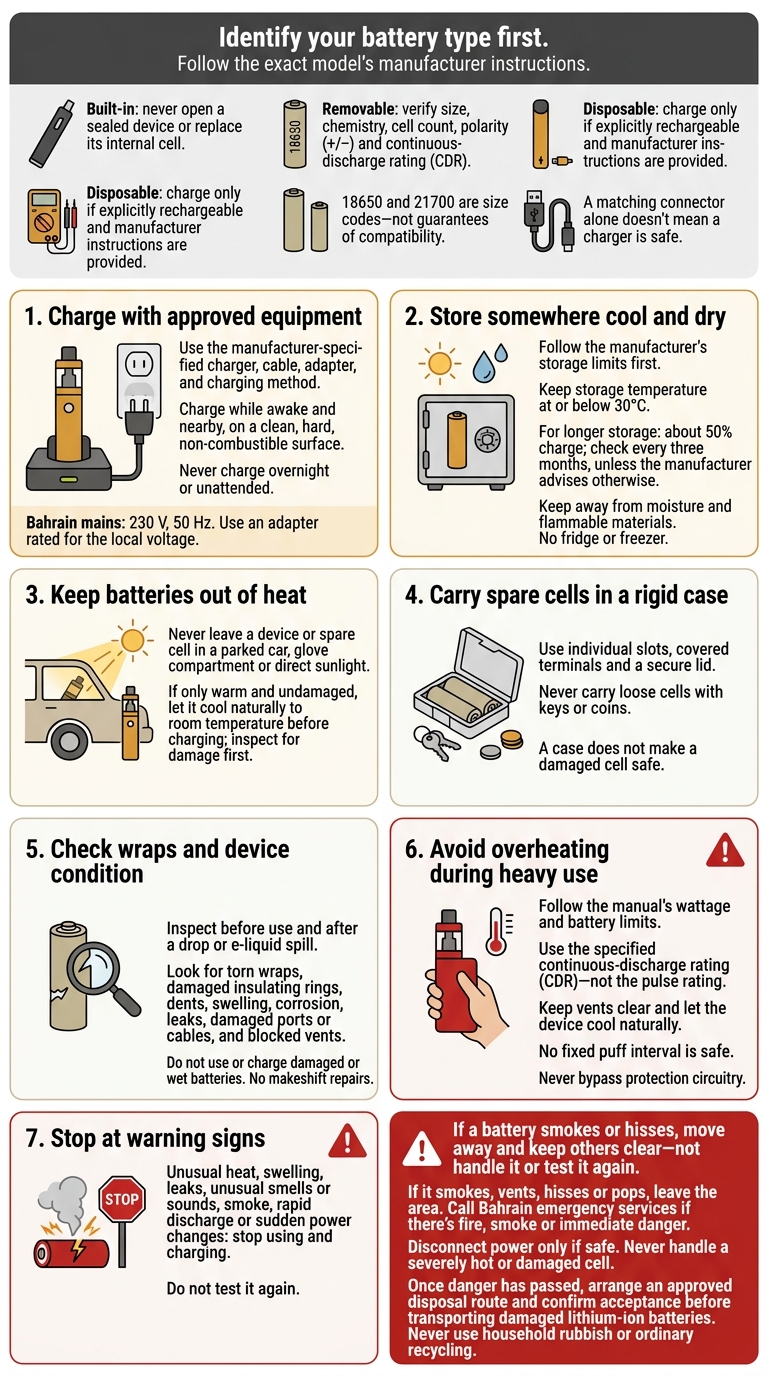
I follow these seven checks:
- Charge with approved equipment, while awake and nearby, on a non-flammable surface.
- Store batteries somewhere cool and dry, within the maker’s limits; around 50% charge may suit longer storage.
- Keep batteries away from heat and let a warm battery cool naturally before charging.
- Carry spare cells in rigid battery cases, never loose with keys or coins.
- Check wraps and device condition, including ports, contacts and signs of damage.
- Avoid overheating during heavy use by following battery and wattage limits.
- Stop at warning signs, including unusual heat, swelling, leaks, smells or sounds.
These checks work together. <u>If a battery smokes or hisses, I move away and keep others clear – not handle it or test it again.</u> Damaged batteries need an approved disposal route, not household rubbish.
7 Vape Battery Safety Tips for Daily Use
Vape Battery Safety Tips ☝ WHAT NOT TO DO with Batteries & Devices
sbb-itb-837e7ad
Check Your Battery Type First
Identify the battery type before charging or replacing anything. The charging rules depend on it. Check the packaging, manual or official website for built-in, removable or rechargeable. Don’t rely on the device’s shape or charging port alone.
Built-in batteries charge through the device’s official charging port. Never open a sealed vape or replace its internal cell. Only charge a rechargeable disposable if the manufacturer provides charging instructions. Never recharge or modify a non-rechargeable disposable.
Removable cells need different checks. These devices have a battery door, cap or tray. Check the manual and battery compartment for the required size, chemistry, cell count, polarity (+/−) and discharge rating. 18650 and 21700 are size codes – not guarantees of compatibility. The continuous-discharge rating must meet the device’s requirements. Even if a battery fits, incorrect specifications can cause overheating or battery failure.
Before charging, confirm the approved charging method, cable, input voltage and current. For removable cells, check whether the device allows in-device charging or requires an external charger. A matching connector alone doesn’t mean a charger is safe.
If labels are missing or instructions are unclear, don’t charge or use the device until you’ve verified its specifications. Confirm the exact model with the manufacturer, then save the official manual or product page for reference. Once you’ve confirmed the battery type, move on to charging gear and setup.
1. Use Manufacturer-Approved Charging Equipment
After confirming the battery type, charge it only with matching equipment.
Safe daily practice
Use only the manufacturer-specified charger, cable, adapter, and charging method. Bahrain’s mains supply is 230 V, 50 Hz, so use an adapter rated for the local voltage.
Charge while you’re awake and nearby, with the device in sight. Place it on a clean, hard, non-combustible surface, such as a ceramic or stone worktop.
Never charge overnight, leave it unattended, or charge on bedding or sofas. Don’t charge through a wet, loose, or damaged port. Replace frayed cables rather than trying to repair them.
Hazard prevented
Soft surfaces trap heat. Damaged connections can cause overheating at the connection point.
What to do
Disconnect the device when charging finishes. Unplug it sooner if it becomes unusually hot – but only if it’s safe to do so.
Stop using it if the battery swells, leaks, hisses, smokes, or smells burnt. If it overheats when it isn’t charging, follow these vape safety tips and the warning-sign checks in Tip 7.
2. Store Batteries Somewhere Cool and Dry
Safe daily practice
Keep removable batteries for top vape pens indoors in a cool, dry place, ideally an air-conditioned room. Follow the manufacturer’s storage limits first, and keep the storage temperature at or below 30°C. Avoid bathrooms and kitchens. Keep batteries away from aerosols, paper, fabrics and other flammable materials.
Hazard prevented
Heat makes batteries age faster, while moisture can corrode their contacts. Loose cells can also short-circuit if metal connects their terminals, causing fast heating or fire.
What to do
Store each removable 18650 or 21700 cell in a rigid plastic battery case that keeps the terminals separated. Replace any case that cracks or no longer closes securely.
For longer storage, keep removable cells at about 50% charge and check them every three months, unless the manufacturer advises otherwise. Don’t store batteries in a fridge or freezer: condensation can form when a cold battery returns to warmer air.
Bahrain’s outdoor heat needs a separate check, even when indoor storage is suitable.
3. Keep Batteries Out of Bahrain’s Heat
Bahrain’s heat calls for a separate battery rule: heat can damage a battery even when you store and charge it correctly.
Safe daily practice
Never leave a device or spare cell in a parked car, glove compartment or closed bag. Take it with you when you leave the car. Keep batteries off window ledges and away from stoves, radiators and other heat sources.
If a battery has been exposed to heat, wait until it reaches room temperature before charging it. Never charge it on a hot surface or inside a bag. Once it has cooled, check for damage before using or charging it again.
Hazard prevented
Heat can cause swelling, leakage or thermal runaway, which can lead to fire. Built-in protection circuits do not make heat exposure safe.
What to do
After heat exposure, check for damage before touching the battery. Look for swelling, a distorted shape or leaks, and watch for a burning smell or hissing. If it is only warm and shows no damage, place it on a shaded, ventilated, non-flammable surface. Let it cool naturally to room temperature.
Stop using or charging the battery if it stays hot after use, heats up while idle, or shows swelling, leaks, a burning smell or hissing. Keep people away. If it is damaged, ask the manufacturer, a battery-recycling service or a hazardous-waste service for guidance.
4. Carry Spare Cells in a Rigid Battery Case
Safe daily practice
Before leaving home, put every spare cell in a rigid battery case with individual slots, covered terminals and a secure lid. Keep the case away from keys, coins and other metal items. Never carry cells loose in pockets or bags – even for a short trip. A fabric pouch or loose plastic bag is not enough.
Hazard prevented
Metal can connect a cell’s terminals and cause a short circuit. This can lead to fast heating, fire or explosion. A damaged wrap can also expose the metal casing. A case does not make a damaged cell safe.
What to do
Check the wrap and insulating ring before leaving home. Do not carry cells with tears, peeling, dents or corrosion. Replace damaged cells and take them to an approved battery-recycling route for disposal.
For multi-cell devices, keep matched cells together and at the same charge level.
Check the device itself separately before use.
5. Check Battery Wraps and Device Condition
Correct charging and storage cannot make up for physical damage.
Safe daily practice
Inspect your device before use and after any drop or e-liquid spill. Check the battery, device body and charging gear for torn wraps, exposed metal, dents, swelling, discolouration, corrosion or leaks. Also check for cracked housing, damaged contacts, blocked vents, frayed cables, loose ports and bent pins.
Hazard prevented
Damaged wraps can cause short circuits, even when cells are stored or carried correctly. Damaged contacts can lead to overheating, while blocked vents can stop gas from escaping safely. A battery that still supplies power is not necessarily safe.
What to do
Stop using damaged cells and do not charge them. Replace frayed cables rather than patching them. For damaged wraps, contacts, ports or housing, use the correct replacement part or manufacturer-approved service – not makeshift repairs.
Treat e-liquid in the battery compartment or charging port as contamination, and stop using the device. Switch it off and disconnect power only if safe, then leave it unused until it has been inspected. Do not use a wet battery or clean contacts with metal tools.
If the battery smokes or hisses, move away and do not touch it.
If the battery passes inspection, the next risk is heat from heavy use.
6. Avoid Overheating During Heavy Use
Even a battery with intact wraps can overheat during heavy use.
Safe daily practice
Follow the manual’s wattage and battery limits. For removable cells, use the specified size, chemistry and continuous-discharge rating (CDR) – not the pulse rating. Never use an unsuitable cell or mix cells in a multi-battery device, and only use compatible vape accessories.
Keep airflow inlets and vents clear of fingers, cases and clothing. Let the device cool naturally between periods of heavy use, especially in Bahrain’s heat. No fixed puff interval is safe: heat depends on wattage, battery condition, temperature and how you use the device.
Hazard prevented
Repeated firing can push a battery beyond its limits and trigger thermal runaway: a self-sustaining reaction that can release hot gas or flames. Never bypass protection circuitry or modify the device to increase power.
What to do
If the device becomes unusually hot, stop using it immediately. If a charger is connected, disconnect it if safe to do so. Place the device on a clean, flat, non-flammable surface and let it cool naturally. Don’t keep firing it to test it, and don’t charge it until it has cooled.
If overheating returns or performance changes, stop using the device and seek guidance from the manufacturer. If overheating comes with swelling, an unusual smell, hissing or smoke, move to Tip 7.
7. Stop Using Batteries That Show Warning Signs
Safe daily practice
If the battery gets hot again or starts behaving differently, take it seriously. Stop using and charging it immediately if you notice unusual heat, swelling, leakage, discolouration, a strong or unusual smell, hissing, popping, crackling, smoke, rapid discharge, failure to hold a charge, or sudden power changes.
Hazard prevented
These warning signs can indicate internal failure and a risk of fire.
What to do
Disconnect the power or move the device away from bedding, curtains and paper only if it’s safe to do so. Never handle a severely hot or damaged cell, or try to open, puncture or repair it. If it smokes, vents, hisses or pops, move people away and leave the area. Call Bahrain emergency services if there’s fire, smoke or immediate danger.
Once the danger has passed, contact the manufacturer, a vape technician or an approved waste service for vape accessories. Before transporting the battery, confirm that they accept damaged lithium-ion batteries. Never put the cell, or a device containing it, in household rubbish or ordinary recycling.
Daily Battery Safety Checklist
Run through this checklist before charging, using or heading out with your vape. It brings the seven tips above into one daily check.
- [ ] Correct charging setup: Use an approved charger, cable and adapter on a clean, visible, non-flammable surface. Never leave it charging unattended.
- [ ] Cool, dry storage: Keep batteries cool, dry and away from moisture and flammable materials.
- [ ] No heat exposure: Keep batteries out of direct sunlight, parked cars and hot vehicle compartments.
- [ ] Protected spare cells: Store each spare cell in a rigid battery case, away from keys and coins.
- [ ] Intact Vaporesso Luxe Q Pod or other device: Check wraps and insulating rings for tears or peeling. Make sure the terminals, charging port, tank area and body are dry and undamaged.
- [ ] No unusual heat: Check for sudden or excessive heat during use or charging.
- [ ] No warning signs: Check for swelling, leakage, unusual odour or sounds, smoke, unexpected firing or sudden power loss.
Treat any abnormal sign as a stop signal. Stop using and charging the battery immediately. Do not test it again. Follow the manufacturer’s instructions for replacement or disposal.
FAQs
How can I tell if my vape is too hot?
Mild warmth can be normal. Warning signs include uncomfortable heat, noticeable warmth during light use or charging, heat that builds quickly or does not go away, swelling, hissing, unusual chemical smells or smoke.
If the device becomes dangerously hot, stop using it immediately. Unplug it if safe, and let it cool on a hard, non-flammable surface away from anything that could catch fire. Do not use or charge an overheating device.
Should I replace a battery after dropping it?
Yes – replace or retire the battery if you notice unusual heat, swelling, bulging, cracks, dents, leaks, or a burnt or chemical smell. Stop using it immediately, and don’t charge it if it appears damaged.
If it only feels weak or blinks, let it cool down, then check the basics, including the charging contacts. If the problem persists, stop testing it repeatedly and replace the battery.
Where can I safely dispose of vape batteries in Bahrain?
Keep vape batteries out of household rubbish and standard recycling bins. For disposal guidance, contact an authorised hazardous-waste or battery-recycling service, your municipality or the Supreme Council for Environment.
If a battery is damaged, leaking or swollen, stop using it immediately and place it in a non-flammable container, such as a glass jar. Before dropping it off, check that the facility accepts damaged lithium-ion cells. Never try to repair or open a damaged battery.
Related Blog Posts
- Vape Battery Storage Guide: Heat, Charge, Cases
- Vape Charging Safety: 8 Rules to Follow
- How to Store Vape Batteries at Home Safely
- 7 Signs Vape Battery Needs Replacement
Frequently Asked Questions
Use approved charging equipment, charge while awake and nearby, and place the device on a non-flammable surface. Keep batteries away from heat, follow the maker’s battery and wattage limits, and stop using them if you notice unusual heat, swelling, leaks, smells or sounds.
Store vape batteries in a cool, dry place and follow the maker’s storage limits. For longer storage, around 50% charge may suit the battery, while spare cells should be kept in rigid battery cases rather than loose with keys or coins.
No. A vape device or spare cell should not be left in a parked car or direct sunlight because batteries need protection from heat. Let a warm battery cool naturally before charging it.
Identify whether the battery is built-in, removable or rechargeable by checking the packaging, manual or official website before charging. Use approved equipment, charge on a non-flammable surface, and remain awake and nearby rather than leaving the battery unattended.
Carry spare cells in rigid battery cases to protect them during transport. Never place a loose battery near keys, coins or other objects that could contact it.
Check the battery wrap, device condition, ports and contacts for damage before use. Stop using the battery if it becomes unusually hot, swells, leaks, smells or makes sounds; damaged batteries require an approved disposal route, not household rubbish.
Move away and keep other people clear if a battery smokes or hisses. Do not handle it or test it again, and use an approved disposal route for the damaged battery.