
Ultimate Guide to Vape Coils and Maintenance


Most coil problems come from three things: too much power, poor priming, or letting the wick run dry. If I get those right, I usually get better flavour, fewer burnt hits, and less wasted e-liquid.
Here’s the short version:
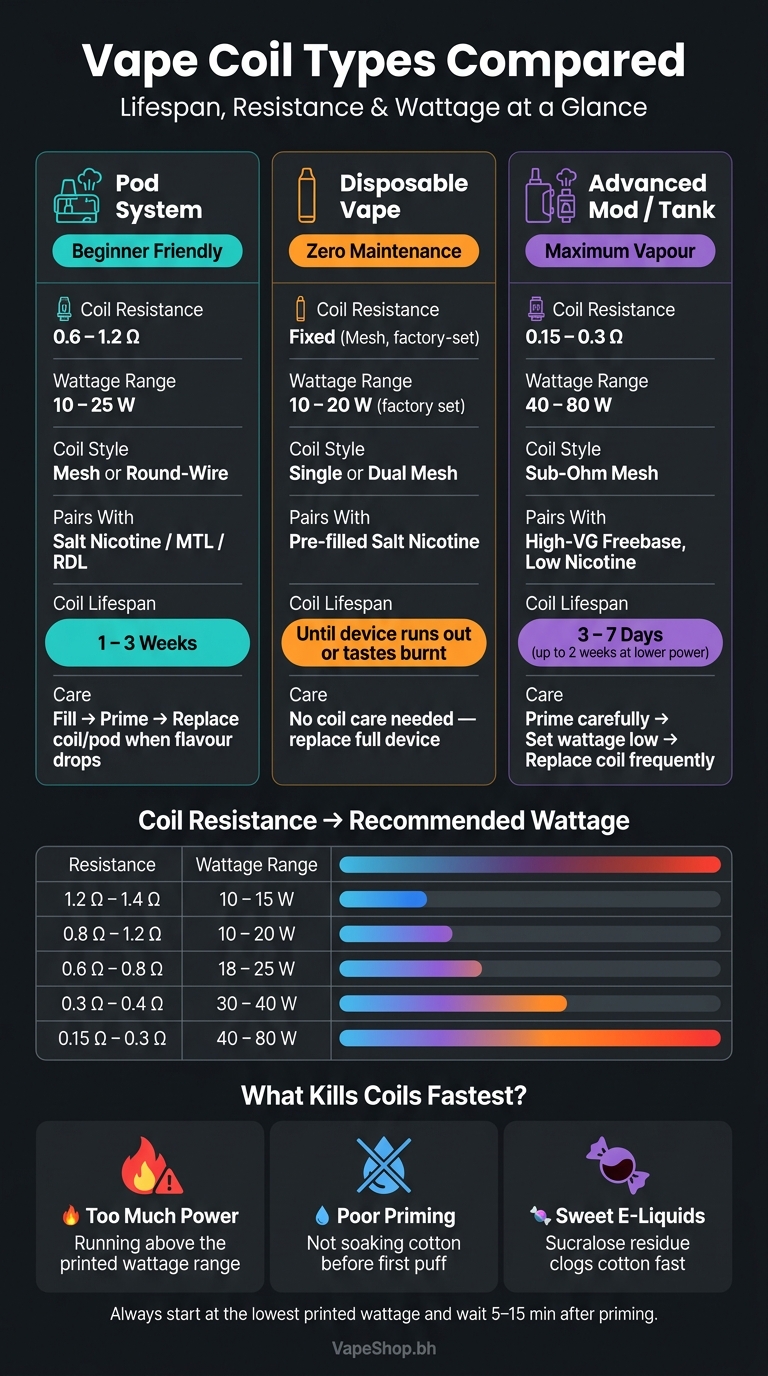
- Pods often use 0.6–1.2 Ω coils and usually last 1–3 weeks
- Disposables have sealed coils, so I use them until flavour drops, then replace the device
- Sub-ohm tank coils often sit around 0.15–0.3 Ω and may last 3–7 days, sometimes up to 2 weeks
- I start a new coil at the lowest printed wattage
- I prime a new coil, then wait 5–15 minutes before vaping , a crucial step in any beginner’s safety guide
- In Bahrain heat, especially above 40 °C, coils can wear out faster if the device sits in the sun or in a car
- Sweet e-liquids often shorten coil life because residue builds up on the cotton
Vape Coil Types Compared: Lifespan, Resistance & Wattage Guide
Coil Cleaning 3 Methods Tested and Results (How To and Save Money)
sbb-itb-837e7ad
Quick comparison
| Device | Coil setup | Usual care | Usual lifespan |
|---|---|---|---|
| Pod system | Built-in pod coil or replaceable coil | Fill, prime, clean pod/tank parts, replace coil/pod when flavour drops | 1–3 weeks |
| Disposable vape | Sealed internal coil | No coil care; replace full device when taste or vapour drops | Until device runs out or tastes burnt |
| Advanced mod/tank | Replaceable stock sub-ohm coil or rebuildable setup | Prime, set wattage with care, clean tank parts, replace coil often | 3–7 days to 2 weeks |
A coil is just metal and cotton, but it controls most of what I notice when I vape: flavour, vapour, warmth, and whether a puff tastes clean or burnt. This guide boils it down into simple steps, warning signs, and small habits that can help me spend less and waste less.
Coil Types and Resistance Across Different Devices
Coil style and resistance shape heat, flavour, and how long a coil lasts. Round-wire coils use standard wire wrapped around cotton, and they’re still common in higher-resistance MTL setups. Mesh coils use a perforated metal sheet that heats more evenly across a larger surface area. In plain terms, that usually means faster ramp-up, stronger flavour, and fewer hot spots that can scorch the cotton. Mesh is now common in pods, disposables, and advanced tanks. From there, wattage and priming play a big part in coil life.
Pod Coils: Built-In Pods, Replaceable Coils, and Mesh Options
Pod systems come in two main formats. Built-in coil pods have the coil built into the pod cartridge, so once flavour drops off, you replace the whole pod. Replaceable coil pods use a separate coil head, which means you can swap the coil without throwing away the pod body. That can cut waste and lower running costs over time.
Most pod coils sit in the 0.6–1.2 ohm range. A 1.0–1.2 ohm coil gives a tighter, cigarette-like MTL draw and works well with salt nicotine e-liquids at higher strengths. Move down to around 0.6–0.8 ohm, and the draw opens up a bit for a restricted direct-lung (RDL) inhale, with a little more warmth and vapour. Coil resistance also affects how fast the cotton wears out and when the coil needs replacing.
Disposable Vape Coils: Sealed Designs and Fixed Performance
Disposables use sealed, non-replaceable coils, so there’s nothing to change or fine-tune. Most modern disposables use single or dual mesh coils at a fixed, low wattage, usually around 10–20 W, set at the factory for steady output.
Because the coil, battery, and e-liquid capacity are matched when the device is made, performance tends to stay steady until flavour fades. Once flavour fades, the whole device is replaced. There’s no coil to service.
Advanced Device Coils: Sub-Ohm Mesh, Round-Wire, and Stock vs Rebuildable
Advanced tanks use stock coil heads. These are pre-made coil units that fit into the tank and are replaced when worn out. Most are sub-ohm mesh coils in the 0.15–0.3 ohm range, built for direct-lung inhaling at higher wattages, usually 50–80 W. They produce far more vapour than pod coils and pair best with high-VG freebase e-liquid at low nicotine strength.
Rebuildable atomisers, such as RTAs and RDAs, work differently. The user installs their own wire and cotton instead of using a pre-made coil head. That gives more control over resistance and flavour, but it also takes more skill, the right tools, and a clear grasp of safety. For anyone new to vaping, stock coil heads are the simplest place to start. Follow the resistance and wattage printed on the coil or the box. That label gives you the starting point for wattage and priming.
| Device Type | Typical Resistance | Coil Style | Pairs With |
|---|---|---|---|
| Pod systems | 0.6–1.2 Ω | Mesh or round-wire | Salt nicotine / MTL / RDL |
| Disposables | Fixed (often mesh) | Single or dual mesh | Pre-filled salt nicotine |
| Advanced tanks | 0.15–0.3 Ω | Sub-ohm mesh | High-VG freebase, low-strength nicotine |
Wattage, Priming, and Daily Habits That Protect Your Coil
Once you know your coil type, three day-to-day habits have the biggest effect on how long it lasts: using the right wattage, priming it properly, and avoiding dry hits.
How to Read Coil Labels and Stay Within the Recommended Wattage Range
Most replaceable coils show two main details: the resistance (the Ω number) and the recommended wattage range. Think of that wattage range as the coil’s working zone. If you push past it, coil life drops and the heating element can scorch. If you stay too far below it, the e-liquid may vapourise unevenly, which can lead to flooding or weak flavour.
The safest approach is simple: start at the lowest wattage printed on the coil, then move up in 1–2 W steps until the flavour and warmth feel right.
| Coil Resistance | Typical Wattage Range |
|---|---|
| 1.2 Ω – 1.4 Ω | 10–15 W |
| 0.8 Ω – 1.2 Ω | 10–20 W |
| 0.6 Ω – 0.8 Ω | 18–25 W |
| 0.3 Ω – 0.4 Ω | 30–40 W |
| 0.15 Ω – 0.3 Ω | 40–80 W |
With disposable vapes, you don’t need to adjust anything. The wattage is set at the factory.
Getting the wattage right helps the coil during use. Priming helps it survive that very first puff.
How to Prime a New Coil Before the First Puff
Skipping priming is one of the main reasons a new coil tastes burnt straight away. Once a dry coil burns, it usually doesn’t come back. A coil that’s primed the right way can last 5–14 days with moderate use, while a badly primed one might fail in a day or two.
Do this each time you fit a new coil:
- Add a few drops to the exposed cotton, install the coil, and fill the pod or tank.
- Wait 5–15 minutes. Thicker liquids and larger mesh coils usually need a bit more time.
- Take a few gentle test puffs. On button-fired devices, inhale without firing. On auto-draw pods, take very short, soft puffs. This helps pull liquid into the cotton without heat.
- Start at the lowest wattage. Begin at the bottom of the printed range, then increase bit by bit only if the vape feels too cool.
What you do after that matters just as much. Even a well-primed coil can burn out early if your daily habit is too hard on it.
Daily Habits That Reduce Burnt Hits and Wasted Coils
Most coil failures come down to the same few problems: dry cotton, too much heat, and refilling too late.
Chain vaping is a common one. If you puff again too soon, the cotton may not have enough time to soak up more liquid. That creates dry spots, and the next puff can overheat them. A good rule is to wait 10–20 seconds between puffs and keep each draw to about 2–3 seconds instead of taking long pulls.
Liquid level matters too. If the e-liquid drops below the wick openings, parts of the cotton can sit exposed to air. That can cause partial dry hits even when your wattage setting is sensible. Refill when the tank is around one-third full, or as soon as the liquid reaches the bottom of the viewing window. On the other hand, filling past the maximum line can force liquid into the airflow tube and lead to gurgling or leaks.
In Bahrain, summer temperatures often go past 40 °C, and that heat can warm your e-liquid before you even take a puff. The same wattage may feel harsher outside than it does in an air-conditioned room. Store your device upright in a cool, shaded spot. Don’t leave it in a parked car, because heat speeds up coil wear. During Bahrain’s hottest months, it’s smart to stay near the lower end of the coil’s wattage range.
Cleaning, Warning Signs, and When to Replace a Coil
Once wattage and priming are sorted, the next step is simple: work out whether the coil can still be saved. In most cases, that comes down to knowing what to clean, what to swap out, and when to stop wasting e-liquid on a worn coil.
What Can Be Cleaned and What Should Be Replaced
You can clean the tank glass, pod body, mouthpiece, and airflow ring. Rinse them under warm water, wipe the connection points with a dry cotton bud, and let everything air-dry fully before putting it back together.
A used coil is different. Don’t rinse it. It rarely brings flavour back, and it often leads to flooding. Once the cotton inside is damaged, there’s no proper fix besides replacing the coil.
The same goes for disposable vapes. Don’t wash them or try to patch them up. When performance drops, replace the device.
If you use rebuildables and know what you’re doing, you can dry-burn and rewick them. If you’re new to vaping, it’s safer and simpler to replace stock coils instead.
If you’ve cleaned the tank and the flavour or vapour still feels off, the coil is probably the issue.
Common Signs of a Failing Coil: Burnt Taste, Weak Flavour, Leaks, and Gurgling
A persistent burnt or harsh taste is the clearest sign that a coil needs replacing. Once the cotton is scorched, no amount of cleaning will fix it. Sometimes the warning shows up earlier in a quieter way: flavour starts to fade as residue builds up on the wick and dulls the taste.
| Symptom | Likely Cause | Usual Fix |
|---|---|---|
| Burnt taste | Scorched cotton, insufficient priming, or wattage above the coil’s rating | Replace coil; prime properly; lower wattage |
| Muted or weak flavour | Sweetener residue buildup or coil near end of life | Clean tank; replace coil; consider a less sweet e-liquid |
| Reduced vapour | Gunked heating element, low battery, or wattage too low | Charge device; check wattage setting; replace coil if clouds stay thin |
| Gurgling or spit-back | Flooded coil from overfilling, drawing too softly, or worn cotton | Wipe excess liquid; take slightly firmer draws; replace coil if persistent |
Gurgling and flooding are worth calling out, especially for pod users. A very light draw can cause this. A slightly firmer, steadier inhale often helps. If the sound and spit-back keep coming back after you’ve wiped away excess liquid, the cotton in the coil is likely no longer wicking evenly, and replacement is the fix.
How Long Coils Last: Pods, Disposables, and Sub-Ohm Coils
How long a coil lasts mostly depends on two things: how sweet the e-liquid is and how much power you run through the coil. Pod coils usually last 1–3 weeks. Sub-ohm coils usually last 3–7 days, or up to two weeks at lower power.
Sweet e-liquids and high wattage shorten coil life faster than anything else. Sucralose caramelises on the cotton and leaves behind dark, sticky residue that blocks wicking.
With those warning signs in mind, a simple replacement routine is usually enough to keep flavour steady and avoid extra waste.
Conclusion: A Simple Coil Care Routine for Better Flavour and Less Waste
Good coil care comes down to a few simple habits. Once you’ve got the basics in place, the rest is easy to stick with. Use the right coil, keep your device within the stated wattage range, and prime each new coil the right way. Add a few drops of e-liquid to the coil, fill the tank or pod, then wait 5–10 minutes before you vape.
After that, day-to-day use makes the biggest difference. Keep the tank, contacts, and mouthpiece clean. Don’t vape when the liquid is running low, and give the coil a short pause between puffs. Coil life changes from person to person and from one e-liquid to another, but heavy use and sweeter liquids usually wear coils out faster.
When the flavour starts to taste burnt, muted, or flat, it’s often a sign the coil is done. The same goes for weak vapour or gurgling that keeps coming back even after cleaning. If those signs don’t go away, swapping the coil is the fastest fix.
With the best disposable vapes, things are more straightforward. Use the device until the flavour drops off or it starts to taste burnt, then replace the full device.
Adult customers in Bahrain can order coils, pods, disposables, and accessories from VapeShop.bh with same-day delivery across Bahrain and WhatsApp ordering.
FAQs
Which coil is best for MTL or RDL vaping?
For MTL vaping, go with a higher-resistance coil, usually around 1.0 ohm or higher, and pair it with restricted airflow for a tighter draw that feels closer to a cigarette.
For RDL vaping, pick a lower-resistance coil and open up the airflow a bit more. That gives you a warmer, airier inhale.
Always check the resistance printed on the coil or pod, and make sure it matches both your device and the way you like to vape.
Why do sweet e-liquids burn coils faster?
Sweet e-liquids often have more sweetener in them. That extra sweetener can caramelise on the coil and leave behind a sticky residue called "gunk".
Here’s the problem: that buildup acts like a layer around the coil. It blocks heat transfer, so the device has to run hotter to make vapour. And when that happens, the coil wears out faster.
It can also change the flavour of your vape. Instead of a clean taste, you may start to notice harsh, burnt, or metallic notes as the coil gets close to the end of its life.
Can I use the same wattage indoors and in Bahrain heat?
Yes, but in Bahrain’s heat, don’t push past the coil’s rated wattage.
High temperatures can make e-liquid thinner, which may increase the chance of leaks. They can also put extra strain on coils and batteries, especially above about 45°C.
If your device has adjustable wattage, keep it within the range printed on the coil label. If the device starts feeling hotter than usual or performance drops, pause for a bit and let it cool down.
Related Blog Posts
- 5 طرق لإطالة عمر كويلات الفيب
- How to Replace Coils in Pod Systems
- What Is Coil Resistance in Vaping?
- How to Choose the Right Coil for Your Vape Mod
Frequently Asked Questions
For most pod systems, this guide explains that coils with around 0.6–1.2 Ω resistance usually last 1–3 weeks before flavour and vapour start to drop. In Bahrain’s hotter weather, especially when temperatures go above 40 °C and the device is left in a car or direct sun, coils can wear out faster, so monitoring taste and vapour is important.
The guide stresses that poor priming is one of the main causes of burnt hits, along with using too much power and letting the wick run dry. It recommends priming a new coil and then waiting 5–15 minutes before vaping, starting at the lowest wattage printed on the coil for safer, smoother performance.
According to the lifespan comparison, stock sub-ohm tank coils around 0.15–0.3 Ω typically last 3–7 days, and sometimes up to 2 weeks with good care. Pod system coils in the 0.6–1.2 Ω range generally last 1–3 weeks, especially if wattage, priming, and wick saturation are managed properly.
The guide explains that disposables use a sealed internal coil, so there is no separate coil maintenance or cleaning to perform. With disposable vapes, the whole device is used until flavour or vapour drops or tastes burnt, and then the device itself is replaced rather than the coil.
This guide includes a section on vape coil cleaning with three methods tested, focused on how-to steps and saving money by extending coil life. While exact results are not quantified, it shows that regular cleaning of pod or tank parts and proper priming can reduce common vape troubleshooting issues like muted flavour and early burnt hits.
The comparison table outlines that pod systems need filling, priming, cleaning of pod or tank parts, and coil or pod replacement when flavour drops. Disposable vapes have no coil care and are simply replaced when taste or vapour declines, while advanced mods with sub-ohm or rebuildable coils require careful priming, correct wattage setting, and frequent tank cleaning.
The guide notes that sweet e-liquids often shorten coil life because residue builds up on the cotton, leading to faster flavour decline and burnt hits. Running coils at too much power is another key cause of problems, so staying near the lowest printed wattage and keeping the wick well saturated helps improve flavour and reduce wasted e-liquid.