
Technical differences between advanced vape mods and kits explained for Bahrain buyers

Advanced Vape Mods vs. Kits in Bahrain: A Technical Buyer’s Guide for Same‑Day Shoppers
If you’re browsing from Manama, Riffa, Juffair, or Muharraq and wondering whether to buy a powerful box mod or a simpler pod kit, you’re not alone. Bahrain’s vape market offers everything from discreet commuters to cloud‑chasing rigs, often with same‑day delivery. The challenge is choosing the right architecture, understanding what the specs really mean, and knowing how the device will behave with your preferred e‑liquid. ⏱️ 8-min read
This guide breaks down the technical differences in plain English and maps them to real‑world use in Bahrain. You’ll learn how power and coil design translate into flavor, throat hit, and vapor volume; how to choose safe batteries; how salt nic and VG/PG ratios pair with each device type; and how to vet local sellers for fast, compliant delivery. By the end, you’ll be able to match your vaping style—and your day—to the right device and place your order with confidence.
Core technical differences: device architecture and intended users
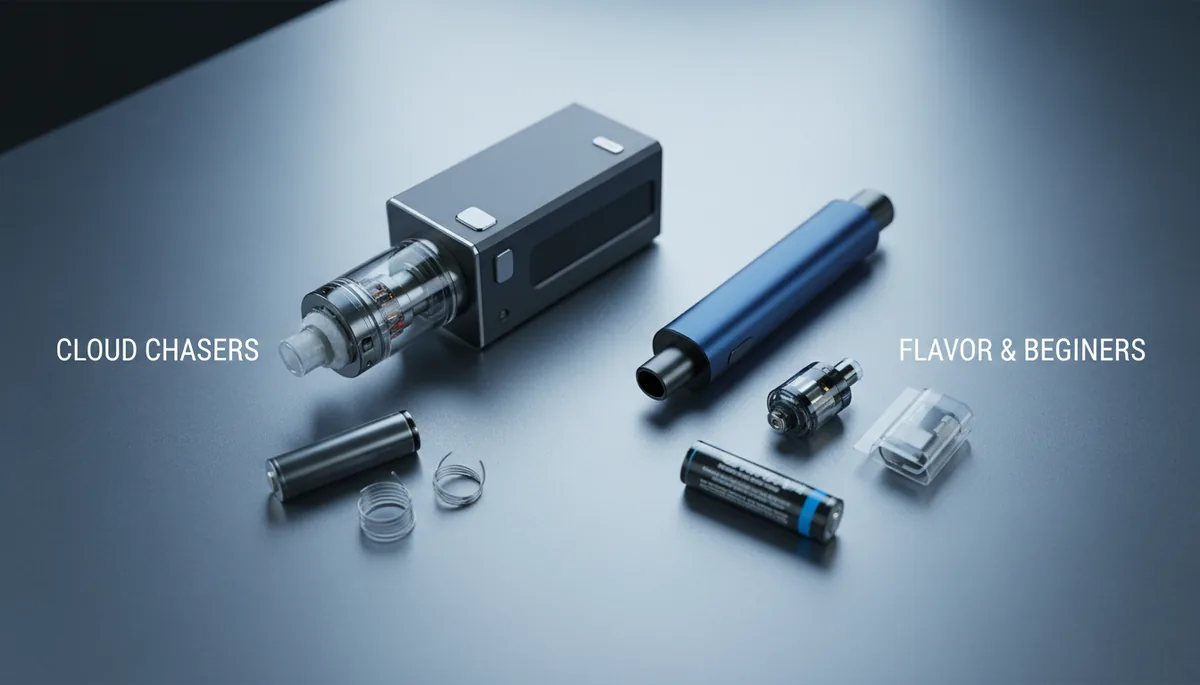
Most choices come down to architecture. Advanced box mods are separate power houses—a body that holds one or more batteries and a control chip, paired with an external tank or rebuildable atomizer. This modular approach gives you full control over power, airflow (through the tank), and in many cases advanced modes like temperature control. It also lets you swap tanks and rebuildables as your preferences evolve. The trade‑off is size, weight, and a steeper learning curve.
Kits and pod systems take the opposite approach. They’re integrated and compact, with a small battery sealed inside or a slim replaceable cell and a pod that clicks in. The pod might be disposable or refillable; either way, the coil and airflow are optimized for simplicity. You get fewer variables to tweak, faster setup, and pocket‑friendly proportions. What you sacrifice is headroom—less maximum wattage, smaller e‑liquid capacity, and fewer customization options.
Another line you’ll see in product pages is “regulated” versus “mechanical.” Regulated devices (both mods and many pods) include a chipset that stabilizes power and adds protections such as short‑circuit, overheat, and over‑discharge cutoffs. Mechanical mods—bare‑bones tubes or boxes without a chip—deliver raw battery current to the coil. They’re for experienced builders who understand Ohm’s law, battery limits, and resistance calculations in their sleep. For nearly all buyers in Bahrain comparing consumer kits and box mods, regulated devices are the safer, more practical choice.
Who benefits from each? Cloud‑chasers and tinkerers gravitate to box mods with sub‑ohm tanks or rebuildables because they can push 80–200+ watts, fine‑tune airflow, and change the coil build to alter warmth and density. Flavor chasers who like to dial in nuance often pick rebuildable tank atomizers (RTAs) on a single‑battery mod. Commuters, first‑time buyers, and anyone who values discretion and speed find pod kits ideal—especially with salt nicotine e‑liquids. Picture the morning rush through Manama’s Financial Harbour: a slim pod that slides into a front pocket and fires without fiddling makes sense. At home or on a night out in Juffair, a robust mod brings the drama.
Power and performance: wattage, voltage, and temperature control
Power settings determine how much energy hits your coil, which changes how quickly e‑liquid vaporizes, the warmth of the draw, and the volume of vapor. Think in three broad bands. At low power (5–20 W), you’ll get a tight, cigarette‑like mouth‑to‑lung (MTL) draw with modest vapor and a pronounced throat hit if you’re using higher nicotine. This is the sweet spot for most pod kits and small AIO devices. Step up to the mid‑range (20–80 W) and you’re in restricted direct‑lung (RDL) territory: more visible clouds and bolder flavor without extreme heat. At high power (80–200+ W), dual‑battery mods and sub‑ohm tanks create thick, warm vapor for full direct‑lung (DL) pulls and showy clouds—at the cost of faster e‑liquid consumption and shorter coil life.
Most regulated devices let you choose how to express that power. In voltage mode you set a fixed output (say 3.7 V), but the vape will change as coil resistance shifts during use. Wattage mode is the standard: you set the desired watts, and the device continuously adjusts the voltage to maintain it, compensating as the coil heats and cools. For daily reliability—especially with pods or sub‑ohm tanks—wattage mode is the set‑and‑forget option.
Temperature control (TC) is different. Instead of aiming at a wattage, you set a target temperature (for example, 220 °C), and the chip monitors the coil’s resistance changes to estimate its temperature and throttle power to hold that line. TC only works with metals whose resistance shifts predictably with heat—nickel (Ni200), titanium (Ti), and stainless steel (SS). Stainless steel is versatile because it also vapes well in wattage mode. If dry hits have haunted you, or you use cotton‑sensitive flavors, TC can smooth the ride and protect wicks.
What results should you expect? A 12 W pod with a 1.0–1.2 Ω coil will sip e‑liquid and deliver a crisp, cigarette‑style hit—excellent for commuting or quick breaks in Muharraq. A 40–60 W RDL tank on a single‑battery mod strikes a balance: satisfying plume without draining the tank every hour. Crank a dual‑18650 mod to 90–150 W with a 0.15–0.2 Ω mesh coil and you’ll get dense fog and a warmer mouthfeel—great for a night in Juffair’s lounges—but plan on refilling often and changing coils more frequently. Power maps directly to consumption and maintenance; choose the band that fits your routine.
Coils and atomizers: prebuilt vs rebuildable (RTA/RDA/RDTA)
Prebuilt coil heads are the simplest path: select the head designed for your tank or pod, screw or push it in, prime it, and go. Brands publish recommended wattage ranges on the coil barrel—follow them. For moderate use with balanced e‑liquid, expect 1–2 weeks from MTL heads and 3–7 days from sub‑ohm heads. Sweetened or dark juices shorten that lifespan. The upside is predictability and easy upkeep. In Bahrain, popular shops commonly stock multi‑packs for mainstream tanks, and many offer same‑day coil replacements in Manama and Riffa so you aren’t stuck with a burnt taste.
Rebuildables come in three flavors. RTAs (rebuildable tank atomizers) pair a build deck with a tank, delivering extended capacity plus the satisfaction—and responsibility—of your own coil and wick. RDAs (drippers) have no tank; you drip directly onto the deck for intense flavor and fast coil swaps, ideal for testing new e‑liquids at home. RDTAs blend both: a deck perched above a small reservoir. Each requires basic building skills: wrapping or installing coils, tightening post screws, trimming and placing cotton, and getting wicking tension just right. Do it well and you can outperform many stock coils; get it wrong and you’ll wrestle with leaks or dry hits.
Materials matter. Kanthal (FeCrAl) and Nichrome (Ni80/NiCr) are staples for wattage mode: they heat quickly, hold shape, and are beginner‑friendly for RTAs and RDAs. Stainless steel (SS316/SS304) can run in both wattage and TC modes, making it a flexible choice for flavor‑focused RTAs. Nickel (Ni200) and titanium (Ti) are TC‑only and require careful handling; they’re best left to experienced users and well‑tuned chipsets. In tanks, mesh coils—a lattice of metal rather than a single wire—offer larger surface area, speeding vaporization and improving consistency. Mesh sub‑ohm heads at 0.15–0.3 Ω dominate modern cloud tanks for that reason.
Performance is a dance between resistance, surface area, airflow, and wicking. Lower resistance (for example 0.2 Ω) means higher current and faster ramp‑up at the same wattage; larger coil surface means more contact with e‑liquid and denser vapor. Airflow must match: starve a big coil with tight airflow and it will overheat; drown a small MTL coil with a wide‑open tank and flavor thins out. Wicking tension is the last mile: too tight and cotton can’t resupply; too loose and it floods. If you’re new to building in Bahrain’s warm climate, start with an RTA that has generous wick channels and follow a reliable, coil‑specific tutorial from a trusted reviewer before ordering cotton and wire.
Batteries and charging: cell choice, ratings, and safe handling
Battery strategy is one of the biggest separators between pods and mods. Pods usually use an integrated battery rated 500–1200 mAh, charged over USB‑C. It’s worry‑free—no battery decisions to make—but once the cell degrades, the device’s life is tied to it. Advanced mods typically use removable high‑drain cells like 18650, 20700, or 21700. These cells are designed to deliver higher continuous current to power low‑resistance coils. You choose capacity (mAh) versus current capability (CDR, measured in amps) to match your power needs.
Numbers to know: modern 18650s range roughly 2000–3500 mAh with CDRs around 15–30 A, while 20700/21700s span 3000–5000 mAh with 20–35 A CDRs. Higher mAh often means a slightly lower CDR—so balance runtime and safety. On a dual‑battery mod running a 0.15 Ω mesh coil at 90 W, two quality 18650s with 20–25 A CDR each are a sensible baseline. Always check independent test data or the manufacturer spec before buying, and avoid rewrapped or unknown cells. Trusted lines from Samsung, Sony, Molicel, and LG are the standard.
Charging can happen inside the mod via USB, but an external charger
Frequently Asked Questions
Advanced vape mods offer adjustable wattage, temperature control, and customizable airflow, allowing experienced users to fine-tune power output up to 200W and use sub-ohm coils for larger clouds. Vape kits, like pod systems, are simpler with fixed or minimal settings, smaller batteries, and plug-and-play designs for easier use. Mods typically have larger tanks and replaceable external batteries, while kits prioritize portability and less maintenance.
Advanced mods require knowledge of settings like wattage and coil resistance, plus more maintenance like cleaning tanks and monitoring battery health. Beginner kits are plug-and-play with automatic or simple controls, making them lightweight and ideal for casual vapers. In Bahrain, both types follow local regulations limiting nicotine to 20mg/ml.
Advanced mods excel in vapor production thanks to higher power output, sub-ohm coils, and adjustable airflow for cloud chasing. Pod kits produce less vapor with their compact design and fixed settings suited for flavor and discretion. Mods suit heavy users wanting intense sessions, while kits fit lighter, on-the-go vaping.
Mods feature larger or replaceable external batteries for extended sessions, especially for high-wattage use. Kits have built-in smaller batteries ideal for casual daily vaping but need more frequent charging. This makes mods better for heavy vapers despite their bulkier size.
Kits offer simplicity with minimal adjustments, compact size, and low maintenance, perfect for new users transitioning from smoking. Mods demand understanding of safety like battery handling and coil types to avoid risks such as overheating. Kits minimize these complexities while still delivering satisfying flavor.
Advanced mods provide extensive customization including wattage, temperature, and coil options for personalized vaping. Some modern pod kits offer basic adjustable airflow or wattage as a middle ground, but lack the full control of mods. Choose based on whether you want interactive control or ease.
Mods are larger and heavier due to bigger batteries and tanks, less ideal for pocket carry in busy Manama areas. Kits are compact and lightweight, making them discreet for daily commutes. Both comply with Bahrain's 20mg/ml nicotine limit.