
RTA vs RDA vs RDTA: Tank Comparison


I’d choose an RTA for fewer refills, an RDA for easy coil access, or an RDTA for a deck above a tank. All 3 need careful building and wicking; none guarantees better flavour, bigger clouds or no leaks.
For adult mod users in Bahrain, I’d compare the daily upkeep first – not just the vapour output.
Quick Comparison
| Factor | RTA | RDA | RDTA |
|---|---|---|---|
| Liquid feed | Tank feeds the wick | Liquid dripped onto cotton; compatible setups can squonk | Reservoir below the deck |
| Ease of use | Less topping up once wicked correctly | Easy deck access, frequent dripping | Tank storage with more wick-tail care |
| Flavour and clouds | Depend on build, airflow and liquid supply | Depend on build, airflow and saturation | Depend on build, airflow and liquid feeding |
| Leak risk | Wick fit, seals and filling matter | Over-dripping can cause leaks | Wick fit and carrying position matter |
| Building needs | Careful cotton placement | Direct access to coils and cotton | Correct wick-tail length |
My final checks? Mod fit, stable resistance and battery limits. I’d also check liquid thickness, filling instructions and spare-part availability before buying locally. A larger tank means less dripping, not less upkeep – and <u>easy deck access does not make a build electrically safe</u>.
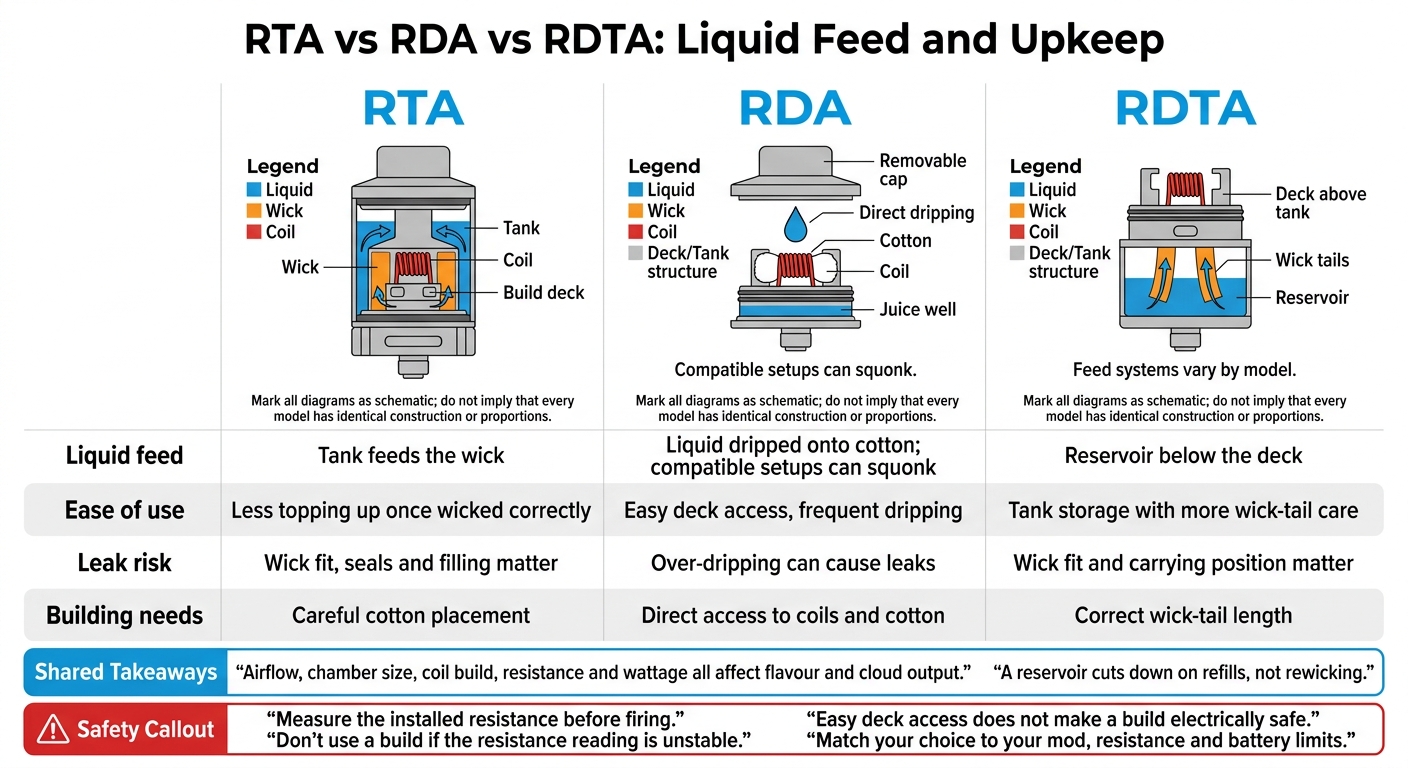
RTA vs RDA vs RDTA: Liquid Feed and Upkeep
Vaping 101: Tank, RDA, RSA, RTA and RDTA
sbb-itb-837e7ad
How Each Atomiser Works
Each format feeds liquid to the coil differently. That affects how you refill it, access the deck, and control leaks.
RTA: Tank Feeding and Wick Placement
An RTA houses the build deck inside a tank. E-liquid moves from the reservoir to the coils through the wick, so you don’t need to keep dripping.
| Criterion | Advantage | Limitation or practical check |
|---|---|---|
| Ease of use | The reservoir feeds the wick, reducing repeated dripping. | Cotton tails must reach the juice channels without being packed too tightly. |
| Flavour | A well-positioned coil and fully saturated wick can give consistent flavour. | Chamber size and airflow also affect flavour. |
| Cloud output | Suitable airflow and liquid supply can support plenty of vapour. | Restricted liquid flow can limit higher-power builds. |
| Leaking risk | Correct wicking and intact seals help keep liquid contained. | Too little cotton can cause flooding; overpacked channels can cause dry hits. |
| Coil-building needs | The deck takes user-installed coils. | Check resistance and fully saturate the cotton before use. |
RDA: Direct Dripping and Deck Access
An RDA has a build deck and a shallow juice well. You drip liquid directly onto the cotton.
| Criterion | Advantage | Limitation or practical check |
|---|---|---|
| Ease of use | A removable cap makes the deck easy to reach for rewicking and coil changes. | You’ll need to drip regularly unless a compatible bottom-feed (BF) RDA and squonk mod supply liquid through a hollow 510 pin. |
| Flavour | Direct saturation and well-positioned airflow can deliver strong flavour. | Airflow and coil placement affect the result. |
| Cloud output | Open airflow and suitable coils can produce large amounts of vapour. | Higher output uses more liquid and battery power. |
| Leaking risk | There’s no conventional tank reservoir. | Over-dripping can flood the well and let liquid escape through the airflow holes. |
| Coil-building needs | Accessible coils make alignment and cotton changes straightforward. | Keep the build within the battery’s continuous-discharge rating. Easy deck access does not make a build electrically safe. |
RDTA: Build Deck Above a Tank
An RDTA usually puts an RDA-style deck above a reservoir. Most use cotton tails to draw liquid from the tank, while some have model-specific feed systems.
| Criterion | Advantage | Limitation or practical check |
|---|---|---|
| Ease of use | An accessible deck and reservoir reduce repeated dripping. | Follow the manufacturer’s filling instructions; some models need tilting to keep liquid feeding. |
| Flavour | Direct airflow can deliver strong flavour with a well-positioned coil. | Wick tails must keep liquid flowing to the deck above the tank. |
| Cloud output | Many RDTAs pair open airflow and high-vapour builds with a reservoir. | Stay within the mod’s safe power range. |
| Leaking risk | Correctly placed wicks help control liquid flow. | Tilting, overfilling, or the wrong wick length can cause seepage. |
| Coil-building needs | Deck access can make coil installation and rewicking easier. | Follow the wick lengths specified for the model. Don’t block feed openings or leave gaps that allow uncontrolled flooding. |
RTA vs RDA vs RDTA: Side-by-Side Comparison
Easy to build doesn’t mean easy to use all day. This table compares the usual trade-offs, but deck design can change how each format performs.
| Factor | RTA | RDA | RDTA |
|---|---|---|---|
| Ease of use | Suits all-day use once wicked correctly, though the first build needs care. | An accessible deck makes building easier, but regular dripping interrupts use. | Combines an accessible deck with tank feeding. You may need to tilt it as the liquid level drops. |
| Flavour | Can match the others with the right chamber design, airflow and wicking. | Can produce immediate, intense flavour, depending on the build. | Can offer RDA-like flavour with liquid fed from a reservoir. |
| Cloud output | High potential with enough airflow and liquid supply. | High potential. | Similar potential when airflow, coils and liquid feeding support it. |
| Leaking risk | Depends on wick fit, filling technique and seal condition. | No tank seepage, but excess dripping can cause leaks through the airflow holes. | Depends on wick-tail fit and storage position. |
| Coil-building needs | Needs precise cotton placement in the juice channels. | Generally offers the easiest access for fitting coils and cotton. | Offers an easy-access deck, but wick-tail length needs more attention. |
| Refill frequency | A tank means less topping up. | Needs regular dripping. | A tank reduces dripping, though feeding varies by model. |
Judge the full setup, not just the format. Airflow, chamber size, coil build, resistance and wattage all affect flavour and cloud output.
Cotton and liquid viscosity matter too. Thick liquid feeds slowly, while thin liquid can flood a loose wick. Start with the manufacturer’s recommended liquid range, then adjust cotton density, power and airflow gradually.
Filling technique, worn seals and storage position can matter more than the format itself. Check O-rings every few refills and replace damaged seals. Top-airflow designs generally resist leaks better than bottom-airflow designs, but both need correct assembly and wicking. Match your choice to your mod, resistance and vape battery safety limits.
Choose a Setup for Your Mod and Routine
Match the Format to Your Priorities
Use the comparison above to narrow your choice based on how often you refill and rebuild. For daily use, consider leak risk and airflow too.
Before buying, check the atomiser’s diameter, capacity, fill access and liquid-feed design.
| Your priority | Starting point | What to check |
|---|---|---|
| Fewer top-ups | RTA | Tank capacity, filling access and replacement glass availability |
| Frequent coil or e-liquid changes | RDA | Deck access, juice-well depth and willingness to carry liquid for dripping |
| Deck access plus stored liquid | RDTA | Wick-feed instructions, reservoir capacity and recommended orientation |
| Carrying a filled setup | RTA or RDTA, model-dependent | Fill seals, glass protection and manufacturer transport guidance |
Tank size alone doesn’t guarantee all-day use. Choose a deck you’re comfortable rewicking: a reservoir cuts down on refills, not rewicking.
For transport, check seals, O-rings, airflow closure and the safe carry position. Prevent accidental firing, secure e-liquid containers and inspect for leaks before packing.
Check Mod Fit, Resistance and Battery Limits
Once you’ve chosen a format, check that it suits your mod’s size, resistance range and battery limits.
Match the atomiser’s diameter, height and fill clearance to the mod’s top plate and 510 connection. Use the manufacturer’s specifications to confirm connector and pin compatibility. Check the supported resistance range in Ω and power limits in W – don’t build around the mod’s maximum output.
Measure the installed resistance before firing. Check for loose leads, shorts or wire touching the chamber. Don’t use a build if the resistance reading is unstable.
Use suitable, undamaged batteries with intact wraps. Follow battery pairing and charging instructions, and carry spare cells in protective cases. A regulated mod’s protections don’t replace safe building. Mechanical mods require extra knowledge of Ohm’s Law, battery-discharge limits and fault-finding; they aren’t beginner equipment.
Find Compatible Accessories in Bahrain
After choosing your atomiser, confirm which parts you need before ordering.
VapeShop.bh offers advanced mods, coils and accessories for rebuildables. Send the atomiser and mod model names via WhatsApp to check compatibility for coils, cotton, screws, seals and replacement glass. Don’t assume pod or stock-coil heads will fit rebuildable decks.
Same-day delivery is available across Bahrain; confirm the timing before payment.
Conclusion: Choose by Refilling and Building Needs
Choose the format that suits how often you want to refill and how much deck access you need. No format is better for everyone.
Performance still depends on the build, airflow and wick quality. Once you’ve chosen a format, check that your mod and build can support it.
Before buying, check mod fit, deck compatibility and spare-part availability. Before firing, confirm that the final resistance falls within both the mod’s and the battery’s limits.
In Bahrain, VapeShop.bh offers same-day delivery and WhatsApp ordering for rebuildable coils, Cotton Bacon and accessories.
The setup should be one you can refill, build and use safely – not simply the biggest on paper.
FAQs
Which setup is best for my first rebuildable?
Start with a sub-ohm tank before trying an RDA. Its pre-made coils let you skip manual coil building and help cut down on trial-and-error mistakes while you learn.
When you’re ready for a rebuildable atomiser, the Geekvape Tengu RDA is a beginner-friendly option. Its velocity-style posts make coil installation simpler, and it comes with the tools, coils and cotton you need to get started.
How can I tell when my wick needs replacing?
Replace your wick when flavour drops noticeably or the cotton looks darkened. Most users change it after 5–7 days of regular use, though timing depends on how often you vape and the colour of your e-liquid. To restore performance, take apart your atomiser, rinse the deck and fit a new wick.
VapeShop.bh offers vaping supplies with same-day delivery across Bahrain. You can place orders via WhatsApp.
Why does my atomiser leak after refilling?
Leaks after refilling often happen when the tank loses vacuum pressure or Bahrain’s heat thins the e-liquid. Close the airflow vents before refilling and keep your device upright.
If you use a bottom-airflow atomiser, check that the O-rings and seals are intact to help prevent seepage. Consider a higher-VG blend, such as 70/30 or 80/20 VG/PG. These thicker blends resist thinning and leaking better in high temperatures.
Related Blog Posts
- Pyrex vs. Acrylic: Vape Tank Glass Comparison
- 510 vs. 810 Drip Tips
- How to Choose the Right Vape Device
- Beginner’s Checklist for Cloud Chasing
{“@context”:”https://schema.org”,”@type”:”FAQPage”,”mainEntity”:[{“@type”:”Question”,”name”:”Which setup is best for my first rebuildable?”,”acceptedAnswer”:{“@type”:”Answer”,”text”:”Start with a sub-ohm tank before trying an RDA. Its pre-made coils let you skip manual coil building and help cut down on trial-and-error mistakes while you learn. When you’re ready for a rebuildable atomiser, the Geekvape Tengu RDA is a beginner-friendly option. Its velocity-style posts make coil installation simpler, and it comes with the tools, coils and cotton you need to get started.”}},{“@type”:”Question”,”name”:”How can I tell when my wick needs replacing?”,”acceptedAnswer”:{“@type”:”Answer”,”text”:”Replace your wick when flavour drops noticeably or the cotton looks darkened. Most users change it after 5–7 days of regular use, though timing depends on how often you vape and the colour of your e-liquid. To restore performance, take apart your atomiser, rinse the deck and fit a new wick. VapeShop.bh offers vaping supplies with same-day delivery across Bahrain. You can place orders via WhatsApp.”}},{“@type”:”Question”,”name”:”Why does my atomiser leak after refilling?”,”acceptedAnswer”:{“@type”:”Answer”,”text”:”Leaks after refilling often happen when the tank loses vacuum pressure or Bahrain’s heat thins the e-liquid. Close the airflow vents before refilling and keep your device upright. If you use a bottom-airflow atomiser, check that the O-rings and seals are intact to help prevent seepage. Consider a higher-VG blend, such as 70/30 or 80/20 VG/PG. These thicker blends resist thinning and leaking better in high temperatures.”}}]}
Frequently Asked Questions
An RTA feeds liquid from a tank to the wick, while an RDA uses liquid dripped directly onto the cotton and coils. An RDTA combines a deck above a liquid reservoir, so each rebuildable atomiser has different filling and wicking needs.
An RTA usually needs less frequent topping up once it is wicked correctly because liquid is stored in its tank. An RDTA also has a reservoir, while an RDA requires regular dripping unless used with a compatible squonk setup.
An RDA provides direct access to the coils and cotton, which can make deck work more straightforward. An RTA requires careful cotton placement around the tank-fed liquid channels, so wicking technique matters more during setup.
Neither format guarantees better flavour or bigger clouds. Results depend on the build, airflow, liquid supply and how well the cotton remains saturated.
Leak prevention depends on correct wick fit, intact seals and following the filling instructions. RDTA users also need the correct wick-tail length and should consider how the atomiser is carried, while an RTA requires careful placement around its liquid-feed areas.
Check that the atomiser fits the mod, the resistance is stable and the device is used within the battery limits. Liquid thickness, filling instructions and spare-part availability are also worth checking before choosing an RTA, RDA or RDTA in Bahrain.
A larger tank means less frequent dripping, but it does not remove the need for careful building and wicking. All three formats require attention to liquid feeding, cotton placement and leak prevention.