
Disposable vs refillable vapes in Bahrain: cost comparison, convenience, and regulations

Disposable vs Refillable Vapes in Bahrain: Real Costs, Convenience, and Rules Explained
If you live in Manama, Riffa, or Muharraq and you are comparing disposable vapes to refillable systems, the decision usually comes down to three things: how much you actually spend per month, how convenient you want your day-to-day experience to be, and whether you can easily buy and restock within Bahrain’s rules. The right pick is rarely “one size fits all.” It depends on your usage, your appetite for maintenance, and how quickly you need items delivered. ⏱️ 8-min read
This guide turns the Bahrain market into practical numbers and clear choices. We break down upfront versus ongoing costs, give plug-and-play templates you can use with local prices, map out where to buy (walk-in shops, online stores, and same‑day delivery), and explain the nicotine formats, maintenance routines, and compliance steps that matter here. By the end, you’ll have a grounded picture of what really fits your budget and lifestyle in Bahrain—without guessing.
Head-to-head cost snapshot: upfront vs ongoing expenses
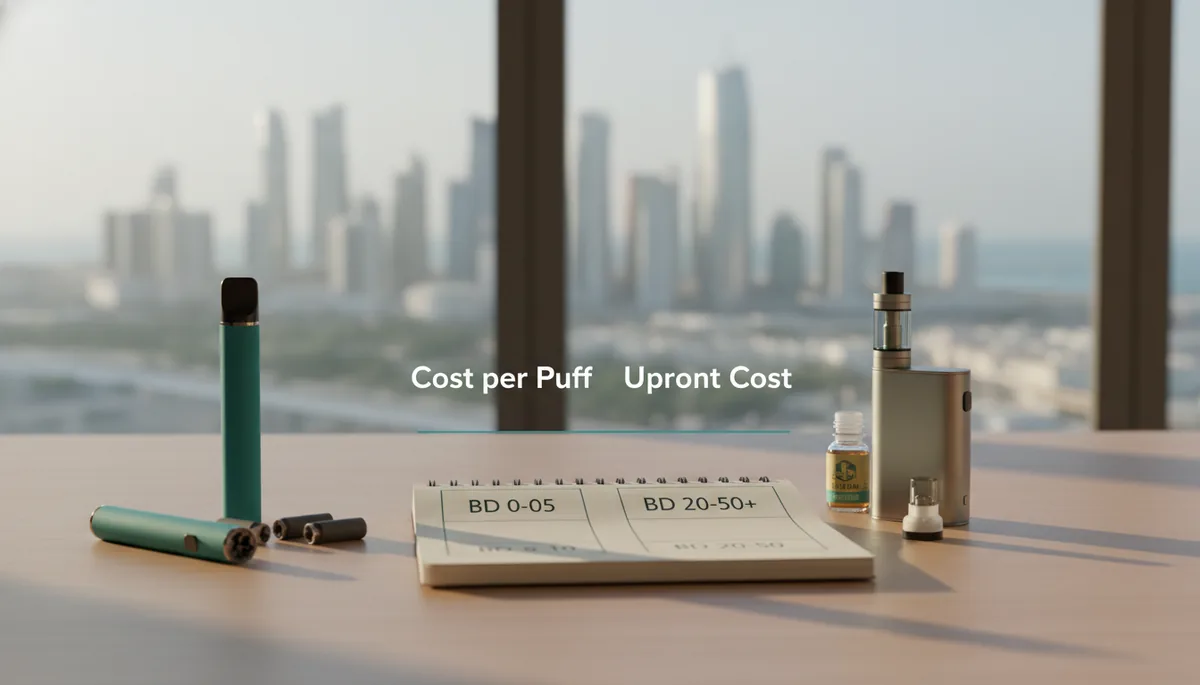
Start with the sticker price. A single disposable vape typically sells for about USD 3–12 (roughly BHD 1.2–4.6 depending on brand, puff count, and retailer). You’ll often see 600‑puff disposables in the USD 4–8 band, with larger formats priced higher according to their claimed puff counts. Refillable pod starter kits usually run USD 15–60 (about BHD 5.7–22.6), which includes the device and a pod or coil; you’ll add e‑liquid and coils or pods over time. Local sellers in Bahrain, including online retailers that advertise same‑day delivery, commonly stock both options, so you can compare on a single checkout page.
Ongoing expenses work differently for the two systems. With disposables, you buy the whole device again whenever it’s empty. For refillables, you buy e‑liquid and replace coils or pods periodically. Over time, per‑puff cost is where refillables typically win. Quick math: a BHD 3.00 disposable with 600 puffs costs about BHD 0.005 per puff (half a fils). A refillable pod with reasonably priced e‑liquid can fall closer to BHD 0.001–0.002 per puff once you amortize coils and the device, especially if you buy 30–60 ml bottles or larger.
Monthly budgets make the difference visible. Moderate users who burn through 3–4 small disposables (BHD 9–12) per month are already very close to the typical running costs of a refillable setup. Refillable users often spend BHD 10–30 per month on e‑liquid and coils after the initial starter kit. That ballpark varies by how much you vape, what e‑liquid you prefer, and coil efficiency—but the direction is consistent: refillables tend to lower the per‑puff and per‑month spend, the more you vape.
The “break‑even” point often comes quickly. If you’re buying several disposables a month, you’ll usually match or exceed the monthly cost of a basic refillable system within the first one to two months. The more you vape, the sooner you break even. That doesn’t mean disposables are poor value; they excel for convenience and low commitment. But if you are trying to control long‑term costs in Bahrain, the refillable path generally wins once your consumption rises above occasional use.
How to calculate real cost: templates and sample math
To compare options on your own, plug your local prices into these simple templates. The goal is to calculate both cost per puff and your expected monthly spend. That way, you can swap in shop prices from Manama or Riffa and see exactly where you stand.
Template A — Disposables (monthly spend): Monthly Cost = Price per Disposable × Units per Month. Cost per Puff = Price per Disposable ÷ Claimed Puffs. Example: BHD 3.00 ÷ 600 = BHD 0.005 per puff. If you use three a month, Monthly Cost = 3 × BHD 3.00 = BHD 9.00. Note: Higher puff counts usually improve the math if the unit price doesn’t rise proportionally.
Template B — Refillables (monthly spend): Monthly Cost = (mL Used per Month × Price per mL) + (Coils per Month × Coil Price) + (Starter Kit Price ÷ Lifespan in Months). Example assumptions to test: e‑liquid BHD 0.08 per mL; coils BHD 2.00 each; starter kit BHD 20 spread over 12 months (BHD 1.67/month). If you use 20 ml per month and one coil per month, the equation reads: (20 × 0.08) + (1 × 2.00) + 1.67 = BHD 1.60 + 2.00 + 1.67 = BHD 5.27/month.
Now let’s run two worked examples, including one with a large‑puff disposable. Scenario 1 (moderate user): You vape roughly 600 puffs per week (~2,400 per month). You’re considering either four 600‑puff disposables at BHD 3 each or a refillable pod. Disposable route: 4 × BHD 3 = BHD 12/month. Refillable route (20 mL/month at BHD 0.08 per mL, one coil at BHD 2, device amortized BHD 1.67): BHD 5.27/month. You save roughly BHD 6–7 per month with a refillable—and more if you buy e‑liquid in bigger bottles that drive per‑mL cost down.
Scenario 2 (20,000‑puff disposable vs pod): You spot a high‑capacity disposable rated for 20,000 puffs priced at BHD 20. On paper, that’s BHD 0.001 per puff, which competes closely with refillables. If you take 300 puffs/day (~9,000 per month), that single device could last ~2.2 months at a total cost of BHD 20, or ~BHD 9/month. Compare a pod system at 50 mL/month (BHD 0.08 per mL = BHD 4), two coils (BHD 4), and device amortization (BHD 1.67): roughly BHD 9.67/month. The refillable still edges out in flexibility and consistent cost, but the big‑puff disposable narrows the gap—until its flavor fades or it under‑delivers on puff count. This example shows why you should combine cost per puff with realistic usage and quality expectations before you buy.
If you are a light user, sensitivity to promotions matters. A BHD 2.50 disposable on offer can be cheaper month‑to‑month than a refillable if you only use one to two units each month. As your consumption rises beyond three or four units monthly—or if you value broader flavor choice—refillables reclaim the lead. The best approach is to plug in your own prices from local stores or same‑day delivery listings and run the templates for your actual usage.
Convenience and daily use: portability, maintenance, and delivery
Convenience is the main reason many Bahrain residents start with disposables. They’re pocket‑ready and require no learning curve, cables, or spare parts. Traveling from Manama to Muharraq? Slip one into a pocket and you’re set for the day. When it is empty, you replace the entire unit. The simplicity is unbeatable for first‑time buyers or anyone who wants an ultra‑low‑commitment experience.
Refillables ask for occasional attention in exchange for control and lower costs. With compact pod kits, you’ll top up e‑liquid, replace a coil or pod every one to three weeks, and charge the device regularly. Common battery capacities in popular pod systems range from roughly 400 mAh to 1,500 mAh. Under typical use, you might charge every two to four days if you’re light, daily or every other day if you’re moderate, and possibly more often if you’re heavy. The upside: you can switch flavors, pick your nicotine strength, and save money over time—especially if you buy coils and e‑liquid in sensible quantities.
Delivery and restocking habits differ by system. Disposable users tend to reorder more frequently, especially if they prefer smaller 600–1,000‑puff sticks. Many Bahrain retailers offer same‑day delivery in Manama, Riffa, and Muharraq with order cut‑offs in the late afternoon or evening; some run 24/7 rider networks with late‑night delivery windows. If you are a refillable user, your restocking pattern may be slower and more planned: you order a multipack of coils and two bottles of e‑liquid to cover a month or more, then top up as needed.
Think about your daily rhythm. If you regularly forget to charge your phone, a device that also relies on a charger may frustrate you; disposables remove that variable. If you like tailoring your nicotine strength or shifting from fruit to menthol after lunch, a refillable pod gives you that freedom with a quick swap. And if delivery speed is the deciding factor, locate a seller with same‑day coverage to your neighborhood—so a dead disposable or a burnt coil doesn’t leave you stranded.
Where to buy in Bahrain: shops, online stores, and delivery options
Bahrain’s market offers three practical paths: licensed brick‑and‑mortar shops, dedicated vape stores, and online sellers with shipping or same‑day delivery. Walk‑in shops in central Manama and Muharraq are the most straightforward if you prefer to see devices before you pay. The advantage is human: staff can talk you through the differences between disposables and refillables, help you match nicotine strengths to your goals, and point you to compatible coils or pods. You can also check the device build quality, packaging seals, and batch numbers on the spot.
Licensed tobacco retailers versus independent vape
Frequently Asked Questions
Disposable vapes feel cheaper at first because each device is only about USD 3–12 (roughly BHD 1.2–4.6), but the cost stacks up fast if you buy them regularly. Refillable pod kits usually cost around USD 15–60 (about BHD 5.7–22.6) upfront, yet your ongoing spend is mainly bottles of e‑liquid and occasional coils, which typically works out far lower over 12 months. For most daily vapers, refillables win on yearly cost once the first month is out of the way.
Disposable vapes are the most convenient for beginners because they come pre‑filled and ready to use, with no refilling, coil changes, or setup. Refillable pod kits need a bit more involvement (filling pods and replacing coils), but they give more control over flavour and nicotine strength and reduce how often you need to buy hardware. Many Bahrain vapers start on disposables then move to refillables once they are comfortable with basic maintenance.
In Bahrain, the legal maximum nicotine strength for vape products is 20mg/ml, and this cap applies to both disposable devices and refillable e‑liquids. Any products labelled above this level are for information only and should not be sold or promoted for use locally. Whether you pick disposable or refillable, always check the nicotine number on the packaging to make sure it complies with BH 2:2021.
A simple way is to total what you currently spend on disposables per week (for example, the number of devices times BHD 1.2–4.6 each) and multiply by four to get a monthly figure. Then compare that to a refillable setup: one‑time device cost in the USD 15–60 (about BHD 5.7–22.6) range, plus your expected monthly spend on e‑liquid and coils. Most regular users find that after the first month, the refillable system works out significantly cheaper each month than buying multiple disposables.
Refillable vapes do need some simple upkeep such as refilling the pod, occasionally changing coils, and keeping contacts clean, but there is no advanced technical work involved. Disposables remove all maintenance because you throw the whole device away once the battery or liquid is finished. If you are comfortable topping up a pod and following basic instructions, a refillable system is manageable for most users.
Refillable vapes generally produce much less waste because you keep the main device and only replace pods, coils, and small bottles of e‑liquid. Disposable vapes are single‑use products that combine battery and tank in one body, so every finished device adds to electronic waste. For vapers who care about reducing rubbish from batteries and plastic, refillable kits are usually the more environmentally friendly choice.
For occasional or social use, a disposable can make sense because you pay a low upfront price and do not have to worry about hardware sitting unused between sessions. If your usage is light, the long‑term savings of a refillable pod kit may be smaller, so the extra setup and maintenance might not be worth it. Regular or daily vapers in Manama usually see more benefit from investing in a refillable device.
This guide does not list specific device–liquid pairings, so always follow the manufacturer’s instructions for your particular pod or kit. In general, refillable systems are designed for use with compatible e‑liquids only, and using the wrong type can affect performance or coil life. Check your device manual or packaging for recommended e‑liquid types and vape within Bahrain’s 20mg/ml nicotine limit.