
Vape Charging Safety: 8 Rules to Follow


Wrong charging can damage a vape battery fast, and in some cases it can lead to heat, fire, or burns. In Bahrain, that risk is higher because summer temperatures often reach 40–45 °C, and a parked car can hit 72 °C in under 25 minutes.
If I had to boil the article down, I’d say this: use the right charger, charge on a hard dry surface, check the battery before plugging in, and never leave it charging overnight or in a hot place. That covers the main risk points for lithium-ion vape batteries.
Here’s the full checklist at a glance:
- Use the correct charger and cable
- Charge on a clean, dry, hard surface
- Check battery wraps, dents, swelling, and corrosion
- Do not charge overnight or leave it unattended
- Keep it away from heat and direct sun
- Store batteries in a case after charging
- Use matched batteries and proper accessories
- Follow vape safety tips and Bahrain rules
Quick Comparison
| Rule | Safe habit | Unsafe habit |
|---|---|---|
| Charger | Manufacturer-approved plug and cable | Unlabelled, damaged, or wrong-rated charger |
| Surface | Tile, stone, metal, or clean wood | Bed, sofa, carpet, pillow, or car seat |
| Battery check | Wrap intact, no swelling or dents | Torn wrap, exposed metal, bulging cell |
| Supervision | Watch it while charging; unplug when full | Overnight charging or leaving home with it plugged in |
| Heat | Cool indoor room, around 20–25 °C | Parked car, sunny window, near a cooker or kettle |
| Storage | Plastic battery case, away from metal objects | Loose in a pocket, bag, drawer, or cup holder |
| Paired cells | Same brand, model, age, and rating | Mixed cells or replacing only one of a pair |
| Instructions | Follow manual and local product rules | Guessing charger limits or using random parts |
Bottom line: if your vape gets hot, smells burnt, or the battery looks swollen, I’d stop charging it at once and disconnect it.
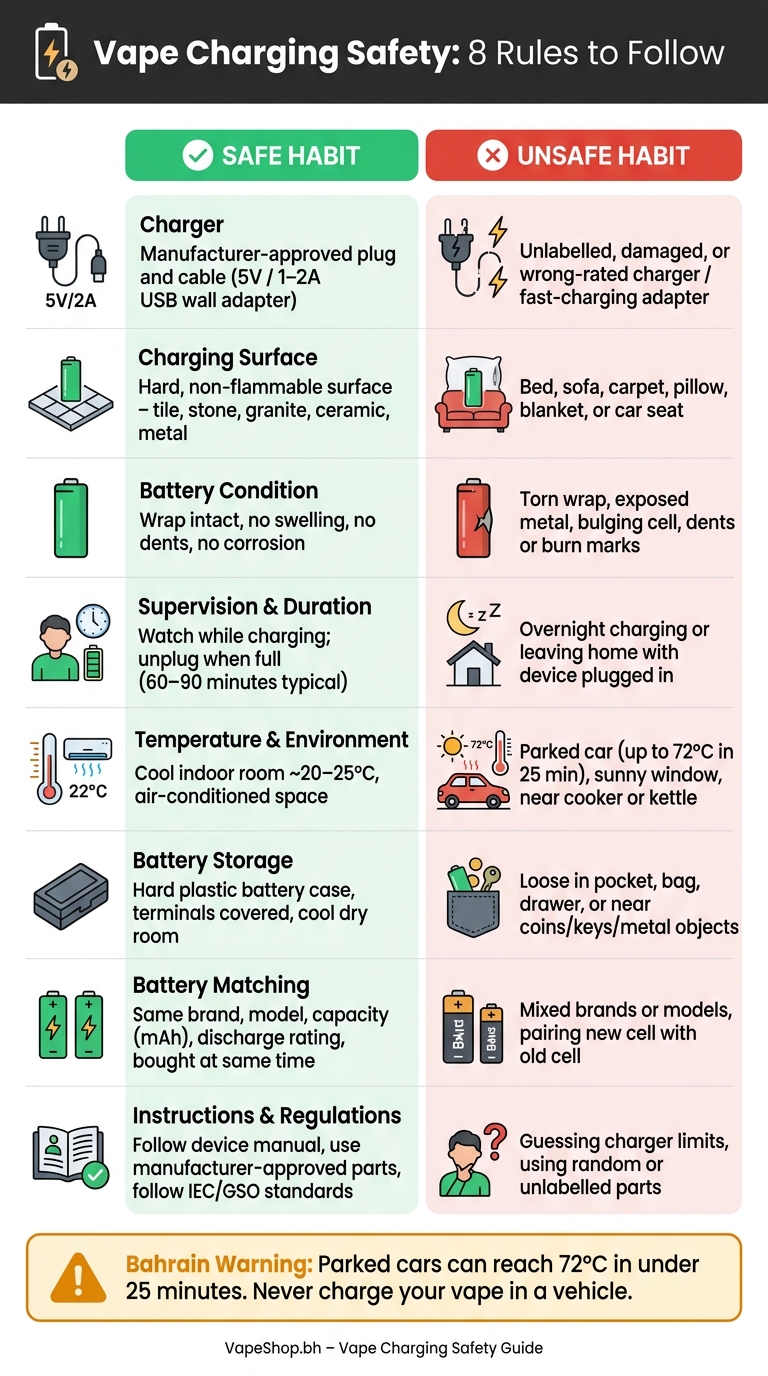
Vape Charging Safety: Safe vs Unsafe Habits at a Glance
How to Charge a Vape Pen – Everything You Need to Know about Charging 510 Thread Battery
sbb-itb-837e7ad
1. Use the Correct Charger and Plug
Stick with the charger and cable that came with your device. Manufacturers set them up to suit the battery’s voltage, current, and safety features. That becomes even more important when you swap to a third-party charger. A cable may look like it fits and still charge badly, harm the port, or make the device run hot.
For most vape pens, pods, and compact mods, a standard 5 V / 1–2 A USB wall adapter is the safer pick. It helps keep the battery cooler and puts less strain on the cells. Skip fast-charging plugs unless your manual clearly says the device supports them.
In Bahrain, wall sockets use 230 V, 50 Hz Type G. That means your wall adapter should be rated for 100–240 V, 50/60 Hz. Don’t use a 110–120 V charger in Bahrain, even if you have a plug adapter.
If a cable is damaged, replace it straight away. And when you buy a new charger, use a genuine or certified option that matches the device input.
Once the charger is sorted, the charging surface is the next thing to check.
2. Charge on Clean, Dry, Hard Surfaces
Once you’ve got the right charger, the next thing is where you charge. That part matters more than many people think. Even a proper charger can become unsafe if the device is sitting on the wrong surface.
The surface affects heat build-up and fire risk. Charge on a hard, non-flammable surface like tile, ceramic, granite, stone, or metal. Soft materials such as beds, sofas, pillows, and carpets trap heat around the battery, which can push the temperature up and increase fire risk.
Devices left on beds or near sofas can ignite soft furnishings.
In Bahrain, parked cars are a serious risk. Internal vehicle temperatures can spike to 72 °C in less than 25 minutes, which is far beyond safe charging conditions for a lithium-ion battery. Charge your device on a cool, hard surface and keep it away from direct heat.
The surface should also be clean and dry. Spills, condensation, and humid bathrooms can lead to short circuits. Dust and sand can clog USB ports and battery contacts, which may cause poor connections and overheating. Knowing how to clean vape devices before plugging in is a simple step, but it can help.
Safer surfaces include:
- Tile
- Granite
- Metal
- Wood
- Stone
Avoid charging on:
- Beds, sofas, carpets, pillows, blankets, and car seats
After the surface is safe, check the battery itself before charging.
3. Check Battery Wraps and Physical Condition Before Charging
Before you plug anything in, check the battery itself. On removable batteries like 18650, 20700, and 21700 cells, the wrap is the plastic sleeve around the outside. If that wrap is torn or peeling, metal can be exposed. And once that happens, the battery can short in the charger, in the mod, or even against another battery. Any tear in the wrap is a safety fault.
Inspect removable batteries under good light before charging. Go over the full length of the battery and look for tears, nicks, peeling edges, thin spots, or missing sections. Pay extra attention to the positive end. Even a small tear there can let metal touch where it shouldn’t and cause a short.
Also check the insulating ring at the positive end. If it’s cracked, missing, or out of place, don’t charge the battery.
Then look at the battery body itself. Check for:
- dents
- bulging or swelling
- corrosion on the terminals
- burn marks or discolouration
- exposed bare metal
Bulging can point to internal gas build-up or cell failure. Charging a swollen battery increases the risk of thermal runaway in high-power devices.
If the battery has no dents, swelling, or corrosion, you can rewrap it with a new heat-shrink sleeve and insulating ring. Use low heat to shrink the wrap. Don’t use electrical tape or duct tape. That’s a shortcut you don’t want to take with batteries.
If the battery has dents, bulging, corrosion, or any other structural damage, recycle it.
| Condition | Action |
|---|---|
| Torn or peeling wrap, no structural damage | Rewrap with a new heat-shrink sleeve and insulating ring |
| Dents, bulging, or corrosion | Recycle – do not charge |
| Missing or cracked insulating ring | Replace the ring before charging |
| Exposed bare metal | Do not charge |
If the battery passes inspection, the next rule is simple: don’t leave it charging for long periods without supervision.
4. Do Not Charge Overnight or Leave Devices Unattended
After checking the battery, the next rule is simple: don’t leave it charging unattended. Most modern vape kits reach a full charge in 60 to 90 minutes, so unplug the device after about 60 to 90 minutes, or as soon as it reaches full charge.
In Bahrain’s hot weather, charging can put extra strain on the battery. That’s why it’s smart to keep the device where you can see it while it charges. If the battery feels unusually hot or gives off a burnt smell, unplug it at once.
It also helps to avoid deep discharges and long charging sessions at 100%. Keeping charge times short is one of many tips to extend your vape device life and reduce battery strain. Unplug the device when the light turns green, the blinking stops, or the screen shows full.
Once it’s unplugged, the next step is keeping it away from heat.
5. Keep Devices Away from Heat and Direct Sunlight
Even if you use the right charger and place the device on a dry, hard surface, heat can still turn charging into a risk. Lithium-ion cells warm up while charging, and extra heat from the sun or nearby appliances can push them into an unsafe range. Try to charge at around 20–25 °C. In Bahrain, that usually means a cool indoor space with the air conditioning on.
That’s why parked cars, sunny windowsills, and spots near hot appliances are a bad idea.
Never charge or leave a vape in a parked car. The same goes for indoor areas near an active cooker, a kettle, or any place where direct sunlight hits the device. Too much heat can cause a battery to release gas, swell, or catch fire.
Use a cool, shaded, well-ventilated indoor spot instead. If the device feels hot, unplug it and let it cool to room temperature. After it cools, store the battery properly once charging is done.
6. Store Batteries Properly After Charging
Once the cells are full and have cooled down, take them out of the charger. If you leave batteries sitting in an external charger after they’re fully charged, that puts extra strain on the cells and can shorten their lifespan over time.
Put them in a hard plastic battery case with the terminals covered. If you use paired cells, keep those pairs together for every charge cycle. That simple habit helps avoid mix-ups.
Never carry or store loose batteries in pockets, bags, or next to coins, keys, or other metal items. If a metal object touches both ends of a bare cell, it can cause an instant short circuit. That can lead to fast heat build-up, venting, or even a fire.
For home storage in Bahrain, keep battery cases in a cool, dry, air-conditioned room. A bedroom drawer or a dedicated shelf is a good fit. Skip balconies, bathrooms, and kitchens, where heat or humidity can build up. Only store batteries with wraps that are still intact. If a wrap is torn or damaged, don’t use or store the battery until it has been rewrapped or replaced.
7. Match Batteries and Use the Right Accessories
If your vape uses two cells, battery matching isn’t optional. It’s part of safe charging.
Always use a matched pair. That means two batteries with the same brand, model, capacity (mAh), and discharge rating, bought at the same time. So don’t mix a Samsung 30Q with a Sony VTC6. And don’t pair a new cell with an older one that’s already gone through a lot of charge cycles.
When cells don’t match, one battery ends up doing more work than the other. That can build extra internal heat and increase the risk of venting or thermal runaway. This matters even more in dual-battery mods wired in series, where the weaker cell may drain unevenly under a heavy load.
A simple habit helps here: label each pair A1/A2 and switch their positions every time you use them. If one battery in the pair gets damaged, swells, or starts feeling much weaker, retire both cells, not just the bad one.
For charging, use a good external charger. Look for independent bay monitoring, so each slot is charged and checked on its own. The charger should stop at 4.20 V per cell and include reverse-polarity and short-circuit protection.
Use the charger to check both cells, then move to the device instructions and local rules.
8. Follow Manufacturer Instructions and Local Regulations
Even if you have the right charger and the batteries match, the manual still sets the final limit. It tells you the allowed voltage, current, cable type, and charging time. So if it says 5 V / 1 A, don’t plug it into a fast charger. Once the device is fully charged, unplug it. And yes, it’s worth reading the manual before the first charge.
In Bahrain, those limits also sit under local safety rules. Electronic nicotine products in Bahrain must meet the relevant IEC and GSO safety standards, and the Arabic-English user guide forms part of the required safety information.
When you need a replacement, stick to manufacturer-approved parts only. Any new cable or charger should match the manual before you use it. Go with clearly labelled, manufacturer-approved chargers, and stay away from unlabelled adapters. If the device gets hot, gives off a burnt smell, or starts to swell while charging, stop charging straight away and disconnect it.
Safe vs Unsafe Charging: Quick Comparison
Use this table as a last check before you plug in. It turns the eight rules into a simple checklist you can scan in seconds.
| Charging Factor | Safe Practice | Unsafe Practice |
|---|---|---|
| Adapter / Plug | Original or manufacturer-approved charger and cable | Cheap unbranded plug, fast-charging adapter, or overloaded extension |
| Cable Condition | Original USB-C or Micro-USB cable in good condition | Frayed, damaged, or uncertified cable; loose connection |
| Charging Surface | Hard, clean surface such as stone or ceramic tile | Bed, sofa, carpet, or cluttered surface |
| Temperature / Environment | Cool, shaded indoor room | Sunny window, parked car, or near a heat source |
| Charge Duration | Only as long as needed; unplug when full | Overnight or unattended charging |
| Battery Condition | Wrap intact, no dents or swelling | Torn wrap, dented cell, or exposed metal |
Unsafe charging often comes from a mix of problems, not just one. A bad charger on a soft surface, in a hot spot, with no one around to keep an eye on it? That’s when things can go wrong fast.
Conclusion
Put together, these eight rules make vape charging safer and easier. The main idea is simple: be consistent. Use the correct charger, charge on a dry, hard surface, unplug the device when it’s full, and store batteries the right way after use.
In Bahrain’s heat, those basics matter even more. Keep your device away from parked cars, sunny windows, and other heat sources. After charging, store batteries in a cool, dry place inside a battery case, away from coins, keys, and other metal objects. Follow the manufacturer’s instructions for your specific model, along with any rules that apply in Bahrain.
If you need replacement wraps, cables, or storage cases, VapeShop.bh offers same-day delivery across Bahrain.
FAQs
Can I charge my vape with a phone charger?
It’s best to skip high-wattage fast chargers, especially ones built for laptops. They can make the battery run too hot and shorten its life. If the charger isn’t compatible and pushes too much power, it may also void your warranty.
For safer charging, use a standard 5V/2A wall adapter or a computer USB port with the cable included in your kit.
What should I do if my battery wrap is torn?
If you spot any nicks or tears in your battery wrap, sort it out straight away. Even a tiny 1 mm or 2 mm tear can make the battery unsafe to use.
Replace the battery wrap, or replace the battery itself. Do not keep using a battery with a damaged wrap, as it poses a serious safety risk.
Where is the safest place to charge a vape in Bahrain?
The safest place to charge your vape in Bahrain is indoors, in a cool, shaded, dry spot. Keep it away from sunny windows, direct sun, and parked cars, where Bahrain’s heat can cause the battery to overheat, swell, or leak.
Always charge it on a dry surface, and don’t leave it unattended or charging overnight.
Related Blog Posts
- Guide to 18650 Batteries for Vapes
- How Fast-Charging Works in Vape Devices
- How to Maintain Vape Mods for Peak Performance
- Vape Battery Storage Guide: Heat, Charge, Cases
Frequently Asked Questions
For safe vape battery charging in hot Bahrain weather, always use the manufacturer-approved charger and cable on a clean, dry, hard surface like tile, stone, metal, or wood. Avoid charging on beds, sofas, carpets, pillows, or car seats, and keep the device away from parked cars, sunny windows, and other hot spots where temperatures can reach 40–45 °C or more.
Incorrect charging can quickly damage a lithium-ion vape battery and in serious cases lead to heat, fire, or burns. Using unlabelled, damaged, or wrong-rated chargers, charging on soft surfaces, or leaving the device plugged in unattended or overnight are key risk factors highlighted in the safety checklist.
Before charging, inspect the battery wrap to make sure it is intact, with no torn plastic, exposed metal, dents, swelling, or corrosion. A wrap in good condition and a cell that is not bulging or damaged are essential for safe charging, and any battery showing these issues should not be used until properly repaired or replaced.
The guide clearly advises not to charge a vape overnight or leave it plugged in while unattended, because continuous charging increases the risk of overheating and battery failure. The safer habit is to watch the device while it charges and unplug it once it is full.
Place the vape on a clean, dry, hard surface such as tile, stone, metal, or flat wood when charging, which allows heat to dissipate properly. Soft surfaces like beds, sofas, pillows, carpets, or car seats trap heat and are listed as unsafe habits in the comparison table.
After charging, store loose batteries in a dedicated plastic battery case, away from keys, coins, and other metal objects that could cause a short circuit. Keeping batteries loose in a pocket, bag, drawer, or cup holder is marked as an unsafe habit and increases the chance of accidental damage.
The guide focuses on using the correct charger and cable, charging on hard dry surfaces, checking battery wraps and damage, avoiding overnight or unattended charging, and keeping devices away from heat and direct sun. It also highlights storing batteries in cases, using matched batteries with proper accessories, and following local vape safety rules to reduce risks in a hot climate like Bahrain.