

Guide to Lithium Vape Battery Recycling


Do not put vape batteries in household rubbish or mixed recycling. In Bahrain, used vape batteries are treated as hazardous e-waste, and a crushed lithium battery can start a fire in a bin lorry or waste site. With summer heat in Bahrain often going above 45°C, the risk gets worse if a battery is left in a car or outdoor bin.
Here’s the short version I’d follow:
- Removable battery? Take it out, tape both ends, and drop it at a battery collection point.
- Sealed vape or disposable? Keep the device whole and take it to an e-waste drop-off point.
- Damaged, swollen, leaking, hot, or smoking battery? Keep it separate in a non-metal container and contact the SCE or an approved recycler before moving it.
- Never crush, burn, puncture, or pry open a vape to get to the battery.
- Never carry loose batteries with coins, keys, or tools.
One stat stands out: the US EPA recorded more than 240 fires at 64 facilities between 2013 and 2020 linked to battery waste. That’s why safe handling matters from the moment you stop using the device to the moment you drop it off.
If I wanted the simplest rule, it would be this: match the item to the right route – battery bin for loose intact cells, e-waste for sealed devices, and special handling for damaged batteries.
| Item | What I’d do |
|---|---|
| 18650 / 21700 removable cell | Tape terminals and use a battery drop-off point |
| Rechargeable pod kit with built-in battery | Take the whole device to e-waste |
| Disposable vape | Take the whole device to e-waste |
| Swollen or leaking battery | Isolate it and ask SCE or an approved recycler first |
Below, I’ll keep it simple and show the safest way to sort, store, move, and recycle vape batteries in Bahrain.
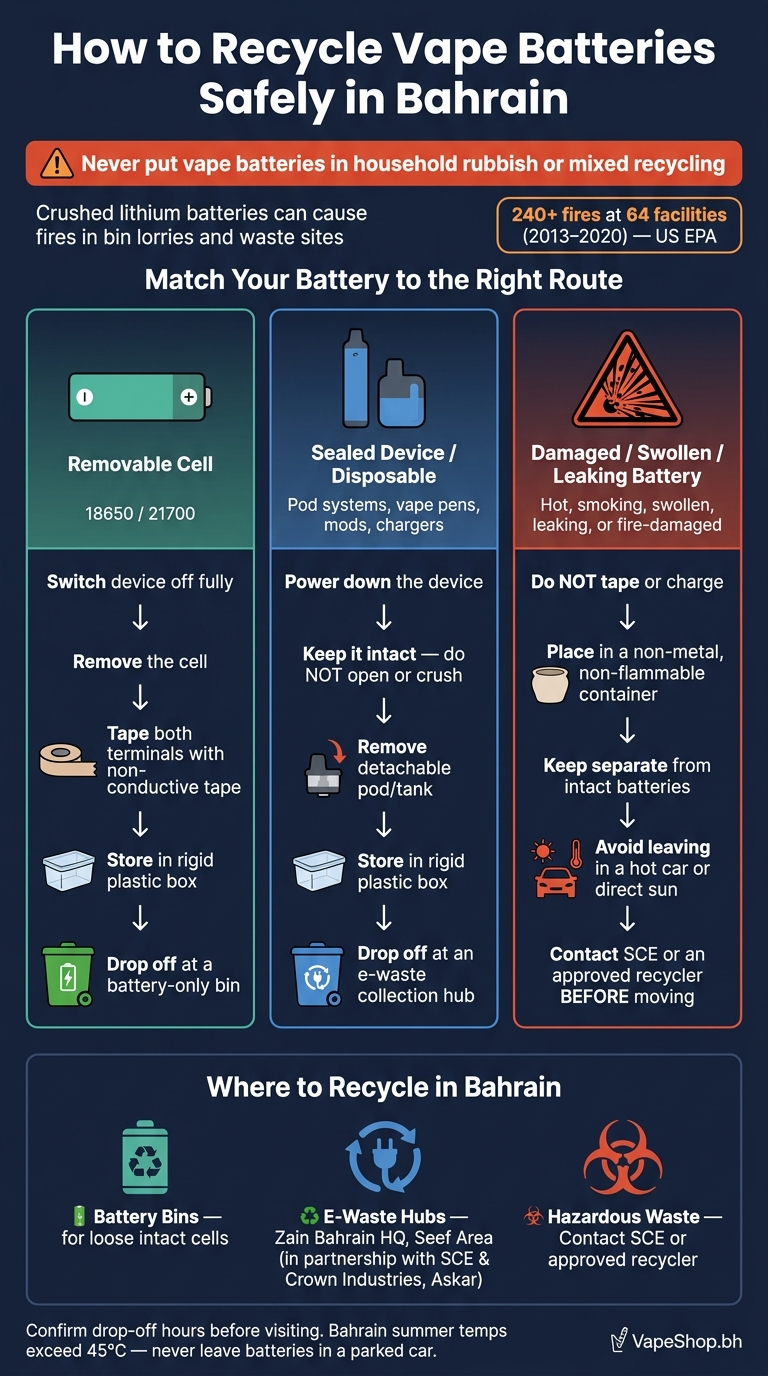
How to Recycle Vape Batteries Safely in Bahrain
How a young engineer is recycling old vape batteries to power e-bikes
sbb-itb-837e7ad
Never put lithium vape batteries in household rubbish or standard recycling
Once you know the battery type, the next step is simple: keep it out of the waste stream. If a vape battery ends up in rubbish or mixed recycling, it can be crushed during collection or compaction and start a fire.
This is not a small issue. Lithium-battery fires are a documented problem in the waste sector. The US EPA recorded more than 240 fires at 64 facilities from 2013 to 2020. Hydraulic compactors can crush a battery casing, short the cell, and ignite the electrolyte. SCE warns that crushed batteries can short-circuit and ignite, creating fires that are difficult to extinguish.
No vape device or lithium battery belongs in a household rubbish bag, an office bin, a street litter bin, or a mixed recycling bin. That includes a fully depleted disposable and a used removable cell.
Common disposal mistakes that raise fire risk
Most fire risks come from everyday habits, not freak incidents.
One of the most common is storing loose batteries near metal objects, a common vape safety mistake. A spare 18650 cell rolling around in a car console, desk drawer, or pocket with keys or coins can short-circuit the second metal touches both terminals.
Another high-risk habit is trying to dismantle or flatten a device before disposal. Bending, crushing, or prising open a sealed disposable to get at the battery can damage the cell casing straight away. And burning a vape or battery is extremely dangerous. Lithium fires burn at very high temperatures and release toxic gases that are harmful to inhale.
| Mistake | Why it is dangerous |
|---|---|
| Throwing vapes into household rubbish or mixed recycling | Battery can be crushed in a compactor, causing a short-circuit and fire |
| Storing loose batteries with keys, coins, or tools | Metal can bridge the terminals and trigger rapid discharge and heat |
| Leaving batteries in a hot car or sun-exposed bin | High temperatures can add stress and make batteries more unstable |
| Crushing, bending, or puncturing a sealed device | Can breach the cell casing, risking ignition or toxic fume release |
| Attempting to burn a vape or battery | Lithium fires are intense, difficult to control, and produce toxic smoke |
If you have a removable battery, cover the terminals with non-conductive tape and store each cell on its own in a non-conductive container.
How to prepare vape batteries for recycling
Good prep takes only a few minutes, but it matters a lot for your safety and for the people handling batteries at collection points.
Preparing intact removable and built-in batteries
If you’re dealing with removable cells such as 18650 or 21700 batteries, switch the device off fully before taking the cell out. Then cover both the positive and negative terminals with non-conductive electrical tape. Store each cell on its own in a rigid plastic box. After that, keep it packed and ready for direct drop-off.
For sealed disposables and devices with built-in batteries, leave the unit intact. Don’t try to pry it open, crush it, or puncture the casing to get to the internal cell. Take the whole device to an e-waste drop-off point as-is.
Remove any detachable pod or tank before drop-off.
What to do with damaged, leaking, hot, or swollen batteries
Damaged cells need isolation, not normal packing.
If a battery is leaking, swollen, unusually hot, or giving off an odour, treat it as a high-priority hazard. Do not tape the terminals. Instead, place it in a non-metal, non-flammable container and keep it away from intact cells. If it is hot, smoking, hissing, or swelling, contact the SCE or a professional disposal service for handling instructions instead of moving it yourself.
| Battery Condition | Recommended Container | Key Preparation Step |
|---|---|---|
| Intact / Removable | Rigid plastic box | Tape both terminals with electrical tape |
| Sealed / Disposable | Rigid plastic box | Keep whole; do not puncture, pry open, or disassemble |
| Damaged / Swollen | Non-metal, non-flammable container | Do not tape; do not charge; store separately |
Safe storage and transport before drop-off
Bahrain’s summer temperatures regularly exceed 45°C, and parked cars heat up fast. So don’t leave batteries sitting in your vehicle while you run other errands. Put them in the car only when you’re going straight to a drop-off point.
Use a rigid non-metal container, keep it out of direct sunlight, and drive directly to the drop-off point.
Where to recycle lithium vape batteries in Bahrain
After you’ve packed the battery safely, the next step is picking the right disposal route. There are four main routes to use, and the right one depends on the battery’s condition: battery bins, e-waste collection, retailer take-back, or hazardous-waste handling.
Battery drop-off, e-waste collection, and hazardous-waste routes
Battery-only bins are meant for loose, intact lithium-ion cells like 18650 or 21700 batteries. E-waste collection is the better fit for sealed disposables, pod systems, vape pens, mods, and chargers with built-in batteries.
In Bahrain, Zain Bahrain‘s headquarters in the Seef area runs a public e-waste drop-off point in partnership with the SCE and Crown Industries, an approved recycler based in Askar that accepts lithium-ion batteries.
If a battery is damaged, swollen, leaking, hot, or fire-damaged, do not put it in a battery bin or a general e-waste box. Place it in a non-conductive container, keep it separate from other items, and contact the SCE or an approved recycler for instructions before you travel.
Match the item to the route below.
| Route | Accepted Items | When to Use | Basic Preparation |
|---|---|---|---|
| Battery-only bins | Loose, intact lithium-ion cells such as 18650 or 21700 batteries | For removable batteries in good condition | Tape both terminals; store in a rigid, non-metallic container |
| E-waste collection hubs | Sealed disposables, pod systems, vape pens, mods, chargers | For whole devices with built-in batteries | Power down; keep the device intact, cool, and dry |
| Hazardous-waste channel | Damaged, swollen, leaking, hot, or fire-damaged batteries | For any battery showing physical damage or heat | Place in a non-conductive container; contact the SCE or an approved recycler |
| Retailer take-back | Used devices or batteries, where offered | Useful when you’re unsure what can be removed safely | Confirm acceptance and follow the retailer’s guidance |
Drop-off points, accepted items, and opening hours can change, so it’s smart to confirm before heading out. Check the latest guidance from the site or the SCE, and call during local business hours.
How retailer guidance can help
If you’re not sure whether the battery can be removed, send VapeShop.bh a photo on WhatsApp and ask them to identify it before drop-off.
Use the checklist below before you leave for drop-off.
Conclusion and vape battery recycling checklist
Before you head out, do one last check.
Recycle lithium vape batteries through Bahrain’s approved battery, e-waste, or hazardous-waste routes. Do not put them in household rubbish or standard recycling.
If a cell is swollen, leaking, or hot, keep it away from other batteries. Also, don’t leave it in a parked car or in direct sun.
Quick checklist before you leave for drop-off
- Confirm battery type: Is it a removable cell, like an 18650 or 21700, or a built-in battery inside sealed disposable vapes?
- Tape exposed terminals on intact removable batteries with non-conductive tape. Cover both the positive and negative ends.
- Store each battery separately in a rigid, non-metal container.
- Keep damaged cells apart from intact ones. Don’t place them in the same container. Keep all batteries dry and away from heat before and during transport.
- Use the right route: battery bin for loose intact cells, e-waste for sealed devices, and hazardous waste for damaged batteries.
FAQs
How do I know if my vape battery is removable or sealed?
Check how your device is built. Rechargeable pod systems and advanced mods often come with a battery compartment that lets you take out the cell, such as an 18650 or 21700. Disposable vapes are sealed, with the battery kept inside the plastic shell.
Do not pry open or take apart a disposable vape. Doing that can puncture the lithium-ion cell and start a fire. If you’re not sure whether the battery can be removed, check the user manual for your model.
What should I do if I cannot get to a drop-off point straight away?
If you can’t get to an authorised e-waste drop-off point right away, keep your used vape or battery in a dry, non-flammable container like a glass jar. Store it in a cool spot, away from direct sunlight.
Cover both terminals with non-conductive electrical tape to help stop short circuits. Never place these items in household rubbish or recycling bins. During Bahrain’s hot summer months, store them in a dry, temperature-controlled place.
Can I recycle a disposable vape if it is dead?
Yes. A dead disposable vape can still be recycled, but it should be treated as electronic waste.
Don’t put it in household rubbish. The internal lithium-ion battery can catch fire if it’s crushed.
Instead, keep it in a cool, dry place until you can take it to an authorised e-waste collection point or an e-waste bin in a major shopping centre.
Related Blog Posts
- دليل شامل للفيب الديسبوزبل في البحرين
- Guide to Recycling Disposable Vapes in Bahrain
- Guide to 18650 Batteries for Vapes
- Reusable Pods vs. Disposable Vapes: Which Is Greener?
Frequently Asked Questions
Used vape batteries should never go in household rubbish or mixed recycling because they are treated as hazardous e-waste and can cause fires in waste trucks or sites. The guide explains that removable batteries should be taken out, both ends taped, and dropped at a battery collection point, while sealed vapes or disposables should be kept whole and taken to an e-waste drop-off point.
Disposable vapes and rechargeable pod kits with built-in batteries should not be crushed, opened, or thrown in general waste. The guide states that these sealed devices must be kept whole and taken to an appropriate e-waste drop-off point to reduce fire risk and handle the lithium battery safely.
For removable cells like 18650 or 21700, the guide recommends taking the battery out of the device, taping both terminals, and using a dedicated battery drop-off point. This prevents the battery from shorting against metal objects and keeps lithium cells out of household rubbish and mixed recycling.
Damaged, swollen, leaking, hot, or smoking batteries need special handling and should never be thrown into a normal bin or recycling container. The guide advises keeping them separate in a non-metal container and contacting the Supreme Council for Environment (SCE) or an approved recycler before moving them.
The guide is clear that vape batteries must not go in household rubbish or mixed recycling because they are hazardous e-waste and can ignite if crushed. Instead, removable cells should go to battery collection points and sealed vapes or disposables should be taken to e-waste drop-off points.
With summer temperatures often exceeding 45°C, the guide notes that leaving a lithium vape battery in a car or outdoor bin makes the fire risk worse if the battery is damaged or crushed. Matching each item to the right route—battery bin for intact loose cells, e-waste for sealed devices, and special handling for damaged batteries—helps prevent heat-related incidents.
The guide warns never to carry loose batteries alongside coins, keys, or tools because contact with metal can cause a short circuit and potentially start a fire. Taping the battery terminals and storing or transporting cells in a separate, protected container reduces this risk.