
Direct-to-Lung Vaping: Full Guide 2026


Direct-to-lung (DTL) vaping draws vapour straight into the lungs in one inhale. It uses more open airflow than mouth-to-lung (MTL) vaping and usually consumes more liquid. Start at the coil’s printed minimum wattage – not a setting based on resistance alone.
For adult nicotine users in Bahrain, the main checks are:
- Hardware: Match the device, tank, coil and battery. Sub-ohm coils have resistance below 1.0 Ω, but each coil has its own power limits.
- E-liquid: Check the liquid against the device guidance. A 70% VG/30% PG blend is common for DTL, but lower nicotine strength does not guarantee lower exposure.
- Setup and care: Prime the coil, use gentle draws, and check burnt taste, leaks or harshness before continuing.
- Safety and local rules: Keep devices out of parked cars and direct sunlight, charge safely, and check current Bahrain purchase, labelling and public-use requirements.
Vaping is not risk-free, and nicotine is addictive. Stop use if symptoms occur; seek urgent medical help for chest pain, breathing difficulty or severe symptoms.
How to vape – MTL VS. DTL
sbb-itb-837e7ad
DTL Devices, Coils and Wattage
With airflow and coil basics covered, the next step is matching your hardware to the coil’s limits. Choose the device and coil together: a regulated mod, a compatible tank or DTL pod, open airflow and e-liquid made for high-power use. Check the connection, exact coil family, resistance range and wattage limit. Coils that look alike often aren’t interchangeable. Look for short-circuit, overheat, overcurrent and low-battery protection, but don’t treat these features as a substitute for correct use.
Mods, Tanks and DTL Pods
Built-in-battery sub-ohm kits are compact and charge through the device. They suit beginners who want a simple DTL setup. External-battery regulated mods use replaceable cells and can offer longer runtime and more control. They also need correctly rated batteries, careful inspection and a proper charger.
Sub-ohm tanks take replaceable factory coils and are generally the easiest choice for daily use. Before buying, check how the tank fills and whether replacement coils are available. In Bahrain, keep every device out of parked cars and direct sunlight.
DTL pods are smaller and simpler, but they must be designed for open airflow, lower-resistance coils and higher power. Don’t assume a pod sold for restricted DTL use works like an open-airflow sub-ohm tank.
Rebuildable dripping atomisers (RDAs) and rebuildable tank atomisers (RTAs) require knowledge of coil-building, resistance-checking, wicking and battery safety. These are advanced options, not a first DTL setup.
Coil Resistance, Mesh and Power Limits
The ranges below are guides, not fixed settings. Coil construction, airflow and wicking affect the power needed, even when two coils have the same resistance.
Mesh coils use a perforated strip or sheet instead of conventional round wire. Their larger heating surface can heat up fast and evenly, but results vary. Flavour also depends on the tank chamber, airflow design, wick material, e-liquid, power and coil condition. Mesh coils can use more e-liquid and battery power, so check tank capacity and expected battery life before choosing them.
Resistance suggests a rough power range – not an exact setting. Both mesh design and resistance need to be matched with the right wattage.
| Coil resistance | Illustrative power range | Airflow needs | Vapour output | Experience requirements |
|---|---|---|---|---|
| 0.60–0.80 Ω | 15–30 W | More restricted DTL | Moderate | Beginner to intermediate |
| 0.40–0.59 Ω | 25–45 W | Open | Moderate to large | Intermediate |
| 0.20–0.39 Ω | 40–80 W | Airier | Large | Intermediate to advanced |
| Below 0.20 Ω | Often 70 W and above | Very open | High | Advanced |
Illustrative only; resistance alone does not set wattage.
Follow the coil’s printed wattage range and the device’s limits first. After priming and filling, start at the lower end. Take a few short draws with the airflow open, then increase power only if the vapour stays cool and the flavour stays clean.
Your coil also limits the VG/PG ratio you can use. Its output helps guide your choice of liquid thickness, nicotine strength and flavour.
Choosing DTL E-Liquid
VG/PG Ratios and Nicotine Strength
Once you know the coil’s limits, choose a liquid that suits the hardware.
VG is thicker and produces denser, smoother vapour. PG is thinner, carries flavour and adds throat hit. Match the blend to the coil’s wick ports, airflow and wattage range. The ratio alone does not guarantee compatibility.
The pairings below are common starting points, not fixed rules. Check both the device and liquid labels before filling.
| VG/PG ratio | Nicotine format and strength | Resistance and device class | Main mismatch risks |
|---|---|---|---|
| 70% VG/30% PG | Freebase, 3 mg/mL or 6 mg/mL | 0.15–0.5 Ω; sub-ohm mesh tank or high-wattage DTL device | Too much nicotine too fast; leak risk |
| 60% VG/40% PG | Freebase, 3 mg/mL or 6 mg/mL | Moderate-output DTL or restricted-DTL device if specified | Harshness or leaking |
| Manufacturer-approved 50/50 | Format and strength must follow liquid and device guidance | Around 1.0 Ω or higher; only for pods built for 50/50 liquid | Wicking failure; avoid high-strength liquid in high-output mode |
Avoid high-strength nicotine salts in high-power tanks, even when the label says salt nicotine. More vapour, longer draws and more frequent use can increase nicotine exposure, even at 3 or 6 mg/mL. Stop if you feel nausea, dizziness, a headache or a racing heartbeat. Check bottle volume in mL and nicotine concentration in mg/mL: a larger bottle does not mean a stronger liquid.
Fruit, Cooling, Dessert and Tobacco Flavours
With the ratio and strength sorted, flavour shapes the final draw. Fruit and dessert liquids can be very sweet and leave residue that shortens coil life. Tobacco flavours tend to taste dry or toasted, and airflow affects their intensity. Cooling liquids add a minty or icy sensation, but that feeling does not mean the vapour is cooler or safer. Choose cooling for taste, not protection against overheating.
Open airflow can make flavour less intense. Power and coil condition also affect the taste, so do not increase wattage to chase fading flavour. A worn or dry coil can mute flavour, add bitterness and taste burnt. Replace it when cleaning or re-wicking no longer helps. No flavour category is safer by nature.
DTL Setup, Technique and Care
DTL Setup: Compatibility, Priming and Safety Checks
Once you’ve chosen the right coil and liquid, focus on safe priming, gentle draws and regular care.
Prime the Coil and Take a DTL Inhale
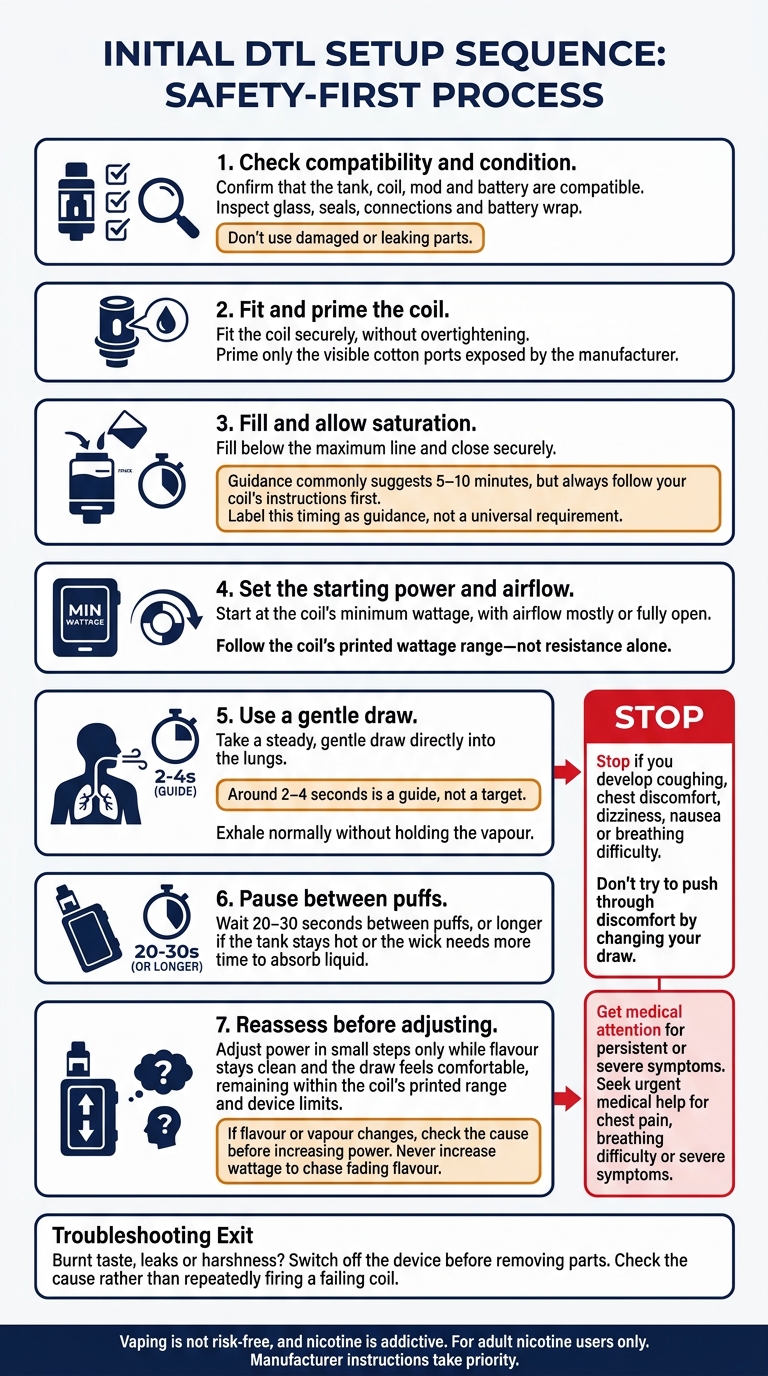
Before assembly, check that the tank, coil, mod and battery are compatible. Inspect the glass, seals, connections and battery wrap. Don’t use damaged or leaking parts. Fit the coil securely, without overtightening.
Prime only the visible cotton ports exposed by the manufacturer. Fill below the maximum line, close securely and allow time for saturation. Guidance commonly suggests 5–10 minutes, but always follow your coil’s instructions first.
Start at the coil’s minimum wattage, with the airflow mostly or fully open. Take a steady, gentle draw directly into your lungs. Around 2–4 seconds is a guide, not a target. Exhale normally without holding the vapour.
Wait 20–30 seconds between puffs, or longer if the tank stays hot or the wick needs more time to absorb liquid. Adjust power in small steps only while the flavour stays clean and the draw feels comfortable.
Stop if you develop coughing, chest discomfort, dizziness, nausea or breathing difficulty. Get medical attention for persistent or severe symptoms. Don’t try to push through discomfort by changing your draw.
If flavour or vapour changes after setup, check the cause before increasing power.
Fix Burnt Taste, Leaks and Harshness
Switch off the device before removing parts. Check the symptom once rather than repeatedly firing a failing coil.
| Symptom | Likely causes | Safe corrective action |
|---|---|---|
| Burnt taste | Poor priming, low liquid, too much power or worn cotton | Stop, check liquid and power, then allow saturation. Replace the coil if the burnt taste persists or the cotton is scorched. |
| Gurgling or spitting | Flooding, overfilling or condensation | Disconnect the tank and wipe the mouthpiece and connection. Check the fill level and seals. Stop if liquid reaches your mouth. |
| Leaks | Poor coil seating, damaged seals or glass, or heat-thinned liquid | Keep the device upright, reseat the coil and replace damaged parts. Don’t use it if liquid has entered the electronics. |
| Harshness | Restricted airflow, a dry wick, excessive power or nicotine strength | Open the airflow, reduce power within the coil’s range and allow the wick to absorb liquid. Check whether the nicotine strength suits you; stop if discomfort continues. |
| Weak flavour | Flooding, a dirty tank, overly open airflow or a declining coil | Check for flooding, clean removable parts and review airflow. Replace a declining coil rather than adding power. |
A light crackle is normal. Unusual hissing, popping or buzzing alongside abnormal heat, malfunction or battery warnings is not. Stop using and charging the device. If safe, move it away from flammable materials. Seek emergency help if there’s smoke or fire.
Replace coils that repeatedly flood or lose performance despite correct installation. Regular cleaning also helps keep flavour stable and reduce leaks.
Cleaning and Storage in Bahrain’s Heat
Turn off the device and disconnect the tank. Use a dry or slightly damp lint-free cloth to wipe condensation and e-liquid from the tank base, 510 connection, pod contacts and mouthpiece.
Remove the coil before rinsing any tank parts the manufacturer permits you to wash, then dry everything fully. Check airflow openings for lint or liquid and inspect the O-rings. Replace worn seals or cracked glass. Never immerse mods, batteries, charging ports or electronics.
Store the device upright and capped, away from children, pets, sunlight and parked vehicles. Bahrain’s heat can thin liquid and strain batteries, so follow the manufacturer’s storage limits in °C.
After hot-car exposure, don’t fire or charge the device. Let it cool, then check for leaks or damage. Keep spare cells in protective cases, away from keys and coins.
DTL Safety and Bahrain Rules
Once you’ve chosen the right coil and liquid, check how to use them safely and follow Bahrain’s rules. Nicotine is addictive. DTL is for adult nicotine users – not non-smokers, people who have never used nicotine, pregnant people or anyone sensitive to inhaled aerosol. More vapour can mean greater liquid consumption and nicotine exposure.
Battery Handling and Charging
Regulated mods may have short-circuit, over-temperature, low-voltage and over-charge safeguards. These protections do not make damaged batteries or unsafe charging habits safe. Use genuine cells rated for the device’s continuous-discharge demand. For dual-battery setups, follow the manufacturer’s instructions on paired cells. Mechanical mods are not suitable for inexperienced users.
- Check battery type, orientation, continuous-discharge rating and device limits. Inspect wraps and insulators before use.
- Charge on a clear, stable, non-flammable surface. Disconnect when charging is complete.
- Transport batteries in protective cases. Never carry loose cells near metal.
- Clean up spilled e-liquid promptly. Keep liquid away from charging ports and battery contacts.
- Stop using the device immediately if it becomes unusually hot, vents, leaks heavily or behaves erratically.
Store e-liquid sealed and upright, away from children, pets and heat.
Nicotine Symptoms and When to Stop
Nausea, dizziness, headache, shakiness, sweating, vomiting and palpitations can all signal too much nicotine. Stop using nicotine if these symptoms occur. Seek urgent medical help for severe or worsening symptoms, breathing difficulty, chest pain, fainting or confusion.
Bahrain Rules and Compatible Products
Device safety and compliance with Bahrain’s rules go hand in hand. Check current Bahrain Ministry of Health and Ministry of Industry and Commerce guidance on purchase restrictions, public use, technical regulations, labelling and import requirements. A product being available does not mean it complies with local rules.
VapeShop.bh offers devices, e-liquids, pods, coils, mods and accessories, with same-day delivery across Bahrain and WhatsApp ordering. When your order arrives, check that the packaging is sealed and clearly labelled. Confirm the nicotine concentration, ingredients, warnings, batch details and component compatibility. Keep the receipt and product information.
If you choose DTL, use a simple, legal setup and stay within the device’s limits.
Conclusion: Is DTL Right for You?
DTL suits adult vapers who want an open draw and more vapour, and accept higher liquid use and upkeep. Before choosing, check hardware compatibility, nicotine strength, wattage limits and safe storage in Bahrain’s heat.
FAQs
How do I know if DTL suits me better than MTL?
DTL may suit you better if you prefer large vapour clouds, bold flavours and a smoother, cooler inhale. It also suits those who enjoy fine-tuning their device and adjusting the airflow.
MTL remains the better choice for strong nicotine satisfaction, a tight, cigarette-like throat hit, discreet vaping or lower e-liquid use. If you choose DTL, VapeShop.bh offers a broad range of sub-ohm gear.
How can I track my nicotine intake with DTL?
Choose low-strength freebase e-liquids, typically 3 mg/mL or 6 mg/mL, and keep track of how quickly you finish a tank or bottle. Direct-to-lung (DTL) devices vaporise more e-liquid per puff than mouth-to-lung setups, so a lower nicotine strength helps limit excessive intake.
Avoid high-strength nicotine salts in DTL devices. Their high power can deliver an unintended, overwhelming nicotine rush.
How can I tell if Bahrain’s heat has damaged my vape?
Bahrain’s heat can thin e-liquid, leading to leaks, flooding or gurgling. If your device feels unusually hot or the vapour becomes harsher, heat may be affecting airflow or wicking.
Keep your device and e-liquid in a cool, dry place – never in a parked vehicle. Stop using the device immediately if it keeps overheating, develops electrical faults or shows signs of battery damage, such as swelling or hissing.
Related Blog Posts
- Sub-Ohm Vaping for Flavor: Guide
- How Beginner Sub-Ohm Kits Work
- Beginner’s Checklist for Cloud Chasing
- Top 5 Factors Driving Vape Sales in Bahrain
Frequently Asked Questions
DTL vaping, or direct-to-lung vaping, draws vapour straight into the lungs in one inhale. It uses more open airflow than MTL vaping and usually consumes more e-liquid.
DTL coils should be used within the printed wattage range for that specific coil. Sub-ohm coils have resistance below 1.0 Ω, but similar-looking coils may not be interchangeable, so check the exact coil family and device compatibility.
A 70% VG/30% PG e-liquid blend is common for DTL vaping. The liquid should also be checked against the device guidance, especially when using hardware designed for higher-power vaping.
Start at the coil’s printed minimum wattage rather than choosing a setting from resistance alone. Each coil has its own power limits, so confirm the wattage range before increasing power.
Prime the coil before vaping, then take gentle draws while checking the setup. Stop if a burnt taste, leaking or harshness appears, and inspect the device, tank, coil and e-liquid guidance.
Match the device, tank, coil and battery, and check the connection and wattage limits before use. Keep the device away from parked cars and direct sunlight, and charge it safely.
Adult nicotine users should check the e-liquid strength against the device guidance because DTL vaping can consume more liquid, and lower nicotine strength does not guarantee lower exposure. Current Bahrain purchase, labelling and public-use requirements should also be checked before use.