Starter Kit Comparison for Bahrain Vapers: Pod Systems Versus Vape Pens

Pod Systems vs Vape Pens in Bahrain: Cost, Nicotine, and Same‑Day Buying Guide for Your First Device
If you live in Manama, Riffa, Muharraq, or nearby and you’re choosing your first vape, you’re probably torn between two main formats: compact pod systems and traditional vape pens. Both can deliver a satisfying experience, but they shine in different ways—one in sheer convenience and discreet use, the other in range and runtime. The best first choice depends on what you smoked before, what nicotine you plan to use, how much you want to spend over the next few months, and how quickly you want your order delivered. ⏱️ 9-min read
This guide compares pod systems and vape pens through a Bahrain‑specific lens: what’s easy to buy locally (and get same‑day), the nicotine types most shops actually stock, how to estimate your monthly spend, and where to source spares without chasing rare coils. By the end, you’ll have a practical pick with the right nicotine strength and a go‑to buying channel—so you can start confidently instead of guessing.
Key technical differences: pod systems vs vape pens
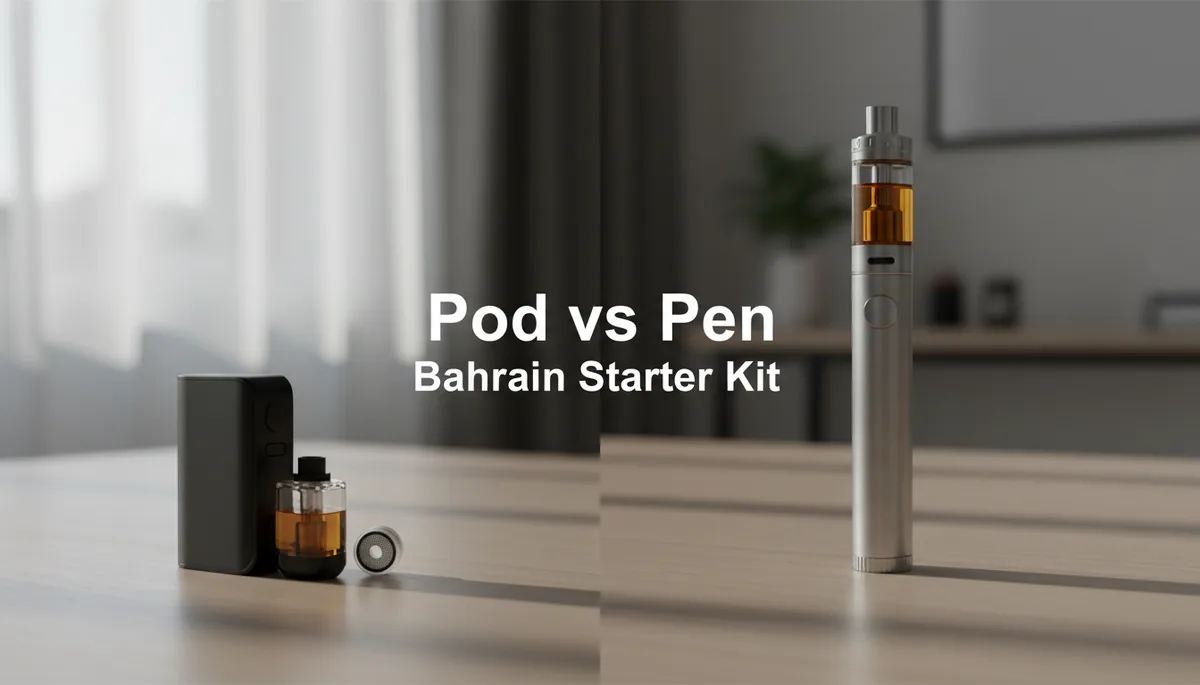
Pod systems are built for simplicity. A small battery body—often lighter than a key fob—pairs with a snap‑in pod that holds your e‑liquid and coil together. That compact form makes them easy to carry and hard to break, but it limits battery capacity (and therefore runtime) and the amount of liquid you can carry onboard. It also narrows the performance window: most pods operate at low, regulated wattage, designed for steady, predictable puffs rather than large, lung‑filling clouds.
Vape pens, by contrast, are larger cylinders with bigger batteries and a separate tank. They’re bulkier in the pocket, but that extra space buys you longer intervals between charges and larger e‑liquid capacity. Many pen kits support variable wattage with a wider output range—commonly 20 to 80 watts or more—so you can tune vapor warmth, density, and throat hit. If you’re the kind of user who likes adjusting airflow and dialing in “just right,” a pen’s flexibility will feel rewarding.
Coils and airflow reveal the biggest practical split. Pod coils are typically higher resistance and optimized for mouth‑to‑lung (MTL) draws that mimic a cigarette’s tighter pull. Airflow is usually fixed or minimally adjustable. Pens serve a broader set of preferences: you’ll find high‑resistance MTL coils, but also sub‑ohm mesh options and wide airflow control rings for direct‑to‑lung (DTL) inhalation and denser vapor. In other words, pods simplify decision‑making while pens open the door to personalization.
Match those traits to smoking profiles and the picture clarifies. If you were a light‑to‑moderate smoker and value discretion, a pod system with a tight MTL draw often feels instantly familiar. If you were a heavier smoker or you like a more robust inhale and pronounced flavor, a mid‑power vape pen with adjustable airflow may fit better. Both will work to replace cigarettes; the right choice is simply the one that aligns with how you want each puff to feel—and how much fine‑tuning you want to do.
Nicotine and e-liquid compatibility in Bahrain
Nicotine choice is the lever that most affects how your first device will feel. In Bahrain, you’ll commonly see two formats: nicotine salts (often supplied at around 20 mg/mL for regulated markets) and freebase nicotine (typically 3–18 mg/mL). Saltnic is smoother at higher strengths because it’s designed to minimize harshness; freebase delivers a sharper throat hit at equivalent milligrams and is better suited to higher‑wattage use.
Pod systems pair naturally with saltnic at moderate strengths. In practice, many Bahrain shops stock 20 mg saltnic options across popular lines—Mazaj 20 mg salts are a frequent sight—because that level offers quick craving relief without the bite you’d get if you tried the same strength in freebase. If you smoked up to a pack a day, 20 mg saltnic in a low‑wattage pod is a sensible starting point. Former very heavy smokers who still feel under‑satisfied sometimes look for stronger salts; availability can vary and there may be regulatory limits, so check what your local retailer legally carries.
Vape pens tend to shine with lower‑strength freebase, usually 3–6 mg for sub‑ohm coils and 6–12 mg for MTL coils. Because pens push more power and move more vapor per puff, that lower milligram count still delivers plenty of nicotine to the bloodstream. If you run 3 mg in a 0.4 Ω mesh coil around 35–45 watts, expect a smooth inhale with robust flavor and enough punch for many ex‑smokers—without the harshness that higher freebase strengths can bring at those wattages.
Also factor in PG/VG ratios. Pods prefer thinner liquids for wicking and a clean MTL hit—look for 50/50 or 60/40 PG/VG. Viscous, high‑VG blends can struggle to feed tiny wicks, causing dry hits and shortened coil life. Pens tolerate thicker juices and often reward them with bigger, softer clouds; 60–70% VG is a safe sweet spot for sub‑ohm coils. Whatever you buy, read the label: confirm nicotine type (salt vs freebase), strength listed as mg/mL or percent, and the PG/VG ratio. Reputable brands include ingredient lists, batch codes, and contact information. If a bottle is missing basics, skip it—especially in a hot climate where you want assurance the liquid was manufactured and stored properly.
Upfront cost vs ongoing expenses
Think of your first kit like a phone plan: the device is a one‑off, but the monthly bill is what matters. Entry pod kits in Bahrain generally sit in the BHD 7.5–23 range (roughly $20–$60). Simple vape pen kits run slightly higher on average—about BHD 9–26 ($25–$70)—because you’re paying for a larger battery and a more complex tank. Local retailers, including shops that advertise same‑day delivery, usually list both formats side by side, so you can weigh price against features at a glance.
The recurring costs are similar across both—coils or pods plus e‑liquid—but the pace can differ. Expect to replace a pod or coil every 1–4 weeks depending on power, sweetness of juice, and how often you vape. Single coils or replacement pods commonly run BHD 0.8–2.3 ($2–$6). E‑liquid consumption varies wildly: a light user might sip 2–3 mL a day; an average user lands around 3–5 mL; heavy users can reach 8–12+ mL, especially with sub‑ohm pens.
Here’s a realistic monthly snapshot. An average user at 4 mL/day paying around $0.15 per mL spends about $18 on liquid. Add three coils or pods at $4 each if they last roughly 10 days, and you’re near $30 a month. A heavy sub‑ohm user buying 100 mL bottles at $12–15 (lower per‑mL cost) might vape 10 mL/day—about $36 a month—plus two or three $4–$6 coils. Multiply that by a few months and you can see why buying larger bottles and learning good coil care pays off.
What about disposables, especially the big “9,000–20,000 puff” models? They can be convenient for travel or trial runs, but cost per puff often surprises people. Puff counts are lab estimates based on short puffs at low airflow, not the longer drags many adults take. If a 10,000‑puff disposable costs BHD 6–10 and realistically yields 4,000–7,000 satisfying puffs for you, you’re paying more per milliliter than bottled e‑liquid—often by a large margin. Bulk ordering liquids or coils (two‑packs, five‑packs) and choosing refillable gear tends to cut your monthly spend substantially once you get past the first week of learning.
Maintenance, reliability, and parts availability
Keeping any starter kit happy is less about tools and more about tiny habits. Wipe the pod contacts and mouthpiece daily to remove condensation and dust; it takes ten seconds and prevents misfires. When you open a new coil or pod, prime it with a few drops of liquid directly on the exposed cotton, then fill the tank and let it sit 5–10 minutes. Starting at the low end of the coil’s rated wattage for the first handful of puffs “beds in” the coil, extending its life and avoiding the dreaded burnt taste.
How long do parts last? In broad strokes, sub‑ohm pen coils give 1–2 weeks of clean flavor with average use; MTL pod coils often stretch to 2–4 weeks because they run cooler and at lower wattage. You’ll know it’s time when flavor dulls, vapor thins, or the taste turns even slightly acrid. Heavy, sweetened, or very dark juices will age coils faster. If you notice persistent gurgling or leakage, check O‑rings and seals first; inexpensive seal kits can save you from misdiagnosing a perfectly good coil.
In Bahrain, the biggest reliability win is choosing a kit with readily available spares. Before you buy, search the coil name and resistance (for example, “Xros 1.0Ω pods Bahrain” or “GTX 0.6Ω coils Bahrain”) and see how many local sellers stock them. Many licensed vape shops in Manama, Riffa, and Muharraq carry popular coil lines and can swap a fresh coil for you in minutes if you’re unsure. Online wholesalers and local e‑commerce suppliers likewise keep multi‑packs at better per‑coil pricing, so it’s worth adding a pack to your first order to avoid downtime later.
Finally, warranty terms matter. Most brands offer limited warranties against manufacturing defects—think dead‑on‑arrival batteries, not wear and tear. Confirm how your chosen shop handles exchanges: some Bahrain retailers manage claims in‑store; others require courier return. Keep your receipt, original packaging, and the device’s authentication code stickers. If you ever do need a repair or replacement, clear photos and a short description of the fault speed the process up.
Convenience and portability for daily use
If you commute across Manama’s busy corridors or hop between offices in Riffa and Muharraq, pocket comfort might tip the scales. Pod systems excel here: they’re slim, light, and easy to palm for a quick MTL puff. They also refill quickly from small 30 mL bottles, and many offer USB‑C charging that tops up from near‑empty to usable in under 20 minutes. The trade‑off is smaller batteries—often 400–1000 mAh—which means more frequent charging if you vape steadily through the day.
Vape pens are less discreet but more autonomous. A 1500–3000 mAh battery and a 2–5 mL tank can take you from early morning to bedtime without refilling for many users, especially at moderate wattages. If you carry a bag or keep a device on your desk, the extra size becomes less of an issue. Pens also tend to sip e‑liquid more steadily at equivalent satisfaction levels once you dial in a coil and wattage that suits you, because you’re not pushing the small coil near its limits.
Charging and refilling frequency can matter more than you think. If you prefer to “set and forget,” a pen with a spare coil in your wallet might be less hassle than a pod you’re topping up mid‑afternoon. On the other hand, if you want something you can clip to a lanyard or keep in a shirt pocket without printing an outline, pods keep a low profile. Both device types now use USB‑C commonly, but check whether your specific kit supports pass‑through vaping (using while charging) and what charging
Frequently Asked Questions
Pod systems are simpler and more beginner-friendly—just insert a pre-filled or refillable pod and inhale, no buttons or settings to adjust. Vape pens require occasional coil changes and offer more customization options, making them better for vapers who want to experiment with different settings and vapor styles. If you're new to vaping, a pod system is usually the easier choice.
Vape pens typically last longer per charge because they have larger batteries, especially high-wattage models. Pod systems have smaller batteries and need more frequent charging, but they're more portable and convenient for quick sessions throughout the day.
Vape pens, especially sub-ohm models, produce denser and more powerful vapor with a wider flavor range. Pod systems create lighter vapor and are designed more for a smooth, cigarette-like experience using nicotine salts rather than cloud production.
Yes, pod systems are often preferred for smokers transitioning to vaping because they mimic the feel of traditional cigarettes with a smooth throat hit and fast nicotine delivery. They work best with nicotine salts and 50/50 e-liquid blends, offering the restricted draw that feels familiar to someone used to smoking.
Both pods and pens allow nicotine level adjustments, but vape pens offer a wider range of nicotine strengths including nicotine-free options. Pod systems typically use higher-concentration nicotine salts, which work better for smokers seeking faster satisfaction, while pens give you more flexibility to reduce nicotine over time. In Bahrain, the legal maximum is 20mg/ml, so check product labels before purchase.
Pod systems are easier to maintain because pods are pre-filled or quickly refillable without coil changes. Vape pens require regular coil replacement and tank cleaning, so they demand more hands-on care. If you want minimal fuss, a pod system is your best bet.
VapeShop.bh offers express delivery within 1 hour across Bahrain from 9 AM to midnight daily, available for both pod systems and vape pens.[current store policy] You can pay via cash on delivery, BenefitPay, or card for convenience.
Pod systems are generally more durable because they have fewer components that can fail and are built to handle daily use better. Vape pens are sometimes prone to leaks and breakage due to their simpler construction, though quality varies by brand.