
Shipping to Bahrain explained: customs, taxes, and delivery times for international vape orders

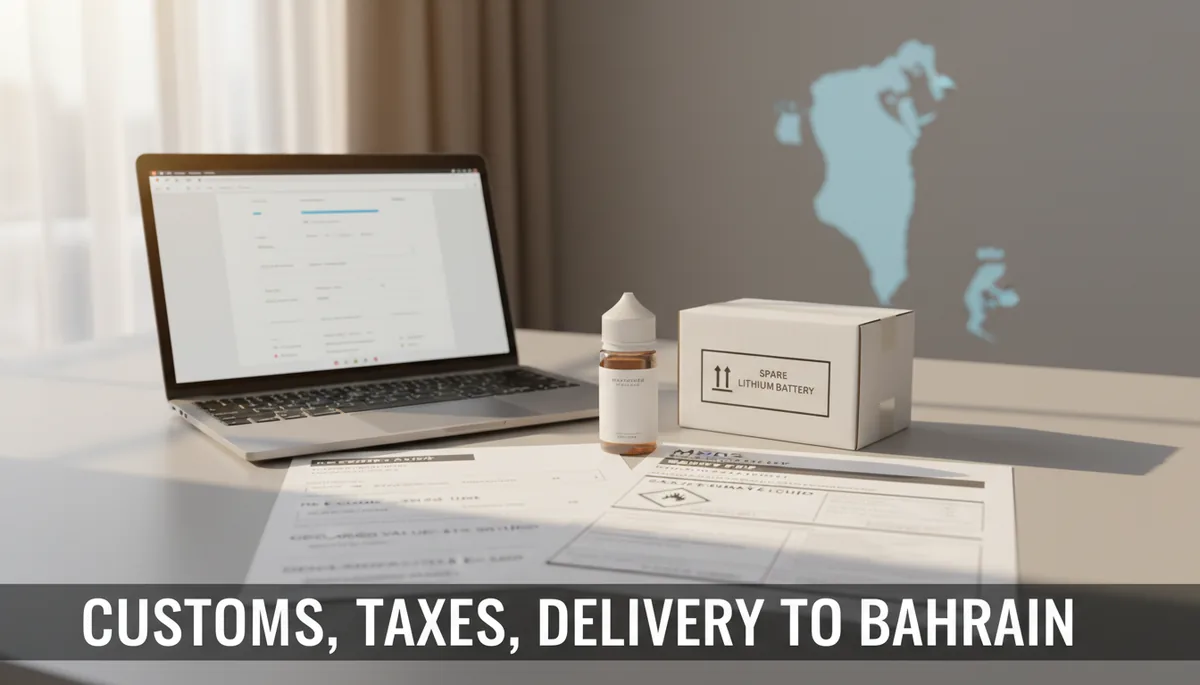
Shipping Vape Products to Bahrain: A Practical Guide to Customs, Taxes, and Delivery Timelines
If you sell or buy vape products across borders, Bahrain can be a straightforward destination—provided you prepare the right paperwork, classify goods correctly, and choose a carrier that understands nicotine and battery rules. If you don’t, the same shipment can stall for weeks, rack up fees, or get refused outright. ⏱️ 6-min read
This guide pulls together what international retailers, freight forwarders, and Bahraini customers need to know before shipping disposables, e-liquids (salt nic and freebase), starter kits, and batteries into the Kingdom. You’ll find plain-English explanations of what’s allowed, how taxes and duties are typically calculated, which carriers will actually carry your goods, and how long delivery really takes to Manama, Riffa, and Muharraq when customs checks are part of the journey.
Legal status and what can (and can’t) be imported into Bahrain
Vaping products are legal in Bahrain but regulated. Imports must comply with Bahrain Customs requirements and the health and safety rules overseen by the National Health Regulatory Authority (NHRA) and Ministry of Health. That means your customs declaration has to match what’s in the box, your labels need to say what’s inside in clear terms, and your product and packaging should meet safety expectations. Local, licensed vendors operate under these rules; observing what they carry—and how those items are labeled—is a practical way to understand what typically clears.
Common reasons vape shipments are refused at the border include unlabelled nicotine liquids, flavorings that raise red flags for appealing to minors, and devices without credible manufacturer certifications. Counterfeit products are a non-starter. Customs is quick to detain items that look like copies of well-known brands, use suspicious barcodes, or show inconsistent batch and expiry data. Prototype, modified, or homemade hardware is also a frequent problem; unless you can document testing and safety compliance, expect a refusal.
What tends to clear? Sealed, commercially produced devices in unopened packaging with traceable batch numbers, safety markings, and a manufacturer’s contact address. Properly labeled e-liquids—listing ingredients, nicotine strength, warnings, and production/expiry dates—are far more likely to pass routine checks. Child-resistant closures and tamper-evident seals matter. If you include a Safety Data Sheet (SDS/MSDS) for nicotine-containing products and any available certificates of analysis (COAs), you reduce the chance that officers will hold your parcel for sampling.
Regulations evolve. Before placing a large order or launching a new product line, verify current import conditions with official sources: Bahrain Customs for classification, duty and clearance procedures; and NHRA/Ministry of Health for labeling, product claims, and any approvals. An email confirmation from a licensed Bahraini customs broker or a formal customs “advance ruling” on classification can save weeks of back-and-forth later.
Nicotine levels, labelling and product approvals to watch for
Nicotine strength drives risk. Many countries benchmark the European TPD cap of 20 mg/mL (2%) for consumer e-liquids. While Bahrain sets its own policies, this 20 mg/mL figure is often used as a global reference point. If you sell popular salt nic at 20 mg or 35 mg, or high-VG freebase at 3 mg in 60 mL bottles, verify whether Bahrain currently limits nicotine concentration or bottle sizes, and whether a pre-import notification is needed. For local favorites—such as well-known branded lines—confirm that the label format and warnings align with local expectations before you ship a new batch.
Labeling is not a formality; it’s how inspectors decide whether your product is what the invoice says it is. Plan for bilingual labels (Arabic and English) with: a complete ingredient list, nicotine concentration stated clearly (mg/mL and/or percentage), batch/lot number, production and expiry dates, manufacturer/importer contact details, and mandatory health warnings. If your box lists “2%” but the bottle reads “20 mg,” that’s fine—those figures are equivalent—but make sure units are unambiguous to avoid a hold for “verification.” Keep final artwork files and translations handy; if customs requests them during review, you can respond the same day rather than waiting on a designer.
Product claims can trigger an entirely different approval track. If your marketing suggests cessation benefits or therapeutic effects, NHRA may treat the product as a health/pharmaceutical item, which demands formal registration. Most consumer vapes avoid these claims for exactly that reason. Still, even products with no medicinal positioning can require pre-import notification or an import permit in specific cases. The safest approach: ask NHRA or a licensed Bahraini importer to confirm whether your exact SKUs and nicotine concentrations require filings. Keep accredited lab paperwork—COAs for <a href="https://vapeshop.bh/15000-puff-disposable-vapes-vs-rechargeable-pods-in-bahrain-cost-convenience-and-waste/” rel=”nofollow noopener noreferrer”>nicotine strength/purity and an SDS for each formula—attached to the shipment and available electronically.
Finally, be consistent. If your 20 mg salt nic in Mango is accepted with one label set, don’t change bottle sizes, warning layouts, or ingredient order in your next run without checking the impact. Sudden changes raise questions during repeat imports, and consistency helps customs recognize your brand as a compliant regular shipper.
Customs codes, documentation and commercial vs. personal shipments
Customs classification (HS codes) determines whether your product can be imported, what duty rate applies, and which agencies might take an interest. Vape devices have historically been classified in Chapter 85 (electrical/electronic apparatus), while e-liquids and nicotine preparations have appeared under chemical or perfumery headings. However, more recent HS versions introduced a dedicated tobacco/nicotine heading (often noted as 24.04 in HS 2022) covering certain e-cigarettes and nicotine products. Bahrain applies its own tariff, so confirm the correct subheading for your device, e-liquid, or accessory with the Bahrain Customs tariff lookup or via an advance ruling. A correct code can mean the difference between a 0–5% duty and a higher excise category.
Expect to provide a detailed commercial invoice and packing list. The invoice should include itemized descriptions (e.g., “Disposable electronic vaporizer, 2% nicotine, 600 puffs, 10 mL; HS code [proposed]”), unit quantities and values, currency, Incoterms, and both seller/buyer details. Match the packing list to the physical cartons—weights and dimensions included—so any inspection can verify quickly. Include an SDS for any nicotine-containing liquid and a COA or manufacturer declaration stating nicotine concentration and batch. If lithium batteries are present, battery test evidence (UN 38.3) and device safety declarations accelerate screening.
Who is the importer of record matters. For small personal-use parcels—say, one 30 mL bottle or a single starter kit—carriers often act as clearing agents with simplified data. Scrutiny can still be high for nicotine, and Bahrain may restrict private imports of certain nicotine products to licensed importers. For commercial shipments—pallets of freebase liquid, or a wholesale carton of 20,000‑puff disposables—expect formal customs entries, potentially additional agency reviews, and a request for product registrations or a local importer license. Have a licensed Bahraini distributor receive and clear bulk orders; it removes a major point of failure.
If you’re unsure how customs will treat a new product type, submit a classification query with supporting documents (technical sheets, ingredients, images). A written response—or a broker’s binding ruling—creates predictability
Frequently Asked Questions
Bahrain applies a standard customs duty of 5% on the CIF value (cost, insurance, freight) for most goods, including vapes, though tobacco products like disposables may face up to 100% excise tax in some cases. VAT is 10% on the total value after duties. Goods from the US often qualify for duty-free entry under the US-Bahrain Free Trade Agreement if properly documented with a Certificate of Origin.
Express options like DHL or FedEx deliver from the US in 2-6 business days, while economy shipping takes 4-14 days. Air mail from places like Hong Kong arrives in 4-9 days, but ocean freight can take 41+ days and is not recommended for vapes. Delays often occur due to customs checks on batteries and nicotine content.
All shipments require a Bahrain Customs Declaration, and for duty-free US goods, include a Certificate of Origin under the FTA. Vapes need accurate HS codes, commercial invoice, and proof of compliance with battery and nicotine rules to avoid holds. Incomplete docs can cause weeks of delays or refusal.
Shipments over $650 USD trigger formal clearance with extra docs, and vapes face scrutiny for lithium batteries and nicotine limits (max 20mg/ml under Bahrain law). Tobacco shipments incur checking fees starting at BD5 plus weight-based charges. Using a customs broker helps speed things up.
Vapes must comply with Bahrain Customs rules on hazardous batteries and nicotine, with tobacco products needing special release approval and fees. Alcohol and high-nicotine items face higher duties, but standard vapes under 20mg/ml are allowed with proper labeling. Arab-origin goods may get exemptions except for tobacco.
Start with customs value (product + freight + insurance), apply 5% duty, add any excise (up to 100% for tobacco), then 10% VAT on the total. For example, a $1000 shipment at 5% duty adds $50 duty plus VAT. Factor in carrier fees and potential clearance charges for accurate landing cost.