
How to Import 20k Puff Disposable Vapes into Bahrain Customs Taxes and Compliance

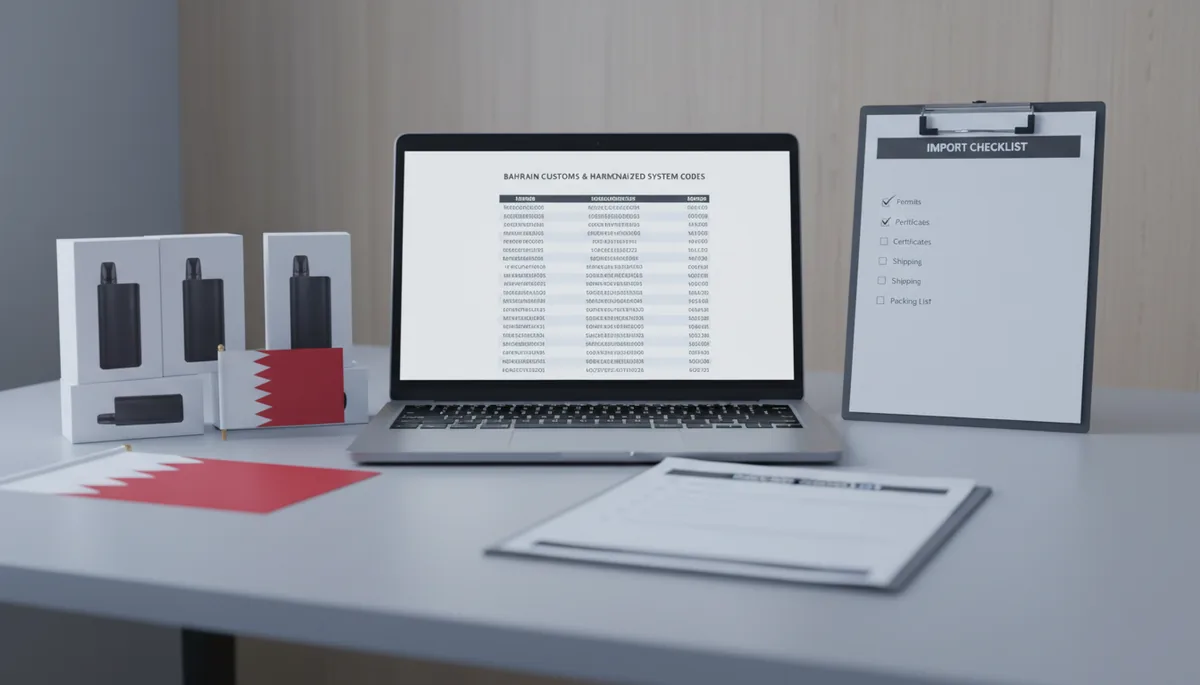
How to Import 20k‑Puff Disposable Vapes into Bahrain: A Compliance, Tax, and Logistics Roadmap
Importing high‑capacity disposable vapes into Bahrain isn’t just a shipping exercise—it’s a choreography of product classification, health approvals, dangerous‑goods handling, and cost modeling that must all align at the exact moment your consignment hits the border. Done right, you move seamlessly from purchase order to same‑day delivery in Manama. Done poorly, you face detentions, relabeling requests, or outright seizure. This guide lays out a step‑by‑step roadmap that experienced importers use to reduce risk and protect margin on 20,000‑puff disposables. ⏱️ 8-min read
What follows blends regulatory context with practical execution: how to classify disposable vapes under the Harmonized System, what approvals and labels Bahrain authorities expect, how to calculate the real landed cost (beyond duty and VAT), and how to ship lithium‑battery devices compliantly under IATA/IMDG rules. You will also find a pre‑shipment documentation checklist, partner selection advice for forwarders and brokers, and a realistic plan for handling on‑arrival inspections. If you are an importer, distributor, online vape retailer, or an overseas supplier planning bulk shipments into Bahrain, use this as your operational playbook—and verify every assumption with Bahrain’s regulators before you place your order.
Bahrain regulatory landscape for e‑cigarettes and disposables
Bahrain’s framework for electronic nicotine delivery systems (ENDS), including 20k‑puff disposables, is shared across several authorities. The Ministry of Health (MoH) and the National Health Regulatory Authority (NHRA) typically oversee product registration, safety, and elements of retail licensing. Bahrain Customs controls what crosses the border and will enforce documentation, tariff assessments, and any border holds for public‑health or dangerous‑goods concerns. Depending on your setup, the Ministry of Industry and Commerce and local municipalities can also touch trade or shop licensing, while the National Bureau for Revenue administers VAT at import.
Before you commit to tooling or a production run, answer three legal questions directly with the NHRA and Customs: (1) Is import of disposable e‑cigarettes currently permitted, and for which nicotine strengths? (2) Are there explicit concentration caps or product composition restrictions (e.g., prohibited additives, flavor claims) you must observe? (3) What point‑of‑sale and advertising constraints bind wholesalers and retailers, both online and offline? Bahrain has an active market—local websites advertise same‑day delivery within major cities—but that market operates under licensing, age‑verification, and promotional limits. Youth‑targeted designs, unsubstantiated health claims, or mismatched nicotine labeling are frequent reasons for import refusals or relabeling demands.
Regulatory policy in this category can shift quickly. MoH/NHRA advisories sometimes tighten labeling, flavor descriptors, or retail standards with limited lead time. Build verification into your sourcing calendar: have your Bahrain broker or legal counsel request written confirmation of current requirements, preferably as part of a pre‑clearance dialogue. When your brand and SKUs are known to regulators before the first shipment sails, you significantly reduce the chance of a surprise hold on arrival.
Practically, plan for two tracks in parallel. Track A is product compliance: technical dossiers, ingredient disclosure, and pack/leaflet language aligned to Bahrain expectations. Track B is trade compliance: securing correct HS codes, obtaining any special import permits, and lining up VAT and duty calculations. Keep both tracks moving, and keep them documented—because at the border, a clear paper trail is your best defense.
Product classification: finding the correct HS code and implications
The Harmonized System (HS) code you declare will determine not just your customs duty rate, but also whether your shipment triggers additional health controls, excise, or documentary requirements. Misclassification is a red flag in this category; declaring a nicotine‑filled disposable as a generic “electronic device” tempts inspection, sampling, and delay.
Two families of tariff lines tend to be relevant for disposables. Many jurisdictions use headings in the electronic apparatus chapter (historically variants under 8543) for self‑contained devices that heat e‑liquid. Others, especially since the HS 2022 updates, classify nicotine products under headings aligned with “products for oral or inhalation of nicotine, not containing tobacco” (commonly chapter 24 “nicotine products” in some customs unions). Where your product lands depends on local tariff practice, whether the device is prefilled with nicotine, and how your invoice describes composition and function. Accessories and spares (e.g., chargers) can fall under separate lines if shipped alone.
For Bahrain, the only safe approach is to obtain or confirm your HS code before you ship. Here’s a proven sequence: (1) Draft a highly descriptive product sheet that spells out device type, single‑use construction, battery chemistry, e‑liquid composition, and nicotine strength. Include exploded‑view photos. (2) Share that with a licensed Bahrain customs broker and ask them to propose a code and duty estimate. (3) Submit an advance binding ruling request to Bahrain Customs using your broker as agent. The ruling, while taking time, de‑risks your first arrival. (4) Mirror the ruling description and HS code on all commercial documents and outer‑carton labels to maintain consistency through clearance.
The implications of your final HS code cascade through the rest of the import. Duty percentage and any excise hinge on this classification. So does the VAT base. A nicotine‑bearing device may face tighter scrutiny and require NHRA permits, while a nicotine‑free variant could clear like a consumer electronic with fewer touchpoints. Be cautious about mixed shipments: if one SKU in the container is nicotine‑bearing and another is not, customs can apply the higher‑risk treatment to the entire consignment pending verification. Invoices should segment quantities and values by SKU to prevent a blanket approach that inflates your tax bill.
Import permits, product approvals and labelling requirements
High‑capacity disposables are more than electronics. From a regulator’s perspective, they are products that deliver a pharmacologically active substance and house a lithium battery—both sensitive categories. That is why, ahead of production, importers often pursue either (a) full product registration with NHRA where applicable, or (b) a special import permit for limited quantities while full registration is pending. Which path is available depends on your device, nicotine content, and the intended distribution channel.
Expect your application to require a technical dossier that looks like this: complete ingredient list for the e‑liquid with percentages; nicotine concentration certificate (mg/mL and total mg per device); manufacturing quality evidence (e.g., ISO 9001 certificate for the factory); batch and lot traceability plan; device description including heating element type and battery chemistry; and proof of lawful sale in the country of manufacture (certificate of free sale). Authorities may also request safety assessments, toxicological summaries for key ingredients, and declarations that prohibited additives (such as certain vitamins or stimulants, if restricted locally) are absent. A licensed customs broker can file the permit request and coordinate questions; this usually shortens cycles and prevents avoidable gaps.
On‑pack and leaflet requirements in Bahrain typically include bilingual labelling in Arabic and English. Your unit box and outer carton should display: product name, nicotine strength (in mg/mL or percent), explicit health warnings that match local phrasing, a full ingredient list, batch/lot number, and expiry date. Include the importer’s or local representative’s details and storage conditions. Packaging should be child‑resistant and tamper‑evident. Provide an Arabic instruction leaflet explaining safe use and disposal, and consider battery disposal icons where applicable. Many clearance delays arise from small inconsistencies—nicotine stated as 5% on the box and 50 mg/mL on the leaflet without clarifying equivalence, or missing Arabic on the warning. Pre‑clearance label review with your broker or NHRA contact is worth the extra week it adds to your timeline.
Submit product samples early. A physical unit in the hands of your broker and the regulator lets them verify claims, inspect seals, and assess labeling quality ahead of the first container. If something needs to change—a minor warning phrasing or the position of an Arabic statement—you can correct at the factory rather than over‑labeling at the port. Over‑labeling is sometimes permitted, but it slows clearance and increases labor costs; it is better as a last resort than a core plan.
Taxes, duties and how to calculate landed cost
Plan your pricing around the full landed cost in Bahrain, not the ex‑factory price. Bahrain calculates taxes on the customs value, which is typically the CIF value—cost of goods plus insurance and freight to the port or airport of import. From there, customs duty, any applicable excise, and VAT are layered. As of this writing, Bahrain’s standard VAT rate is 10%, administered by the National Bureau for Revenue; always verify the current rate and any sector‑specific rules before you ship, because rates and interpretations can change.
Since HS classification drives the duty (and whether an excise applies), confirm those rates in advance with your broker. Some importers assume uniform 5% duty across electronics and are surprised when a nicotine‑bearing device is treated differently. Beyond headline taxes, budget for the “frictional” charges that quietly damage margins: port handling and terminal charges, customs examination or lab testing fees, broker service fees, warehousing for short‑term storage, and DG surcharges if your carrier applies them for lithium batteries. For small, high‑value shipments, these can add a material dollar amount per unit and need to be modeled explicitly.
A simple landed cost model you can adapt: (1) CIF value = FOB cost + freight + insurance. (2) Duty = CIF × duty rate. (3) Excise (if applicable) = (CIF + duty) × excise rate. (4) VAT = (CIF + duty + excise + eligible fees) × VAT rate. (5) Landed cost per unit = (CIF + duty + excise + VAT + all local charges) ÷ total units. Keep a separate line for inspection/testing fees so you can run scenarios with and without a lab hold.
Illustrative scenarios, for planning only: Scenario A—Nicotine disposable, airfreight. 1,000 units at $6.00 FOB =
Frequently Asked Questions
Importing 20k puff disposable vapes into Bahrain requires compliance with Technical Regulation BH 2:2021, including registration of devices and liquids plus premarket notification to the Ministry of Health. Contact Bahrain Customs and Ministry of Health for import permits, distributor licensing, and written confirmation to avoid delays. Prepare bilingual Arabic/English labels with health warnings, nicotine concentration, ingredients, batch codes, and expiry dates.
Bahrain applies a typical 5% import duty on most goods, but tobacco products like vapes face 100% selective excise plus VAT. Verify current rates and filing with the National Bureau for Revenue, declaring liquids and devices separately if needed. Factor these into landed costs early to protect margins.
Vapes are regulated as tobacco products under BH 2:2021, requiring Material Safety Data Sheets for e-liquids and UN38.3 certificates for lithium batteries. Ensure IATA Dangerous Goods compliance for air shipping or IMDG for sea, plus bilingual labeling with health warnings and importer details. Confirm standards with Ministry of Health to meet retail expectations.
Premarket notification and product registration for devices and liquids are mandatory before import under Bahrain's regulations. Obtain import permits and distributor licensing directly from Ministry of Health and Customs Affairs. Keep records of emails and reference numbers for smooth clearance.
Labels must be bilingual in Arabic and English, listing ingredients, nicotine concentration and type, batch codes, manufacture/expiry dates, and health warnings in required font size. Get artwork pre-approval if rebranding, matching standards seen on shelves at local retailers. Non-compliance risks seizure at customs.
A proposed blanket ban on e-cigarettes and vapes by MPs is under review and could impact future imports if passed. Current rules allow imports with BH 2:2021 compliance, registration, and premarket notification. Check latest updates from authorities before proceeding.
UN38.3 test certificates for lithium batteries in 20k puff disposables are essential, along with MSDS for e-liquids. Air shipments need IATA Dangerous Goods declarations; sea follows IMDG Code. Share digital copies with your broker for port clearance.