
Cost breakdown and pricing tips for bulk 20k puff disposable vape orders in Bahrain

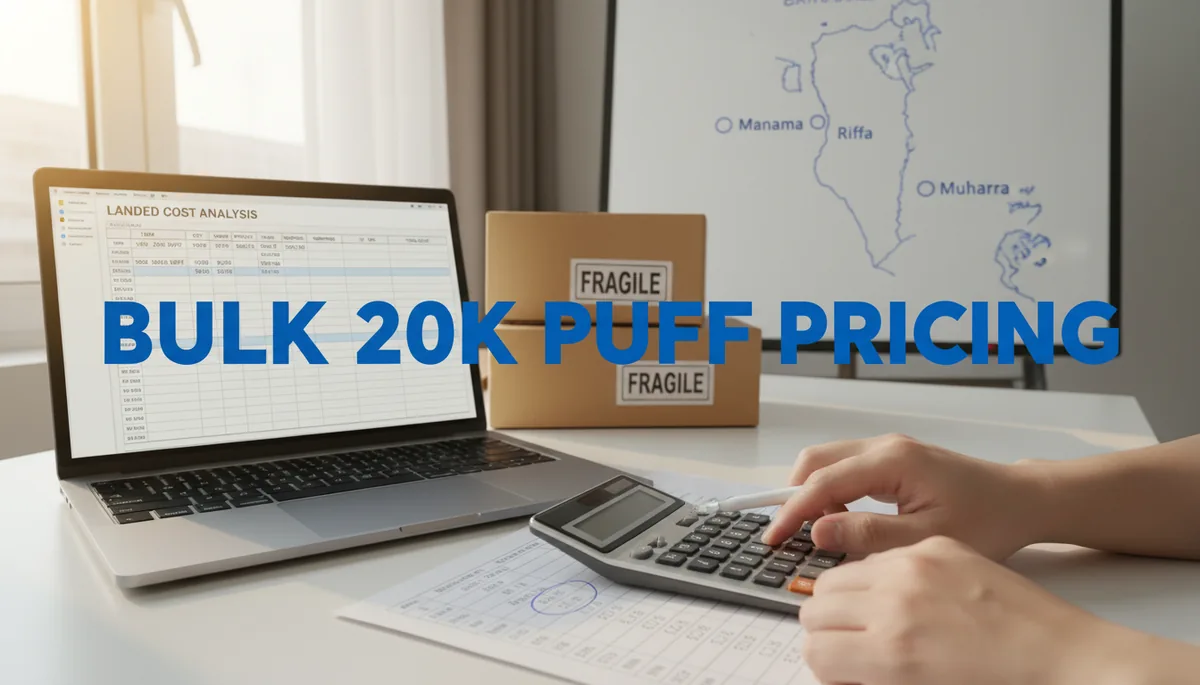
The Bahrain Numbers Playbook: How to Calculate Landed Cost and Set Profitable Prices for 20,000‑Puff Disposable Vapes
For vape shop owners and resellers in Bahrain, ultra‑high‑puff disposables have become the fast‑moving SKU that pays the bills. But volume alone doesn’t guarantee profit. Margin lives and dies in the math: what you pay at the factory, what it costs to bring a device legally into Bahrain, and what it takes to sell it fast in Manama, Riffa, or Muharraq. ⏱️ 8-min read
This is a practical, numbers‑first guide to help you price with confidence. You’ll see every landed‑cost line item, learn where the unit economics change with volume, and get templates you can copy into your own sheet. We’ll compare local purchasing against direct import, show real‑world delivery options in Bahrain, and close with QC, storage and returns policies that protect your cash. If you’re planning a bulk run of 20,000‑puff disposables—or just want to price like a wholesaler—this playbook will keep your margins honest.
Bahrain market snapshot and buyer profiles
Bahrain’s demand for high‑puff disposables is steady and channel‑driven. Sales cluster where convenience meets speed: walk‑in retail along busy corridors of Manama and Muharraq; online stores promising same‑day delivery across the island; and event or nightlife sellers who do brisk business during long weekends and peak seasons. Riffa’s residential density also supports frequent replenishment for neighborhood shops that push value bundles and mixed‑flavor packs.
Who’s buying and in what volumes? Walk‑in retailers typically reorder in small but frequent batches—think 200–600 units per week across a handful of flavors to keep cash turning. Online shops and social sellers tend to hold deeper inventory to guarantee same‑day delivery; 500–2,000 units per cycle is common when they hit a strong flavor trend. Event and club vendors buy in bursts, often 100–300 units ahead of a weekend, then top up mid‑run if the mix sells through. On the supply side, importers and wholesalers work in pallet to container quantities, usually 5,000–20,000 units per purchase, and set the flavor mix to cover core fruit, mint, and dessert profiles.
Nicotine preference matters when sizing inventory. Disposables in the region skew toward salt nicotine. Many retailers report 20 mg/mL salt nic as the safe “mainstream” strength for broad appeal, with a secondary audience asking for lower ranges to chain‑vape comfortably. Freebase at 3 mg is more common in refillable tanks than in disposables but occasionally appears in low‑nic SKUs designed for flavor‑first customers. Always confirm Bahrain’s legal nicotine strength limits before committing to a large order.
Brand familiarity reduces shelf friction. Locally recognized names and lines with clean, consistent flavor delivery move faster. Brands like Mazaj and other established Middle East favorites get trial more easily because customers have seen them in multiple channels. That said, the 20,000‑puff claim is a technical promise; your buyers care less about the number on the box and more about battery life, flavor stability to the last draw, and leak‑free handling in Bahrain’s heat. Align your flavor spread to three pillars—fruit, ice, and dessert—with one or two rotating limited editions to test demand without bloating inventory.
Complete landed‑cost components to calculate
The single most important discipline in vape retail is calculating landed unit cost the same way every time. Start with the supplier’s per‑unit price and add every expense required to get a device into inventory, legally sellable and ready to deliver. For bulk orders, the correct denominator is the total number of sellable units after accounting for defects and write‑offs—not just what you shipped.
At minimum, include these line items in your worksheet:
- Supplier unit price at your exact MOQ and packing configuration (FOB or ex‑works baseline).
- Packaging and labeling: inner boxes, cartons, pallets, shrink, Arabic/English labels and any relabeling or inserts required for Bahrain.
- International freight, insurance and handling: air or sea, fuel surcharges, terminal fees, container or consolidation charges.
- Import duties, excise and VAT: apply taxes to the legally defined valuation base (often CIF) and add customs broker fees.
- Currency conversion and payment fees: wire/SWIFT, card, escrow or L/C charges; hedge costs if applicable.
- Local inland logistics: port to warehouse drayage, storage, picking, and last‑mile delivery (same‑day bike courier vs scheduled drop).
- Quality assurance/testing: sample testing, lab checks, third‑party inspections, and inbound QC labor.
- Returns and defects reserve: a prudent allowance for leaking units, dead batteries, or customer returns.
Which costs are variable versus fixed? Supplier price, freight, taxes and courier fees scale with volume. Packaging also scales but may have brackets—for example, a per‑pallet fee that lowers per‑unit cost as you add units. Fixed or semi‑fixed overheads include import brokerage retainers, compliance or registration fees, document legalizations, and the base rent for storage. Convert every semi‑fixed line to a per‑unit amount by dividing over expected throughput for that shipment.
A quick method to keep your numbers clean: record FOB as your baseline, convert all other expenses into the same currency, sum them, then divide by total sellable units. For a 20,000‑unit run, your landed unit cost equals the total of product + shipping + taxes + local charges + reserves, divided by 20,000. Keep the math transparent inside your sheet so you can explain your price—and pressure the right costs—when negotiating.
Where to source 20k‑puff disposables (local vs international)
Bahrain buyers face a clear trade‑off. Buying locally—from wholesalers or shops that also operate online—wins on speed, predictability, and after‑sales support. You’ll pay more per unit, but you’ll get same‑day or next‑day delivery, easier returns, and someone else carries the compliance risk. This is attractive if you’re testing demand, filling a stock gap before a weekend surge, or need to replenish a runaway flavor without waiting for a container.
Direct import from manufacturers or regional distributors can cut your unit price meaningfully at scale. Factories often offer stepped discounts at 5,000, 10,000, and 20,000 units, and the FOB on an OEM‑capable manufacturer is typically lower than a trading company. The cost is complexity: higher MOQs, 4–8+ weeks by sea, customs paperwork, and supplier vetting. In practice, many Bahrain resellers blend both approaches—maintain a local safety stock to protect cashflow while staging larger imports for core flavors with predictable sell‑through.
To reduce risk, verify your supplier thoroughly before wiring funds, whether they are in Bahrain or abroad. Use this quick checklist:
- Commercial documents: pro forma invoice and draft contract terms including Incoterms, MOQ, lead times, and warranty language.
- Product validation: full specs with confirmed puff rating methodology, coil type, battery capacity, and e‑liquid volume.
- Nicotine and lab testing: certificates of analysis for nicotine concentration, heavy metals, and VOCs; batch traceability.
- Safety and transport: UN 38.3 for lithium battery transport and, where applicable, IEC 62133 or equivalent cell documentation.
- Compliance evidence: labeling templates including Arabic and English warnings, age restriction markings, and manufacturing/expiry dates.
- Supplier identity: business license, factory address, audited accounts when available; references from existing customers.
Consider running a paid pilot: order 100–300 sample units by air, sell through in Manama and Riffa under real conditions, then move to a 5,000‑unit consolidation if performance matches spec. You’ll learn more in two weeks of live sales than in a month of emails, and you’ll validate both the product and the supplier’s responsiveness.
Shipping, logistics and delivery options in Bahrain
International transport sets your clock and your cost. Air freight delivers speed for urgent reorders but costs more per unit; sea freight is the workhorse for bulk orders. As a rule of thumb, typical transport‑only cost per unit for 20,000‑puff disposables looks like this: at 1,000 units, air can run about 1.50–3.50 USD per unit versus 0.30–0.80 by sea; at 5,000 units, air 1.00–2.00 versus sea 0.12–0.45; at 10,000 units, air 0.75–1.50 versus sea 0.08–0.30. Expect air door‑to‑door in 2–7 days, and sea in roughly 20–40 days plus port handling. Use air to protect sales velocity on hot flavors; use sea to anchor your base inventory and margin.
Incoterms shape your responsibilities. With FOB, the seller clears export and loads the goods; you pay for freight, insurance, and import costs onward. CIF shifts freight and insurance to the seller up to your port, but you still handle import clearance. DDP puts maximum burden on the seller—they deliver to your door and pay duties. DDP simplifies planning and yields a predictable landed cost, but it prices in the seller’s risk premium. If you have a reliable forwarder, FOB often gives you better control and savings; if you’re new to importing, CIF or DDP can reduce surprises in your first runs.
On the island, last‑mile choices affect how you compete. Same‑day delivery in Manama is increasingly the baseline for online sellers; bike courier partners can be priced per drop, per zone, or per hour. In Riffa and Muharraq, next‑day or same‑day windows with a cut‑off time work well, especially if you cluster deliveries by neighborhood. Negotiate a blended rate: for example, a base fee for 30 drops per day plus a per‑stop kicker after the threshold. For warehouse distribution to retail
Frequently Asked Questions
Landed cost for bulk 20,000-puff disposable vapes in Bahrain includes the supplier price from platforms like Alibaba, plus shipping, customs duties under BH 2:2021, and local handling fees. For example, a unit cost might start around BHD equivalents of international wholesale rates, but factor in 5-10% duties on e-cigarettes imported to Bahrain. Contact suppliers via WhatsApp +973 66324432 for precise quotes tailored to bulk orders.
Retail at BHD 5-10 per unit depending on flavor and nicotine strength up to 20mg, matching local demand in Manama shops. Test with small bulk runs first to adjust based on sales velocity.
Source bulk 20k puff disposables from Alibaba suppliers offering Bahrain e-cigarette shipping, with options like Vapes Bars Angel featuring 850mAh rechargeable batteries and 20mg nicotine. Look for packs with prefilled pods and Type-C charging to ensure compliance. VapeShop.bh handles verified imports—reach out on WhatsApp +973 66324432 for guidance.
Bulk prices for 20,000-puff vapes start from international wholesalers at rates equivalent to BHD 2-4 per unit for large orders, before adding Bahrain shipping and duties. Models like those with 20mg nicotine and mesh coils offer good value for resellers. Factor in payment via COD, BenefitPay, or card for smooth transactions.
Promote features like rechargeable batteries and multiple flavors to boost turnover. Track margins closely and use WhatsApp +973 66324432 for bulk order support.
Bahrain imposes duties around 5-10% on e-cigarette imports like 20k puff disposables, plus any VAT, calculated on CIF value. Ensure nicotine stays at or below 20mg/ml to comply with local law. Consult customs or VapeShop.bh via WhatsApp +973 66324432 for accurate bulk clearance details.
Use Cash on Delivery (COD), BenefitPay, or credit/debit card for bulk 20,000-puff vape orders through trusted Bahrain suppliers.WhatsApp +973 66324432 confirms payment options before shipping.